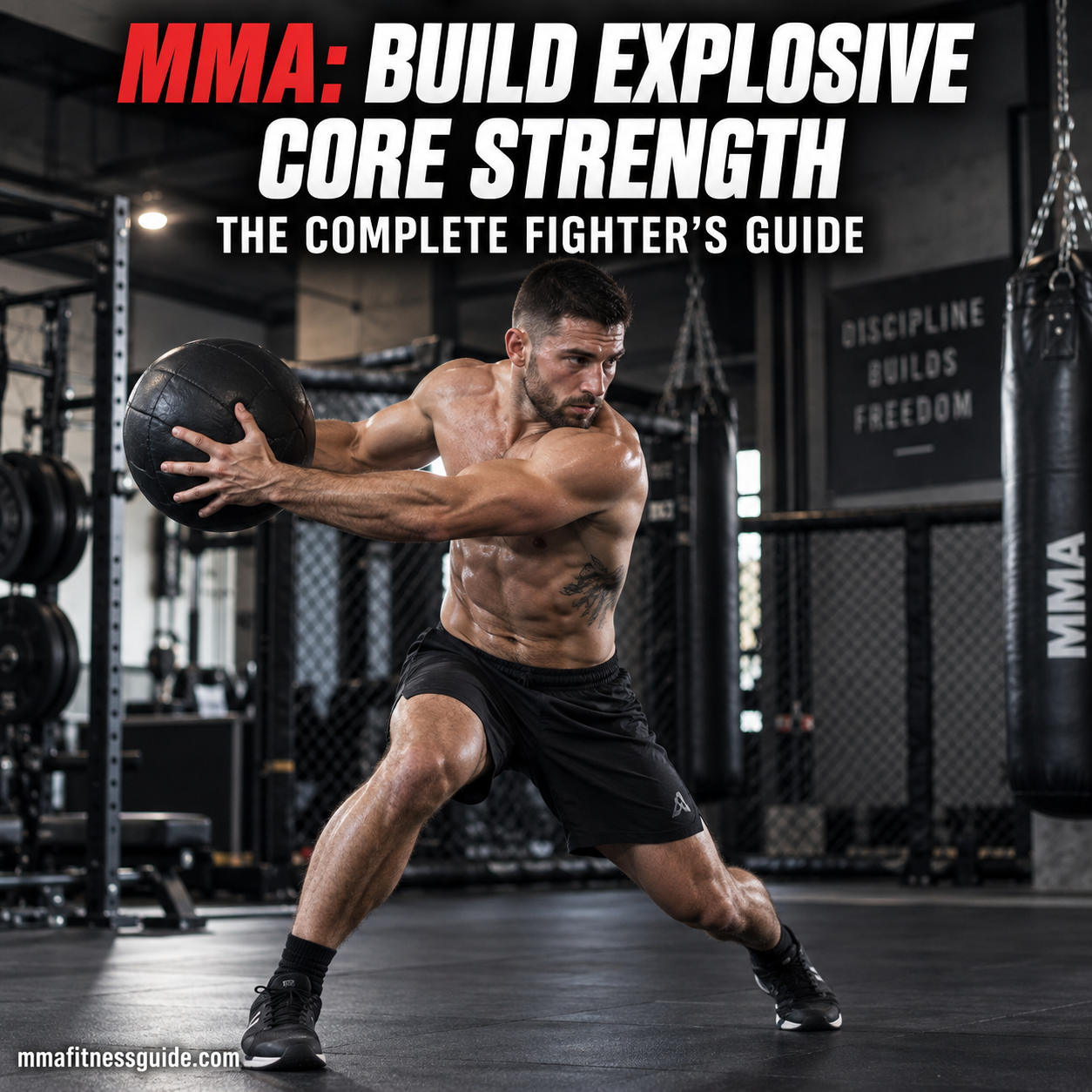
Few physical qualities transfer to the cage as directly as explosive core strength. It helps transfer power into punches, supports balance during takedown exchanges, and allows fighters to maintain control during unpredictable scrambles.
Whether you are throwing a powerful right hand, defending a double-leg takedown, or escaping from bottom position, your core helps connect your upper and lower body.
However, developing an explosive core requires more than traditional abdominal exercises.
Hundreds of crunches might improve muscular endurance, but they do not necessarily develop the rotational power, rapid force production, and dynamic stability needed for mixed martial arts.
Effective MMA core training combines strength, speed, coordination, and the ability to resist unwanted movement.
This comprehensive guide explains how explosive core strength works, which exercises deserve a place in your training, and how to build a practical routine without compromising your striking, grappling, or recovery.
Why Explosive Core Strength Matters in MMA
Your core acts as a connection between your lower and upper body.
When throwing a cross, for example, force begins with pressure against the floor. Your legs and hips initiate rotation, your trunk transfers that force, and your shoulder and arm deliver the punch.
Your core must be strong enough to transfer force while allowing the coordinated movement necessary for an effective strike.
A similar principle applies to wrestling.
When defending a takedown, your trunk helps maintain posture while your legs, hips, and upper body respond to the opponent’s pressure.
Developing explosive core strength can support several important aspects of MMA performance.
More Rotational Force for Striking
Hooks, crosses, elbows, and spinning attacks rely on coordinated rotation.
The abdominal muscles, particularly the internal and external obliques, help control and produce trunk rotation.
A well-trained core allows fighters to transfer force between the hips and shoulders without excessive movement or loss of balance.
However, punching power depends on the entire kinetic chain, including technique, timing, leg drive, and coordination. Core strength alone will not automatically produce harder punches.
Stronger Hip Control for Kicks and Knees
Roundhouse kicks require coordinated movement through the supporting leg, hips, pelvis, and trunk.
Your core helps stabilize your body as the kicking leg accelerates.
It also helps you recover your stance after the strike.
For knee strikes, trunk stability supports posture while the hips drive forward or upward.
Better Balance During Takedown Defense
During a takedown attempt, an opponent may pull, rotate, or drive your body away from its base of support.
Your trunk muscles help resist these forces while you reposition your feet and hips.
Anti-rotation exercises are particularly useful for developing the ability to maintain trunk position against external resistance.
For additional balance-focused training, see our guide on how to improve balance and coordination for MMA .
Improved Stability During Clinch Battles
The clinch involves constant changes in pressure.
You might be fighting for underhooks, defending a body lock, or trying to turn an opponent against the cage.
A strong core helps maintain posture and transmit force while the upper and lower body perform different tasks.
More Controlled Scrambling
Scrambles require rapid transitions between positions.
A fighter might move from turtle to a hip escape, post on one arm, rotate toward an opponent, and immediately stand.
Dynamic trunk stability helps coordinate these movements and maintain control as the body’s base of support changes.
The goal is not simply to develop strong abdominal muscles. It is to build a trunk that can produce, transfer, and resist force during unpredictable movement.
What Explosive Core Training Actually Is
Explosive core training develops the ability to generate force quickly while maintaining control of the trunk.
This is different from performing abdominal exercises until muscular failure.
A complete MMA core program should address four primary qualities.
1. Rotational Power
Rotational power involves producing force rapidly through coordinated movement of the hips and trunk.
It contributes to movements such as:
- Hooks and crosses
- Rotational elbows
- Spinning attacks
- Certain throws and takedown finishes
- Rapid changes in body orientation
Medicine ball throws and controlled landmine rotations are practical ways to train this quality.
The objective is to accelerate the movement without sacrificing technique.
2. Anti-Rotation Control
Anti-rotation refers to resisting unwanted twisting forces.
Imagine an opponent pulling your upper body sideways while attempting to move your hips in the opposite direction.
Your core must help maintain alignment as you adjust your stance and respond.
Exercises such as Pallof presses, suitcase carries, and offset-loaded holds train this ability.
Anti-rotation training is especially relevant to maintaining posture during clinching and grappling, although actual takedown defense also requires technical skill and full-body strength.
3. Dynamic Stability
Dynamic stability means maintaining trunk control while the arms, legs, or entire body move.
Examples include:
- Posting on one arm during a scramble
- Throwing combinations without losing balance
- Recovering stance after a missed kick
- Moving between grappling positions
Plank shoulder taps, dead bugs, and controlled crawling exercises can develop this quality.
4. Hip and Thoracic Spine Mobility
Powerful rotation requires adequate movement through the hips and thoracic spine.
The thoracic spine is the middle and upper portion of the back.
Limited movement in these areas may encourage a fighter to compensate through excessive lumbar spine rotation or awkward positioning.
Mobility work should improve usable movement without forcing the joints beyond comfortable ranges.
Useful drills include:
- Quadruped thoracic rotations
- Half-kneeling hip flexor stretches
- Controlled hip rotations
- Open-book thoracic mobility exercises
Combining mobility with strength and power training allows fighters to develop movement they can control under load.
For athletes who need a foundation before explosive training, our basic core training guide for stability and power covers the essential principles.
Understanding the Core Muscles Used in MMA
The core includes more than the visible abdominal muscles.
Several muscle groups contribute to trunk stability and force transfer.
Rectus Abdominis
The rectus abdominis runs along the front of the abdomen.
It contributes to trunk flexion and helps resist excessive spinal extension.
It is involved in movements such as knee raises and bracing exercises.
Internal and External Obliques
The obliques run along the sides of the abdomen.
They contribute to trunk rotation, side bending, and stabilization.
These muscles are particularly important during rotational movements such as punches and certain grappling transitions.
Transverse Abdominis
The transverse abdominis is a deep abdominal muscle that contributes to abdominal pressure and trunk stability.
It works with other muscles during bracing rather than functioning as an isolated power generator.
Erector Spinae and Multifidus
These muscles help support and control the spine.
They contribute to maintaining posture during lifting, wrestling, and clinching.
Diaphragm and Pelvic Floor
These muscles work with the abdominal wall to regulate pressure within the trunk.
Coordinated breathing and bracing can help fighters maintain stability during demanding movements.
The important takeaway is that core training should develop these muscles as a coordinated system rather than attempting to isolate each muscle during every session.
Best Exercises to Build Explosive MMA Core Strength
The following exercises address rotational power, anti-rotation, and dynamic stability.
Each serves a different purpose.
Choose exercises based on your current ability, available equipment, and training schedule.
1. Medicine Ball Rotational Slams
Medicine ball rotational slams develop rapid force production through coordinated hip and trunk movement.
They are particularly useful for teaching fighters to accelerate through rotation.
How to perform them:
- Stand with your feet approximately shoulder-width apart.
- Hold a light medicine ball near your torso.
- Rotate through your hips and upper back.
- Drive the ball forcefully toward the floor at an angle.
- Retrieve the ball, reset your stance, and repeat.
Keep the movement controlled and avoid forcing rotation through the lower back.
Use a ball designed for slamming that will not rebound dangerously.
Recommended training:
- 3–4 sets
- 4–6 repetitions per side
- 60–90 seconds of rest between sets
Use a medicine ball light enough to maintain high movement speed.
For some fighters, a rotational wall throw is a more practical option because it allows forceful release without the need to control the ball throughout the entire movement.
Why It Helps MMA Fighters
Rotational medicine ball work trains rapid coordination between the legs, hips, and trunk.
The movement pattern can complement striking practice, but it should not replace technical punching drills.
2. Landmine Rotations
Landmine rotations develop coordinated trunk movement and strength while challenging the athlete to control resistance.
They can be performed with a properly secured landmine attachment.
How to perform them:
- Stand with your feet slightly wider than shoulder-width.
- Hold the end of the barbell with both hands.
- Maintain a controlled bend in your elbows.
- Rotate the bar toward one hip.
- Pivot your feet and hips as needed.
- Guide the bar across your body toward the opposite side.
Avoid twisting the lower back while keeping the pelvis completely fixed.
The hips and feet should participate in the movement.
Recommended training:
- 3 sets
- 6–8 repetitions per side
- 60–90 seconds of rest
Start with an unloaded bar if necessary.
Landmine rotations can be performed as a controlled strength exercise or a faster power-focused movement.
When training explosiveness, use a manageable load and stop the set when speed noticeably decreases.
For a broader selection of resistance exercises, explore our top 10 strength workouts for MMA fighters .
3. Pallof Press Hold
The Pallof press is an effective anti-rotation exercise.
Unlike rotational drills, its purpose is to prevent unwanted trunk movement.
This makes it a useful complement to medicine ball and landmine exercises.
How to perform it:
- Attach a resistance band or cable at chest height.
- Stand sideways to the anchor point.
- Hold the handle at your chest.
- Brace your abdomen.
- Extend your arms directly forward.
- Maintain your position without rotating toward the anchor.
Keep your ribs stacked over your pelvis and maintain steady breathing.
Recommended training:
- 3 sets
- 15–30-second holds per side
- 30–60 seconds of rest
Increase resistance gradually.
If you cannot keep your torso square, reduce the load or move closer to the anchor point.
Why It Helps MMA Fighters
The Pallof press develops the ability to resist rotational forces.
This quality can support posture during clinching, striking, and grappling.
However, resisting an opponent’s takedown requires additional skills, including footwork, hip positioning, and wrestling technique.
4. Hanging Knee Raises With Twist
Hanging knee raises strengthen the abdominal muscles and hip flexors while challenging trunk control.
Adding a small, controlled rotational component increases the coordination demands.
How to perform them:
- Hang from a secure pull-up bar.
- Establish a stable shoulder position.
- Raise your knees toward your torso.
- Rotate your pelvis slightly toward one side.
- Lower your legs under control.
- Alternate sides.
Avoid swinging or using momentum to complete repetitions.
Recommended training:
- 3 sets
- 6–10 controlled repetitions
- 60 seconds of rest
Beginners can start with lying reverse crunches or captain’s chair knee raises.
Avoid forcing the twisting movement, particularly if it causes discomfort in the lower back or hips.
The goal is controlled movement rather than maximum rotation.
5. Explosive Plank Shoulder Taps
Plank shoulder taps develop dynamic stability while the body temporarily relies on three points of support.
This challenges the trunk to resist rotation as the arms move.
How to perform them:
- Begin in a high plank.
- Position your hands beneath your shoulders.
- Keep your feet slightly wider than hip-width.
- Lift one hand and touch the opposite shoulder.
- Return the hand to the floor.
- Alternate sides.
Begin slowly.
Once you can maintain stable hips, increase the speed without allowing excessive trunk movement.
Recommended training:
- 3 sets
- 10–20 total taps
- 30–60 seconds of rest
This exercise develops reactive trunk control, but it is primarily a stability drill rather than a maximum-power exercise.
For a more comprehensive approach to athletic movement, read our functional fitness exercises for combat sports .
Additional Core Exercises Worth Including
The original five exercises provide a useful foundation, but fighters can benefit from additional movement patterns.
Dead Bugs
Dead bugs train the ability to maintain trunk position while moving opposite arms and legs.
They are particularly useful for beginners who struggle to control their lower back during more demanding exercises.
Perform 2–3 sets of 6–10 repetitions per side.
Suitcase Carries
Hold a heavy dumbbell or kettlebell in one hand and walk while maintaining an upright posture.
The uneven load challenges the trunk to resist side bending.
Perform 2–3 sets of 20–30 meters per side.
Side Planks
Side planks develop lateral trunk stability.
Begin with 20–30-second holds per side.
Progress by increasing the duration or adding controlled leg movement.
Medicine Ball Scoop Throws
Stand sideways to a sturdy wall, rotate through your hips, and throw a medicine ball explosively.
Use a ball designed for throwing and ensure the area is clear.
Perform 3–4 sets of 3–5 repetitions per side.
Scoop throws are particularly useful when the goal is rotational power rather than abdominal fatigue.
Complete Explosive Core Circuit for MMA Fighters
This circuit combines rotation, anti-rotation, dynamic stability, and muscular endurance.
It can be performed 2–3 times weekly when recovery and the rest of your MMA training allow.
However, there is an important distinction: a timed circuit develops a mixture of conditioning and core strength, while maximum explosive power is generally better trained with short sets and sufficient recovery.
Use the following circuit for general core conditioning.
MMA Explosive Core Circuit
Intermediate workout
WORK
45 seconds
REST
15 seconds
ROUNDS
3–4
BETWEEN ROUNDS
60–90 seconds
Exercise order
- Medicine Ball Rotational Slams
- Landmine Rotations
- Explosive Plank Shoulder Taps
- Hanging Knee Raises With Twist
- Pallof Press Hold
Perform the medicine ball and landmine movements in short, crisp bursts within the work interval. Rest or reset when movement speed declines. For the Pallof press, divide the interval between sides.
How to Adjust the Circuit for Your Experience Level
Beginners should start with two rounds and use lighter resistance.
Intermediate fighters can perform three rounds.
Advanced athletes may use four rounds when their weekly training load permits.
Do not turn every session into a test of exhaustion.
If your main objective is maximum power, perform medicine ball throws and landmine power drills separately using low repetitions and longer rest periods.
Reserve the circuit for sessions where core conditioning is the priority.
How to Train for Maximum Explosive Power
Explosive strength and muscular endurance require different training approaches.
A fighter performing medicine ball throws for 45 continuous seconds will eventually experience fatigue.
As fatigue accumulates, movement speed and power may decline.
This makes long circuits less suitable when maximum power is the primary objective.
For dedicated explosive training, use the following principles.
Keep Repetitions Low
Perform approximately 3–6 explosive repetitions per set.
Each repetition should be intentional and technically consistent.
Rest Between Sets
Allow roughly 60–120 seconds between sets, or longer when necessary to restore movement quality.
Use Manageable Resistance
A heavier medicine ball is not automatically better.
Choose a load that allows rapid acceleration without changing the movement pattern.
Stop When Speed Declines
If your fifth repetition is noticeably slower than your first, end the set.
Power training rewards high-quality repetitions rather than accumulated fatigue.
This distinction is explored further in our guide to balancing strength and speed for fighters .
Common Core Training Mistakes to Avoid
Even experienced fighters can make mistakes when adding core training to an already demanding schedule.
Training the Core Hard Every Day
Your core is involved in striking, wrestling, grappling, and strength training.
Adding intense direct core work every day may create unnecessary fatigue and interfere with recovery.
Daily low-intensity mobility or technique work can be appropriate, but demanding power and resistance sessions should be scheduled with recovery in mind.
Start with two focused sessions weekly and increase only if performance and recovery remain consistent.
Only Doing Crunch Variations
Crunches can develop abdominal strength and endurance.
However, they do not cover every function required in MMA.
A balanced program should include:
- Rotational power
- Anti-rotation strength
- Anti-extension control
- Lateral stability
- Dynamic movement
Traditional abdominal exercises can remain part of the program, but they should not be the entire program.
Using Too Much Weight
Excessive loading can reduce movement speed and encourage compensation.
This is particularly problematic during rotational exercises.
Use heavier resistance for controlled strength work and lighter, manageable resistance for explosive movements.
Ignoring Mobility
Limited hip or thoracic movement can interfere with efficient rotation.
Include a short mobility warm-up before explosive training.
Avoid aggressive twisting or forcing additional range of motion under heavy loads.
Training Through Lower Back Pain
Sharp pain, radiating symptoms, or persistent discomfort should not be treated as normal training fatigue.
Stop the aggravating movement and seek assessment from a qualified healthcare professional when appropriate.
Confusing Fatigue With Progress
A burning sensation in your abdominal muscles does not prove that you have developed explosive power.
Track movement quality, resistance, repetitions, and recovery instead of judging every workout by exhaustion.
How to Integrate Explosive Core Work Into Your MMA Week
Core training should support technical development rather than compete with it.
The best placement depends on your existing schedule.
Before Striking Sessions
A small amount of rotational medicine ball work can serve as part of a power-focused warm-up.
Example:
- Medicine ball rotational throws: 3 sets of 3 per side
- Light shadowboxing: 2 rounds
- Technical striking practice
Keep the medicine ball work brief.
Avoid fatiguing your trunk before demanding pad work or sparring.
After Grappling Sessions
Controlled anti-rotation exercises can be added after grappling when you are not excessively fatigued.
Example:
- Pallof press: 2 sets of 20 seconds per side
- Side plank: 2 sets of 20 seconds per side
If the grappling session was particularly demanding, reduce the additional work or skip it.
On Strength Training Days
Core exercises can complement compound lifts such as squats, deadlifts, and presses.
For example:
- Medicine ball throws before heavy lifting
- Squats or deadlifts
- Upper-body strength work
- Pallof presses or suitcase carries
Perform explosive movements early in the session, after warming up and before significant fatigue develops.
Our ultimate full-body fighter workout provides additional ideas for organizing strength training around MMA performance.
Once Weekly: Full Core Circuit
Use the complete circuit when you want to develop broader trunk conditioning.
Place it away from your hardest sparring session when possible.
Weekly Template Example
A structured weekly plan helps distribute training stress.
The following example includes four core-related training exposures, but only two are substantial sessions.
| Day | Core focus | Training |
|---|---|---|
| Monday | Rotational power | Medicine ball throws + striking |
| Tuesday | Anti-rotation | Pallof presses after grappling |
| Wednesday | Recovery | Mobility or rest |
| Thursday | Power and strength | Landmine rotations + strength session |
| Friday | Technical training | No additional core work |
| Saturday | Core conditioning | Full circuit, if recovered |
| Sunday | Recovery | Rest or gentle mobility |
This template should be adjusted according to your training volume.
If you spar several times weekly or perform demanding wrestling sessions, two dedicated core sessions may be sufficient.
The goal is to improve performance without accumulating fatigue that interferes with technical training.
How to Progress Your Explosive Core Training
Progressive overload is important, but adding weight is not the only way to improve.
Core training can progress through better movement quality, faster force production, increased resistance, and more demanding stability exercises.
Weeks 1–2: Establish Control
Focus on technique and consistent trunk positioning.
Use light medicine balls, basic Pallof presses, and controlled plank variations.
Perform two sessions weekly.
Weeks 3–4: Increase Speed
Maintain the same manageable resistance while emphasizing faster, more coordinated movements.
Introduce medicine ball throws if you have the necessary equipment and space.
Avoid increasing speed at the expense of control.
Weeks 5–6: Increase Resistance Gradually
Increase resistance slightly during landmine rotations and Pallof presses if technique remains consistent.
Continue using a medicine ball that allows rapid acceleration.
Weeks 7–8: Consolidate Performance
Maintain high-quality explosive work while adjusting total volume according to recovery.
You may increase the difficulty of stability exercises or add a small amount of resistance.
If performance declines or fatigue accumulates, reduce training volume.
Progress should be based on movement quality and measurable improvement, not simply completing harder workouts every week.
How to Measure Improvements in Core Power
You do not need sophisticated equipment to monitor progress.
Choose a few repeatable measurements and record them every two to four weeks.
Medicine Ball Throw Distance
Use the same medicine ball, throwing technique, and testing area.
Measure the distance of a rotational throw.
Perform several attempts per side and record the best technically valid result.
An increase in distance may indicate improved performance in that specific movement.
Pallof Press Resistance
Track the resistance you can hold while maintaining proper trunk alignment.
Progress might involve increasing cable resistance while keeping the same hold duration.
Plank Shoulder Tap Control
Record how many technically consistent taps you can perform without excessive hip movement.
Do not prioritize speed until control is established.
Left-to-Right Differences
Compare rotational throws and anti-rotation exercises on both sides.
Some asymmetry is normal, particularly in athletes who repeatedly train from a preferred stance.
Large or increasing differences may warrant closer attention to technique, strength, and mobility.
These measurements indicate progress in training exercises. They do not independently establish improvements in punching power or fighting performance.
Evaluate your MMA technique separately through coaching, controlled drills, and consistent practice.
Core Training at Home Without a Full Gym
Fighters do not need an extensive equipment collection to improve trunk stability.
A resistance band, exercise mat, and suitable open space can support a practical home routine.
Try the following workout:
| Exercise | Sets | Repetitions |
|---|---|---|
| Resistance Band Pallof Press | 3 | 10 per side |
| Dead Bug | 3 | 8 per side |
| Plank Shoulder Taps | 3 | 16 total |
| Side Plank | 2 | 30 seconds per side |
| Reverse Crunch | 3 | 12 |
Rest approximately 30–60 seconds between sets.
This routine emphasizes stability and control.
For true explosive rotational work, a suitable medicine ball and safe throwing area are useful.
Avoid improvising high-speed throws with objects that are not designed for that purpose.
If you are building a broader home program, see our best at-home MMA conditioning routines .
Combining Core Power With Plyometric Training
Plyometric exercises develop the ability to produce force rapidly through movements that use the stretch-shortening cycle.
Examples include jumps, bounds, and certain explosive upper-body movements.
Although plyometrics are not exclusively core exercises, they can complement rotational power training.
A simple power session might include:
- Medicine ball rotational throws: 3 × 4 per side
- Box jumps: 3 × 3
- Landmine rotations: 3 × 6 per side
- Pallof press holds: 2 × 20 seconds per side
Rest sufficiently between explosive sets.
Choose an appropriate box height and avoid high-impact exercises if you lack the necessary strength, technique, or physical readiness.
The objective is coordinated force production throughout the body.
For more exercise options, read our plyometric exercises for fighters .
Recovery and Nutrition for Explosive Core Development
Core strength improves through a combination of appropriate training and recovery.
Adding more exercises will not compensate for inadequate sleep, insufficient food, or excessive overall training stress.
Prioritize Sleep
Aim for sufficient, consistent sleep to support recovery and training performance.
Most adults should target approximately seven to nine hours nightly, although individual needs vary.
Eat Enough to Support Training
MMA athletes often perform several demanding sessions weekly.
Adequate energy intake supports recovery and helps maintain training quality.
Protein contributes to muscle repair, while carbohydrates help replenish glycogen used during demanding exercise.
Avoid aggressive calorie restriction when trying to improve explosive performance.
Manage Total Training Volume
A fighter’s core is already challenged by wrestling, clinching, grappling, and compound strength exercises.
Direct abdominal work should be programmed alongside these activities rather than treated as an entirely separate workload.
Adjust Training During Fight Camp
As sparring intensity and technical demands increase, additional strength and conditioning volume may need to decrease.
Short, high-quality power sessions can help maintain training qualities without creating excessive fatigue.
Coordinate changes with your coach and conditioning professional when possible.
Frequently Asked Questions About Explosive MMA Core Training
How Often Should MMA Fighters Train Their Core?
Two to three focused sessions weekly is a practical starting point for many fighters.
The ideal frequency depends on training experience, overall workload, recovery, and the intensity of each session.
Some athletes may benefit from two substantial sessions and one brief stability session.
Are Sit-Ups Good for MMA?
Sit-ups can develop trunk flexion strength and muscular endurance.
However, they should not be the only core exercise in an MMA program.
Rotational power, anti-rotation control, and dynamic stability require additional movement patterns.
Can Core Exercises Increase Punching Power?
Core training can improve physical qualities involved in transferring force during punches.
However, punching power also depends on technique, timing, coordination, lower-body strength, and striking practice.
Improving core strength does not guarantee a measurable increase in punching power.
Should I Train My Core Before or After MMA Practice?
Brief explosive drills may be performed after a warm-up and before technical training if they do not cause fatigue.
Longer conditioning circuits are generally better placed after technical work or in a separate session.
Avoid exhausting your trunk before demanding sparring or grappling.
Do I Need Heavy Weights for Explosive Core Training?
No.
Explosive training requires rapid force production.
Manageable resistance that allows high movement speed is often more appropriate than heavy loading.
Heavier resistance can still be useful for controlled strength exercises.
How Long Does It Take to Develop Explosive Core Strength?
Some athletes may notice improvements in exercise coordination within several weeks.
More substantial strength and power adaptations generally require consistent training over a longer period.
Progress depends on training history, exercise selection, recovery, and program quality.
There is no universal timeline for improved MMA performance.
Final Tips for Building a Strong, Explosive MMA Core
Explosive core development requires a balance between producing force and controlling movement.
Use the following principles to guide your training:
- Prioritize movement speed during dedicated power exercises.
- Use manageable resistance and maintain proper technique.
- Combine rotational power with anti-rotation and stability work.
- Include hip and thoracic mobility exercises.
- Stop explosive sets when movement speed or technique declines.
- Schedule demanding core sessions around sparring and grappling.
- Track measurable progress without sacrificing recovery.
Remember that the purpose of core training is not simply to build stronger abdominal muscles.
It is to develop the ability to transfer force, maintain posture, and coordinate movement under the physical demands of MMA.
A well-designed program combines explosive medicine ball work, controlled resistance exercises, stability training, and sufficient recovery.
Build these qualities consistently, and your core training can become a valuable part of your overall development as a fighter.
Related MMA Strength and Conditioning Guides
Continue building a complete training program with these related articles from MMA Fitness Guide.
- Basic Core Training for Stability and Power — Develop the foundational strength and control needed before progressing to more explosive exercises.
- The Ultimate Full-Body Fighter Workout — Combine core training with full-body resistance exercises.
- Top 10 Strength Workouts for MMA Fighters — Explore additional strength-building exercises for combat sports.
- Balancing Strength and Speed for Fighters — Learn how to organize strength and power training without sacrificing movement speed.
Developing explosive core strength is one part of becoming a more complete athlete. Combine it with consistent technical practice, progressive strength training, and intelligent recovery to build physical qualities that support your performance inside the cage.