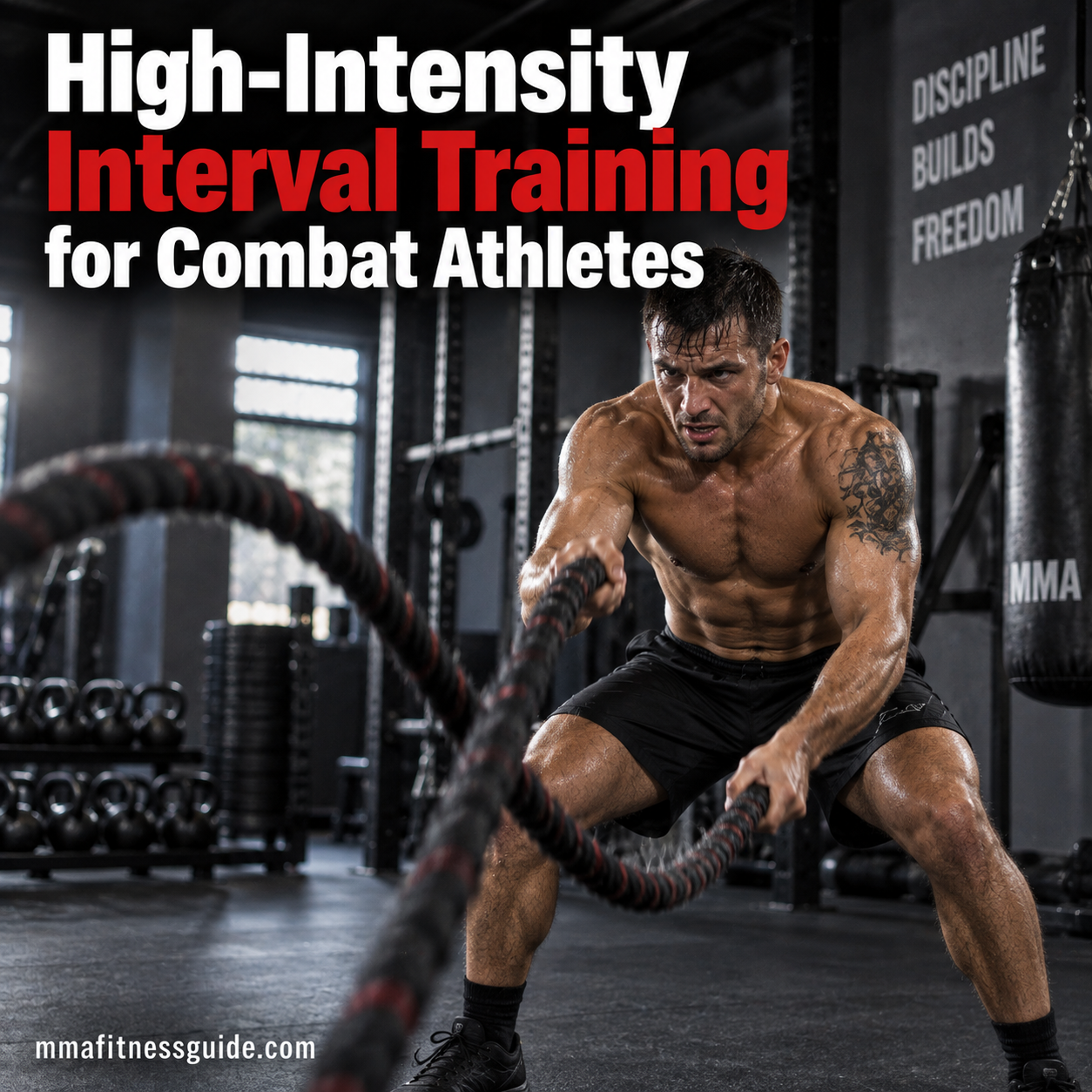
Thirty seconds into a hard grappling exchange, your opponent shoots for a takedown. You sprawl, scramble back to your feet, and immediately exchange punches against the cage. Your breathing accelerates, your shoulders begin to burn, and your legs feel heavier with every movement.
Now imagine having to repeat that sequence several times over a five-minute round.
Combat sports demand more than the ability to run long distances or perform a few explosive movements. Fighters need to produce repeated bursts of effort, recover during brief opportunities, and maintain technical control as fatigue accumulates.
High-intensity interval training (HIIT) can help develop these qualities when programmed correctly.
However, effective HIIT for combat athletes isn’t simply about performing burpees until exhaustion. The intensity, exercise selection, work-to-rest ratio, and placement within your training schedule all determine whether a conditioning session supports your fighting performance or adds unnecessary fatigue.
What Is High-Intensity Interval Training?
High-intensity interval training alternates demanding periods of exercise with planned recovery periods.
A basic example might involve sprinting for 20 seconds, recovering for 100 seconds, and repeating the sequence several times.
Another workout might involve 60 seconds of hard cycling followed by 60 seconds of easy pedaling.
Both use interval training, but they place different demands on the body.
HIIT is generally characterized by repeated efforts performed at high intensity, often near or above the intensity an athlete could sustain continuously for an extended period.
It is also important to distinguish HIIT from sprint interval training, which commonly involves very short, near-maximal or all-out efforts with substantial recovery.
For combat athletes, the objective is to choose intervals that develop specific conditioning qualities without compromising technical training.
Understanding the Energy Systems Used in Combat Sports
A fight involves several energy systems working together. They don’t switch on and off independently; their relative contributions change according to exercise intensity and duration.
Understanding these systems helps explain why fighters benefit from different types of conditioning.
The ATP-PC System: Explosive Efforts
The phosphagen system provides energy rapidly during very short, powerful movements.
Examples include:
- An explosive double-leg takedown
- A short punching combination
- A powerful escape from bottom position
- A rapid acceleration across the mat
This system supports maximal efforts lasting only a few seconds before its immediate energy supply becomes substantially depleted.
Training short, explosive intervals with sufficient recovery can help athletes repeatedly produce high-quality efforts.
However, performing explosive movements continuously with almost no rest changes the training stimulus. As fatigue increases, power output usually declines.
The Anaerobic Glycolytic System: Sustained High-Intensity Work
During longer, demanding exchanges, anaerobic glycolysis contributes substantially to energy production.
Think of an extended wrestling scramble, a prolonged clinch exchange, or repeated striking combinations.
These efforts can produce significant metabolic stress.
As intensity increases, lactate production and associated changes in muscle chemistry occur. Lactate itself is not simply a waste product responsible for fatigue; it can also be used as fuel.
The goal of conditioning isn’t to eliminate lactate. It is to improve the athlete’s ability to sustain demanding work and recover from it.
The Aerobic System: Recovery and Endurance
The aerobic system supplies energy during sustained activity and contributes throughout a fight, including during high-intensity efforts.
It also supports recovery between explosive exchanges and helps restore phosphocreatine during lower-intensity periods.
A well-developed aerobic system can help fighters maintain their work rate over multiple rounds.
This explains why steady-state cardiovascular training still has a place in combat sports.
HIIT complements aerobic conditioning rather than automatically replacing it.
A fighter who combines an appropriate aerobic foundation with well-designed interval training may be better prepared for the changing intensity of competition.
Why HIIT Is Useful for MMA, Boxing, and Grappling
Combat sports involve repeated changes in intensity.
A boxer might spend several seconds moving and observing before throwing a rapid combination.
An MMA fighter may transition from striking to wrestling, defend a takedown, and then spend an extended period working against the cage.
A Brazilian jiu-jitsu athlete may alternate between relatively controlled positional exchanges and explosive scrambles.
HIIT provides a way to train repeated high-intensity efforts under controlled conditions.
Improved Cardiovascular Fitness
Well-designed HIIT can improve maximal oxygen uptake, commonly called VO₂ max.
VO₂ max reflects the body’s capacity to take in, transport, and use oxygen during intense exercise.
Improving aerobic fitness can support sustained activity and recovery between demanding exchanges.
However, cardiovascular improvements depend on the training protocol, individual fitness level, and overall program.
Better Repeat-Effort Capacity
Combat athletes rarely perform one explosive movement and then rest completely.
They must repeatedly accelerate, strike, wrestle, and reposition.
Intervals can be designed to challenge an athlete’s ability to repeat demanding efforts while maintaining an acceptable level of performance.
For example, repeated 15-second efforts on an air bike can provide a measurable conditioning stimulus without requiring a fighter to perform technically complex movements while exhausted.
More Efficient Conditioning Sessions
HIIT can provide substantial cardiovascular training in a relatively short period.
This can be useful for athletes balancing technical sessions, strength training, work, and recovery.
However, shorter doesn’t necessarily mean easier.
A 20-minute interval session can create considerable fatigue, particularly when performed near maximal intensity.
HIIT vs. Steady-State Cardio: What Should Fighters Choose?
Fighters sometimes treat HIIT and traditional endurance training as competing approaches.
In practice, both can serve different purposes.
Steady-state cardio involves maintaining a relatively consistent intensity for an extended period.
Examples include easy running, cycling, swimming, or rowing.
These sessions can develop aerobic fitness while often creating less acute fatigue than maximal interval training, depending on their duration and intensity.
HIIT introduces higher-intensity efforts that can challenge cardiovascular capacity and repeated-effort performance.
Neither approach automatically makes a fighter faster, slower, stronger, or more explosive.
The outcome depends on how the training is programmed alongside strength and technical work.
For example, an MMA athlete might perform one or two easy aerobic sessions and one dedicated HIIT session each week.
An athlete already completing several demanding sparring and wrestling sessions may need less additional interval work.
The objective is to fill conditioning gaps, not accumulate as many exhausting workouts as possible.
How to Structure HIIT for Combat Athletes
Before choosing exercises, decide what the session should accomplish.
Three useful approaches are short power intervals, aerobic-focused intervals, and longer fight-style circuits.
1. Short Power Intervals
These intervals emphasize repeated high-output efforts.
Example:
- 10 seconds of near-maximal air bike sprinting
- 50–110 seconds of easy recovery
- Repeat 6–10 times
Longer recovery helps preserve output across repetitions.
If your power drops dramatically after the first few efforts, the intensity may be too high or the recovery period too short.
This type of workout is useful when the goal is repeated explosive effort rather than continuous exhaustion.
2. Aerobic-Focused HIIT
These intervals involve longer periods of hard work at a demanding but controlled intensity.
Example:
- 2 minutes of hard cycling
- 2 minutes of easy cycling
- Repeat 4–6 times
The effort should be challenging but repeatable.
You should not need to sprint all-out during the opening interval.
The goal is to accumulate quality work at a high cardiovascular intensity.
3. Fight-Style Conditioning Circuits
Circuits combine different movements into a longer sequence.
For example, a fighter might alternate between bag work, sprawls, and footwork.
These sessions can resemble some of the changing physical demands of combat sports.
However, they are not automatically superior to simpler intervals.
Exercise complexity makes it harder to measure output, and technical quality can deteriorate when fatigue becomes excessive.
Use fight-style circuits as supplementary conditioning, not as a replacement for sparring, drilling, or skill development.
A 25-Minute HIIT Workout for Combat Athletes
This workout is intended for healthy athletes who already have a reasonable conditioning foundation.
It combines simple exercises with combat-related movements while allowing enough recovery to maintain quality.
You will need a heavy bag, an air bike or similar cardio machine, and enough space to move safely.
If you don’t have access to this equipment, use the substitutions provided.
Phase 1: Warm-Up (5 Minutes)
Begin with:
- 2 minutes of easy cycling or jogging
- 1 minute of controlled hip and shoulder mobility
- 1 minute of light shadowboxing
- 1 minute of progressively faster movement
Your breathing should increase gradually.
Avoid jumping directly into maximal effort while your muscles and joints are still cold.
Phase 2: Main HIIT Circuit (15 Minutes)
Complete five rounds of the following three-minute sequence.
| Exercise | Duration |
|---|---|
| Heavy bag combinations | 30 seconds |
| Easy footwork and breathing | 30 seconds |
| Air bike or fast cycling | 30 seconds |
| Easy cycling | 30 seconds |
| Controlled sprawls | 20 seconds |
| Standing recovery | 40 seconds |
Total: 3 minutes per round × 5 rounds = 15 minutes.
During heavy bag work, throw controlled combinations at a challenging pace. Prioritize balance, defensive positioning, and clean technique.
For the air bike, work at approximately 8 out of 10 on a perceived exertion scale.
During sprawls, maintain proper positioning rather than trying to complete as many repetitions as possible.
If your technique deteriorates, reduce the pace or substitute a simpler exercise.
Beginners can start with three rounds and progress toward five as their conditioning improves.
Phase 3: Cooldown (5 Minutes)
Finish with:
- 2 minutes of easy walking or cycling
- 1 minute of gentle hip mobility
- 1 minute of comfortable shoulder and upper-back stretching
- 1 minute of relaxed breathing
The cooldown provides a gradual transition away from intense exercise.
It doesn’t guarantee faster recovery or prevent soreness, but it can help you finish the session comfortably.
How to Make HIIT More Specific to Your Combat Sport
The physical demands of combat sports overlap, but individual disciplines require different movement patterns.
Conditioning should reflect those differences without turning every workout into a simulated fight.
HIIT for Boxers
Boxers can use intervals that combine cardiovascular work with controlled punching.
For example:
- 20 seconds of fast, technically sound bag combinations
- 40 seconds of light footwork
- Repeat 8–10 times
Avoid throwing every punch at maximum power when fatigued.
Focus on maintaining stance, breathing, and defensive awareness.
HIIT for Wrestlers
Wrestlers may benefit from intervals involving controlled level changes and repeated accelerations.
A sample workout could include:
- 15 seconds of fast stance movement
- 45 seconds of recovery
- Repeat 8 times
Technical takedown entries can also be included when movement quality remains high.
Avoid performing uncontrolled neck-loading movements or repeated poorly executed shots simply to increase intensity.
HIIT for Brazilian Jiu-Jitsu Athletes
Grapplers can use simple movements such as bridges, technical stand-ups, and controlled hip escapes.
For example:
- 30 seconds of alternating technical stand-ups
- 60 seconds of recovery
- Repeat 6–8 times
These exercises can develop conditioning while reinforcing familiar movement patterns.
However, live rolling already provides substantial intermittent conditioning. Additional HIIT should account for the intensity and frequency of grappling sessions.
How Often Should Fighters Perform HIIT?
More HIIT doesn’t automatically produce better conditioning.
Combat athletes must balance interval training with sparring, technical practice, strength training, and recovery.
For many recreational fighters, one dedicated HIIT session per week is a reasonable starting point.
Athletes with greater conditioning needs and sufficient recovery capacity may progress to two sessions.
Three dedicated HIIT sessions may be appropriate in some programs, but they can be excessive when combined with frequent hard sparring and intense wrestling.
A sample training week might look like this:
| Day | Training focus |
|---|---|
| Monday | Technical MMA + strength |
| Tuesday | Easy aerobic conditioning |
| Wednesday | Technical training + HIIT |
| Thursday | Light drilling or recovery |
| Friday | Strength + technical training |
| Saturday | Sparring or grappling |
| Sunday | Rest |
This is an illustrative schedule rather than a universal prescription.
The intensity of each session matters more than simply counting training days.
If Wednesday’s technical practice involves hard wrestling rounds, adding HIIT afterward may create more fatigue than benefit.
In that situation, consider moving the conditioning session or reducing its volume.
Common HIIT Mistakes Combat Athletes Should Avoid
Turning Every Session Into an Exhaustion Test
Finishing a workout completely drained doesn’t prove that it was effective.
A conditioning session should create a specific training stimulus.
If the goal is repeated explosive power, allowing sufficient recovery between efforts is essential.
If the goal is aerobic development, consistent high-quality intervals may be more useful than an uncontrolled circuit.
Performing Complex Techniques Under Extreme Fatigue
High fatigue can interfere with coordination and movement quality.
Repeatedly performing difficult takedowns, high kicks, or advanced grappling movements while exhausted may reinforce poor mechanics or increase exposure to unnecessary risk.
Use simpler exercises for demanding conditioning sessions.
Save complex technical development for periods when you can move with sufficient control.
Neglecting Recovery
HIIT creates substantial physiological stress.
Combining it with hard sparring, heavy lifting, and inadequate sleep can reduce training quality.
Watch for persistent soreness, declining performance, unusual fatigue, and difficulty completing normally manageable sessions.
These signs may indicate that your overall workload needs adjustment.
Replacing All Aerobic Training With HIIT
Steady aerobic training can improve endurance without requiring maximal effort every session.
Removing it entirely may leave gaps in your conditioning program.
A combination of easy aerobic work, appropriately programmed intervals, and sport-specific practice is generally more versatile than relying exclusively on HIIT.
Using HIIT Primarily for Weight Cutting
HIIT increases energy expenditure, but it shouldn’t be treated as a shortcut for rapid weight loss.
Aggressive calorie restriction, dehydration, and excessive conditioning can compromise training performance and health.
Combat athletes preparing for a weight-class competition should approach weight management through an appropriate nutrition and training plan, ideally with qualified professional support.
How to Measure Your HIIT Progress
You don’t need laboratory testing to determine whether your conditioning is improving.
Start by choosing a repeatable workout.
For example, complete six 30-second air bike intervals with 90 seconds of easy recovery.
Record your output for each interval.
Over time, look for improvements such as:
- Greater total work completed at a similar effort
- More consistent output across intervals
- Improved ability to repeat the same session
- Lower perceived exertion at a previously challenging workload
Use the same equipment and interval structure when comparing sessions.
A workout performed after hard sparring isn’t directly comparable to one completed after a rest day.
You can also observe your performance during technical training.
Are you maintaining your movement quality later in rounds? Can you recover sufficiently between demanding exchanges? Are you completing your scheduled training without excessive fatigue?
These observations help determine whether your conditioning program is supporting your actual goals.
Remember that HIIT alone cannot guarantee improvements in punching power, reaction time, or fighting skill. Those qualities require their own targeted training.
Frequently Asked Questions About HIIT for Fighters
Is HIIT better than running for MMA?
Not necessarily. HIIT and steady running develop overlapping but different conditioning qualities. Many MMA athletes benefit from combining aerobic training with appropriately programmed intervals.
Can beginners perform HIIT?
Yes, provided they are healthy enough for vigorous exercise and begin with an appropriate intensity and volume. Beginners should start with fewer intervals, longer recovery periods, and simple movements before progressing.
Should fighters do HIIT before or after sparring?
Avoid placing demanding HIIT immediately before sparring when it could compromise technical performance and safety. If both sessions must occur on the same day, prioritize the session that matters most and manage total workload carefully.
Does HIIT improve punching power?
HIIT can improve conditioning and repeated-effort capacity, but it does not automatically increase maximal punching power. Strength, explosive training, and technical development remain necessary.
How long should a HIIT workout last?
The appropriate duration depends on intensity, work-to-rest ratio, and training goals. Some effective sessions involve only a few minutes of accumulated high-intensity work, while others use longer intervals. Including warm-up and cooldown, a practical session may take approximately 20–35 minutes.
Final Thoughts
Combat athletes need conditioning that supports repeated effort, sustained movement, and recovery between demanding exchanges.
HIIT can help develop these qualities, but the effectiveness of a workout depends on more than how exhausted you feel afterward.
Choose intervals that match your training objective. Use simple exercises when intensity is high, allow enough recovery to maintain quality, and account for the demands of sparring, grappling, and strength training.
Combine interval work with aerobic conditioning rather than assuming one approach must replace the other.
Most importantly, judge your conditioning by how well it supports your performance.
The goal isn’t to become the athlete who can survive the hardest workout in the gym. It’s to develop the fitness needed to execute your techniques consistently when the pace of a fight increases and fatigue begins to accumulate.