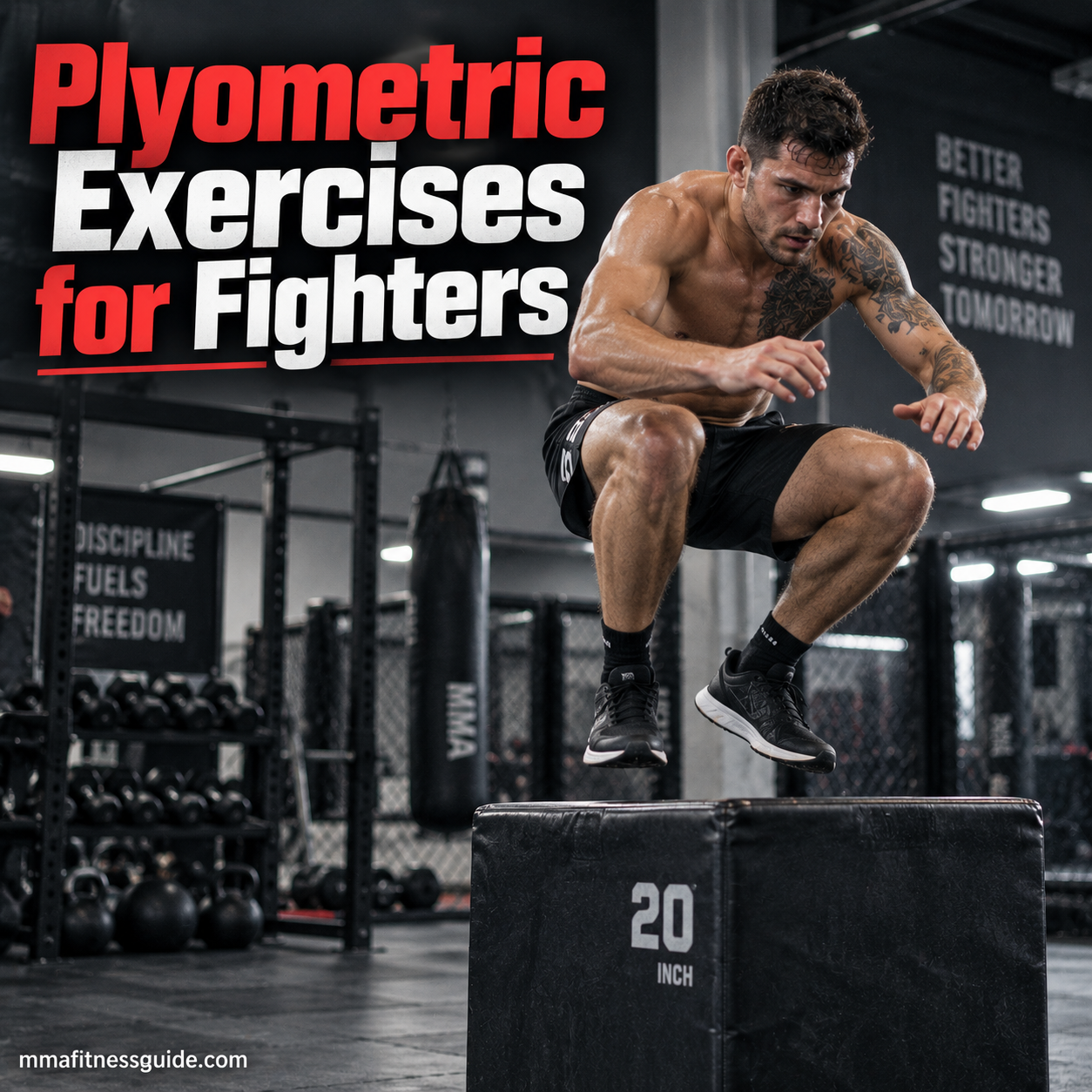
MMA repeatedly demands force in short bursts. A fighter may drive forward on a double-leg, push off the mat during a scramble, change direction to create a striking angle, or rotate through the hips during a punch or kick.
Plyometric exercises train the ability to produce force quickly. They use rapid loading and explosive movement to develop qualities that complement strength training and technical MMA practice.
This guide covers plyometric exercises for the lower body, upper body, and full body, along with practical ways to incorporate them into an MMA training schedule.
Why Plyometrics Matter for MMA
Traditional strength training develops force production, but MMA also requires fighters to apply that force quickly.
Plyometric training can support:
- Faster level changes and takedown entries
- More explosive changes of direction
- Quicker push-offs during footwork
- Rapid hip extension during athletic movements
- Explosive upper-body pushing
- Faster transitions during scrambles
- Improved coordination during high-speed movements
Many plyometric exercises use the stretch-shortening cycle. A muscle-tendon unit rapidly lengthens before immediately shortening, as happens when dipping before a jump or quickly loading the legs before changing direction.
Training this action can help fighters become more efficient at producing explosive movements.
Safety Before Adding Plyometrics
Jumps, bounds, and explosive push-ups can place considerable stress on the ankles, knees, hips, shoulders, and tendons. Landing mechanics and movement control should therefore come before adding height, distance, or speed.
Before progressing to demanding plyometrics, fighters should be able to:
- Land from a small jump under control
- Maintain knee and hip alignment
- Squat and hinge comfortably
- Stabilize the trunk during explosive movements
- Perform basic strength exercises with good technique
- Train without current joint or tendon pain
Beginners can start with lower-intensity hops, skips, small jumps, and controlled medicine-ball exercises before progressing to more demanding variations.
Pain during jumping, landing, or explosive pushing is a reason to stop and determine what is causing it rather than attempting to train through it.
Lower-Body Plyometrics for Fighters
Lower-body plyometrics emphasize rapid force production through the hips, knees, and ankles. These qualities contribute to footwork, shots, kicks, sprawls, and changes of direction.
1. Box Jumps
Box jumps train rapid hip and leg extension without requiring the same landing impact as repeatedly jumping and landing from maximum height.
Benefits for fighters:
- Develops vertical force production
- Trains coordinated hip, knee, and ankle extension
- Reinforces controlled landing mechanics
- Builds lower-body explosiveness
Technique cue: Use a box height you can reach without excessively pulling your knees toward your chest. Land under control and step down rather than repeatedly jumping off the box.
2. Lateral Bounds
Lateral bounds involve pushing forcefully from one leg and traveling sideways before landing on the opposite leg.
This movement pattern has useful crossover to cutting angles, lateral footwork, and rapid changes of direction.
Benefits for fighters:
- Develops side-to-side power
- Challenges single-leg stability
- Strengthens lateral hip control
- Trains deceleration after explosive movement
Stick each landing before progressing to faster continuous bounds.
3. Broad Jumps
Broad jumps emphasize horizontal rather than vertical force.
That makes them useful for athletes who need to accelerate forward rapidly, including wrestlers practicing explosive entries.
Benefits for fighters:
- Develops horizontal power
- Trains aggressive hip extension
- Improves coordinated forward propulsion
- Challenges landing control
Aim for a powerful takeoff followed by a quiet, balanced landing.
4. Split-Stance Jump Lunges
Jump lunges require the athlete to produce force from a split position and control the landing before repeating the movement.
Benefits for fighters:
- Develops unilateral leg power
- Challenges balance and coordination
- Trains rapid stance transitions
- Strengthens control in staggered positions
These can become fatiguing quickly. Keep sets short enough that landing position and speed remain consistent.
Upper-Body Plyometrics for Fighters
Upper-body plyometrics train rapid pushing and rotational force production. They can complement punching, framing, hand fighting, clinch work, and explosive movements from the ground.
5. Plyometric Push-Ups
In a plyometric push-up, the athlete pushes hard enough for the hands to leave the floor.
Benefits for fighters:
- Develops rapid upper-body force
- Trains explosive pressing
- Challenges trunk stability
- Complements strength work for the chest, shoulders, and triceps
Start with a small amount of hand clearance. Higher jumps or clap variations are unnecessary until basic explosive push-ups are controlled.
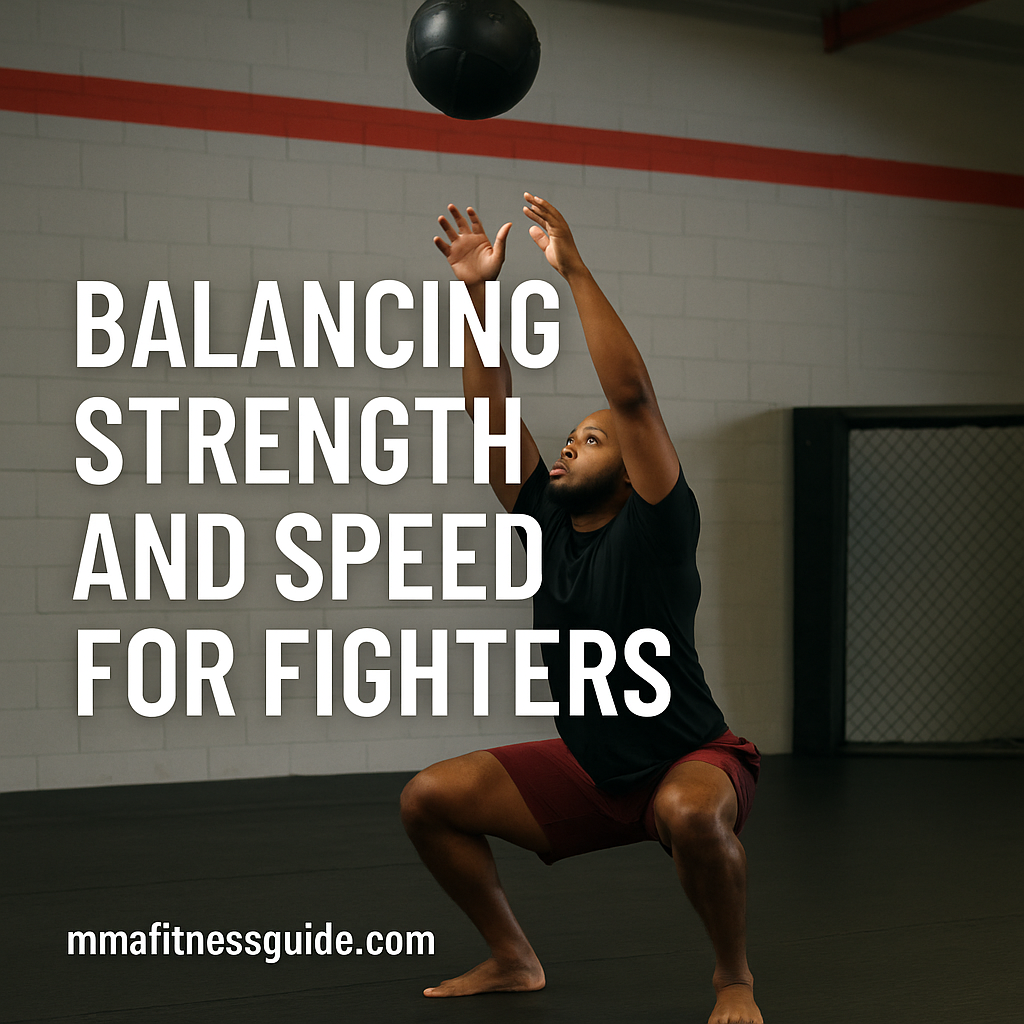
6. Medicine Ball Chest Pass
The medicine ball chest pass allows fighters to accelerate an external object without having to slow it down at the end of the movement.
Benefits for fighters:
- Develops explosive pressing
- Trains rapid force production through the upper body
- Allows maximal throwing intent
- Can be performed against a wall or with a partner
Use a medicine ball light enough to throw quickly. A heavier ball is not automatically better if it substantially reduces throwing speed.
7. Rotational Medicine Ball Throws
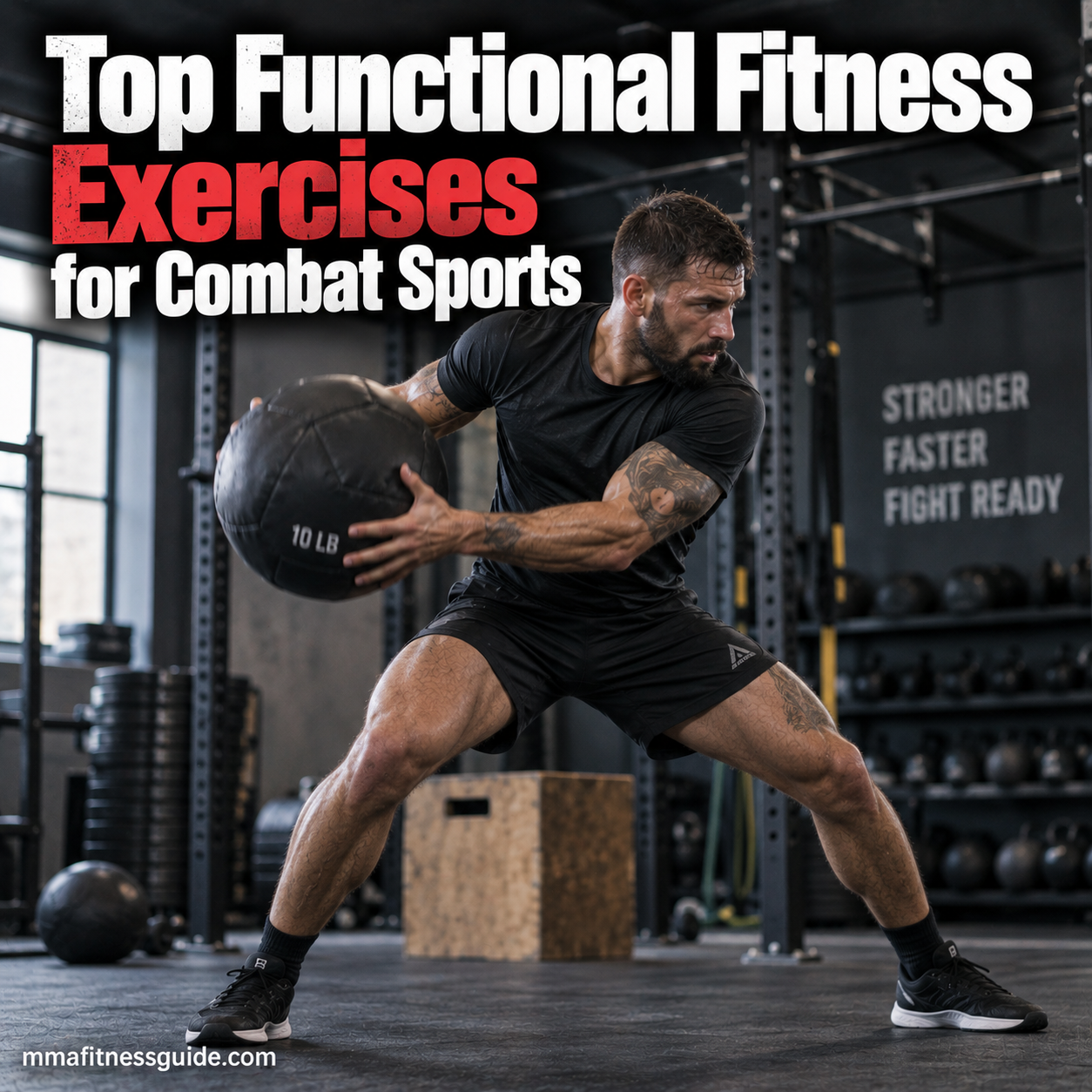
Rotational throws train force transfer from the ground through the hips and torso before releasing the ball.
That sequence resembles the coordinated rotation used during hooks, crosses, kicks, and other striking movements.
Benefits for fighters:
- Develops rotational power
- Trains hip and torso coordination
- Reinforces force transfer through the body
- Allows explosive rotational movement without slowing the implement
Drive through the floor and rotate through the hips rather than relying primarily on the arms.
Full-Body Plyometrics for MMA
Full-body variations combine upper- and lower-body actions and can resemble the rapid transitions encountered during MMA exchanges.
8. Burpee Tuck Jumps
This variation combines a burpee with an explosive vertical jump in which the knees rise toward the torso.
Benefits for fighters:
- Combines upper- and lower-body movement
- Trains explosive jumping while fatigued
- Challenges coordination
- Adds a conditioning component
Because fatigue accumulates quickly, this exercise works better in limited doses than in long sets where jump height and landing mechanics deteriorate.
9. Sprawl-to-Jump
The athlete sprawls toward the floor, rapidly returns to the feet, and finishes with an explosive jump.
The movement combines a familiar MMA defensive action with rapid recovery to an athletic stance.
Benefits for fighters:
- Practices explosive recovery after a sprawl
- Trains transitions between floor and standing positions
- Challenges coordination
- Develops repeated full-body power
The goal should be a quick, technically sound transition rather than simply accumulating repetitions.
10. Kneeling Jump to Squat Jump
Starting from the knees, the athlete explosively drives the hips forward and lands in a squat position before performing a vertical jump.
This is a demanding progression requiring adequate hip power, coordination, and landing control.
Benefits for fighters:
- Develops explosive hip extension
- Trains rapid transition between positions
- Challenges lower-body coordination
- Develops force production from a disadvantaged starting position
Learn the kneeling-to-squat portion before adding the second jump.
How Often Should Fighters Train Plyometrics?
For many MMA athletes, one or two short plyometric sessions per week can provide enough exposure without adding excessive fatigue to an already demanding training schedule.
A session does not need dozens of exercises. Two to four movements performed with high intent can be enough.
Keep these principles in mind:
- Prioritize explosive repetitions over high repetition counts
- Take adequate rest between sets
- Stop when jump height, distance, or speed noticeably declines
- Avoid placing demanding plyometrics immediately before hard sparring
- Adjust volume around wrestling, strength, and conditioning sessions
A fighter already completing several intense MMA sessions each week may require less additional plyometric work than someone in a general preparation phase.
How to Program Plyometrics for MMA
Plyometrics are generally performed when the athlete is relatively fresh.
A practical order is:
- General warm-up
- Mobility and movement preparation
- Low-intensity jumps, hops, or throws
- Higher-intensity plyometric exercises
- Strength training
- Conditioning when scheduled
For example, a short power session could include:
- Lateral bounds: 3 sets of 3–5 reps per side
- Box jumps: 3 sets of 3–5 reps
- Rotational medicine ball throws: 3 sets of 4–6 reps per side
Rest long enough between sets to maintain speed and coordination.
The exact volume should reflect the fighter’s experience, training phase, and workload from other sessions.
How to Tell if Plyometric Quality Is Dropping
Explosive exercises should look explosive.
Watch for:
- Increasingly loud or uncontrolled landings
- Noticeable loss of jump height
- Shorter bounds or slower throws
- Knees collapsing inward during landing
- Loss of balance
- Slower ground contact
- Technique changing to complete additional repetitions
Once power or movement quality declines significantly, adding more repetitions usually turns a power exercise into fatigue training.
Combining Plyometrics With Strength Training
Strength and plyometric training develop related but distinct qualities.
Heavy strength exercises improve the ability to produce force, while plyometrics emphasize producing force rapidly. MMA athletes can use both within the same training program.
One approach is to pair movements with similar patterns, such as:
- Squats with box jumps
- Split squats with lateral bounds
- Presses with medicine ball chest passes
- Rotational strength exercises with rotational medicine ball throws
These pairings are optional rather than mandatory. The larger priority is managing total workload so power training does not reduce the quality of striking, grappling, wrestling, or sparring sessions.
Common Plyometric Training Mistakes
Fighters should avoid:
- Turning every plyometric session into conditioning
- Performing high-repetition jumps after technique deteriorates
- Choosing box heights based on appearance rather than useful jump mechanics
- Using medicine balls that are too heavy to throw explosively
- Adding advanced depth jumps before developing basic landing control
- Performing demanding plyometrics while already exhausted
- Ignoring knee, ankle, Achilles, hip, wrist, or shoulder pain
- Adding too much plyometric volume alongside hard MMA training
More jumps do not automatically produce more power. The quality and speed of each repetition matter.
Final Thoughts: Developing Explosive Power for MMA
Plyometric exercises give fighters a way to train rapid force production through jumps, bounds, explosive push-ups, medicine ball throws, and MMA-specific transitions.
Lower-body exercises can develop acceleration and directional power. Upper-body and rotational drills train rapid pressing and force transfer, while full-body movements challenge explosive transitions between positions.
Start with controlled movements, keep repetitions crisp, and increase difficulty only when landing mechanics and speed remain consistent. Combined with technical MMA practice and progressive strength training, plyometrics can become a focused part of developing faster, more explosive movement inside the cage.