Strength training plays a critical role in MMA fitness. While striking technique, grappling skills, and cardiovascular conditioning are essential, physical strength helps fighters generate force, maintain control, and perform demanding movements throughout training and competition.
A fighter needs more than the ability to lift heavy weights. They must produce force from different positions, maintain balance while resisting an opponent, and repeat demanding movements without losing technical control.
Consider the physical demands of a typical MMA training session. A fighter might throw powerful combinations, defend takedowns, maintain pressure in the clinch, scramble from the ground, and continue moving through several rounds. Each activity places different demands on the muscles, joints, and cardiovascular system.
Effective strength training prepares the body for these demands.
Unlike bodybuilding programs that primarily emphasize muscle size and appearance, MMA strength programs prioritize movement quality, force production, stability, and recovery. Compound exercises form the foundation, while explosive movements and conditioning drills provide additional benefits.
This guide covers ten strength-building exercises for MMA fighters, explains how to perform them correctly, and provides practical training routines for beginners, intermediate athletes, and experienced fighters.
Whether you train competitively or simply enjoy MMA-inspired fitness, these exercises can help you develop a stronger, more capable body.
Why Strength Training Matters in MMA Fitness
Strength training improves the body’s ability to produce and control force. In mixed martial arts, this ability contributes to striking, wrestling, grappling, and maintaining posture under pressure.
However, strength alone does not determine fighting performance. Technique, timing, coordination, conditioning, and tactical decisions remain essential.
A properly structured strength program develops physical qualities that complement those skills.
1. Greater Force Production
Striking and grappling involve coordinated force production throughout the body.
For example, a powerful punch begins with the lower body. Force travels through the hips and trunk before reaching the shoulder, arm, and fist.
Exercises such as squats, deadlifts, and medicine ball throws develop physical qualities involved in this process.
Increasing general strength can provide a foundation for power development, although technical practice is necessary to apply that strength effectively.
2. Improved Joint Stability and Balance
MMA frequently places athletes in uneven positions.
A fighter may need to maintain balance while standing on one leg, resisting a takedown, or controlling an opponent against the cage.
Strength exercises that challenge the hips, knees, ankles, shoulders, and trunk can improve the ability to control these positions.
Lunges, farmer’s carries, and unilateral exercises are particularly useful for developing stability.
3. Stronger Core and Better Posture
The core connects the upper and lower body.
It helps transfer force during striking and maintain posture during wrestling exchanges.
Exercises such as planks, loaded carries, and compound lifts develop different aspects of trunk strength.
For a more specialized approach, see our guide on building explosive core strength for MMA .
4. Greater Physical Resilience
Progressive resistance training can strengthen muscles, tendons, and bones over time.
These adaptations may help athletes tolerate training demands and can contribute to injury-risk reduction when combined with appropriate programming and recovery.
However, no strength program can completely prevent injuries.
Contact sports involve unpredictable forces, and technical training, workload management, and adequate recovery remain important.
5. Improved Movement Efficiency
Greater strength can reduce the relative effort required to perform certain physical tasks.
For example, a fighter with stronger legs may find a given resistance easier to overcome than before.
This does not automatically translate into better endurance, but it can complement conditioning and technical development.
The objective is to build strength that supports MMA performance without creating unnecessary fatigue.
How MMA Strength Training Is Different
MMA strength training shares many principles with conventional resistance training.
Both use progressive overload, appropriate exercise selection, and recovery to produce adaptations.
The primary difference is how the program is organized around the athlete’s goals.
A bodybuilder might prioritize maximizing muscle growth in specific areas.
A powerlifter focuses on maximizing performance in the squat, bench press, and deadlift.
An MMA fighter needs strength that supports several physical demands while leaving enough energy for technical practice.
Compound Movements Form the Foundation
Compound exercises involve multiple joints and muscle groups.
Examples include:
- Squats
- Deadlifts
- Pull-ups
- Push-ups
- Lunges
These movements allow fighters to develop substantial strength efficiently.
They also challenge coordination and trunk control.
Isolation exercises can still be useful for addressing individual weaknesses, building muscle, or supporting rehabilitation. They simply should not replace the foundational movements of a complete program.
Strength and Power Are Trained Differently
Strength refers to the ability to produce force.
Power involves producing force quickly.
Heavy squats may improve maximum strength, while jumps and medicine ball throws emphasize rapid force production.
Both qualities matter in MMA.
A balanced program includes controlled resistance exercises alongside appropriate explosive movements.
Conditioning Must Be Considered
MMA fighters already perform demanding cardiovascular work through sparring, pad sessions, wrestling, and grappling.
Adding excessive strength circuits can create unnecessary fatigue.
Some sessions should prioritize strength with longer rest periods. Others may combine resistance exercises and conditioning.
Our guide to balancing cardio and strength for optimal performance explains how to organize these training demands.
Recovery Determines How Much Work You Can Handle
The ideal strength program depends on your total workload.
A recreational athlete training MMA twice weekly may tolerate three strength sessions.
A competitive fighter performing multiple technical sessions daily may need fewer dedicated lifting sessions.
Strength training should support the overall program rather than compete with it.
The Top 10 Strength Workouts for MMA Fighters
The following ten exercises cover major movement patterns and physical qualities.
Each exercise includes its primary benefits, execution instructions, recommended training volume, and common mistakes.
The exercises are presented individually so they can be combined into complete workouts later in this guide.
1. Squats: Build Lower-Body Strength and Stability
Squats are among the most useful exercises for developing lower-body strength.
They primarily train the quadriceps and glutes while involving the adductors and trunk muscles.
Strong legs support movements such as changing levels, maintaining stance, driving through takedowns, and recovering from low positions.
How to Perform a Barbell Back Squat
- Position the bar securely across your upper back.
- Stand with your feet approximately shoulder-width apart.
- Brace your trunk and maintain a stable foot position.
- Bend your hips and knees to lower your body.
- Descend as far as you can while maintaining control.
- Push through your feet to return to standing.
Allow your knees to move naturally in line with your feet.
Squat depth should reflect your mobility, anatomy, and ability to maintain a stable position.
Recommended Sets and Repetitions
For general strength development:
- 3–4 sets
- 4–8 repetitions
- 2–3 minutes of rest
Beginners can start with bodyweight or goblet squats.
Common Mistakes
Avoid allowing your heels to lift unintentionally, losing trunk control, or increasing the load before establishing consistent technique.
Do not force a particular squat depth if it causes discomfort or loss of position.
MMA Application
Squats develop the lower-body force production used in athletic movements.
They provide a strength foundation for wrestling and explosive actions, although technical skill determines how effectively that strength is applied.
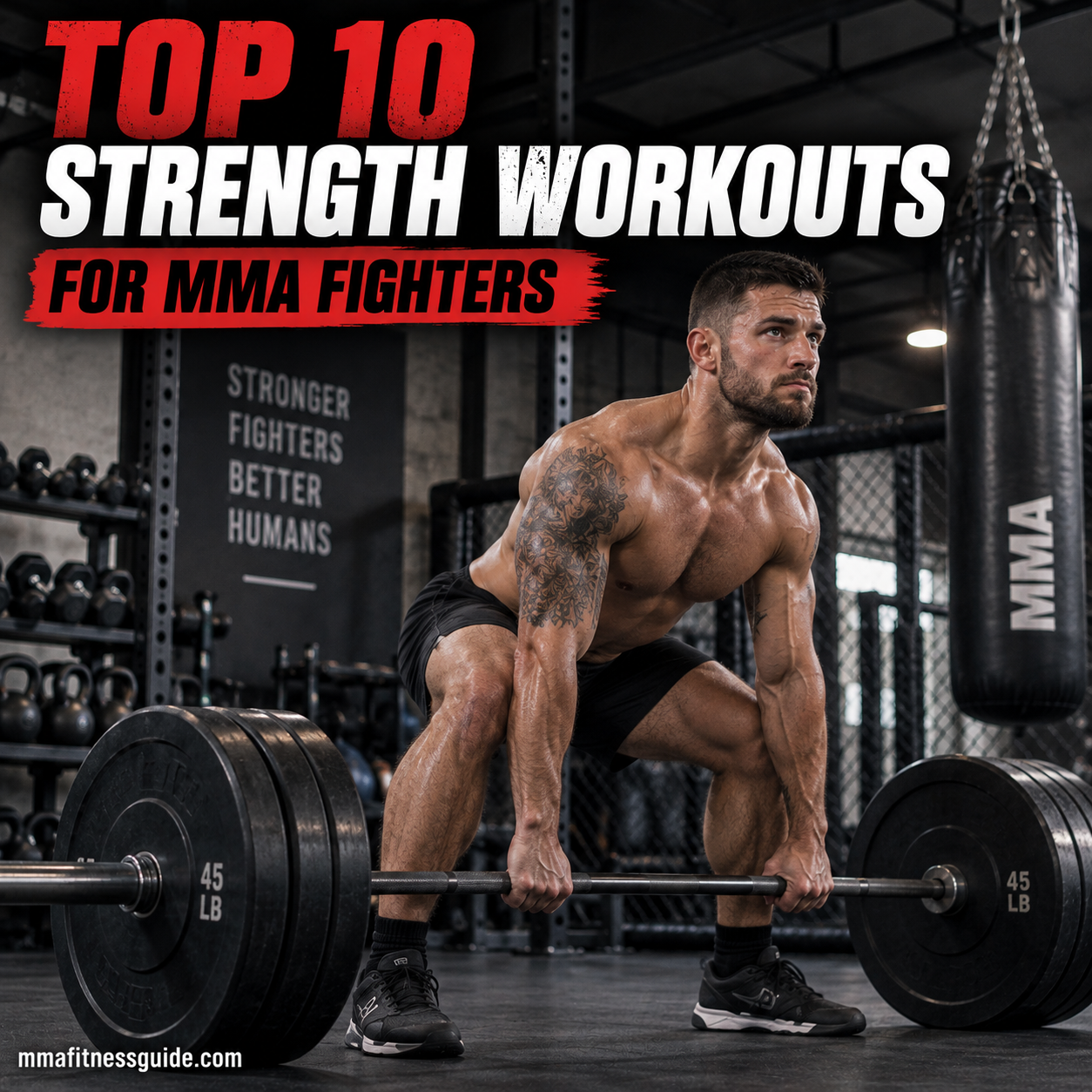
2. Deadlifts: Strengthen the Posterior Chain
Deadlifts develop the posterior chain, particularly the glutes, hamstrings, and spinal erectors.
They also challenge grip strength and trunk stability.
These qualities contribute to lifting, pulling, and maintaining strong body positions.
How to Perform a Conventional Deadlift
- Stand with the bar positioned over your midfoot.
- Bend at the hips and knees to grip the bar.
- Brace your trunk and establish a stable back position.
- Keep the bar close to your body.
- Push through the floor and extend your hips and knees.
- Stand tall without leaning excessively backward.
- Lower the bar under control.
Use a load that allows you to maintain consistent technique.
Recommended Sets and Repetitions
- 3–4 sets
- 3–6 repetitions
- 2–3 minutes of rest
Beginners may find trap-bar deadlifts or kettlebell deadlifts easier to learn.
Common Mistakes
Avoid jerking the bar from the floor, allowing it to drift far from your body, or repeatedly lifting loads that exceed your technical ability.
Deadlifts should develop strength without creating excessive fatigue that interferes with grappling.
MMA Application
Posterior-chain strength supports hip extension and the ability to maintain posture under resistance.
Deadlifts can complement wrestling training, but they do not replace actual takedown practice.
3. Push-Ups: Develop Upper-Body Pushing Strength
Push-ups strengthen the chest, triceps, and shoulders while requiring trunk stability.
They are especially practical because they require minimal equipment.
A properly performed push-up challenges the athlete to maintain a stable body position throughout the movement.
How to Perform Push-Ups
- Begin in a high plank.
- Position your hands slightly wider than shoulder-width.
- Maintain a straight, controlled body position.
- Bend your elbows to lower your chest.
- Press back to the starting position.
Allow your shoulder blades to move naturally.
Avoid excessive lower-back sagging or raising your hips to shorten the movement.
Recommended Sets and Repetitions
- 3 sets
- 8–15 repetitions
- 60–90 seconds of rest
Choose a variation that makes the final repetitions challenging without compromising form.
Push-Up Progressions
Beginners can use incline push-ups with their hands on a stable bench.
Intermediate athletes can perform standard push-ups.
Advanced athletes can use weighted push-ups or more demanding variations.
Explosive push-ups may be introduced once sufficient strength and control have been developed.
MMA Application
Push-ups build general pushing strength and trunk control.
They can support physical preparation for posting, framing, and other upper-body actions, although those movements require their own technical training.
For additional equipment-free exercises, explore our bodyweight exercises that build fighter strength .
4. Pull-Ups or Assisted Pull-Ups: Build Pulling and Grip Strength
Pull-ups develop upper-body pulling strength.
They primarily involve the latissimus dorsi, upper-back muscles, and elbow flexors while challenging the grip and trunk.
Pulling strength is useful for maintaining strong upper-body positions during grappling.
How to Perform Pull-Ups
- Grip a secure pull-up bar.
- Begin from a controlled hanging position.
- Pull your body upward.
- Bring your chin above the bar if your mobility and technique allow.
- Lower yourself under control.
Avoid excessive swinging or using momentum to complete repetitions.
Recommended Sets and Repetitions
- 3–4 sets
- 4–8 repetitions
- 90–120 seconds of rest
Beginner Alternatives
If you cannot perform a full pull-up, use:
- Assisted pull-up machines
- Resistance-band assistance
- Controlled negative repetitions
- Lat pulldowns
Progress gradually toward unassisted repetitions.
MMA Application
Pull-ups develop the general pulling strength involved in controlling resistance.
They also challenge grip endurance, although specific grip training and grappling practice are necessary for developing sport-specific gripping ability.
5. Lunges: Improve Unilateral Leg Strength and Balance
Lunges train one leg at a time while challenging coordination and stability.
They develop the quadriceps, glutes, and other muscles responsible for controlling the hips and knees.
Unilateral exercises are valuable because many athletic movements involve uneven weight distribution.
How to Perform Reverse Lunges
- Stand upright with your feet approximately hip-width apart.
- Step backward with one leg.
- Lower your body by bending both knees.
- Maintain a stable front foot.
- Push through the front leg to return to standing.
- Alternate sides.
Keep the movement controlled.
Recommended Sets and Repetitions
- 3 sets
- 8–10 repetitions per leg
- 60–90 seconds of rest
Useful Variations
Reverse lunges are a practical starting point.
Walking lunges add movement and coordination demands.
Dumbbell lunges increase resistance.
Split squats allow athletes to develop strength without stepping between repetitions.
MMA Application
Unilateral strength supports balance and force production when the legs are positioned unevenly.
This is relevant to stance changes, directional movement, and many wrestling positions.
However, lunges should complement—not replace—technical footwork and takedown drills.
6. Planks: Develop Core Stability and Control
Planks are isometric exercises that train the trunk to resist unwanted movement.
They primarily challenge the abdominal muscles while involving the shoulders, glutes, and other stabilizing muscles.
Unlike sit-ups, planks emphasize maintaining position rather than repeatedly flexing the spine.
How to Perform a Forearm Plank
- Position your elbows beneath your shoulders.
- Extend your legs behind you.
- Brace your abdomen.
- Maintain a stable position from head to heels.
- Breathe steadily throughout the hold.
Avoid allowing your lower back to sag.
Do not hold your breath unnecessarily.
Recommended Sets and Duration
- 3 sets
- 20–45 seconds
- 30–60 seconds of rest
Longer holds are not always better.
Once you can maintain a strong position consistently, increase the difficulty rather than extending the hold indefinitely.
Advanced Variations
Side planks challenge lateral stability.
Plank shoulder taps introduce anti-rotation demands.
Weighted planks increase resistance.
MMA Application
Planks develop the ability to maintain trunk position under load.
This can complement posture control during striking and grappling, although dynamic exercises are also necessary for a complete core program.
7. Kettlebell Swings: Develop Explosive Hip Power
Kettlebell swings train rapid hip extension.
The movement primarily involves the glutes and hamstrings while requiring trunk control and coordinated movement.
When performed in longer sets, swings also create a cardiovascular demand.
However, their effectiveness depends on using proper technique and choosing an appropriate load.
How to Perform Kettlebell Swings
- Place the kettlebell slightly in front of your feet.
- Hinge at your hips and grip the handle.
- Pull the kettlebell backward between your legs.
- Extend your hips forcefully.
- Allow the kettlebell to swing forward naturally.
- Guide it back into the next hip hinge.
The movement should come primarily from the hips.
Avoid lifting the kettlebell with your shoulders or turning the exercise into a squat.
Recommended Sets and Repetitions
For power-focused training:
- 3–5 sets
- 8–12 repetitions
- 60–120 seconds of rest
Use a manageable kettlebell and stop when technique or movement speed deteriorates.
Common Mistakes
Avoid excessive lower-back extension at the top, squatting too deeply, or allowing the kettlebell to pull you out of position.
Beginners should learn the hip hinge before attempting faster swings.
Our beginner kettlebell movements guide provides a useful starting point.
MMA Application
Kettlebell swings develop explosive hip extension and posterior-chain coordination.
These physical qualities can complement striking and wrestling preparation, although the movement itself is not a substitute for technical practice.
8. Medicine Ball Slams: Train Total-Body Power
Medicine ball slams develop rapid force production through coordinated movement of the trunk, shoulders, arms, and lower body.
They are useful for introducing explosive training without requiring heavy barbells.
How to Perform Medicine Ball Slams
- Stand with your feet approximately shoulder-width apart.
- Hold a slam ball in front of your body.
- Raise the ball overhead within a comfortable range.
- Brace your trunk.
- Drive the ball forcefully toward the floor.
- Retrieve it and reset before repeating.
Use a ball specifically designed for slamming.
Ensure the floor and surrounding area are suitable.
Recommended Sets and Repetitions
- 3–4 sets
- 5–8 repetitions
- 60–90 seconds of rest
Use a ball that allows explosive movement.
An excessively heavy ball may reduce speed and alter the intended training effect.
Common Mistakes
Avoid excessive backward leaning, uncontrolled spinal movement, or continuing repetitions after power output noticeably declines.
MMA Application
Medicine ball slams develop coordinated force production and can complement power training.
Rotational medicine ball throws may be more specific to developing rotational power, while overhead slams emphasize a different movement pattern.
9. Farmer’s Carries: Build Grip and Full-Body Stability
Farmer’s carries involve walking while holding resistance in both hands.
The exercise challenges grip strength, trunk stability, posture, and lower-body coordination.
It is simple to perform but can be demanding when properly loaded.
How to Perform Farmer’s Carries
- Position two dumbbells or kettlebells beside your feet.
- Lift them using a controlled hinge or squat.
- Stand upright with your shoulders in a comfortable position.
- Walk forward using controlled steps.
- Maintain steady breathing and trunk tension.
- Set the weights down safely.
Avoid leaning excessively or allowing the weights to swing uncontrollably.
Recommended Sets and Distance
- 3–4 sets
- 20–40 meters
- 60–120 seconds of rest
Choose a weight that challenges your grip without compromising posture.
Useful Variations
Suitcase carries use one weight and challenge resistance to side bending.
Front-rack carries increase trunk and upper-body stabilization demands.
Overhead carries require additional shoulder mobility and control and are best reserved for appropriately prepared athletes.
MMA Application
Farmer’s carries develop general grip strength and the ability to maintain posture while moving under load.
These qualities complement grappling preparation.
However, gripping an opponent or controlling a gi requires additional sport-specific practice.
10. Burpees: Combine Strength-Endurance and Conditioning
Burpees combine a squat, plank transition, and standing movement into a continuous exercise.
Depending on the variation, they may also include a push-up and jump.
Unlike heavy squats or deadlifts, burpees primarily develop muscular endurance and cardiovascular conditioning rather than maximum strength.
They are still useful within an MMA fitness program when performed with control.
How to Perform Strength-Focused Burpees
- Stand with your feet approximately shoulder-width apart.
- Lower into a squat.
- Place your hands on the floor.
- Step or jump your feet backward into a plank.
- Perform a controlled push-up if appropriate.
- Bring your feet forward.
- Return to standing or perform a small jump.
Maintain trunk control during the plank transition.
Recommended Sets and Repetitions
- 3 sets
- 6–10 repetitions
- 60–90 seconds of rest
Beginners can step backward and forward instead of jumping.
More experienced athletes can include a push-up or controlled jump.
Common Mistakes
Avoid rushing through repetitions while allowing the lower back to collapse.
If technique deteriorates significantly, reduce the pace or end the set.
MMA Application
Burpees challenge the ability to transition between standing and floor positions while working under fatigue.
They can support general conditioning but should not replace technical stand-ups, sprawls, or grappling drills.
Structuring Strength Workouts for MMA Fitness
Selecting effective exercises is only the beginning.
The next step is organizing them into a program that develops strength while allowing sufficient recovery.
Different training goals require different repetition ranges and rest periods.
Training for Maximum Strength
Maximum strength training generally uses relatively heavy resistance, lower repetitions, and longer rest periods.
A practical starting framework is:
- 3–5 sets
- 3–6 repetitions
- 2–4 minutes of rest
Exercises such as squats, deadlifts, and weighted pull-ups are suitable for this approach.
The load should be challenging while allowing consistent technique.
Training for Muscle Development
Building muscle can contribute to strength development, particularly for athletes who lack sufficient muscle mass.
A practical approach includes:
- 3–4 sets
- 6–12 repetitions
- 60–120 seconds of rest
Muscle development should be considered alongside weight-class requirements and overall training demands.
Training for Explosive Power
Power training emphasizes rapid force production.
Use relatively low repetitions and sufficient recovery.
For example:
- Medicine ball slams: 4 × 5
- Kettlebell swings: 4 × 8
- Rest: 60–120 seconds or longer as needed
The objective is to maintain speed and quality.
Training for Muscular Endurance
Higher-repetition exercises and circuits can develop the ability to sustain repeated muscular effort.
Push-ups, lunges, carries, and burpees are practical options.
However, muscular endurance sessions should not replace dedicated strength work when increasing maximum strength is the goal.
Complete MMA Strength Workout: Three-Day Program
The following program uses the ten exercises covered in this guide.
It is designed for recreational and intermediate athletes who can recover from three weekly strength sessions alongside their MMA practice.
Athletes with demanding sparring schedules may need to reduce the frequency or total volume.
Day 1: Lower-Body Strength and Core
| Exercise | Sets | Reps |
|---|---|---|
| Squats | 4 | 5 |
| Reverse Lunges | 3 | 8 per leg |
| Kettlebell Swings | 3 | 10 |
| Planks | 3 | 30 seconds |
Rest approximately two to three minutes after heavy squats and 60–90 seconds after accessory exercises.
The primary objective is lower-body strength, with additional hip-power and trunk-stability work.
Day 2: Upper-Body Strength and Grip
| Exercise | Sets | Reps |
|---|---|---|
| Pull-Ups | 4 | 6 |
| Push-Ups | 3 | 12 |
| Farmer’s Carries | 3 | 30 meters |
| Side Planks | 3 | 25 seconds per side |
Adjust repetitions according to your ability.
Use assisted pull-ups or incline push-ups when necessary.
This session develops upper-body pushing and pulling strength alongside grip and trunk stability.
Day 3: Full-Body Strength and Power
| Exercise | Sets | Reps |
|---|---|---|
| Medicine Ball Slams | 4 | 5 |
| Deadlifts | 3 | 5 |
| Lunges | 3 | 8 per leg |
| Burpees | 3 | 8 |
Perform medicine ball slams early in the session after warming up.
Rest sufficiently between deadlift sets.
Keep burpees controlled rather than turning the final exercise into an all-out conditioning test.
For another complete training approach, see the ultimate full-body fighter workout .
Beginner, Intermediate, and Advanced Training Context
Strength training should match the athlete’s experience and current physical capacity.
An advanced fighter’s workout is not automatically appropriate for someone who has recently started exercising.
Beginner Training
Beginners should prioritize learning movement patterns.
Start with bodyweight squats, incline push-ups, assisted pull-ups, and light kettlebell deadlifts.
Two full-body sessions per week may be sufficient initially.
Perform approximately two sets per exercise and gradually increase volume as technique and recovery improve.
If you are new to MMA fitness, our beginner MMA workouts you can start at home provide additional accessible options.
Intermediate Training
Intermediate athletes can increase resistance and introduce more demanding exercise variations.
Three weekly sessions may be appropriate when recovery allows.
Focus on measurable progression rather than constantly changing exercises.
For example, increase squat resistance gradually while maintaining the same repetition range and technique.
Advanced Training
Advanced athletes may incorporate heavier strength work, explosive movements, and more specialized programming.
However, advanced training does not mean minimizing rest during every workout.
Heavy strength and maximum-power exercises generally require sufficient recovery between sets.
Short rest periods are more appropriate for selected conditioning sessions.
Advanced athletes should adjust strength training around technical demands, sparring intensity, and competition schedules.
How to Progress Your MMA Strength Workouts
Progressive overload means gradually increasing training demands as your body adapts.
This can involve increasing resistance, repetitions, sets, or exercise difficulty.
However, progression should remain manageable.
Increase Resistance Gradually
If you complete every prescribed repetition with consistent technique and the weight feels manageable, consider a small increase during your next session.
For example, a fighter completing four sets of five squats may increase the load slightly once all sets are performed confidently.
Improve Technique Before Adding Weight
More weight is not useful if movement quality deteriorates.
Maintain control throughout the exercise and avoid relying on momentum to complete repetitions.
Track Your Training
Record the exercises, weights, repetitions, and sets completed.
Also note how you feel during MMA practice.
If strength numbers improve but technical performance suffers because of fatigue, the overall program may need adjustment.
Schedule Easier Training Periods
Periods of reduced training volume can help manage accumulated fatigue.
This may involve performing fewer sets or using lighter resistance for several sessions.
The appropriate timing depends on your overall training schedule.
Balancing Strength Training With MMA Practice
Strength workouts must fit around striking, wrestling, grappling, and conditioning.
A fighter training MMA four or five times weekly may not need three additional demanding lifting sessions.
Two well-structured strength workouts can be a practical option.
Consider the following principles.
Prioritize technical development. Avoid consistently entering important sparring or grappling sessions with significant muscular fatigue.
Separate demanding sessions when possible. If strength and MMA training occur on the same day, allow sufficient recovery between them.
Avoid excessive conditioning overlap. Hard sparring, wrestling circuits, and high-repetition lifting all contribute to fatigue.
Adjust volume during fight camp. As technical intensity increases, strength training may shift toward maintaining existing physical qualities.
The goal is not to maximize every training variable simultaneously.
It is to organize training so that strength, conditioning, and technical development can progress together.
Common Strength Training Mistakes in MMA Fitness
Using Excessive Weight Too Early
Heavy resistance is useful only when an athlete can control it.
Start with manageable loads and increase gradually.
Ignoring Proper Warm-Ups
A warm-up should prepare the muscles and joints for the exercises ahead.
Begin with several minutes of light movement, followed by relevant mobility and progressively heavier warm-up sets.
Neglecting Mobility and Recovery
Strength training should not consistently leave athletes too stiff or fatigued to perform technical movements.
Maintain appropriate mobility work and allow adequate recovery.
Training Strength Without Balance or Control
Compound lifts develop important physical qualities, but unilateral exercises and trunk-stability work provide additional benefits.
Include a variety of movement patterns.
Turning Every Workout Into a Circuit
Circuits can improve conditioning, but they are not always ideal for developing maximum strength.
Heavy exercises generally require longer rest periods.
Use circuits when conditioning is the objective and traditional sets when strength is the priority.
Ignoring Pulling and Posterior-Chain Exercises
Programs dominated by push-ups, bench presses, and abdominal exercises may neglect important movement patterns.
Include pulling exercises, hip hinges, squats, and unilateral leg work.
Copying Professional Fighters’ Programs
Professional fighters often train under supervision and have years of physical preparation.
Their routines may not suit recreational athletes.
Choose training volume according to your own experience, schedule, and recovery capacity.
Training Safety Notice
Strength workouts for MMA fitness can be physically demanding and may not be appropriate for everyone.
Begin with exercises that match your current ability.
Use proper equipment, learn correct technique, and increase resistance gradually.
Athletes with existing injuries, persistent pain, or medical conditions that may affect exercise tolerance should seek individualized guidance from an appropriate healthcare professional.
A qualified strength and conditioning coach can also help with exercise technique and program design.
Stop an exercise if you experience sharp pain, dizziness, or unusual symptoms.
Training should challenge your physical capacity without requiring you to ignore warning signs.
For additional guidance on adjusting exercise intensity and recovery throughout different stages of life, read our article on training safely at any age .
Frequently Asked Questions About MMA Strength Training
How Many Times Per Week Should MMA Fighters Lift Weights?
Two to three weekly strength sessions are a practical starting point for many athletes.
The appropriate frequency depends on training experience, technical workload, recovery, and competition preparation.
Athletes performing several demanding MMA sessions weekly may benefit from fewer lifting sessions.
Should MMA Fighters Lift Heavy or Light Weights?
Both can be useful.
Heavier resistance develops maximum strength, while lighter or moderate loads can be used for certain explosive exercises.
The correct load depends on the exercise and training objective.
Are Bodyweight Exercises Enough for MMA Strength?
Bodyweight exercises can develop substantial strength, particularly for beginners.
Push-ups, pull-ups, lunges, and advanced bodyweight variations provide useful resistance.
However, external weights make it easier to progressively increase loading for certain movement patterns.
Should Fighters Train Strength Before or After Cardio?
The order depends on the primary goal.
If maximum strength is the priority, perform strength training when relatively fresh.
If technical MMA practice is the priority, organize strength work so it does not compromise that session.
Separating demanding sessions can help manage fatigue.
Can Strength Training Make MMA Fighters Slower?
Strength training does not inherently make fighters slower.
Well-designed resistance training can support power development.
However, excessive fatigue, poorly managed training volume, or inappropriate programming may temporarily reduce movement quality.
Combining strength with explosive training and technical practice provides a more complete approach.
How Long Does It Take to Build MMA Strength?
Beginners may notice improvements in exercise performance within several weeks.
More substantial strength development generally requires consistent training over months.
Results depend on training history, nutrition, sleep, exercise selection, and recovery.
Final Thoughts
Strength training is a foundational component of MMA fitness.
Squats and deadlifts develop lower-body and posterior-chain strength. Push-ups and pull-ups strengthen the upper body. Lunges improve unilateral control, while planks and farmer’s carries challenge trunk stability.
Kettlebell swings and medicine ball slams introduce explosive movement, and burpees provide an additional conditioning option.
Together, these ten exercises address several important physical qualities required for a complete training program.
However, the effectiveness of a strength routine depends on more than exercise selection.
Training volume, progressive overload, movement quality, and recovery determine whether the program supports long-term improvement.
Start with a manageable schedule, track your progress, and adjust your workouts according to the demands of your MMA practice.
Consistent strength training, combined with technical development and appropriate conditioning, can help build a stronger and more physically prepared athlete.
Related MMA Strength and Conditioning Guides
Continue developing your training program with these related articles from MMA Fitness Guide.
- Top Functional Fitness Exercises for Combat Sports — Explore additional exercises that develop strength, coordination, and movement control.
- Bodyweight Exercises That Build Fighter Strength — Build strength with minimal equipment using progressive bodyweight movements.
- Build Explosive Core Strength for MMA — Develop rotational power, anti-rotation strength, and dynamic trunk stability.
- Balancing Cardio and Strength for Optimal Performance — Learn how to combine resistance training and conditioning while managing fatigue.
- The Ultimate Full-Body Fighter Workout — Put strength, stability, and conditioning exercises together in a complete fighter-focused routine.