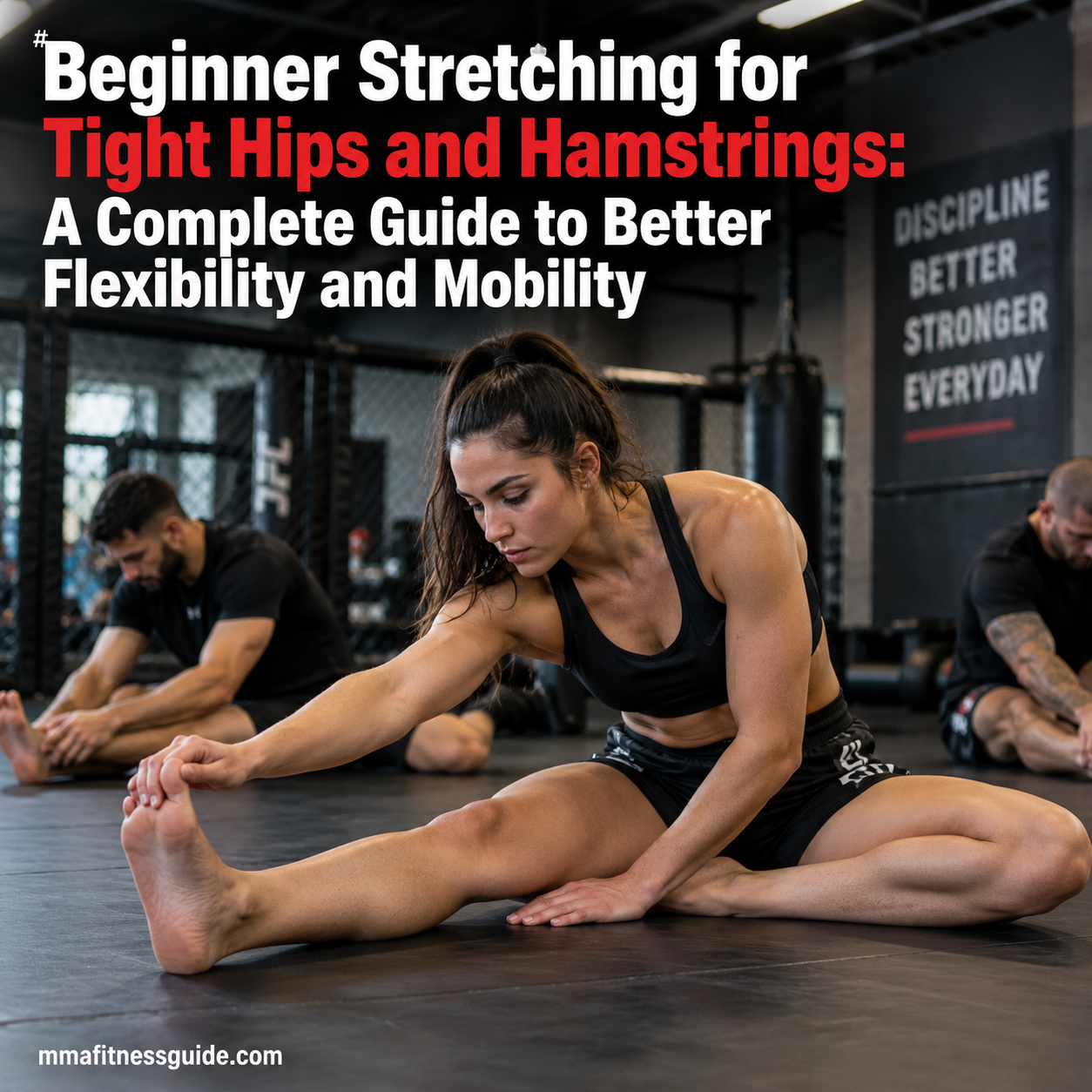
Tight hips and hamstrings can make even simple movements feel harder than they should. Bending forward to tie your shoes, lowering into a squat, climbing stairs, or throwing a controlled kick may feel uncomfortable when your muscles and joints aren’t moving freely.
For beginners entering MMA, kickboxing, Brazilian jiu-jitsu, or general fitness, limited flexibility can be particularly noticeable. Kicks require coordinated hip movement, grappling involves positions that challenge your range of motion, and strength exercises demand control through different joint angles.
Fortunately, you don’t need advanced yoga poses or an hour-long stretching session to start improving your flexibility.
A short, consistent routine combining gentle stretching, controlled mobility exercises, and basic strengthening can help you gradually increase your usable range of motion.
This guide covers seven beginner-friendly stretches, proper technique, common mistakes, a practical weekly routine, and ways to make your flexibility improvements useful during everyday activities and combat sports training.
Why Tight Hips and Hamstrings Are So Common
Hip and hamstring tightness is common among people who spend much of their day sitting, perform repetitive movements, or begin exercising after long periods of inactivity.
However, the sensation of tightness doesn’t always mean a muscle is physically shortened.
Sometimes, the body simply isn’t accustomed to moving comfortably through a particular range of motion. Muscle fatigue, strength limitations, joint restrictions, and sensitivity to stretching can also contribute.
Understanding these factors helps you choose a more effective approach.
1. Prolonged Sitting and Limited Movement
Office work, driving, gaming, and other seated activities keep your hips in a flexed position for extended periods.
During sitting:
- Your hip flexors remain in a relatively shortened position.
- Your hamstrings remain bent at the knee while your hips are flexed.
- Your glutes perform relatively little work.
- Your joints experience limited movement variety.
Sitting alone doesn’t automatically cause permanent muscle shortening. However, spending most of the day in one position provides fewer opportunities to practice movement through a full range of motion.
Someone who sits for eight hours and immediately attempts high kicks may discover that their hips aren’t prepared for the movement.
Regular movement breaks can help address this problem.
2. Limited Strength Through a Full Range of Motion
Flexibility and strength are closely connected.
You might be able to pull your leg toward your chest while lying down but struggle to lift it to the same height without assistance.
This difference illustrates the distinction between passive flexibility and active mobility.
Passive flexibility describes how far a joint can move with assistance. Active mobility describes how much of that range you can control using your own muscles.
For MMA athletes, active mobility is particularly important because kicking, sprawling, and changing positions require strength and coordination.
Stretching can help develop range of motion, while strengthening exercises help you control it.
3. Starting Training Too Aggressively
Beginners sometimes jump directly into demanding workouts without preparing their bodies.
Examples include:
- Attempting high kicks without gradually increasing kicking height.
- Performing deep squats before developing comfortable squat mechanics.
- Forcing wide grappling positions.
- Stretching aggressively immediately after intense training.
These activities can produce discomfort or excessive muscle soreness.
A gradual approach allows your muscles, joints, and nervous system to adapt.
4. Individual Anatomy and Previous Injuries
Not everyone has the same natural hip structure or flexibility.
Differences in joint anatomy, previous injuries, training history, and muscle characteristics can influence comfortable movement.
For example, two people may perform the same hip stretch but experience the sensation in different locations.
You don’t need to match another athlete’s flexibility to make progress.
The goal is to develop a comfortable, functional range of motion suited to your body and activities.
How Tight Hips and Hamstrings Affect MMA Training
Limited hip and hamstring mobility can influence several movements used in combat sports.
Roundhouse Kicks
Roundhouse kicks require coordinated hip rotation and leg movement. Limited hip mobility may make it difficult to reach certain kicking positions comfortably.
Front Kicks
Front kicks challenge hip flexion and hamstring flexibility, particularly when the leg extends toward a higher target.
Takedown Entries
Wrestling entries require coordinated hip and knee bending. Comfortable mobility helps athletes move into lower positions while maintaining balance.
Guard Positions
Brazilian jiu-jitsu involves varying degrees of hip flexion, rotation, and abduction. These positions can feel restrictive when an athlete is unfamiliar with the required ranges.
Sprawls
Sprawling requires coordinated hip extension and trunk control.
Squats and Deadlifts
These strength exercises require sufficient joint range and muscular control to perform the chosen variation comfortably.
Flexibility alone doesn’t determine performance. Strength, technique, coordination, and individual anatomy also matter.
For a deeper explanation of these relationships, read The Role of Flexibility in Martial Arts Performance .
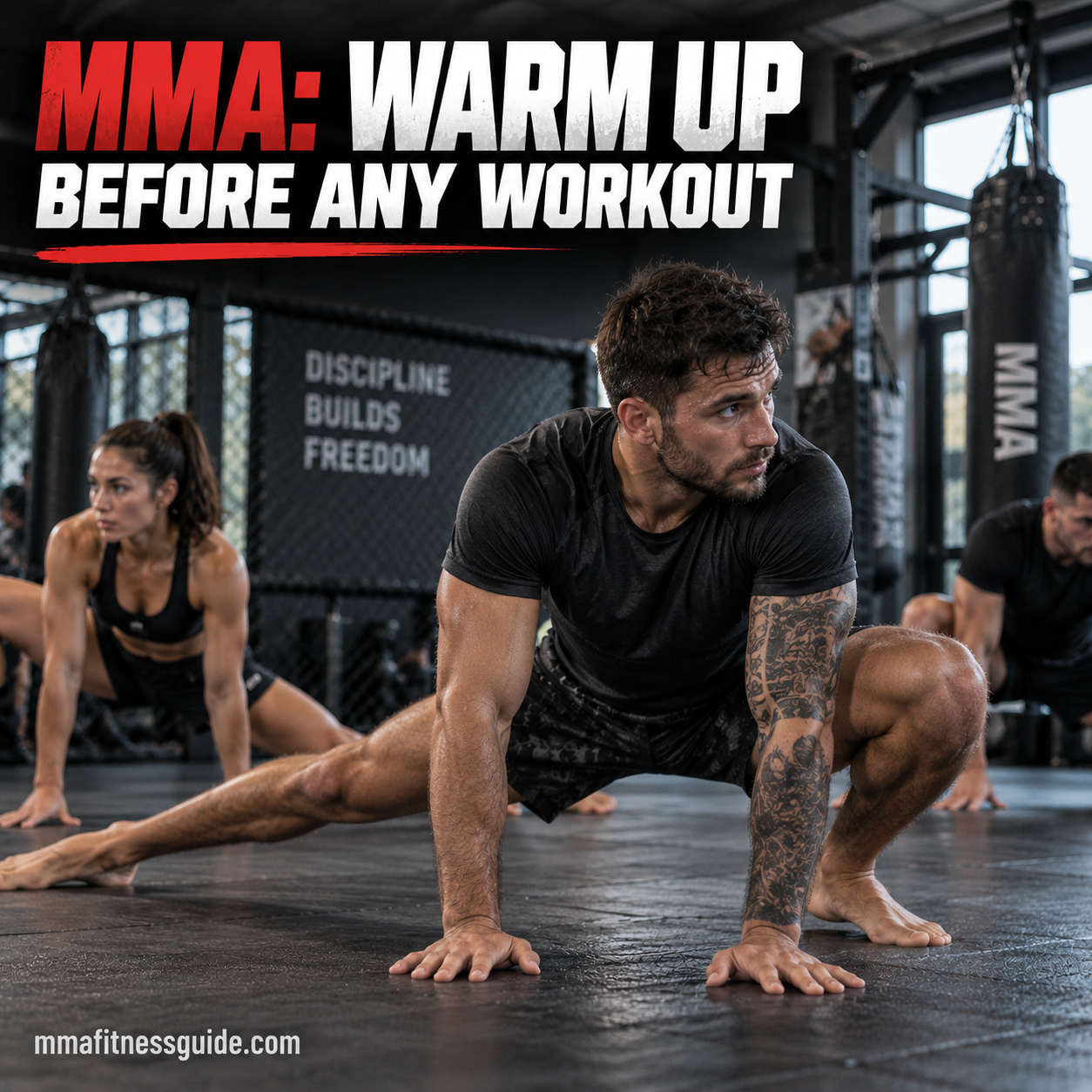
Before You Start: Warm Up Gently
Stretching generally feels more comfortable after a brief period of movement.
Instead of immediately sitting on the floor and forcing a deep hamstring stretch, spend two to five minutes gradually increasing your activity.
A warm-up should prepare your body without exhausting you.
Simple Three-Minute Warm-Up
1. March in Place — 45 Seconds
Swing your arms naturally and gradually increase your pace. Keep your shoulders relaxed and breathe normally.
2. Standing Hip Circles — 30 Seconds
Place your hands on your hips and make small, controlled circles in both directions.
Avoid forcing your hips into uncomfortable positions.
3. Gentle Leg Swings — 45 Seconds
Hold a wall or sturdy surface for balance.
Swing each leg forward and backward using a comfortable range of motion. Start with small movements rather than attempting high kicks immediately.
4. Easy Shadowboxing — 60 Seconds
Move your feet and throw relaxed punches.
Keep the intensity low and avoid explosive kicks until your body feels prepared.
If you’re preparing for an MMA session, dynamic movements are generally more appropriate immediately before explosive activity. Save longer, relaxed static stretching for after training or a separate flexibility session.
Our guide to Mobility Drills Every Fighter Should Practice explores additional movements that can complement your warm-up.
Stretch 1: Standing Hamstring Stretch
The standing hamstring stretch is a simple introduction to stretching the muscles along the back of your thighs.
Your hamstrings consist of three major muscles that cross the back of the hip and knee region. They contribute to knee bending and hip extension.
Recommended hold: 20–30 seconds.
How to Do It
- Stand with your feet approximately hip-width apart.
- Keep your knees slightly bent.
- Push your hips backward as though closing a door with your hips.
- Lean your torso forward while maintaining a comfortable spinal position.
- Rest your hands on your thighs or shins.
- Stop when you feel a gentle stretch behind your thighs.
- Hold for 20–30 seconds while breathing normally.
Return to standing slowly.
Benefits
This stretch can help improve tolerance to hip flexion with the knees relatively straight.
That range of motion is useful when learning exercises such as Romanian deadlifts and other hip-hinge movements.
It may also make everyday bending movements feel more comfortable.
Common Mistakes
Avoid aggressively rounding your lower back to reach the floor.
Your goal is to move primarily through your hips rather than force your hands toward your toes.
Also, avoid locking your knees if that creates discomfort.
Beginner modification: Place your hands on a countertop or sturdy chair for support.
Stretch 2: Hip Flexor Kneeling Stretch
The hip flexors are a group of muscles that help lift your thigh toward your torso.
They include the iliopsoas and rectus femoris, among others.
Hip flexor flexibility can be relevant to activities involving hip extension, including walking, running, lunging, and certain kicking movements.
Recommended hold: 20–30 seconds per side.
How to Do It
- Kneel on a padded surface with your right knee on the floor.
- Place your left foot forward, creating a half-kneeling position.
- Keep your torso upright.
- Gently tighten your abdominal muscles.
- Slightly tuck your pelvis under by squeezing your right glute.
- Shift your body forward a small distance without arching your back.
- Hold for 20–30 seconds.
- Switch sides.
You should feel the stretch toward the front of the hip on the kneeling side.
Benefits
This movement can improve comfort when extending the hip.
It can also help you practice pelvic control, which is useful during lunges and other lower-body exercises.
Common Mistakes
The biggest mistake is pushing the hips forward while excessively arching the lower back.
That movement can create the appearance of a deeper stretch without effectively targeting the intended area.
Instead, maintain gentle abdominal tension and focus on controlled pelvic positioning.
Beginner modification: Place a folded towel under your knee or perform a standing split-stance hip flexor stretch if kneeling is uncomfortable.
Stretch 3: Seated Forward Fold
The seated forward fold stretches the hamstrings while allowing you to work from a stable position.
It can be useful for beginners who find standing stretches difficult to balance.
Recommended hold: 30 seconds.
How to Do It
- Sit on the floor with both legs extended in front of you.
- Bend your knees slightly if needed.
- Sit upright and lengthen your spine.
- Slowly hinge forward from your hips.
- Reach toward your shins, ankles, or feet.
- Stop when you feel a gentle stretch behind your thighs.
- Hold for approximately 30 seconds.
Avoid bouncing or pulling yourself aggressively forward.
Benefits
The seated forward fold can help develop hamstring flexibility and improve your comfort in seated positions that involve hip flexion.
This may be relevant to certain grappling positions, although grappling also requires active hip control, strength, and technique.
Common Mistakes
Don’t sacrifice your spinal position simply to touch your toes.
If your pelvis cannot tilt forward comfortably, you may end up rounding excessively through your back.
Beginner modification: Sit on a folded towel or yoga block to elevate your hips. This can make it easier to hinge forward.
You can also loop a towel around your feet and hold the ends without pulling forcefully.
Stretch 4: Figure-Four Hip Stretch
The figure-four stretch primarily targets the gluteal region and muscles involved in hip rotation.
These muscles contribute to pelvic stability and controlled leg movement.
For beginners, the lying version offers a stable position that makes it easier to adjust intensity.
Recommended hold: 20–30 seconds per side.
How to Do It
- Lie on your back with both knees bent.
- Place your right ankle across your left thigh, just above the knee.
- Keep your right foot gently flexed.
- Reach behind your left thigh.
- Slowly draw your left leg toward your chest.
- Stop when you feel a comfortable stretch in your right glute.
- Hold for 20–30 seconds.
- Repeat on the opposite side.
Keep your head and shoulders relaxed.
Benefits
The figure-four stretch can help improve tolerance to hip rotation and flexion.
These movements appear frequently in grappling, guard transitions, and everyday activities.
Common Mistakes
Avoid pulling aggressively on your knee or forcing the crossed leg downward.
If you feel knee discomfort, reduce the intensity or change the position.
Beginner modification: Keep the supporting foot on the floor and gently move the crossed knee away from your body without applying pressure.
If you experience pain radiating down the leg, numbness, or tingling, stop rather than attempting to stretch through it.
Stretch 5: Butterfly Groin Stretch
The butterfly stretch focuses on the inner thighs, particularly the hip adductor muscles.
The adductors help bring your legs toward the center of your body and contribute to stability during athletic movement.
They are involved in lateral footwork, stance changes, and several grappling positions.
Recommended hold: 20–30 seconds.
How to Do It
- Sit on the floor.
- Bring the soles of your feet together.
- Allow your knees to move outward naturally.
- Hold your ankles or feet.
- Sit upright with your chest comfortably lifted.
- If comfortable, hinge slightly forward from your hips.
- Hold for 20–30 seconds.
Let gravity provide the stretch rather than forcing your knees toward the floor.
Benefits
The butterfly stretch can help improve comfort in positions involving hip abduction and external rotation.
This can be useful when developing the flexibility required for certain guard positions and wide stances.
Common Mistakes
Avoid pressing your knees downward with your hands.
This can create unnecessary stress around the hips or knees.
Also, don’t force your feet extremely close to your body if doing so causes discomfort.
Beginner modification: Place cushions or yoga blocks beneath your knees for support.
Stretch 6: Couch Stretch (Beginner Version)
The couch stretch targets the front of the hip and thigh.
It is particularly useful for stretching the rectus femoris, a quadriceps muscle that crosses both the hip and knee.
However, the full couch stretch can be intense for beginners.
Start with a modified version and increase the difficulty only when you can maintain a comfortable position.
Recommended hold: 20–30 seconds per side.
How to Do It
- Place a padded mat near a wall or sturdy couch.
- Kneel with one knee on the mat.
- Position the foot of your kneeling leg behind you, resting it on a low, stable surface.
- Place your opposite foot forward.
- Keep your torso upright and gently engage your abdominal muscles.
- Slightly tuck your pelvis under.
- Hold for 20–30 seconds.
- Switch sides.
Begin with the rear foot only slightly elevated.
Benefits
The couch stretch can improve flexibility in the quadriceps and hip flexor region.
This range may be useful for hip extension and movements that combine hip and knee positioning.
Common Mistakes
Don’t place your rear foot high against the wall immediately.
Doing so may force your knee into an uncomfortable position or cause excessive arching through the lower back.
Beginner modification: Keep the rear foot on the floor and perform the standard half-kneeling hip flexor stretch instead.
If kneeling produces knee pain, skip this exercise and choose a comfortable standing variation.
Stretch 7: Supine Hamstring Band Stretch
The supine hamstring stretch uses a towel or stretching strap to help control the position of your leg.
Because your back remains supported by the floor, you can concentrate on the hamstring stretch without worrying about balance.
Recommended hold: 20–30 seconds per side.
How to Do It
- Lie on your back.
- Bend one knee and place that foot on the floor.
- Loop a towel or stretching strap around the middle of your opposite foot.
- Slowly lift that leg toward the ceiling.
- Keep a slight bend in the raised knee if needed.
- Gently guide the leg toward your torso until you feel a comfortable stretch.
- Hold for 20–30 seconds.
- Switch legs.
As flexibility improves, you may gradually straighten the supporting leg if doing so remains comfortable.
Benefits
This stretch allows you to adjust the intensity easily.
It can be particularly useful for beginners who struggle to maintain a comfortable back position during seated or standing hamstring stretches.
Common Mistakes
Avoid yanking on the strap or forcing your knee completely straight.
Keep your pelvis relatively level and your shoulders relaxed.
Beginner modification: Bend the supporting knee and reduce how high you lift the stretching leg.
Recommended Beginner Stretching Routine
You don’t need to complete every variation every day.
The following routine combines hamstring, hip flexor, glute, and inner-thigh stretching into one manageable session.
It works well after a workout or as a separate flexibility session following a short warm-up.
Your 6–7 Minute Stretching Routine
- Standing Hamstring Stretch: 30 seconds.
- Kneeling Hip Flexor Stretch: 30 seconds per side.
- Figure-Four Hip Stretch: 30 seconds per side.
- Butterfly Stretch: 30 seconds.
- Seated Forward Fold: 30 seconds.
- Supine Hamstring Band Stretch: 30 seconds per side.
The stretching portion takes approximately four and a half minutes. Allow another couple of minutes for changing positions.
If you have more time, repeat individual stretches or complete a second round.
The couch stretch can be added as an optional exercise once the basic routine feels comfortable.
For a more comprehensive program, explore our Stretching Routines That Keep Fighters Flexible .
Should You Stretch Before or After MMA Training?
The answer depends on the type of stretching and the activity you’re preparing for.
Before Training: Prioritize Dynamic Mobility
Before sparring, kicking drills, wrestling, or strength training, your warm-up should gradually prepare you for the movements you’re about to perform.
Useful examples include:
- Controlled leg swings
- Hip circles
- Bodyweight squats
- Walking lunges
- Gentle torso rotations
- Progressive kicking drills
Start slowly and increase the range and speed as your body warms up.
Long, intense static stretching immediately before explosive activity may temporarily reduce strength or power, particularly when individual stretches are prolonged and aren’t followed by an appropriate dynamic warm-up.
Brief, comfortable stretching can still be included when necessary, but it shouldn’t replace movement-specific preparation.
After Training: Use Gentle Static Stretching
After training, your body is already warm, making this a convenient time for relaxed stretching.
Choose a few areas that feel restricted and hold each position comfortably.
However, stretching is not a guaranteed way to prevent delayed-onset muscle soreness or accelerate tissue recovery.
Think of it primarily as a way to develop flexibility and relax after exercise.
For a complete post-workout approach, read Cooldowns That Help You Recover Faster .
On Rest Days: Practice Comfortable Movement
Rest days can provide an opportunity to work on flexibility without the fatigue of a demanding training session.
A short walk, gentle hip circles, and a few static stretches may be sufficient.
You can also use the techniques in our guide to Simple Mobility Routines for Everyday Life to break up long periods of sitting.
How Often Should Beginners Stretch?
A useful starting point is two to three dedicated flexibility sessions per week.
If your body tolerates the routine well, you can practice gentle stretching more frequently.
Consistency matters more than forcing yourself into difficult positions.
General flexibility recommendations commonly involve holding stretches for approximately 10–30 seconds and accumulating around 60 seconds per muscle group during a session.
Beginners can work toward that volume gradually.
For example, you might perform two 30-second hamstring stretches on each side rather than one aggressive 60-second hold.
A Practical Weekly Schedule
Monday: Full stretching routine after training.
Tuesday: Light mobility and walking.
Wednesday: Full stretching routine.
Thursday: Gentle hip mobility.
Friday: Full stretching routine after training.
Saturday: Optional light stretching.
Sunday: Rest or comfortable movement.
This schedule provides three dedicated stretching sessions alongside opportunities for lighter activity.
If you’re particularly sore after training, reduce the intensity or take an additional recovery day.
How Long Until You See Results?
Flexibility improvements vary depending on your starting point, training frequency, stretch intensity, and individual anatomy.
Some beginners notice that stretching feels more comfortable after several sessions.
Measurable changes in range of motion generally require repeated practice over several weeks.
Week 1: Build Familiarity
Learn the positions, find a comfortable stretch intensity, and establish a consistent routine.
You may notice temporary improvements in how freely you move.
Weeks 2–3: Improve Tolerance
Some stretches may begin to feel easier, and you may notice gradual improvements in your available range of motion.
Weeks 4–8: Develop Measurable Progress
With consistent practice, improvements in flexibility may become easier to observe.
Controlled strengthening can help you use the additional range.
Beyond 8 Weeks: Maintain and Build
Continue practicing while gradually increasing strength and control.
Progress may slow as you approach your individual comfortable range.
These milestones are illustrative rather than guaranteed. Posture and athletic performance changes depend on additional factors beyond stretching.
How to Track Your Flexibility
Instead of relying entirely on how tight your muscles feel, use a simple progress check.
For example, perform the standing hamstring stretch once every two weeks under similar conditions.
Record:
- How far you can comfortably hinge forward.
- Whether you need to bend your knees.
- Where you feel the stretch.
- Whether the movement feels easier.
- Whether your range of motion has improved without discomfort.
You can also track the height of a slow, controlled front kick.
Avoid measuring flexibility immediately after an unusually intense stretching session, since temporary changes may not represent lasting improvements.
Common Stretching Mistakes to Avoid
Stretching is relatively simple, but poor technique and excessive intensity can make it uncomfortable or counterproductive.
1. Stretching Too Aggressively
More discomfort doesn’t automatically produce better results.
An intense stretch may cause you to tense the surrounding muscles, making it difficult to relax into the position.
Use a mild to moderate stretching sensation instead.
2. Holding Your Breath
Some beginners hold their breath when trying to reach farther.
Continue breathing normally.
Slow, comfortable breathing can make it easier to maintain a relaxed position.
3. Bouncing Into a Stretch
Repeatedly bouncing at the end of your range can produce abrupt loading.
Beginners should prioritize controlled movements and stable holds.
Ballistic stretching has specific athletic applications, but it isn’t necessary for this routine.
4. Rounding the Lower Back Excessively
During hamstring stretches, reaching farther by aggressively rounding your spine can shift the movement away from the intended hip hinge.
A small amount of natural spinal movement isn’t automatically dangerous, but forcing the position is unnecessary.
Bend your knees and focus on moving comfortably through your hips.
5. Stretching Only When Something Hurts
Flexibility training works better as a consistent practice than as an emergency response to discomfort.
If you experience persistent pain, however, don’t assume stretching is the solution.
Pain can have many causes and may require an individualized assessment.
6. Ignoring Strength Training
Stretching can increase passive range of motion, but strength training helps you control movement.
Someone who develops flexibility without adequate strength may still struggle with demanding athletic positions.
Combining both approaches provides a more complete training program.
Add Light Strengthening for Better Mobility
Tightness isn’t always caused by weakness, but limited strength can contribute to difficulty controlling a movement.
For example, you may have sufficient passive hip flexibility to lift your leg high but lack the muscular strength to hold it there.
Strength training through a comfortable range of motion can improve both strength and mobility.
Start with the following exercises two or three times per week, allowing recovery between demanding sessions.
1. Glute Bridges
Recommended volume: 2 sets of 10–15 repetitions.
Lie on your back with your knees bent.
Push through your feet and lift your hips while gently squeezing your glutes.
Avoid excessively arching your lower back.
This exercise strengthens the glutes and develops controlled hip extension.
2. Bodyweight Squats
Recommended volume: 2 sets of 8–12 repetitions.
Stand with your feet at a comfortable width.
Bend your hips and knees to lower yourself, then stand back up.
Use a chair for support if needed.
Work within a comfortable range rather than forcing a deep squat.
3. Light Romanian Deadlifts
Recommended volume: 2 sets of 8–10 repetitions.
Hold light dumbbells, soften your knees, and push your hips backward.
Lower the weights only as far as you can comfortably maintain control, then stand tall.
This exercise develops hamstring and glute strength while reinforcing hip-hinge mechanics.
4. Step-Ups
Recommended volume: 2 sets of 8 repetitions per leg.
Step onto a low, stable platform.
Push through your leading foot and stand upright before stepping down slowly.
Start with a low platform and increase the height only when you can maintain balance and control.
5. Side-Lying Hip Abductions
Recommended volume: 2 sets of 10–15 repetitions per side.
Lie on your side and slowly lift your upper leg without rolling your pelvis backward.
Lower it under control.
This exercise targets muscles along the outer hip that contribute to pelvic stability.
These movements help develop strength in the glutes, hamstrings, and surrounding hip muscles.
Progress gradually by increasing repetitions, resistance, or range of motion when the exercises become comfortable.
If your schedule is limited, combine a few of these movements with ideas from our 10-Minute Workouts for Busy Schedules .
Flexibility vs. Mobility: What’s the Difference?
Although the terms are often used interchangeably, flexibility and mobility describe related but different physical qualities.
Flexibility refers to the ability of muscles and surrounding tissues to accommodate movement through a range of motion.
Mobility generally refers to the ability to move a joint through a usable range with appropriate control.
Consider a front kick.
You might be able to lie on your back and pull your leg toward your chest with a stretching strap. That’s an example of assisted range of motion.
But can you lift the same leg while standing, maintain balance, extend the knee, and return to your stance without losing control?
That requires active mobility, strength, and coordination.
How to Develop Both
Use three complementary methods:
- Static stretching to improve tolerance to extended positions.
- Dynamic mobility exercises to practice controlled movement.
- Strength training to develop force and stability through your available range.
For more advanced applications, see Fighter Stretching Routines That Improve Range .
What If Your Hips and Hamstrings Stay Tight?
If you’ve stretched consistently for several weeks without noticeable improvement, consider whether the problem is actually a flexibility limitation.
The sensation of tightness can sometimes be associated with muscle fatigue, joint restrictions, nerve sensitivity, or other conditions.
For example, discomfort extending from the lower back into the buttock and leg may not respond appropriately to aggressive hamstring stretching.
Similarly, a sharp pinching sensation at the front of the hip during deep flexion may indicate that you should modify the movement rather than force a deeper position.
When You Should Stop and Adjust
Stop stretching if you experience:
- Sharp or worsening pain.
- Numbness or tingling.
- Pain radiating down your leg.
- Significant joint discomfort.
- A sudden popping sensation accompanied by pain.
- Unusual weakness.
Persistent symptoms, especially those involving nerve sensations, should be evaluated by a qualified healthcare professional.
Seek urgent medical attention for new bowel or bladder dysfunction, numbness around the groin, or rapidly worsening leg weakness.
Stretching shouldn’t be used to diagnose or treat an unexplained injury.
If lower-back discomfort is part of your concern, our article on Lower Back Pain: Causes and Solutions provides additional background.
Frequently Asked Questions About Hip and Hamstring Stretching
Is It Okay to Stretch Tight Hamstrings Every Day?
Yes, gentle daily stretching is generally reasonable for healthy individuals who tolerate it comfortably.
However, daily stretching isn’t mandatory.
Two or three consistent sessions per week can be a useful starting point, and you can increase frequency based on your response.
Avoid repeatedly forcing sore or painful muscles into deep positions.
Should I Stretch My Hamstrings If My Lower Back Hurts?
It depends on the cause of your discomfort.
Some people tolerate gentle hamstring stretching well, while others find that certain positions aggravate their symptoms.
If stretching increases back pain or produces symptoms traveling down your leg, stop and seek appropriate guidance.
Can Stretching Make My Kicks Higher?
Improving flexibility may help if restricted range of motion is limiting your kicking height.
However, higher kicks also require hip strength, balance, coordination, and proper technique.
Practice controlled kicks at a comfortable height and increase the range gradually.
Do I Need to Touch My Toes?
No.
Touching your toes is not a universal measure of fitness or healthy flexibility.
Your limb proportions, joint anatomy, and movement technique all influence how far you can reach.
Focus on comfortable, controlled movement rather than achieving a particular visual position.
Should I Stretch Before Bed?
Gentle stretching before bed is generally fine if you find it comfortable.
Keep the intensity low and avoid treating stretching as a guaranteed solution for sleep problems.
A short, relaxed routine may be a convenient way to maintain consistency.
Can Tight Hip Flexors Cause Lower-Back Pain?
Hip flexibility and pelvic movement can influence how you perform certain activities, but lower-back pain has many possible causes.
Tight hip flexors alone shouldn’t be assumed to explain persistent back pain.
If symptoms continue, an individualized assessment is more appropriate than simply stretching harder.
Is Stretching Enough to Improve MMA Mobility?
Not usually.
MMA requires flexibility, strength, balance, coordination, and sport-specific technique.
Stretching can address part of the equation, but controlled mobility drills, strength training, and technical practice are also important.
Final Thoughts
Improving tight hips and hamstrings doesn’t require extreme flexibility or complicated routines.
Start with a few comfortable stretches, practice consistently, and gradually develop strength through your available range of motion.
The seven exercises in this guide provide a practical foundation for beginners who want to move more comfortably during everyday activities, strength training, and MMA practice.
Remember that flexibility progress is individual. Avoid comparing your range of motion with experienced fighters or forcing positions that produce pain.
The goal isn’t simply to stretch farther. It’s to develop a range of motion you can use comfortably and control confidently.
With regular practice and appropriate progression, stretching can become a useful part of a broader fitness routine.
Continue Building Your Flexibility and Mobility
Once you’re comfortable with this beginner routine, these related MMA Fitness Guide articles can help you expand your training.
- Stretching Routines That Keep Fighters Flexible — Explore additional stretching strategies for maintaining flexibility during regular combat sports training.
- Mobility Drills Every Fighter Should Practice — Develop more controlled movement through your hips and other major joints.
- Fighter Stretching Routines That Improve Range — Progress beyond basic stretching with routines focused on expanding usable range of motion.
- Cooldowns That Help You Recover Faster — Build a structured post-training cooldown into your fitness routine.