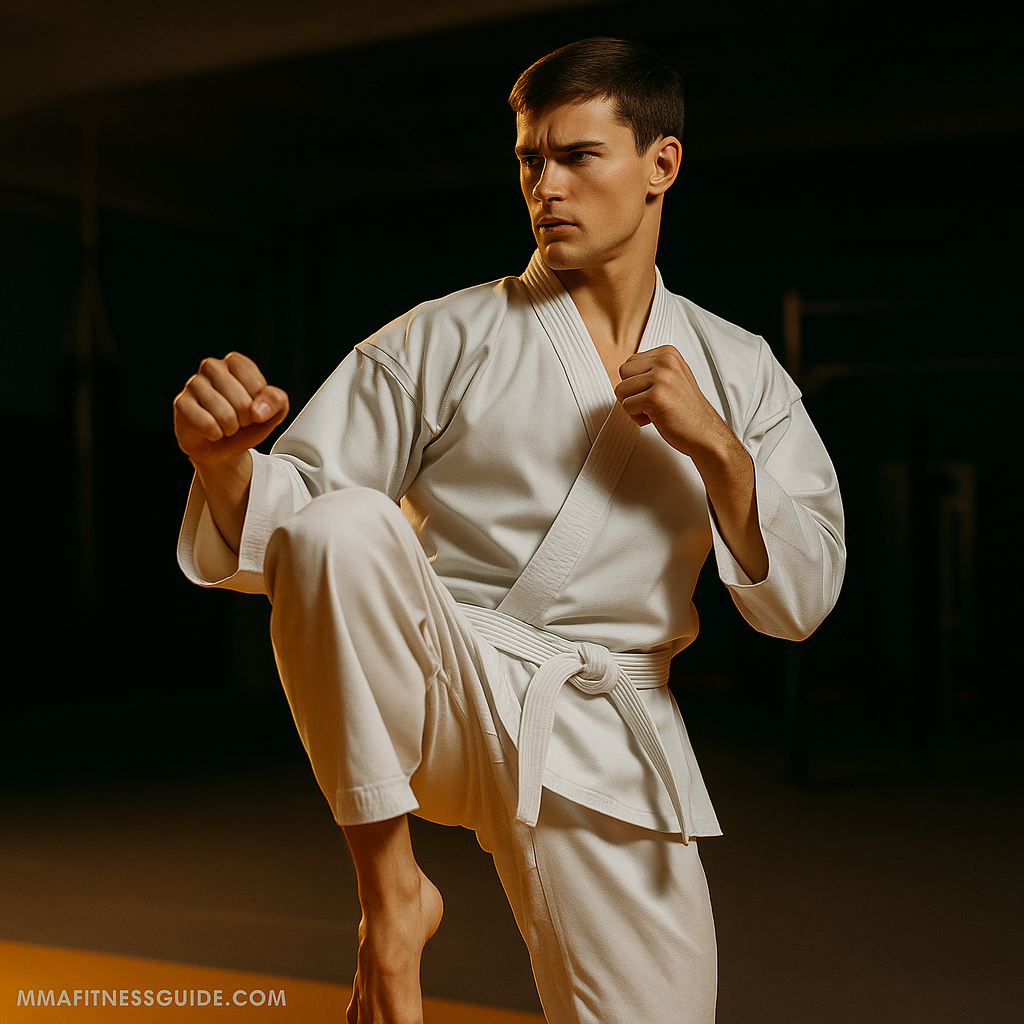
A roundhouse kick requires the hip to rotate freely. A deep level change depends on usable motion through the hips and ankles. Even punching mechanics rely on enough movement through the upper back and shoulders to rotate without forcing the body into awkward positions.
When those areas are restricted, fighters often compensate somewhere else. The knee may collapse inward during a squat or shot, the lower back may contribute too much during a kick, or the shoulder may take additional stress when the upper back isn’t rotating well.
Stretching for MMA should therefore have a specific purpose: developing range of motion that a fighter can actually control during training and competition.
That means prioritizing the hips, ankles, hamstrings, thoracic spine, and shoulders while using different methods before and after training. Dynamic movements can prepare those areas for a session, while targeted mobility work and static stretching can be used separately to address restrictions over time.
The goal isn’t to see how far you can stretch. It’s to give your body enough controlled range to kick, punch, shoot, scramble, and grapple without unnecessary restrictions.
Why Range of Motion Matters in MMA
MMA demands movement across every plane—rotation, extension, flexion, and lateral motion—often under fatigue and resistance.
Improved range helps fighters:
- Generate more power with less effort
- Move efficiently in striking exchanges
- Transition smoothly in grappling
- Maintain posture under pressure
- Reduce joint strain and overuse injuries
Limited range doesn’t just restrict movement—it forces compensation, which leads to breakdowns.
Mobility vs Flexibility: What Fighters Actually Need
Many fighters confuse flexibility with mobility. They’re related, but not the same.
Flexibility refers to how far a muscle can stretch passively.
Mobility refers to how well you can control that range actively.
For MMA, controlled range matters more than passive stretch.
The best routines combine:
- Dynamic stretching
- Active mobility drills
- Short static holds where appropriate
This builds usable range, not loose joints.
When Fighters Should Stretch
Timing matters. Stretching at the wrong time can reduce performance.
Before Training: Dynamic Stretching Only
Pre-training stretching should:
- Increase blood flow
- Prepare joints for movement
- Activate stabilizing muscles
Avoid long static holds before sparring or lifting.
After Training: Range Restoration
Post-training is ideal for:
- Static stretching
- Mobility resets
- Tension reduction
This is where long-term range improvements happen.
On Rest Days: Dedicated Mobility Sessions
Short mobility sessions on rest days:
- Accelerate recovery
- Improve joint health
- Maintain range under heavy training loads
Even 15–20 minutes makes a difference.
Key Areas Fighters Need to Improve Range
Not all stretches are equal. Fighters benefit most from targeting high-demand areas.
Hips: The Foundation of Range
Hips drive striking, takedowns, scrambles, and guard work.
Limited hip range leads to:
- Weak kicks
- Poor shot mechanics
- Tight lower back compensation
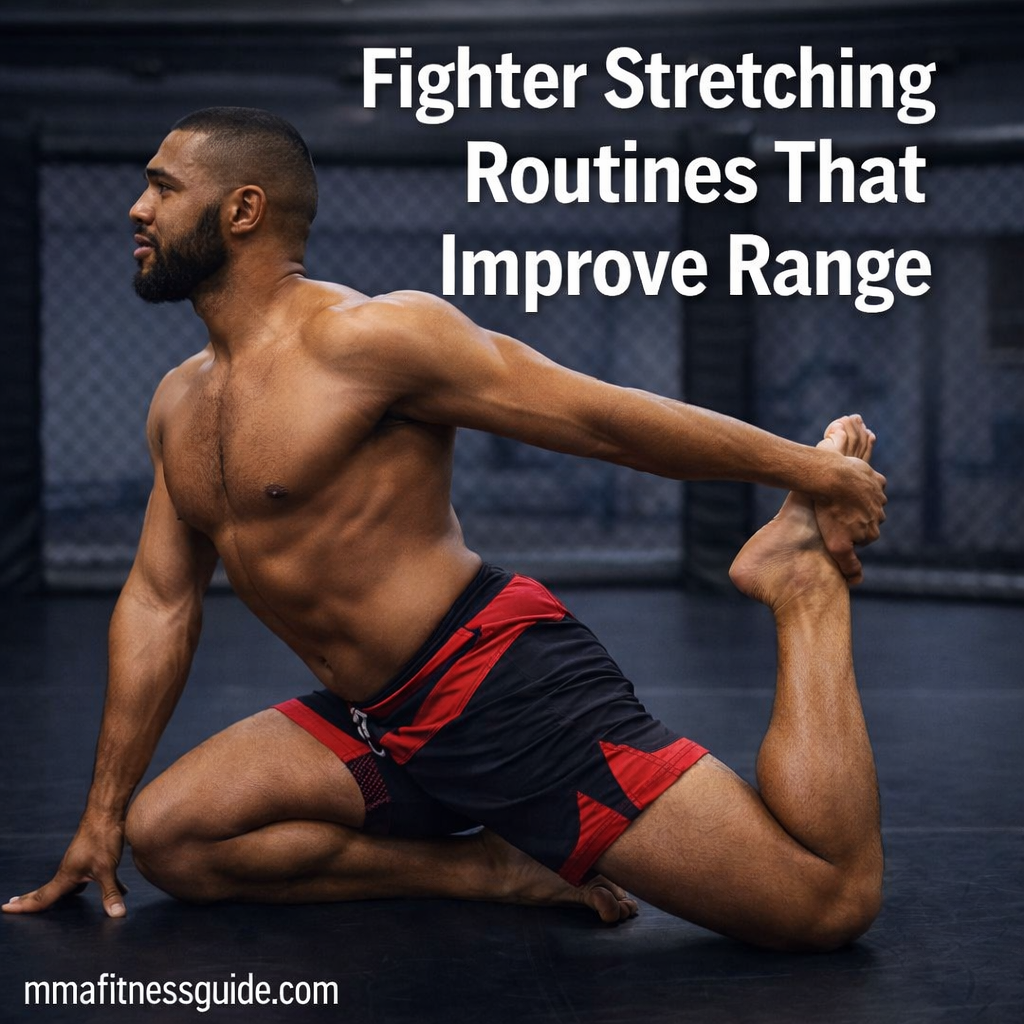
Hip Stretching Routine for Fighters
Include:
- Hip flexor stretches
- 90/90 hip rotations
- Deep squat holds
- Lateral hip openers
Benefits:
- Improved kicking height
- Stronger takedown entries
- Better guard mobility
Thoracic Spine: Rotation and Posture
The upper back controls rotation and posture.
Restricted thoracic mobility limits:
- Punching rotation
- Defensive shelling
- Clinch control
Thoracic Mobility Drills
Focus on:
- Seated spinal rotations
- Quadruped thoracic rotations
- Foam roller extensions
Benefits:
- Cleaner striking mechanics
- Reduced shoulder strain
- Improved breathing under pressure
Shoulders: Stability Through Range
Shoulders must be mobile and stable—especially for grappling-heavy fighters.
Overstretching without control leads to instability.
Shoulder Range Routine
Include:
- Controlled arm circles
- Band-assisted shoulder openers
- Scapular activation drills
Benefits:
- Stronger punches
- Safer posting and framing
- Reduced shoulder injuries
Ankles and Calves: The Hidden Range Limiter
Ankles affect stance, balance, and takedown defense.
Restricted ankle range leads to:
- Poor footwork
- Limited squat depth
- Knee compensation
Ankle Mobility Drills
Use:
- Calf stretches with knee bent and straight
- Ankle dorsiflexion drills
- Weighted ankle mobilizations
Benefits:
- Better stance stability
- Improved balance in scrambles
- Reduced knee strain
Hamstrings: Power Without Tension
Tight hamstrings limit kicking mechanics and guard retention.
The goal isn’t extreme length—it’s controlled extension.
Hamstring Stretching for Fighters
Use:
- Active leg raises
- Single-leg hinge stretches
- Light static holds post-training
Benefits:
- Smoother kicks
- Better hip hinge power
- Less lower back tension
Sample Fighter Stretching Routine (15–20 Minutes)
This routine can be used post-training or on rest days.
Lower Body Focus (10 Minutes)
- Hip flexor stretch – 60 seconds per side
- 90/90 hip rotations – 10 reps per side
- Deep squat hold – 60 seconds
- Ankle dorsiflexion drills – 10 reps per side
Upper Body Focus (8–10 Minutes)
- Thoracic rotations – 10 reps per side
- Shoulder openers – 10 reps
- Chest and lat stretch – 60 seconds per side
Keep breathing slow and controlled.
Stretching Mistakes Fighters Make
Stretching helps only when done correctly.
Avoid:
- Stretching aggressively through pain
- Holding static stretches before hard training
- Ignoring breathing during stretches
- Treating stretching as optional
Consistency matters more than intensity.
How Often Fighters Should Stretch
For best results:
- Light dynamic mobility before every session
- Post-training stretching 3–5x per week
- Dedicated mobility sessions 1–2x per week
Range improves gradually—daily attention beats occasional long sessions.
Stretching and Injury Prevention
Better range reduces injury risk by:
- Allowing joints to move naturally
- Reducing compensatory movement
- Improving force distribution
Stretching doesn’t replace strength—but it supports it.
Range of Motion vs Fighting Style
Different styles stress different ranges.
- Strikers need hips, hamstrings, thoracic rotation
- Wrestlers need ankles, hips, upper back
- Grapplers need shoulders, hips, spinal control
Tailor routines to your training emphasis.
Final Thoughts
Fighter stretching routines should improve usable range—not just flexibility. When mobility is trained intentionally, fighters move more efficiently, strike cleaner, and recover faster.
Stretching doesn’t have to be long or complicated. Target the right areas, stay consistent, and focus on control. Better range isn’t just about moving farther—it’s about moving better.