Introduction
An MMA athlete might lift weights in the morning, drill takedowns in the afternoon, and complete several hard rounds on the pads or mats that evening. Stack too many demanding sessions together, and the quality of each workout can quickly decline.
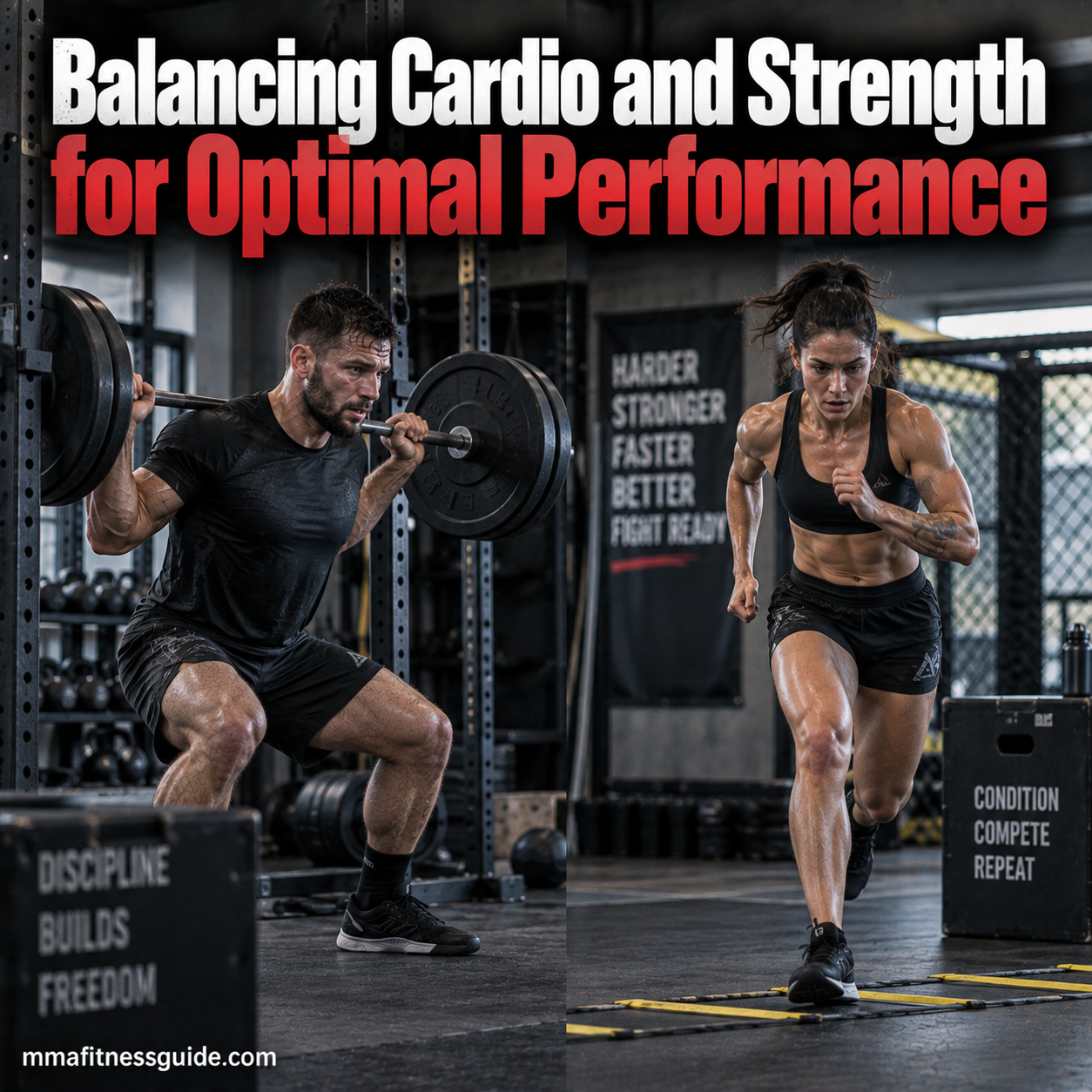
The challenge isn’t choosing between cardio and strength. Fighters need enough endurance to maintain their pace across rounds while preserving the strength and power required for striking, wrestling, clinching, and scrambling.
Managing those qualities comes down to training volume, intensity, timing, and recovery.
Why MMA Requires Cardio and Strength
A fight constantly shifts between different physical demands.
A fighter may spend part of a round moving at a controlled pace before suddenly exploding into a combination, takedown attempt, scramble, or clinch exchange.
That requires several qualities working together:
- Aerobic fitness to support sustained activity and recovery
- Strength for wrestling, clinching, and positional control
- Power for explosive movements
- Muscular endurance for repeated efforts
- Anaerobic conditioning for harder bursts
A training program that develops only one of these qualities leaves fewer physical options when the pace changes.
What Cardio Does for MMA Performance
MMA conditioning isn’t simply about completing long runs or trying to become exhausted during every workout.
Aerobic fitness helps the body recover between harder efforts. That becomes useful when a fighter has to repeatedly accelerate, exchange, recover, and accelerate again.
Conditioning can support:
- Recovery between high-intensity exchanges
- Sustained movement across rounds
- More consistent training output
- Better pacing
- Maintaining technical quality as fatigue develops
Different conditioning methods develop different qualities, so running, intervals, bag rounds, drilling, and sparring shouldn’t automatically be treated as interchangeable.
What Strength Training Contributes
Strength gives fighters a larger physical base from which to produce force.
In MMA, that can contribute to:
- Driving through takedowns
- Resisting positional pressure
- Maintaining posture in clinches
- Controlling an opponent during grappling
- Producing force through the hips and legs
- Handling demanding positions more efficiently
Strength training can also prepare muscles and connective tissues for progressively higher loads when programmed appropriately.
More strength isn’t automatically better, however. A fighter doesn’t need to train like a competitive powerlifter if doing so compromises technical practice or recovery.
Understanding the Interference Effect
Strength and endurance training can be performed successfully in the same program, but high volumes of both can make adaptation more complicated.
This is often discussed as the interference effect.
If an athlete performs large amounts of endurance training while also trying to maximize strength or muscle development, adaptations can sometimes compete—particularly when training volume and fatigue become excessive.
In practical terms, problems are more likely when:
- Hard conditioning is performed immediately before important strength work
- Weekly endurance volume becomes excessive
- Recovery between sessions is inadequate
- Too many sessions are performed at high intensity
- Nutrition doesn’t support the total workload
The answer isn’t eliminating cardio. It’s managing the amount, intensity, and placement of each training stressor.
Should Cardio and Strength Be Separated?
Separating demanding cardio and strength sessions can help preserve workout quality.
Several arrangements can work.
Different Days
Strength training one day and conditioning the next provides clear separation between the two.
This can work particularly well for recreational athletes who don’t train multiple times per day.
Same Day, Separate Sessions
More experienced athletes may lift during one part of the day and perform conditioning several hours later.
This provides more recovery than performing both sessions back-to-back.
Strength Followed by Easy Cardio
Low-intensity aerobic work can sometimes be paired with strength training without creating the same fatigue as hard intervals.
The right arrangement depends on which quality you’re prioritizing and what other MMA training is scheduled around it.
Match Training to the Current Phase
Cardio and strength don’t have to receive equal emphasis throughout the entire year.
General Training or Off-Season
When competition isn’t approaching, fighters may have more room to develop general physical qualities.
Training might place greater emphasis on:
- Building strength
- Improving movement quality
- Developing an aerobic base
- Addressing physical weaknesses
Fight Camp
As competition approaches, technical practice and fight-specific conditioning usually become increasingly important.
Strength training may shift toward maintaining previously developed strength and power without creating unnecessary fatigue.
Conditioning can become more specific to the pace and work-to-rest demands expected during competition.
The exact structure depends on the athlete, sport, competition format, and coaching plan.
Strength Training Without Excessive Fatigue
A strength workout doesn’t need dozens of exercises to benefit a combat athlete.
A streamlined session might include:
- Squat or split-squat variation
- Hip-hinge movement
- Upper-body push
- Upper-body pull
- Carry or trunk exercise
- Explosive movement
Moderate training volume allows fighters to develop strength without turning every lifting session into another conditioning workout.
Long rest periods are also appropriate when the goal is strength or power.
Trying to keep your heart rate high between every set changes the nature of the session.
Conditioning While Strength Is a Priority
When you’re actively trying to improve strength, conditioning should be programmed so it doesn’t repeatedly leave your legs and nervous system exhausted before lifting.
Options can include:
- Low-intensity aerobic sessions
- Controlled tempo intervals
- Short interval workouts
- Pad or bag rounds
- Technical drilling
- Sport-specific conditioning
Not every cardio session needs to reach maximum intensity.
Easy aerobic work and hard fight-specific intervals serve different purposes and should be treated accordingly.
Aerobic vs. Anaerobic Conditioning
MMA uses multiple energy systems rather than operating exclusively in an “aerobic” or “anaerobic” state.
Aerobic Conditioning
The aerobic system contributes throughout training and competition, including during recovery between harder efforts.
Aerobic development can help support:
- Sustained activity
- Recovery between bursts
- Recovery between rounds
- Higher overall training volumes
Low- to moderate-intensity conditioning is commonly used to develop this quality.
Higher-Intensity Conditioning
Hard intervals train the ability to repeatedly produce demanding efforts.
Examples might include:
- Sprint intervals
- Hard bag rounds
- Wrestling intervals
- Assault bike intervals
- Pad rounds
- Controlled scramble drills
These sessions create substantially more fatigue than easy aerobic work, so they need to be placed carefully within the training week.
Example Weekly Training Structure
There’s no universal MMA schedule, but a recreational athlete might organize strength and conditioning something like this:
Monday:
MMA practice + strength
Tuesday:
Technical training + easy aerobic conditioning
Wednesday:
MMA practice or grappling
Thursday:
Strength + optional low-intensity conditioning
Friday:
MMA practice or harder conditioning
Saturday:
Sparring or technical training
Sunday:
Rest or light recovery activity
This is only an example.
Someone training MMA twice per week has much more room for additional strength and conditioning than a fighter already completing eight or ten combat-sports sessions.
Count your entire workload—not just what happens in the weight room.
Sparring Counts as Conditioning
Hard sparring can create substantial cardiovascular and muscular fatigue.
Adding sprint intervals immediately after every sparring session simply because they’re listed as “cardio” may create more fatigue than useful adaptation.
During weeks with demanding sparring:
- Reduce unnecessary conditioning volume
- Keep strength sessions concise
- Avoid stacking hard lower-body sessions
- Prioritize sleep and nutrition
- Adjust training if performance consistently declines
The harder your sport-specific training becomes, the more carefully supplemental conditioning needs to be managed.
Monitor Performance, Not Just Motivation
Fatigue isn’t always obvious from one bad workout.
Look for trends across several sessions.
Potential signs that your workload needs adjustment include:
- Strength numbers consistently declining
- Normal conditioning sessions suddenly feeling much harder
- Persistent soreness
- Slower movement during technical training
- Difficulty completing usual training volumes
- Reduced motivation to train
- Changes in sleep quality
One difficult day doesn’t necessarily mean you’re overtraining.
Several performance markers moving in the wrong direction at the same time deserve more attention.
Nutrition Affects Both Sides of the Equation
High training volumes require enough energy to support them.
Protein supports muscle repair and adaptation, while carbohydrates provide an important fuel source for higher-intensity training.
Athletes should also pay attention to:
- Overall calorie intake
- Carbohydrate availability
- Protein intake
- Hydration
- Electrolytes during prolonged or high-sweat training when appropriate
When an athlete consistently under-fuels, both lifting and conditioning performance can suffer.
That can make the problem look like poor programming when insufficient recovery resources are also contributing.
Common Programming Mistakes
Hard Cardio Before Strength Training
Exhausting your legs with intervals before squats or deadlifts can reduce the quality of the lifting session.
If strength is the priority that day, perform it while relatively fresh.
Treating Every Cardio Session as a Test
Maximum-effort conditioning several days per week can create unnecessary fatigue.
Use different intensities for different purposes.
Turning Strength Work Into Cardio
Rushing between heavy exercises with minimal rest may limit how much force you can produce.
Rest appropriately when strength or power is the objective.
Forgetting About MMA Practice
Pad work, wrestling, grappling, sparring, and drilling all contribute to weekly training stress.
Five MMA sessions plus three lifting workouts plus four dedicated conditioning sessions is not simply “three strength days and four cardio days.”
It’s a large total workload.
Beginners vs. Experienced Fighters
Training age changes how much complexity a program needs.
Beginners
Newer athletes can make substantial progress by developing basic qualities:
- General strength
- Aerobic fitness
- Movement competency
- Technical MMA skills
They usually don’t need highly specialized conditioning protocols.
Experienced Fighters
Advanced athletes may benefit from more precise manipulation of:
- Intensity
- Training volume
- Session timing
- Exercise selection
- Competition-specific conditioning
- Recovery periods
The more training an athlete performs, the more important fatigue management becomes.
Adjusting During Heavy Training Weeks
Training doesn’t have to look identical every week.
If wrestling intensity increases, reduce another source of lower-body fatigue.
If sparring becomes harder, you may need less interval conditioning.
If you’re in a strength-development phase, keep some conditioning easier so you can continue progressing in the weight room.
Training variables should respond to each other.
That’s more practical than forcing the same weekly template regardless of what happens in MMA practice.
Think in Terms of Performance, Not Exhaustion
A workout can be difficult without being productive, and a productive workout doesn’t always leave you lying on the floor.
Progress comes from applying enough training stress to create adaptation and then recovering sufficiently to repeat the process.
For combat athletes, that means balancing:
- Technical practice
- Strength
- Power
- Aerobic conditioning
- High-intensity conditioning
- Recovery
The best balance is the one that allows those qualities to improve without repeatedly degrading the training that matters most.
Final Thoughts
A fighter needs enough strength to produce and resist force, enough power to move explosively, and enough conditioning to repeat those actions throughout training and competition.
Developing all three requires managing fatigue rather than maximizing every session.
Keep strength workouts focused, use both easy and hard conditioning for specific purposes, account for the workload created by MMA practice, and adjust volume when sparring or competition preparation becomes more demanding.
Cardio and strength don’t need to compete for space in an MMA program. They need clearly defined roles within the same training week.