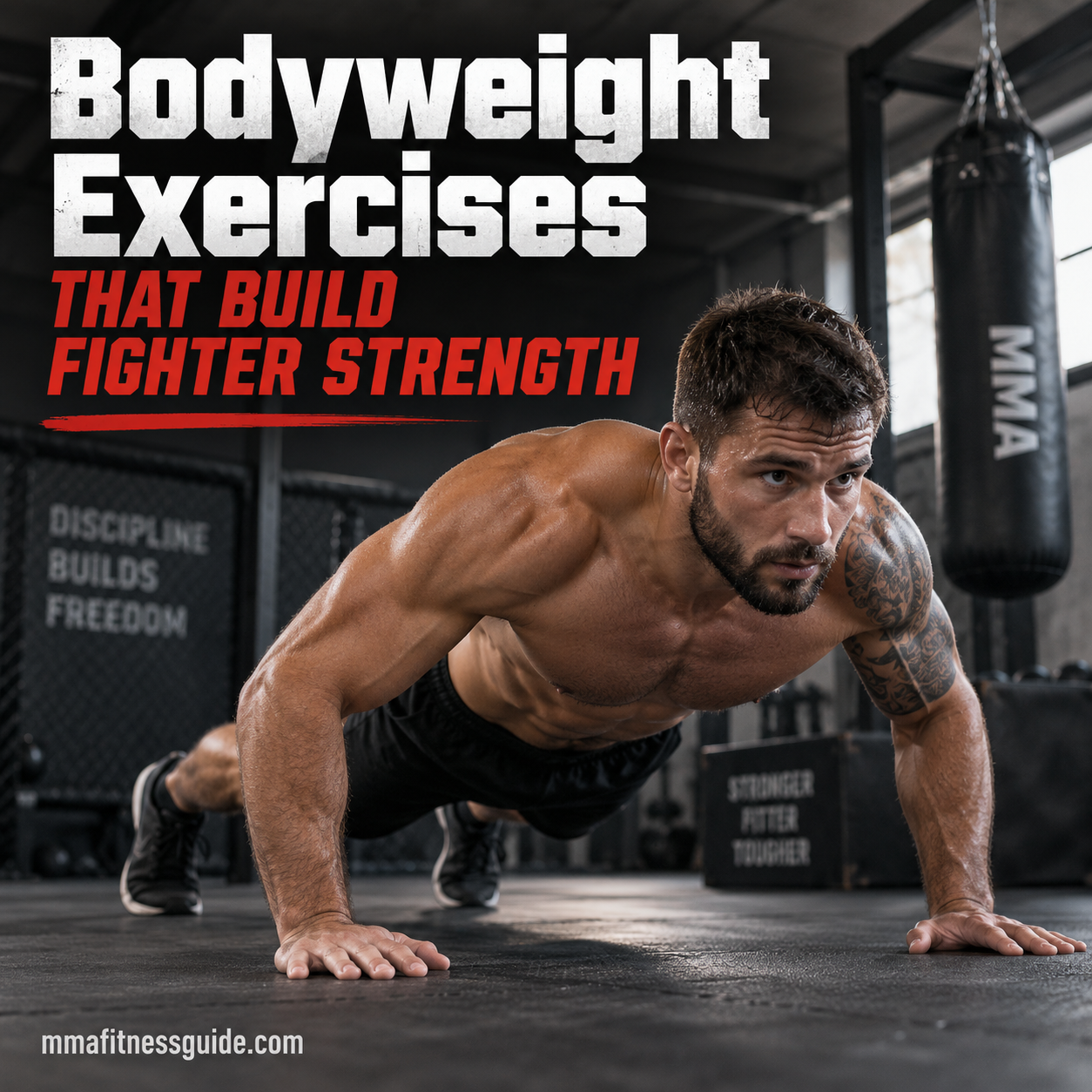
Building strength for mixed martial arts doesn’t require a fully equipped gym, expensive machines, or a room full of weights. Some of the most important physical qualities a fighter needs—balance, muscular endurance, coordination, and body control—can be developed through consistent bodyweight training.
Push-ups, pull-ups, squats, lunges, planks, and burpees provide a practical foundation for fighters who want to become stronger without relying entirely on traditional weightlifting.
However, fighter strength involves more than completing hundreds of repetitions. It requires the ability to produce force, maintain stable positions, resist fatigue, and control your body while an opponent is actively working against you.
A fighter needs strong legs to drive through takedowns, a stable core to transfer force during strikes, and upper-body strength to maintain control in the clinch. Bodyweight exercises can help develop these qualities when performed with proper technique and progressively increased difficulty.
This guide covers seven essential bodyweight exercises for MMA, explains how they contribute to fighting performance, and provides practical workout routines for beginners and experienced athletes.
Whether you’re training at home, supplementing martial arts classes, or building your fitness before joining an MMA gym, these exercises can form the foundation of an effective strength program.
Why Fighters Use Bodyweight Training
Bodyweight training uses your own body as resistance instead of relying primarily on barbells, dumbbells, or machines.
Unlike exercises that isolate individual muscles, many bodyweight movements require several muscle groups to work together while maintaining balance and controlling joint positions.
For example, a push-up trains the chest and triceps while requiring the abdominal muscles, glutes, and shoulders to stabilize the body. A single-leg squat challenges lower-body strength while demanding coordination and balance.
These qualities are valuable in MMA because fighting rarely involves producing force from a completely stable position.
Benefits of Bodyweight Training for MMA
Improved balance and coordination
Exercises such as lunges, single-leg squats, and dynamic planks challenge your ability to maintain control while moving. This can support the balance needed for kicking, changing direction, and defending takedowns.
Greater joint stability
Controlled movements strengthen muscles that support the shoulders, hips, knees, and ankles. Progressively developed strength and control may help reduce certain injury risks, although no exercise program can eliminate injuries.
Better muscular endurance
High-repetition push-ups, squats, and other exercises help muscles sustain repeated contractions. This becomes useful when maintaining a guard, hand fighting, or repeatedly changing positions.
Improved body awareness
Bodyweight exercises teach you to recognize when your hips are dropping, your knees are collapsing inward, or your shoulders are moving out of position.
Minimal equipment requirements
Most movements can be performed in a living room, garage, park, or hotel room. Pull-ups require a secure bar or another suitable setup, but the remaining exercises need little more than floor space.
Can Bodyweight Training Replace Weightlifting?
Bodyweight training can develop substantial strength, particularly for beginners. However, it isn’t automatically superior to weightlifting for building functional strength.
Both methods can improve athletic performance.
Heavy resistance training makes it easier to progressively increase external loads and develop maximal strength. Bodyweight training offers convenient ways to develop relative strength, movement control, and muscular endurance.
For MMA athletes, the two methods can complement each other.
A fighter might perform heavy squats to develop lower-body strength while using jump squats, lunges, and shadowboxing to practice producing force and maintaining control through athletic movements.
For additional exercises that combine different training methods, explore our guide to the top 10 strength workouts for MMA fighters .
1. Push-Ups — Upper Body Power
Push-ups are among the most accessible upper-body strength exercises for fighters.
They primarily strengthen the chest, shoulders, and triceps while requiring the core to stabilize the torso.
These muscles contribute to punching, framing against opponents, and maintaining upper-body control during grappling.
Although punching power depends heavily on technique, lower-body force production, and coordinated rotation, stronger pushing muscles can contribute to overall striking capacity.
How to Perform Push-Ups Correctly
- Begin in a high plank with your hands slightly wider than shoulder-width apart.
- Position your shoulders above your hands and extend your legs behind you.
- Tighten your abdominal muscles and glutes.
- Lower your chest toward the floor while keeping your elbows at a comfortable angle.
- Stop just above the ground or at the deepest position you can control.
- Push back to the starting position without allowing your hips to sag.
Keep your head aligned with your spine rather than looking excessively forward.
Push-Up Variations for Fighters
Knee push-ups: Reduce the resistance for beginners who cannot yet complete standard push-ups.
Diamond push-ups: Place your hands closer together to increase the emphasis on the triceps.
Clap push-ups: Push explosively enough for your hands to briefly leave the floor. These develop explosive upper-body force but should only be attempted after mastering standard push-ups.
Tempo push-ups: Lower yourself over three or four seconds before pressing upward. The slower movement increases time under tension.
Decline push-ups: Elevate your feet on a stable surface to change the loading and increase the challenge.
Recommended Sets and Repetitions
| Experience | Sets | Repetitions |
|---|---|---|
| Beginner | 2–3 | 5–10 |
| Intermediate | 3–4 | 10–20 |
| Advanced | 3–5 | 6–12 challenging reps |
Advanced athletes can use more difficult variations instead of continuously increasing repetitions.
Common mistake: Allowing the lower back to sag as fatigue increases. Stop the set when you can no longer maintain a stable torso.
2. Pull-Ups — Grip and Back Strength
Pull-ups strengthen the upper back, biceps, forearms, and gripping muscles.
These areas are particularly relevant to grappling, where fighters repeatedly pull opponents toward them, control wrists, and maintain upper-body connections.
A stronger back also contributes to posture and shoulder control.
Unlike most exercises in this guide, pull-ups require equipment. A properly installed pull-up bar or secure gym setup is essential.
How to Perform Pull-Ups Correctly
- Grip the bar with your hands approximately shoulder-width apart.
- Begin from a controlled hanging position.
- Engage your shoulders and abdominal muscles.
- Pull yourself upward until your chin reaches the bar.
- Lower yourself under control without swinging.
Avoid using momentum to complete repetitions unless you are deliberately practicing a separate, technically appropriate movement.
Pull-Up Progressions for Beginners
If you cannot perform a complete pull-up, begin with:
- Assisted pull-ups using a resistance band or machine.
- Negative pull-ups that emphasize a slow, controlled descent.
- Inverted rows using a properly secured bar.
- Controlled dead hangs to develop grip endurance.
For negative pull-ups, begin at the top position using a secure step and lower yourself over approximately three to five seconds.
Start with two or three repetitions per set.
Once you can complete several clean pull-ups, work toward three to four sets of six to ten repetitions.
Grip Variations
A standard overhand grip emphasizes traditional pull-up mechanics.
A neutral grip, with palms facing each other, may feel more comfortable for some athletes.
An underhand chin-up grip increases the contribution of the elbow flexors.
Varying grips can provide different training challenges, but use a range of motion that feels comfortable for your shoulders and elbows.
Fighter application: Pull-ups can strengthen muscles involved in pulling and gripping, but they do not replace practicing actual clinch positions, wrestling ties, or submission grips.
3. Squats — Foundation for Power
Strong legs are essential for nearly every major movement in MMA.
Fighters use their lower bodies to drive through takedowns, generate force during strikes, change levels, and maintain a stable stance.
Bodyweight squats strengthen the quadriceps and glutes while involving the hamstrings, calves, and trunk muscles.
They also provide an accessible way to practice controlled knee and hip movement.
How to Perform Bodyweight Squats
- Stand with your feet approximately shoulder-width apart.
- Turn your toes slightly outward if necessary for comfort.
- Brace your abdominal muscles.
- Bend your knees and hips while lowering your body.
- Descend until your thighs are approximately parallel to the ground, or to a comfortable depth you can control.
- Push through your whole foot to return to standing.
Keep your heels grounded and allow your knees to track naturally in the direction of your toes.
Squat Progressions
Standard squats: Build foundational strength and movement control.
Pulse squats: Use small, controlled movements near the bottom of the squat to increase muscular endurance.
Jump squats: Accelerate upward and leave the floor, landing softly with bent knees.
Single-leg squats: Increase the resistance on one leg while challenging balance.
Pistol squats: An advanced single-leg variation requiring substantial strength, mobility, and control.
How Squats Transfer to MMA
Consider a wrestling exchange.
Before attempting a takedown, a fighter often lowers their center of gravity by bending the hips and knees. They must then produce force through the legs while maintaining trunk stability.
Squats develop some of the physical capacities needed for these actions.
However, the exercise does not teach takedown timing, penetration steps, or positioning. Those skills require specific wrestling practice.
For explosive jump squats, begin with three sets of three to five repetitions and prioritize landing quality over fatigue.
4. Plank — Core Stability
Core strength is frequently associated with abdominal exercises, but fighters need more than visible abdominal muscles.
The core helps stabilize the spine, resist unwanted movement, and transfer force between the upper and lower body.
During striking, grappling, and defensive movements, a fighter must maintain trunk control while forces act from different directions.
The plank develops the ability to resist excessive spinal extension.
How to Perform a Proper Plank
- Place your forearms on the ground with your elbows beneath your shoulders.
- Extend your legs behind you.
- Maintain a straight line from your head to your heels.
- Tighten your abdominal muscles and glutes.
- Breathe steadily while maintaining the position.
Begin with 20–30 seconds.
Progress toward 30–60 seconds as your endurance improves.
Core Variations for Fighters
Side planks
Train lateral trunk stability and the muscles responsible for resisting sideways bending.
Plank shoulder taps
Shift your weight between your hands while attempting to minimize hip rotation.
Plank-to-push-ups
Alternate between forearm and high-plank positions while maintaining torso control.
Dead bugs
Develop trunk stability while moving the arms and legs independently.
Why Core Stability Matters in Fighting
Imagine throwing a cross.
Force begins at the ground, travels through the legs and hips, and is transferred through the torso toward the striking arm.
The core helps coordinate and transmit this force.
During grappling, trunk stability also supports posture when an opponent attempts to pull, push, or rotate your body.
For a more complete progression, read our guide to basic core training for stability and power .
5. Lunges — Mobility and Balance
Lunges train one leg at a time, making them useful for developing unilateral strength and coordination.
Unlike squats, where both legs share the load relatively evenly, lunges require each leg to control a greater proportion of your body weight.
This can help expose strength and balance differences between your left and right sides.
Lunges also move the hips and knees through a substantial range of motion, although improvements in flexibility depend on how the exercise is performed and progressed.
How to Perform Forward Lunges
- Stand upright with your feet approximately hip-width apart.
- Step forward with one leg.
- Lower your body by bending both knees.
- Aim for approximately 90-degree knee angles if comfortable.
- Keep your front foot planted and your knee tracking over your toes.
- Push through your front foot to return to standing.
Your front knee does not need to remain directly above your ankle throughout the movement. Allow it to travel naturally while maintaining control.
Lunge Variations
Reverse lunges: Step backward rather than forward. These may feel easier to control for beginners.
Walking lunges: Continue moving forward with alternating legs.
Lateral lunges: Step sideways to challenge the hips and legs in a different direction.
Jumping lunges: Switch legs in the air to increase the explosive demand.
Why Fighters Need Single-Leg Strength
Kicking temporarily places most of your body weight on one leg.
Changing direction during footwork also requires one leg to absorb force before pushing the body in another direction.
Single-leg strength and balance help support these movements.
Lunges are not a direct substitute for footwork drills, but they provide a useful physical foundation.
To develop these qualities further, explore how to improve balance and coordination for MMA .
6. Burpees — Total-Body Conditioning
Burpees combine repeated transitions between standing and floor positions with pushing, squatting, and jumping.
They challenge several muscle groups while rapidly increasing cardiovascular demand.
For fighters, burpees are useful because they require repeated whole-body effort under fatigue.
They can be included in conditioning circuits, warm-ups at a controlled pace, or short high-intensity intervals.
How to Perform Burpees
- Begin standing with your feet approximately shoulder-width apart.
- Bend your knees and hips, placing your hands on the floor.
- Jump or step your feet backward into a plank.
- Perform a push-up if using the full variation.
- Jump or step your feet forward.
- Stand up and perform a vertical jump.
Land softly before beginning the next repetition.
Beginner and Advanced Variations
Beginners can remove the push-up and jump, stepping their feet backward and forward instead.
Intermediate athletes can perform standard burpees with a push-up.
Advanced athletes can use explosive burpees or incorporate them into timed intervals.
Burpees and Fight Conditioning
A fight involves repeated bursts of activity, but its energy demands are more complex than simply performing continuous high-intensity exercise.
Burpees can improve general conditioning and the ability to sustain repeated effort. However, they cannot fully reproduce the resistance, technical decisions, and movement patterns involved in actual fighting.
For a conditioning session, try:
- 20 seconds of controlled burpees.
- 40 seconds of recovery.
- Repeat for 6–10 rounds.
Adjust the intensity to your current fitness level.
Avoid turning every workout into an exhausting burpee challenge. Excessive fatigue can interfere with technical MMA training and recovery.
7. Shadowboxing — Controlled Strength and Flow
Shadowboxing is primarily a technical and conditioning exercise rather than a maximal-strength movement.
However, it helps fighters practice coordinated movement while developing shoulder endurance, balance, and body awareness.
It also provides an opportunity to connect physical conditioning with actual fighting mechanics.
Unlike repetitive strength exercises, shadowboxing allows you to practice combinations, defensive movements, and footwork without an opponent.
How to Shadowbox Effectively
Begin in your fighting stance.
Keep your hands positioned appropriately for your style and maintain a comfortable bend in your knees.
Practice simple combinations:
- Jab–cross.
- Jab–cross–hook.
- Jab–cross followed by a defensive movement.
- Jab followed by a step backward or lateral movement.
Rotate through the hips and torso rather than relying entirely on your arms.
After throwing a combination, return to a balanced position.
Three Shadowboxing Rounds
Round 1: Technique
Move slowly and concentrate on clean punches, stance, and balance.
Round 2: Footwork
Add forward, backward, and lateral movement between combinations.
Round 3: Conditioning
Increase the pace while maintaining technique.
Beginners can start with two-minute rounds and one minute of rest.
More experienced athletes can gradually progress to longer rounds.
Avoid throwing every punch at maximum speed. Shadowboxing is most useful when movements remain controlled and technically purposeful.
Additional Bodyweight Exercises Fighters Should Consider
The original seven exercises provide a strong foundation, but a comprehensive routine should address additional movement patterns.
Glute Bridges
Glute bridges strengthen the hip extensors and help develop control through the pelvis.
Lie on your back with your knees bent and feet flat.
Push through your feet and lift your hips until your torso and thighs form a relatively straight line.
Pause briefly before lowering.
Perform three sets of 12–15 repetitions.
Bear Crawls
Bear crawls challenge shoulder stability, trunk control, and coordination.
Begin on your hands and knees, then lift your knees slightly off the floor.
Move one hand and the opposite foot forward while keeping your hips relatively stable.
Crawl for 15–30 seconds.
Mountain Climbers
Mountain climbers combine plank stability with repeated leg movement.
Start in a high plank and alternate bringing your knees toward your chest.
Maintain a stable torso rather than bouncing your hips excessively.
Use intervals of 20–40 seconds.
Single-Leg Calf Raises
Strong calves contribute to ankle control and repeated footwork.
Stand on one leg near a wall for balance.
Rise onto the ball of your foot, pause, and lower slowly.
Complete 10–20 repetitions per leg.
For additional movements that support athletic performance, see our guide to the top functional fitness exercises for combat sports .
Sample Bodyweight Workout for Beginners
This routine combines upper-body strength, lower-body development, core stability, and conditioning.
Begin with a five-minute warm-up consisting of light jogging in place, arm circles, hip movements, and controlled squats.
Beginner Workout
| Exercise | Duration / Reps | Sets |
|---|---|---|
| Jumping jacks | 1 minute | 1 |
| Push-ups | 10–15 reps | 3 |
| Squats | 15–20 reps | 3 |
| Plank | 30 seconds | 3 |
| Lunges | 10 per leg | 3 |
| Burpees | 8–10 reps | 2 |
| Shadowboxing | 2 minutes | 2 |
Perform the listed sets as a circuit, completing one set of each exercise before returning to the beginning. On the final circuit, skip exercises whose prescribed sets are already complete.
Rest approximately 30–60 seconds between exercises, extending recovery when necessary to maintain proper technique.
The table represents one complete workout. Do not multiply every listed set by another two or three circuits.
If the volume is too demanding, begin with one set of each movement and gradually build toward the full routine.
Train two or three times per week on nonconsecutive days.
Advanced Bodyweight Workout for MMA Fighters
Once basic movements become manageable, increase difficulty through more challenging exercise variations rather than simply adding repetitions indefinitely.
| Exercise | Sets | Reps / Duration |
|---|---|---|
| Explosive push-ups | 3 | 5–8 |
| Pull-ups | 4 | 6–10 |
| Jump squats | 3 | 5 |
| Walking lunges | 3 | 12 per leg |
| Plank shoulder taps | 3 | 20 total |
| Burpees | 3 | 10 |
| Shadowboxing | 3 | 3 minutes |
Rest approximately 60–120 seconds between demanding strength sets.
Keep explosive exercises early in the session when fatigue is relatively low.
This routine is appropriate only when you can perform the underlying movements safely and consistently.
For a broader session combining multiple physical qualities, explore the ultimate full-body fighter workout .
How to Progress Without Adding Weights
One of the biggest challenges with bodyweight training is maintaining progressive overload.
Progressive overload means gradually increasing the demands placed on your muscles so they continue adapting.
Simply repeating the same 15 push-ups every workout will eventually provide less of a strength-building stimulus.
There are several ways to progress.
Increase Repetitions
If you can complete three sets of eight push-ups with proper technique, gradually work toward three sets of twelve.
Use Harder Variations
Progress from knee push-ups to standard push-ups, then to decline or other challenging variations.
Increase Range of Motion
When appropriate, perform exercises through a greater controlled range of motion.
Adjust Tempo
Slower lowering phases increase the difficulty of an exercise without requiring additional equipment.
Train One Side at a Time
Single-leg squats, split squats, and unilateral variations increase the challenge for individual limbs.
Track Your Performance
Record your sets, repetitions, exercise variations, and perceived difficulty.
Aim for measurable improvements over several weeks rather than trying to set a personal record every session.
How Often Should MMA Fighters Do Bodyweight Workouts?
Training frequency depends on experience, recovery, and the amount of martial arts practice already included in your schedule.
A beginner attending two MMA classes per week may benefit from two additional strength sessions.
An experienced fighter training multiple times per day will need to coordinate strength work carefully to avoid excessive fatigue.
A practical beginner schedule might look like this:
| Day | Training |
|---|---|
| Monday | Bodyweight strength |
| Tuesday | MMA technique |
| Wednesday | Rest or light mobility |
| Thursday | Bodyweight strength |
| Friday | MMA technique |
| Saturday | Light conditioning or recovery |
| Sunday | Rest |
Allow sufficient recovery between demanding sessions that train the same muscle groups.
For a structured starting point, read our weekly workout plan for absolute beginners .
Bodyweight Strength vs. Fighter Conditioning: Know the Difference
Strength and conditioning are related, but they are not identical.
Strength training develops your ability to produce force.
Muscular endurance training improves your ability to sustain repeated contractions.
Cardiovascular conditioning develops the systems responsible for delivering energy and supporting repeated activity.
A difficult set of pull-ups may emphasize strength, while several minutes of burpees primarily challenge conditioning.
MMA requires all these qualities.
A fighter preparing for longer bouts needs sufficient endurance to maintain physical output across multiple rounds.
However, performing exhausting circuits every day is not necessarily the most effective approach.
A balanced program includes strength sessions, aerobic conditioning, appropriately dosed high-intensity intervals, technical training, and recovery.
For more specific endurance development, read how to build endurance for five-round fights .
You can also explore our best at-home MMA conditioning routines for additional workouts requiring minimal equipment.
Common Bodyweight Training Mistakes Fighters Should Avoid
Prioritizing Repetitions Over Technique
Completing 50 poorly executed push-ups is not automatically more productive than completing 15 controlled repetitions.
Use a range of motion and repetition count that allows you to maintain proper technique.
Training to Failure Every Session
Occasionally approaching muscular failure can be useful, but doing so during every set may create unnecessary fatigue.
This is especially important when strength workouts are combined with sparring, wrestling, or other demanding sessions.
Ignoring Pulling Exercises
Push-ups and burpees are convenient, but a routine dominated by pushing movements neglects important upper-back and pulling strength.
Include pull-ups or rows whenever suitable equipment is available.
Neglecting Recovery
Strength improvements occur through the combination of training and recovery.
Adequate sleep, nutrition, and rest between demanding sessions help support adaptation.
Confusing Fatigue With Progress
Finishing a workout completely exhausted does not guarantee improved strength or fighting performance.
Track measurable improvements such as cleaner repetitions, more difficult exercise variations, better movement control, and improved recovery between sets.
Key Tips for Building Fighter Strength
The most effective bodyweight program is one you can perform consistently while continuing to improve.
Focus on the following principles:
- Prioritize form before speed. Learn each movement before introducing explosive variations.
- Breathe rhythmically. Exhale during demanding portions of an exercise rather than holding your breath unnecessarily.
- Increase difficulty gradually. Add repetitions, sets, or harder variations as your ability improves.
- Train your entire body. Include pushing, pulling, squatting, lunging, and core exercises.
- Maintain consistency. Two productive workouts every week are more useful than an exhausting session followed by several weeks of inactivity.
- Respect recovery. Reduce training volume when soreness or fatigue begins interfering with technique.
If an exercise produces sharp pain, stop and reassess the movement rather than forcing additional repetitions.
Frequently Asked Questions About Bodyweight Training for MMA
Can you build fighter strength using only bodyweight exercises?
Yes. Bodyweight training can improve strength, muscular endurance, balance, and coordination, particularly for beginners.
Advanced athletes may eventually benefit from additional resistance to continue developing maximal strength.
How many push-ups should an MMA fighter be able to do?
There is no universal push-up requirement for MMA fighters.
Performance depends on body weight, training history, technique, and individual goals.
Focus on improving your own controlled repetitions rather than chasing an arbitrary number.
Are burpees enough for MMA conditioning?
No. Burpees provide a useful conditioning stimulus, but MMA requires aerobic endurance, repeated high-intensity effort, technical efficiency, and sport-specific practice.
Use burpees as one component of a broader conditioning program.
Should fighters perform bodyweight exercises every day?
Light mobility and easy movement can often be performed frequently, but demanding strength sessions require recovery.
Most beginners can start with two or three full-body sessions per week.
Can bodyweight exercises improve punching power?
They can strengthen muscles involved in striking and improve aspects of force production and body control.
However, punching power also depends on technique, timing, coordination, and lower-body mechanics. Strength training should complement regular striking practice.
Final Thoughts: Build Strength That Supports Your Fighting
You don’t need an expensive gym membership to begin developing the physical qualities required for MMA.
Push-ups strengthen the upper body. Pull-ups develop the back and grip. Squats and lunges build lower-body strength, while planks improve trunk stability. Burpees challenge conditioning, and shadowboxing connects movement practice with fighting technique.
The key is to approach these exercises as a structured training program rather than a random collection of repetitions.
Start with movements you can perform correctly, increase the difficulty over time, and balance your workouts with technical MMA training and sufficient recovery.
Bodyweight training won’t replace the skills learned through striking, wrestling, and grappling practice, but it can provide a valuable strength foundation that supports those skills.
Build control first, develop strength progressively, and make every repetition count.
Continue Building Your MMA Fitness Foundation
Bodyweight strength is one part of a complete fighter training program. These related guides will help you develop other essential physical qualities:
- Top 10 Strength Workouts for MMA Fighters — Explore additional strength-building exercises and training methods.
- Best At-Home MMA Conditioning Routines — Build conditioning without relying on a commercial gym.
- Basic Core Training for Stability and Power — Develop trunk strength and stability for striking and grappling.
- The Ultimate Full-Body Fighter Workout — Combine multiple training movements into a complete workout.
These guides provide practical next steps for building a balanced MMA fitness routine.