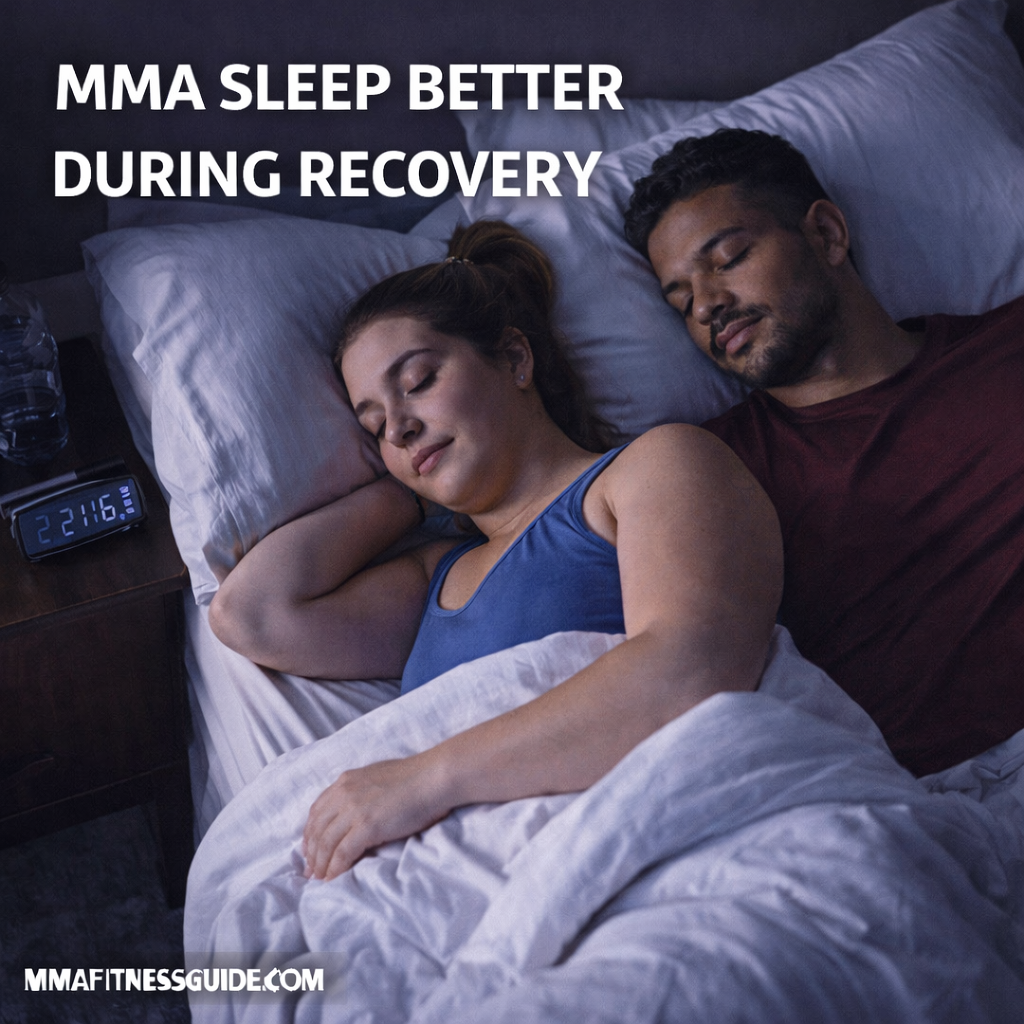
Sleep does more for recovery than almost anything else available to MMA athletes, yet it’s often the first thing sacrificed when training schedules get demanding.
Between striking sessions, wrestling practice, strength training, conditioning, and everyday responsibilities, fighters frequently struggle to get enough rest. Evening sparring can leave you physically exhausted but mentally alert. Sore muscles make it difficult to find a comfortable sleeping position, while thoughts about training mistakes or upcoming competitions can keep your mind active long after you leave the gym.
These problems matter because recovery does not end when training stops.
Sleep supports muscle repair, nervous system function, immune health, hormone regulation, and the consolidation of newly learned skills. When sleep is consistently inadequate, fighters may experience slower reactions, reduced concentration, greater fatigue, and difficulty maintaining training performance.
Improving sleep is not simply about going to bed earlier. It requires managing training intensity, establishing effective nighttime routines, addressing discomfort, and creating an environment that supports uninterrupted rest.
This guide explains how MMA fighters can improve sleep quality, recover more effectively from demanding sessions, and build sustainable habits that support long-term performance.
Why Sleep Matters More Than Any Recovery Tool
MMA athletes have access to numerous recovery methods, including massage, foam rolling, stretching, cold-water immersion, and nutritional supplements.
These tools may have specific benefits, but none can replace the broad physiological functions of adequate sleep.
During sleep, the body coordinates processes involved in tissue maintenance, metabolic regulation, immune function, and neurological recovery.
Muscle repair and adaptation
Hard training creates mechanical stress and microscopic disruption within muscle tissue.
The body responds through processes that repair and remodel tissue, allowing muscles to adapt to training demands.
Sleep supports these processes by providing an important period for normal physiological regulation.
However, muscle repair does not occur exclusively during sleep. It continues throughout the day and depends on appropriate nutrition, training loads, and recovery time.
Consistently inadequate sleep can interfere with the conditions needed for optimal adaptation.
Hormonal regulation
Sleep is associated with the regulation of several hormones involved in recovery and metabolism.
Growth hormone secretion is closely linked with sleep, particularly during early periods of slow-wave sleep.
Sleep restriction can also influence cortisol regulation, appetite-related hormones, and other endocrine processes.
For fighters, this means that regularly sacrificing sleep may interfere with recovery and energy regulation.
A single poor night does not automatically cause a major hormonal imbalance, but chronic sleep restriction is a concern.
Nervous system recovery
MMA places substantial demands on the nervous system.
Fighters must react to unpredictable movements, coordinate complex techniques, and make rapid decisions while physically fatigued.
Sleep supports the neurological functions involved in attention, reaction time, motor control, and learning.
Poor sleep can make these tasks more difficult, particularly during demanding training sessions.
Memory and skill consolidation
Learning a new submission sequence or correcting a striking combination requires more than repetition.
The brain must process and retain information acquired during practice.
Sleep contributes to memory consolidation, including aspects of motor learning.
A fighter who practices a technique and then sleeps adequately may be better positioned to retain that learning than someone who repeatedly sacrifices sleep.
The relationship is complex, and sleep alone cannot replace quality coaching or deliberate practice.
How much sleep do MMA fighters need?
Most adults should regularly obtain at least seven hours of sleep, with seven to nine hours commonly recommended.
Athletes undergoing demanding training may benefit from additional sleep depending on their workload and individual needs.
Eight to nine hours is a reasonable planning target for many fighters, although requirements vary.
The important measures are whether you consistently obtain sufficient sleep, feel reasonably refreshed, and maintain normal daytime functioning.
How MMA Training Disrupts Sleep
Combat sports create several sleep challenges that are less common in ordinary recreational exercise.
Understanding the specific causes makes it easier to develop practical solutions.
Elevated arousal after sparring
During hard sparring, your body responds to intense physical effort and perceived threats.
Heart rate increases, breathing accelerates, and the sympathetic nervous system becomes more active.
Once training ends, these responses gradually decrease.
However, some fighters remain mentally stimulated for hours.
You might finish training at 9 p.m. but still feel alert at 11 p.m.
This does not necessarily mean something is wrong. Your body may simply need time to transition from intense activity toward rest.
Late-night training schedules
Many MMA gyms schedule advanced classes in the evening because athletes work during the day.
A typical schedule might involve:
- Wrestling from 6:30 to 7:30 p.m.
- Striking from 7:30 to 8:30 p.m.
- Sparring until 9 p.m.
- Driving home, showering, and eating afterward.
By the time you finish everything, your intended bedtime may have passed.
The problem becomes more significant when you must wake up early for work or another training session.
Mental replay of training
Fighters often analyze their performance after sparring.
You may replay a takedown you failed to defend, a submission opportunity you missed, or a combination that repeatedly caught you.
Some reflection is useful for learning.
However, repeatedly analyzing mistakes while trying to fall asleep can increase mental arousal.
A better approach is to record a few training notes earlier in the evening and leave detailed analysis for the next day.
Soreness and discomfort
Heavy grappling can leave your neck, shoulders, hips, and back uncomfortable.
Leg kicks may make it difficult to lie on one side, while an irritated shoulder can limit your preferred sleeping position.
Discomfort may delay sleep onset or cause repeated awakenings.
The solution is not always another recovery treatment. Sometimes it involves modifying training, adjusting your sleeping position, or seeking appropriate medical assessment.
The Connection Between Sleep and Injury Risk
Sleep and injury risk are closely related, although the relationship is not determined by sleep alone.
Research in athletic populations has associated inadequate sleep with increased injury risk in some settings. The strength of this association varies by sport, age, training exposure, and study design.
For MMA fighters, several plausible mechanisms deserve attention.
Slower reaction times
Defending strikes and takedowns requires rapid responses.
Sleep deprivation can impair reaction time and vigilance.
A fatigued fighter may recognize an incoming attack later than usual or struggle to maintain concentration throughout a round.
Reduced coordination
Complex movements become more difficult when fatigue affects motor control.
This can influence footwork, balance, defensive positioning, and technical execution.
A tired athlete may also make more errors during strength training or conditioning.
Impaired decision-making
Sleep restriction can affect attention and judgment.
In MMA, this may mean choosing an inappropriate response during a scramble or continuing a demanding drill when technique has deteriorated.
Changes in pain perception
Insufficient sleep can increase pain sensitivity in some individuals.
Normal post-training soreness may feel more uncomfortable after a poor night.
However, reduced sleep does not automatically mean an injury will occur, and sleeping adequately cannot eliminate the inherent risks of combat sports.
Appropriate coaching, protective equipment, training progression, and workload management remain essential.
For a closer look at the psychological effects of sleep, read our guide to sleep and mood: the performance connection .
Establish a Post-Training Wind-Down Routine
One of the most effective ways to improve sleep after evening MMA training is to establish a repeatable wind-down routine.
The objective is to create a gradual transition between demanding exercise and bedtime.
You do not need an elaborate routine involving expensive recovery equipment.
A simple sequence can work well.
Step 1: Complete a gradual cooldown
After training, spend several minutes walking or performing comfortable, low-intensity movement.
Allow your breathing and heart rate to settle naturally.
Avoid immediately transitioning from maximal effort into prolonged breath-holding exercises.
Step 2: Perform gentle mobility
Choose movements that address areas feeling stiff without creating additional fatigue.
For example:
- Gentle shoulder circles.
- Comfortable hip mobility.
- Easy spinal movements.
- Light calf stretching.
Five minutes is sufficient for a basic routine.
Avoid aggressive stretching over an injured area.
Step 3: Shower and change clothes
A comfortable shower can help establish a transition away from training.
Some people find a warm shower relaxing.
Avoid extremely hot water if you are already overheated or dehydrated.
Step 4: Eat and rehydrate
Complete your post-training nutrition without unnecessarily delaying bedtime.
The meal should support recovery while remaining comfortable to digest.
Step 5: Reduce stimulation
Dim unnecessary lights, put away training footage, and avoid starting stressful activities immediately before bed.
Use the same general sequence after evening sessions whenever possible.
Consistency helps establish a predictable bedtime routine.
Breathing to Calm the Nervous System
Controlled breathing is a practical addition to a nighttime recovery routine.
Slow, comfortable breathing may reduce physiological arousal and help some athletes feel more relaxed.
It is particularly useful when you feel mentally alert despite being physically tired.
A simple bedtime breathing exercise
Lie comfortably on your back or side.
Follow this sequence:
- Inhale gently through your nose for four seconds.
- Exhale slowly for approximately six seconds.
- Relax your shoulders and jaw.
- Continue for three to five minutes.
Do not force your lungs to fill completely or empty them aggressively.
If the timing feels uncomfortable, shorten the breaths.
The objective is comfortable relaxation rather than achieving a specific breathing rate.
Why longer exhales may help
Slow breathing can influence autonomic regulation and may encourage parasympathetic activity.
Some individuals find that slightly extending the exhale makes relaxation easier.
However, breathing exercises do not guarantee faster sleep onset or deeper sleep.
Their effectiveness varies between individuals.
If counting breaths makes you more alert, simply focus on breathing naturally and releasing unnecessary muscle tension.
Our guide to breathing and relaxation for faster healing explains additional techniques, including diaphragmatic breathing, body scanning, and relaxation during rehabilitation.
Managing Late-Night Training Sessions
Evening training is unavoidable for many fighters.
The goal is not necessarily to eliminate late sessions but to reduce their impact on sleep.
Review your training schedule
If you repeatedly finish intense sparring shortly before bedtime, consider whether some sessions can be moved earlier.
When scheduling flexibility is limited, avoid stacking additional conditioning after an already demanding evening practice.
Be careful with caffeine
Caffeine can improve alertness and exercise performance, but its effects may persist for several hours.
A pre-workout supplement taken at 6 p.m. may still interfere with sleep later that night.
Individual caffeine sensitivity varies considerably.
If you struggle to sleep, experiment with moving caffeine intake earlier or avoiding it during evening sessions.
Check supplement labels carefully because some products contain substantial caffeine.
Avoid unnecessary mental stimulation
After training, resist the urge to immediately review every sparring exchange.
Write down two or three useful observations if needed.
For example:
“Improve underhook positioning.”
“Work on defending the jab.”
“Ask coach about the failed takedown entry.”
Save detailed analysis for the next day.
Protect your sleep opportunity
If you regularly train until 9 p.m. and must wake at 5 a.m., obtaining sufficient sleep may be difficult regardless of your bedtime routine.
This is a scheduling problem, not simply a relaxation problem.
Consider adjusting session frequency, training times, or other commitments where possible.
Learning to balance these demands is an important part of finding balance between training and rest .
Nutrition Choices That Support Better Sleep
Nutrition affects both recovery and sleep comfort.
Fighters need enough energy to support training, maintain normal physiological function, and repair damaged tissue.
Consistently underfueling can contribute to fatigue, poor recovery, and other health problems.
Include adequate protein
Protein provides amino acids needed for muscle repair and adaptation.
A post-training meal might include:
- Chicken with rice and vegetables.
- Eggs with toast and fruit.
- Greek yogurt with oats.
- Tofu with potatoes and vegetables.
The exact amount depends on your body size, total daily intake, and training goals.
Overall daily protein intake matters more than consuming a specific food immediately before bed.
Do not neglect carbohydrates
MMA training can substantially deplete muscle glycogen.
Carbohydrates help replenish these energy stores.
After evening training, a meal containing rice, potatoes, pasta, oats, or fruit can support recovery.
Some research suggests that meal composition and timing may influence sleep, but there is no universally effective carbohydrate prescription for improving sleep.
Choose foods that meet your nutritional needs and digest comfortably.
Avoid extremely heavy meals
Large, high-fat meals immediately before bed may cause digestive discomfort in some people.
However, skipping dinner after hard training is not necessarily a better solution.
A moderate, balanced meal is often more practical.
If you experience reflux, consider adjusting meal size and timing.
Avoid aggressive weight-cutting practices
Severe calorie restriction and dehydration can disrupt recovery and may create serious health risks.
Rapid weight cutting is particularly concerning in combat sports.
Do not sacrifice hydration or nutrition simply to improve the number on the scale.
Weight management should be planned appropriately, ideally with qualified sports nutrition and medical support.
Hydration Without Nighttime Disruption
Hydration supports normal physiological function and exercise recovery.
However, drinking large amounts of fluid immediately before bed can lead to repeated bathroom trips.
The solution is to distribute fluid intake appropriately throughout the day.
Hydrate before training
Begin sessions reasonably hydrated rather than attempting to compensate afterward.
Replace training-related fluid losses
Sweat losses vary according to exercise intensity, temperature, clothing, and individual physiology.
Long or particularly sweaty sessions may require sodium replacement alongside fluids.
Avoid excessive fluid intake at bedtime
If possible, replace most training-related losses during and shortly after exercise.
Drink according to your needs rather than forcing large quantities immediately before sleep.
Do not deliberately restrict necessary fluids after significant sweating simply to avoid nighttime urination.
Persistent excessive thirst, frequent urination, or symptoms of dehydration warrant medical attention.
Creating a Fighter-Friendly Sleep Environment
Your bedroom should make sleeping easier rather than introducing additional distractions.
Three environmental factors deserve particular attention: temperature, light, and noise.
Keep the room comfortably cool
Body temperature normally changes as part of the sleep process.
A bedroom that feels excessively hot may make sleep more difficult.
Use ventilation, air conditioning, or appropriate bedding to maintain a comfortable temperature.
There is no single perfect temperature for every athlete.
Reduce light exposure
Streetlights, hallway lighting, and bright electronic devices can interfere with a dark sleeping environment.
Consider blackout curtains or a comfortable sleep mask if outside light is difficult to control.
Control noise
Traffic, roommates, and household activity can interrupt sleep.
Earplugs or consistent background noise may help some individuals.
Choose a solution that remains comfortable and does not interfere with important alarms or safety needs.
Select comfortable bedding
A supportive mattress and appropriate pillows can improve comfort.
For fighters with sore shoulders or hips, pillow positioning may reduce pressure on sensitive areas.
There is no universally superior mattress for athletic recovery.
Comfort and individual needs matter more than marketing claims.
Managing Soreness and Discomfort at Night
MMA athletes frequently experience soreness after demanding sessions.
Mild muscle soreness can be a normal response to unfamiliar or intense exercise.
However, persistent pain, swelling, instability, or worsening symptoms should not automatically be dismissed as ordinary soreness.
Use gentle movement
A few minutes of comfortable mobility may help reduce perceived stiffness.
Avoid aggressive stretching immediately before bed, especially if an area is injured.
Consider a warm shower
Warm water may help some athletes feel more comfortable and relaxed.
Avoid excessive heat over an acutely swollen injury unless advised by a healthcare professional.
Adjust sleeping positions
If your shoulder is uncomfortable, try supporting the arm with a pillow.
If your lower back feels stiff, experiment with a pillow beneath your knees while lying on your back or between your knees while lying on your side.
Choose positions that do not aggravate symptoms.
Know when soreness needs assessment
Seek medical advice for significant swelling, severe pain, loss of function, numbness, or symptoms that progressively worsen.
If you suspect a concussion following sparring, stop contact training and obtain appropriate medical assessment.
Do not use sleep or pain medication to conceal symptoms and continue training without professional guidance.
Screen Time and Mental Stimulation
Phones and computers can interfere with sleep through several mechanisms.
Bright light may affect circadian signaling, while engaging content can increase mental alertness.
For fighters, the content itself is often the bigger issue.
Watching intense fight footage, arguing online, or analyzing sparring mistakes may keep your mind active.
Create a screen-free window
Try putting away unnecessary devices 30–60 minutes before bed.
This is a practical experiment rather than a universal requirement.
If you need your phone for essential communication, reduce brightness and avoid stimulating activities.
Separate technical analysis from bedtime
Review fight footage earlier in the day when possible.
Use the final portion of your evening for quieter activities.
Avoid endless scrolling
Social media can make it difficult to maintain a consistent bedtime.
Set a stopping point rather than relying on feeling tired enough to put the phone down.
For more strategies, see our guide to managing screen time for better recovery .
Sleep Consistency Over Perfection
A single excellent night cannot completely compensate for weeks of insufficient sleep.
Likewise, one poor night does not automatically ruin your recovery.
Long-term patterns matter.
Maintain a consistent wake time
Try to wake at approximately the same time each day.
This helps stabilize your sleep schedule.
Some flexibility is reasonable, particularly after travel or unusual training demands.
Establish a realistic bedtime
Work backward from your required wake time.
If you need to wake at 6 a.m. and want eight hours of sleep, you need to be asleep around 10 p.m.
Allow additional time for winding down and falling asleep.
Avoid chasing perfect sleep scores
Wearable devices can provide useful estimates of sleep patterns, but their sleep-stage measurements are not equivalent to clinical sleep testing.
Do not become overly concerned about individual nightly scores.
Focus on sleep duration, consistency, daytime functioning, and longer-term trends.
Naps and MMA Recovery
Napping can be useful when training demands are high or nighttime sleep has been insufficient.
A short nap may improve alertness and reduce perceived fatigue.
Keep naps relatively short
Approximately 20–30 minutes is a practical starting point.
Short naps may reduce the likelihood of waking with prolonged grogginess.
Longer naps can be useful in some circumstances but may produce sleep inertia.
Nap earlier when possible
Early-afternoon naps are generally less likely to interfere with nighttime sleep than late-evening naps.
Individual responses vary.
Do not replace nighttime sleep
Naps can supplement recovery but should not become a routine substitute for adequate overnight sleep.
If you repeatedly need long naps simply to function, examine your overall sleep schedule.
Signs You’re Not Sleeping Enough
Sleep deficiency does not always appear as obvious daytime sleepiness.
Some fighters continue training while gradually accumulating fatigue.
Warning signs may include:
- Persistent soreness that seems disproportionate to training.
- Irritability or reduced motivation.
- Difficulty concentrating during instruction.
- Declining technical performance.
- Unusual daytime sleepiness.
- Increased reliance on caffeine.
- Difficulty waking despite adequate time in bed.
These symptoms are not specific to sleep deprivation.
They may also reflect excessive training loads, inadequate nutrition, illness, psychological stress, or other medical conditions.
If several symptoms persist, review your training and recovery habits rather than assuming you simply need more discipline.
Our article on signs you’re overtraining and how to fix it explains additional warning signs and workload considerations.
Adjusting Training When Sleep Is Poor
Fighters often feel pressure to complete every scheduled session regardless of fatigue.
However, training quality and safety can deteriorate when sleep is severely restricted.
A sensible adjustment depends on how poorly you slept, how you feel, and what the session requires.
After one mildly disrupted night
You may be able to complete a normal session if you feel alert and coordinated.
Monitor your performance and avoid adding unnecessary training volume.
After a very poor night
Consider replacing maximal conditioning or hard sparring with lower-intensity technical practice.
Choose activities that do not require repeated high-risk exchanges.
After several consecutive poor nights
Reduce training demands and prioritize restoring adequate sleep.
Persistent fatigue may require broader changes to your schedule.
Avoid using large quantities of caffeine to repeatedly push through sleep deprivation.
For additional guidance, explore balancing intensity with recovery mentally .
Sleep During Injury Rehabilitation
Sleep becomes especially important when an athlete is recovering from injury.
Normal tissue repair, immune function, and pain regulation all depend on physiological processes influenced by sleep.
However, adequate sleep does not guarantee faster healing or replace appropriate rehabilitation.
Support normal tissue repair
Injured tissues require sufficient energy, nutrients, and time to recover.
Sleep supports the broader physiological environment involved in these processes.
The rate of healing still depends heavily on injury type, severity, treatment, and appropriate loading.
Improve pain management
Poor sleep can increase pain sensitivity.
This may make rehabilitation exercises feel more uncomfortable and interfere with daily functioning.
Improving sleep may help some athletes manage discomfort, although it does not eliminate the underlying injury.
Maintain psychological resilience
Injury can disrupt an athlete’s identity and routine.
Being unable to spar, wrestle, or compete may create frustration and anxiety.
Adequate sleep supports emotional regulation and may make these challenges easier to manage.
Follow rehabilitation restrictions
Do not interpret improved sleep or reduced pain as proof that an injury has healed.
Return-to-training decisions should be based on appropriate clinical assessment and functional progress.
Long-Term Sleep Habits for MMA Longevity
Sustainable MMA training requires more than surviving individual workouts.
It involves managing the cumulative demands of months and years of practice.
Sleep should be treated as a regular component of training planning.
Respect recovery days
Rest days provide opportunities to reduce accumulated fatigue.
They are not necessarily days when you must remain completely inactive.
Light movement may be appropriate depending on your condition.
Learn more about why recovery days boost performance .
Avoid chronic sleep restriction
Repeatedly sacrificing sleep to fit in additional sessions may undermine the benefits of training.
When your schedule becomes crowded, reducing unnecessary training volume may be more productive than consistently shortening your sleep opportunity.
Review your schedule regularly
Every few weeks, ask yourself:
- Am I consistently obtaining enough sleep?
- Do I wake feeling reasonably refreshed?
- Is my training performance stable?
- Am I experiencing persistent fatigue?
- Does my current schedule allow adequate recovery?
These questions can help identify problems before they become more disruptive.
Build recovery habits early
Beginners often experience substantial soreness and fatigue during their first weeks of MMA.
Establishing appropriate sleep habits from the beginning can make the transition easier.
Our guide on how to recover after your first week of MMA training provides additional advice for new athletes.
When Should Fighters Seek Professional Help for Sleep Problems?
Not every sleep problem can be solved through better habits.
Persistent insomnia, excessive daytime sleepiness, or breathing problems during sleep may require medical evaluation.
Speak with a healthcare professional if you experience:
- Difficulty falling or staying asleep several nights per week.
- Loud snoring accompanied by gasping or witnessed breathing pauses.
- Significant daytime sleepiness despite adequate time in bed.
- Persistent sleep problems following a head injury.
- Sleep difficulties that interfere with work, training, or daily functioning.
Sleep apnea and other sleep disorders can affect otherwise fit athletes.
For chronic insomnia, cognitive behavioral therapy for insomnia (CBT-I) is generally recommended as a first-line treatment.
Avoid relying on alcohol, sedatives, or unverified sleep supplements to manage persistent problems.
Frequently Asked Questions About MMA Sleep and Recovery
Is eight hours of sleep enough for MMA fighters?
Eight hours is a reasonable target for many adult athletes.
However, individual requirements vary.
Some fighters may benefit from nine hours or more during demanding training periods.
Pay attention to consistent sleep duration and daytime functioning rather than assuming one number works for everyone.
Is it bad to train MMA right before bed?
Evening exercise does not automatically disrupt sleep.
However, intense sessions ending close to bedtime may interfere with sleep for some individuals.
Training intensity, timing, caffeine intake, and personal sensitivity all matter.
Experiment with your schedule and monitor how you respond.
Can sleeping more reduce muscle soreness?
Adequate sleep supports normal recovery and may influence pain perception.
However, extra sleep does not guarantee that soreness will disappear more quickly.
Training progression, nutrition, and sufficient recovery time remain important.
Should fighters take melatonin?
Melatonin may be useful for certain circadian rhythm problems, such as jet lag, but it is not a universal solution for poor sleep.
Supplement quality, dosage, timing, and individual medical circumstances matter.
Consult a healthcare professional before using sleep supplements, particularly if you take medication or compete under supplement-testing requirements.
Can poor sleep cause overtraining?
Insufficient sleep can contribute to inadequate recovery and may worsen fatigue associated with excessive training loads.
However, overtraining syndrome is complex and cannot be diagnosed from sleep duration alone.
Persistent performance decline requires a broader assessment.
Is it better to sleep longer or wake up early for extra cardio?
If an additional cardio session would repeatedly reduce your sleep below your needs, reconsider the schedule.
Adequate sleep supports the adaptations you are trying to achieve through training.
The appropriate balance depends on your current workload, conditioning goals, and available recovery time.
Final Thoughts
Sleeping better during MMA recovery is not about creating a perfect nighttime routine. It is about giving your body enough time and the right conditions to recover from demanding physical and mental work.
Start with the fundamentals: maintain a consistent sleep schedule, allow sufficient time in bed, manage late-night training intensity, and avoid unnecessary stimulants before bedtime.
Use a short cooldown after evening sessions, eat enough to support recovery, and create a bedroom that is dark, quiet, and comfortable.
When sleep becomes consistently inadequate, adjust your training rather than attempting to compensate indefinitely with caffeine or additional recovery treatments.
Breathing exercises, stretching, and other relaxation techniques can help, but they cannot replace sufficient sleep or appropriate medical care.
For fighters managing injuries, adequate sleep supports normal healing processes and pain regulation, while rehabilitation and return-to-training decisions must still follow appropriate clinical guidance.
Better sleep supports better recovery. Better recovery helps you train more consistently, maintain technical quality, and build a more sustainable relationship with MMA.
Related MMA Recovery Guides
Improving sleep is one part of a complete recovery strategy. These related MMA Fitness Guide articles explore the physical and mental habits that support consistent training.
- Sleep and Mood: The Performance Connection — Understand how sleep affects emotional regulation, concentration, and athletic performance.
- Managing Screen Time for Better Recovery — Reduce digital distractions and build healthier nighttime habits.
- Finding Balance Between Training and Rest — Organize your schedule around sustainable training and recovery.
- Why Recovery Days Boost Performance — Learn why appropriate rest is an important part of athletic adaptation.
- MMA: Recover After Your First Week of Training — Develop recovery habits that make beginning MMA more manageable.
- Signs You’re Overtraining and How to Fix It — Recognize persistent fatigue and other signs that your workload may need adjustment.
- Breathing and Relaxation for Faster Healing — Explore breathing and relaxation methods that support recovery and stress management.
- Balancing Intensity With Recovery Mentally — Manage the psychological demands of training while maintaining a sustainable recovery routine.