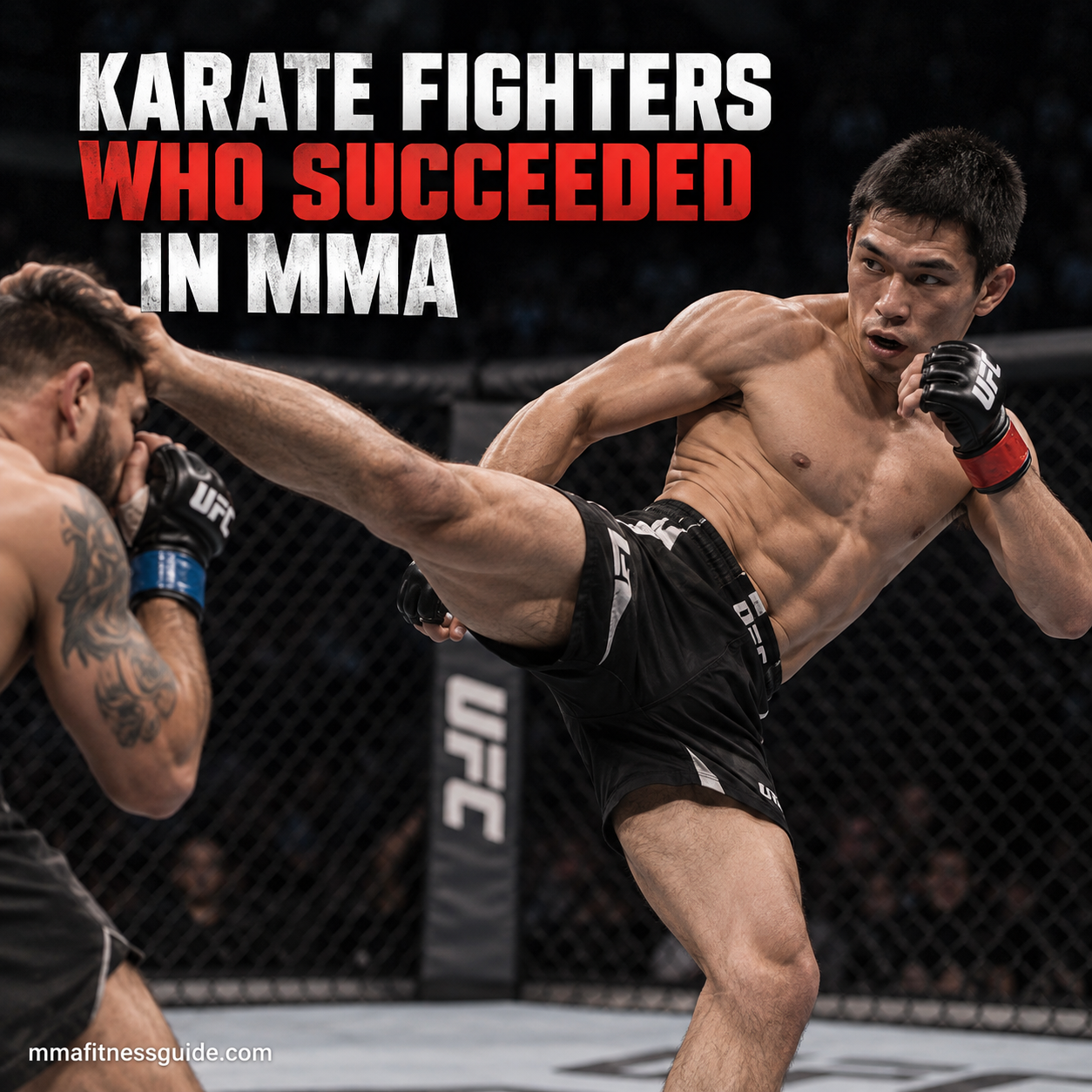
When Lyoto Machida knocked out Randy Couture with a jumping front kick at UFC 129, he delivered one of the clearest demonstrations of karate’s potential in mixed martial arts.
The technique looked unusual compared with the boxing combinations and Muay Thai kicks commonly seen in MMA. Machida created the opening, launched the kick, and finished the fight in the second round.
It wasn’t simply a flashy move. The knockout reflected years of training in distance control, explosive movement, and precise timing.
Karate has produced several successful MMA fighters, including UFC champions and elite contenders. Their achievements challenge the idea that traditional martial arts have no place in modern competition.
However, their success also reveals an important distinction: karate works in MMA when its techniques are adapted to account for wrestling, submissions, leg kicks, and the cage.
From Machida’s Shotokan counterstriking to Stephen Thompson’s unpredictable movement and Georges St-Pierre’s integration of karate and wrestling, these fighters demonstrate different ways to make traditional techniques effective.
Why Karate Can Work in Modern MMA
Karate is not a single fighting style. Shotokan, Kyokushin, American Kenpo, and other systems emphasize different techniques, training methods, and competitive rules.
Some prioritize linear attacks and explosive entries. Others develop close-range combinations, powerful body strikes, or continuous-contact fighting.
These differences matter when examining karate’s influence on MMA.
Nevertheless, several characteristics appear frequently among successful karate-based fighters.
Distance Management
Karate practitioners often train to attack from outside an opponent’s immediate striking range.
Rather than standing close enough to exchange punches continuously, they may remain farther away and close the distance explosively.
This creates an unusual rhythm for opponents accustomed to conventional boxing or kickboxing exchanges.
Explosive Entries
A blitz involves rapidly closing distance while attacking.
In MMA, a fighter might use a sudden forward movement to land a straight punch before exiting at an angle.
The technique becomes dangerous when the opponent cannot accurately judge the entry.
However, charging forward without maintaining balance can create opportunities for takedowns and counters.
Unconventional Kicks
Side kicks, front kicks, spinning kicks, and attacks from unusual angles can make a karate-based fighter difficult to anticipate.
These techniques can target the body, disrupt forward pressure, or capitalize on an opponent’s defensive habits.
Their effectiveness depends on timing and setup rather than surprise alone.
Timing and Counterstriking
Many karate systems emphasize recognizing the moment an opponent begins an attack.
A fighter who identifies an incoming movement early can intercept it, evade it, or counter during the opponent’s recovery.
This principle appears repeatedly in the careers of successful karate-based MMA fighters.
1. Lyoto Machida: Shotokan Karate and the Art of Counterstriking
Lyoto Machida is among the most recognizable examples of traditional karate succeeding at the highest level of MMA.
Born in Brazil, Machida grew up practicing Shotokan karate under his father, Yoshizo Machida.
He eventually combined that foundation with Brazilian jiu-jitsu, sumo, and other combat sports disciplines.
In 2009, he defeated Rashad Evans at UFC 98 to become the UFC light heavyweight champion.
What Made Machida’s Style Different?
Machida frequently operated at a greater distance than conventional pressure fighters.
He used subtle footwork to encourage opponents to move forward, then attacked as they entered his preferred range.
His straight punches, quick entries, and evasive movement made it difficult for opponents to establish a consistent rhythm.
Against Rashad Evans, Machida demonstrated how explosive combinations could punish an opponent once the distance was right.
His knockout of Randy Couture in 2011 provided another example of karate’s unconventional techniques working in MMA.
But Machida’s style was not invulnerable. Opponents who controlled his movement, disrupted his timing, or successfully pressured him could create problems.
Training lesson: Practice recognizing an opponent’s entry rather than countering automatically. Use controlled partner drills to develop the ability to attack at the right distance and recover your stance immediately afterward.
2. Stephen “Wonderboy” Thompson: Karate Footwork and Range Control
Stephen Thompson entered MMA with an extensive striking background in karate and kickboxing.
His father, Ray Thompson, played a major role in his martial arts development.
Thompson’s style features a bladed stance, bouncing footwork, side kicks, and sudden attacks from long range.
These characteristics distinguish him from fighters who rely primarily on conventional boxing combinations.
How Wonderboy Controls Distance
Thompson frequently uses lead-leg kicks to discourage opponents from advancing freely.
A side kick to the body can interrupt forward movement, while a quick retreat or lateral step can create space for another attack.
His movement also makes it difficult for opponents to determine when he intends to engage.
Against Johny Hendricks in 2016, Thompson used movement and varied striking to secure a first-round TKO.
His performances against Vicente Luque and Geoff Neal further demonstrated his ability to manage striking exchanges over extended periods.
What Fighters Can Learn
Thompson’s approach highlights the value of making opponents react to multiple threats.
A fighter who repeatedly uses the same entry becomes predictable. Alternating between kicks, feints, and punching attacks makes distance management more complicated for the opponent.
However, Thompson’s style also illustrates the importance of wrestling awareness.
A bladed stance and extended kicking exchanges can create vulnerabilities when an opponent successfully closes distance.
Training lesson: Practice lead-leg kicks alongside lateral movement, but include drills where a partner threatens a takedown. Learn to recover your stance and defend rather than assuming every exchange will remain at kicking range.
3. Georges St-Pierre: Kyokushin Karate Meets Wrestling
Georges St-Pierre began studying Kyokushin karate as a child before developing into one of MMA’s most accomplished all-around competitors.
His career included two UFC welterweight championship reigns and a middleweight championship victory over Michael Bisping in 2017.
Although St-Pierre eventually became especially associated with wrestling and positional control, his karate background remained an important part of his development.
The Connection Between Striking and Takedowns
St-Pierre became particularly effective at blending his jab with takedown entries.
His opponents had to account for multiple threats.
If they concentrated too heavily on defending punches, they could become vulnerable to takedowns. If they anticipated wrestling, they might leave striking opportunities available.
This combination made his offense difficult to predict.
His explosive forward movement also reflected principles found in karate, although his complete MMA style incorporated extensive boxing, wrestling, and grappling training.
Why His Approach Matters
St-Pierre demonstrated that a karate background does not require a fighter to preserve every traditional technique.
Instead, he integrated useful elements into a broader system.
His success depended on combining striking with wrestling rather than treating them as separate skills.
Training lesson: Practice linking a jab to a takedown entry under qualified coaching. The goal is to understand how one threat changes an opponent’s defensive response and creates opportunities for another.
4. Bas Rutten: Kyokushin Karate and Full-Contact Striking
Bas Rutten brought a different karate background into MMA.
The Dutch fighter trained in Taekwondo and Kyokushin karate before developing his skills in kickboxing and submission fighting.
He became a prominent Pancrase competitor and won the UFC heavyweight championship in 1999.
Unlike point-fighting styles, Kyokushin emphasizes full-contact competition, conditioning, and powerful body attacks.
Rutten’s striking reflected this background, particularly his devastating liver attacks.
How Rutten Adapted Karate
Rutten developed a powerful combination of body punches, kicks, and close-range attacks.
He also improved his submission skills as his career progressed, recognizing that striking alone would not be sufficient against experienced grapplers.
His career provides an example of how fighters from full-contact karate backgrounds could transition into early mixed martial arts.
Training lesson: Develop body striking through supervised pad and bag work while maintaining defensive awareness. A body attack is most effective when it is properly set up and doesn’t leave the attacker exposed.
5. Michael “Venom” Page: Unpredictable Movement and Explosive Attacks
Michael Page developed his striking through freestyle kickboxing and karate-influenced competition.
He became widely recognized during his Bellator career for his unusual movement, long-range attacks, and spectacular knockouts.
His fighting style differs considerably from conventional boxing or Muay Thai.
Page frequently uses a low lead hand, a sideways stance, and exaggerated movements to encourage opponents to react.
He then looks for opportunities to launch sudden attacks.
Why His Movement Creates Problems
Page often changes the rhythm of an exchange.
He may remain relatively stationary, move unpredictably, or suddenly accelerate toward an opponent.
These changes make it difficult to anticipate exactly when an attack will arrive.
His knockout of Evangelista Santos at Bellator 158 demonstrated the devastating potential of a well-timed flying knee.
However, his approach also carries risks.
A low guard can leave openings for punches, and unusual movement patterns can become less effective when an opponent successfully restricts space or establishes grappling control.
Training lesson: Experiment with changes in rhythm during shadowboxing and pad work, but maintain sound defensive fundamentals. Copying Page’s low guard without his experience and distance awareness can create unnecessary vulnerabilities.
6. Kyoji Horiguchi: Karate Movement in the Lower Weight Classes
Kyoji Horiguchi provides another example of karate techniques functioning effectively in MMA.
The Japanese fighter developed a Shotokan karate background before transitioning into mixed martial arts.
He competed in the UFC and became a champion in RIZIN and Bellator.
His style features explosive entries, rapid changes in distance, and sudden punching combinations.
Unlike fighters who rely on continuous forward pressure, Horiguchi often creates opportunities by changing his rhythm and attacking from outside conventional boxing range.
His movement can make opponents hesitate because they cannot easily predict when he will enter.
What Makes His Approach Effective?
Horiguchi combines karate-influenced striking with the wrestling and grappling skills required for MMA.
His explosive movement allows him to close distance quickly, but he also needs to defend takedowns and operate effectively when exchanges become more physical.
His career demonstrates that karate’s principles can translate across weight classes, although individual techniques must be adapted to a fighter’s attributes and opponents.
Training lesson: Practice short, explosive entries followed by immediate defensive recovery. Avoid lunging so far forward that your feet become poorly positioned.
Other Successful MMA Fighters With Karate Backgrounds
Karate’s influence extends beyond fighters whose styles are immediately recognizable.
Several accomplished MMA athletes began their martial arts development in karate or incorporated its techniques into broader fighting systems.
- Robert Whittaker: Karate background; former UFC middleweight champion known for explosive entries and mobile striking.
- Gunnar Nelson: Goju-Ryu karate background combined with extensive Brazilian jiu-jitsu training.
- Chuck Liddell: Kempo karate background; former UFC light heavyweight champion.
- Chinzo Machida: Shotokan karate practitioner who competed professionally in MMA, including Bellator.
Their careers illustrate an important point: a fighter doesn’t need to maintain a visibly traditional karate stance for their original training to influence their MMA style.
Karate may contribute to movement, timing, kicking mechanics, or the ability to enter and exit striking range.
The extent of that influence varies considerably between athletes.
What Karate Fighters Must Change for MMA
Successful karate-based fighters don’t simply transfer every technique from the dojo into the cage.
They modify their approach to account for different rules, equipment, and opponents.
1. Adjust the Stance
Some traditional karate stances position the body sideways, with the lead leg extended farther forward.
This can support quick entries and certain kicks, but it may also expose the lead leg to low kicks or complicate takedown defense.
MMA fighters must learn to adjust their stance according to the opponent’s threats.
2. Develop Takedown Defense
A powerful blitz becomes risky when an opponent can change levels and attack the legs.
Karate practitioners transitioning to MMA need to develop sprawling, underhooks, cage wrestling, and defensive grappling.
These skills allow them to use their striking without becoming excessively vulnerable to wrestling.
3. Adapt to Continuous Exchanges
Point-based karate competition may reward a clean technique and then stop the action.
MMA exchanges continue after a strike lands.
A fighter must be prepared to defend counters, follow up with combinations, or transition into grappling.
Landing the first punch does not automatically end the exchange.
4. Learn to Defend Leg Kicks
A mobile, bladed stance can become difficult to maintain when an opponent repeatedly attacks the lead leg.
Karate-based fighters must develop appropriate checking, evasive movement, stance adjustments, and counterattacks.
5. Integrate Grappling
Even an excellent striker may eventually find themselves on the ground.
Training in wrestling and Brazilian jiu-jitsu allows karate practitioners to defend submissions, escape disadvantageous positions, and develop their own offensive grappling.
These adjustments do not erase karate’s identity. They allow its useful techniques to function within MMA’s broader demands.
How to Incorporate Karate Techniques Into MMA Training
You don’t need a traditional karate background to experiment with its movement and striking principles.
A practical starting point is to introduce one technique at a time.
Begin by practicing explosive entries during shadowboxing. Move into punching range, deliver a controlled straight punch, and immediately recover your stance.
Next, introduce lateral movement after the attack.
Once the movement becomes comfortable, work with a partner who can provide realistic defensive reactions.
Finally, incorporate controlled wrestling threats so that you learn when an entry is safe and when it creates unnecessary risk.
A qualified MMA coach can help identify which techniques complement your existing style.
The goal isn’t to imitate Machida or Thompson exactly. It’s to develop additional options that make your striking more adaptable.
Final Thoughts: Karate’s Place in MMA
Karate has contributed to the careers of UFC champions, international titleholders, and accomplished contenders.
Lyoto Machida demonstrated the effectiveness of Shotokan timing and counterstriking. Stephen Thompson brought distinctive footwork and long-range attacks into the UFC. Georges St-Pierre combined his karate foundation with wrestling to develop a comprehensive MMA game.
Bas Rutten, Michael Page, and Kyoji Horiguchi further illustrate the diversity of karate-influenced approaches.
Their careers do not prove that karate is universally superior to boxing, Muay Thai, wrestling, or other martial arts.
Instead, they demonstrate that techniques from different disciplines can be effective when fighters understand their strengths, recognize their limitations, and adapt them to MMA competition.
For developing fighters, the practical takeaway is to study what works, test techniques under appropriate training conditions, and build a complete skill set.
Karate’s contribution to MMA is not limited to spectacular kicks. Its lasting value can also be found in distance management, explosive movement, timing, and the ability to create openings before an opponent recognizes them.