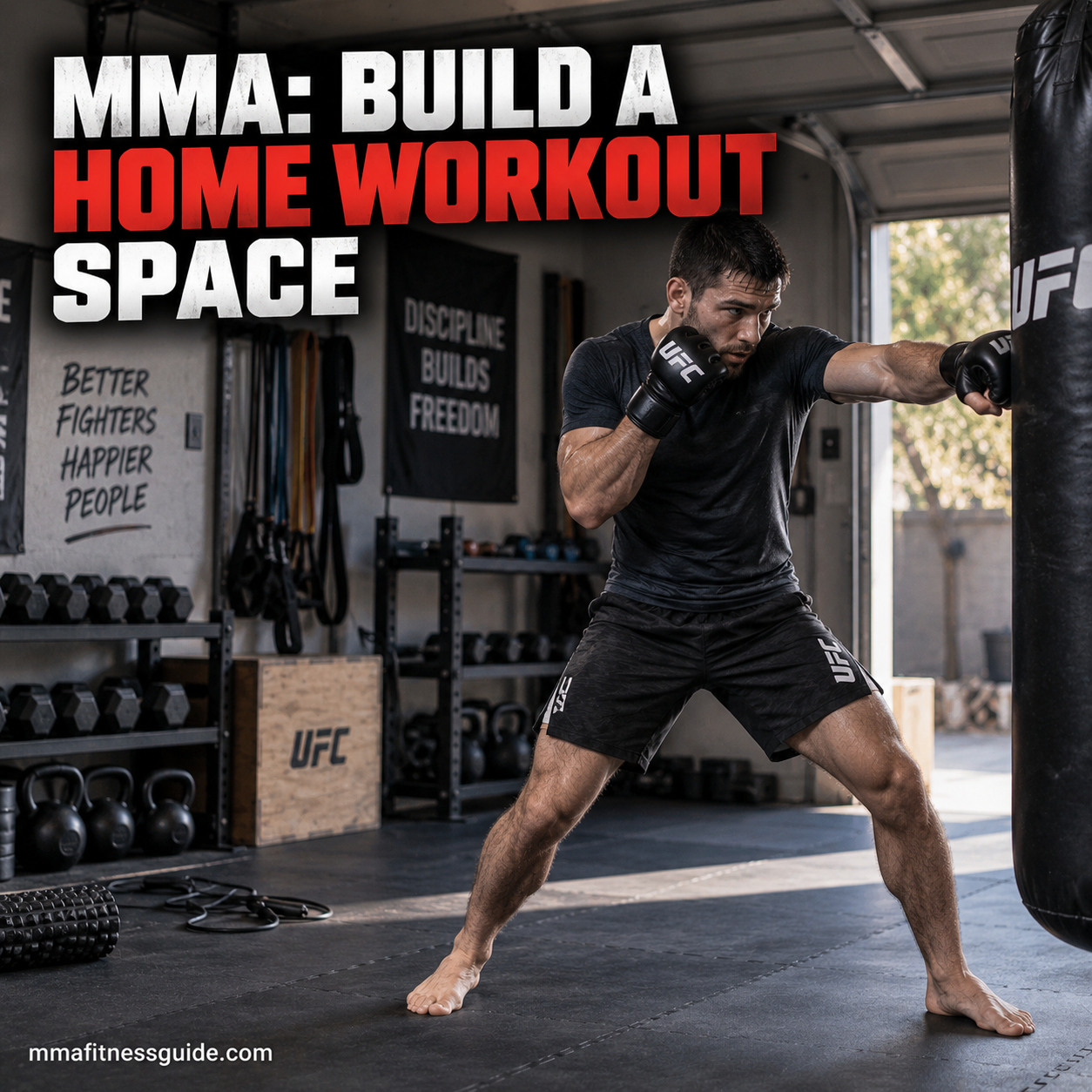
A cleared garage, a few exercise mats, and enough room to throw punches without hitting the furniture can be the foundation of a useful home MMA workout space.
You don’t need an expensive training facility to improve your conditioning, practice footwork, or develop strength. Many exercises used by mixed martial artists can be performed at home with minimal equipment.
However, setting up an MMA training area requires more planning than simply buying a punching bag and finding somewhere to hang it.
The floor needs to provide reliable traction. You need enough room to move safely, and your equipment should match the activities you actually intend to perform.
A well-designed home setup can support striking drills, strength training, cardiovascular conditioning, and mobility work. It can also make training more convenient when getting to a gym isn’t practical.
Here’s how to create a functional MMA workout space without wasting money or compromising safety.
Why Build a Home MMA Training Space?
Training at home offers several practical advantages, especially for people balancing martial arts with work, family, and other responsibilities.
The biggest benefit is convenience.
A 20-minute conditioning session becomes much easier to fit into your schedule when you don’t have to drive to a gym.
A dedicated workout area also allows you to practice specific skills between regular MMA classes.
For example, you can use home sessions to improve:
- Shadowboxing technique and striking combinations
- Footwork and movement patterns
- Cardiovascular endurance
- Muscular strength and endurance
- Flexibility and joint mobility
- General fitness and recovery habits
Home training does have limitations.
You cannot realistically develop complete MMA skills without qualified instruction, training partners, and supervised practice.
Wrestling, submissions, defensive reactions, and live sparring require interaction with another person.
Think of your home workout space as a supplement to proper martial arts training rather than a complete replacement for an MMA gym.
Step 1: Choose the Right Training Space
Before purchasing equipment, identify where you will train.
A garage, spare bedroom, basement, or cleared living room can work. The right choice depends on the amount of space available and the exercises you plan to perform.
How Much Space Do You Need?
A clear area measuring approximately 6 × 6 feet can accommodate basic shadowboxing, stationary strength exercises, and mobility work.
However, this is a starting point rather than a universal safety minimum.
For more dynamic footwork, lateral movement, and kicking drills, aim for approximately 8 × 8 feet or more.
A larger area gives you room to move without worrying about nearby furniture or walls.
If you’re planning to install a heavy bag, you’ll need additional clearance around its full range of movement.
Check the Ceiling Height
Overhead clearance matters for exercises such as jump rope, jumping movements, and overhead presses.
Make sure you can raise your arms and perform your intended exercises without hitting ceiling fixtures.
Low ceilings may require replacing jump rope with another conditioning exercise.
Inspect the Surroundings
Before training, remove potential hazards.
Look for:
- Furniture with sharp edges
- Loose rugs and electrical cables
- Mirrors or windows within striking distance
- Low-hanging lights and ceiling fans
- Unstable shelves or storage containers
Also consider ventilation.
A fan, open window, or properly ventilated garage can make indoor workouts more comfortable.
Avoid training in garages containing running vehicles, exposed chemicals, or other environmental hazards.
Step 2: Choose Flooring That Matches Your Training
Flooring deserves attention because MMA-inspired workouts involve repeated changes in direction, pivots, lunges, and occasionally ground-based exercises.
A slippery or unstable surface can make these movements unnecessarily risky.
Interlocking Foam Mats
Interlocking EVA foam mats are a common choice for basic home fitness setups.
They are relatively affordable, easy to install, and can be removed when the room needs to serve another purpose.
For standing exercises, look for mats with a textured surface and sufficient firmness to support stable footwork.
Thicknesses around ½ to 1 inch are common, but thickness alone does not determine whether a mat is appropriate.
Soft puzzle mats may shift, separate, or compress during explosive movement.
Choose flooring intended for your activity and follow the manufacturer’s installation recommendations.
What About Grappling?
Basic exercise mats are not automatically suitable for takedowns, throws, or wrestling.
Those activities require purpose-designed impact-absorbing surfaces, adequate space, and appropriate supervision.
Do not attempt throws or hard takedowns onto ordinary puzzle mats, carpet, or concrete.
For a beginner home setup, focus on standing drills and controlled ground exercises that don’t involve falling or impact.
Prevent Mats From Moving
Before each workout, check that the mats lie flat and don’t slide across the floor.
Use an appropriate nonslip underlay or another manufacturer-approved method if necessary.
Avoid placing unsecured mats directly over slippery surfaces.
Step 3: Buy Essential Equipment First
You can build a useful training area without purchasing everything at once.
Start with equipment that supports multiple exercises and matches your immediate goals.
1. Exercise Mats
Mats provide a designated area for mobility work, bodyweight exercises, and controlled footwork.
Choose a surface appropriate for your intended activities rather than automatically purchasing the thickest option available.
2. Hand Wraps and Boxing Gloves
If you plan to use a heavy bag, proper hand protection is important.
Hand wraps provide additional support, while appropriately fitted boxing gloves help protect your hands during impact.
Glove selection depends on hand size, training purpose, and manufacturer recommendations. There is no single glove weight that fits every beginner.
For shadowboxing, gloves are optional.
Practice controlled movements without striking hard surfaces.
Never punch a wall or other rigid household surface as a substitute for a punching bag.
3. Resistance Bands
Resistance bands are inexpensive and versatile.
They can support:
- Shoulder warm-ups
- Rows and pulling exercises
- Hip strengthening
- Controlled resistance training
- Mobility exercises
Choose a resistance level that allows you to maintain proper technique.
Inspect bands regularly for cracks or damage, and secure them only to anchors designed to withstand the intended load.
4. A Timer
A round timer is useful for organizing striking and conditioning sessions.
You can use a smartphone timer instead of purchasing dedicated equipment.
For example, beginners might start with two-minute shadowboxing rounds followed by one minute of rest.
As fitness improves, training duration and intensity can gradually increase.
Step 4: Add Equipment Based on Your Goals
Once you have established a consistent routine, consider equipment that addresses a specific training need.
Heavy Bag or Free-Standing Bag
A punching bag allows you to practice striking combinations, develop conditioning, and work on distance.
A hanging bag requires a properly rated structural support and mounting hardware. Consult a qualified installer when necessary.
Never assume that an ordinary ceiling joist or doorway can safely support a swinging heavy bag.
Free-standing bags avoid overhead installation, but they still require adequate floor space and may shift or tip during use.
Whichever option you choose, ensure there is sufficient clearance around the bag.
Start with controlled technique rather than maximum-power striking.
Dumbbells or Kettlebells
Free weights can expand your strength-training options.
Dumbbells are useful for exercises such as rows, presses, squats, and loaded carries.
Kettlebells can also support full-body strength training, although technical movements such as swings should be learned with appropriate instruction.
Choose weights you can control throughout the entire movement.
Jump Rope
A jump rope is an inexpensive conditioning tool.
It can help develop coordination and cardiovascular endurance while providing a convenient warm-up option.
However, jumping may not be suitable for every floor surface or training space.
Use supportive footwear when appropriate and begin with short intervals.
Pull-Up Bar
A properly installed pull-up bar can support upper-body strength training.
Choose equipment rated for your weight and compatible with its mounting surface.
Avoid improvised installations or unsecured doorway bars.
If installation isn’t practical, resistance-band rows or dumbbell rows provide alternative pulling exercises.
Step 5: Organize Your Training Area
A small workout space becomes frustrating when equipment is scattered across the floor.
Keep the training surface clear and give every item a designated storage location.
A simple storage system might include a basket for gloves and wraps, a shelf for small equipment, and a separate area for weights.
Keep heavy objects low to the ground to reduce the risk of falling equipment.
If your workout area is shared with other household activities, consider removable mats and compact equipment.
Cleaning also matters.
Wipe down frequently used equipment, allow gloves and wraps to dry, and clean mats according to the manufacturer’s instructions.
A well-organized space makes it easier to begin training without spending ten minutes moving furniture and searching for equipment.
Step 6: Create a Balanced Home MMA Workout
Once your space is ready, develop a routine that combines technical practice, strength, and conditioning.
You don’t need to train every physical quality in every session.
A beginner can alternate between striking-focused workouts and strength sessions throughout the week.
Here are three practical options.
Workout A: Striking and Footwork (25 Minutes)
Warm-up — 5 minutes
Begin with light marching, shoulder circles, hip rotations, and relaxed shadowboxing.
Footwork — 8 minutes
Practice moving forward, backward, and laterally while maintaining your stance.
Avoid crossing your feet or taking unnecessarily large steps.
Shadowboxing — 9 minutes
Complete three two-minute rounds with one minute of rest between rounds.
Focus on simple combinations such as the jab-cross, followed by a defensive movement or controlled exit.
Cooldown — 3 minutes
Finish with relaxed walking and gentle mobility exercises.
Prioritize balance and accuracy rather than punching as fast as possible.
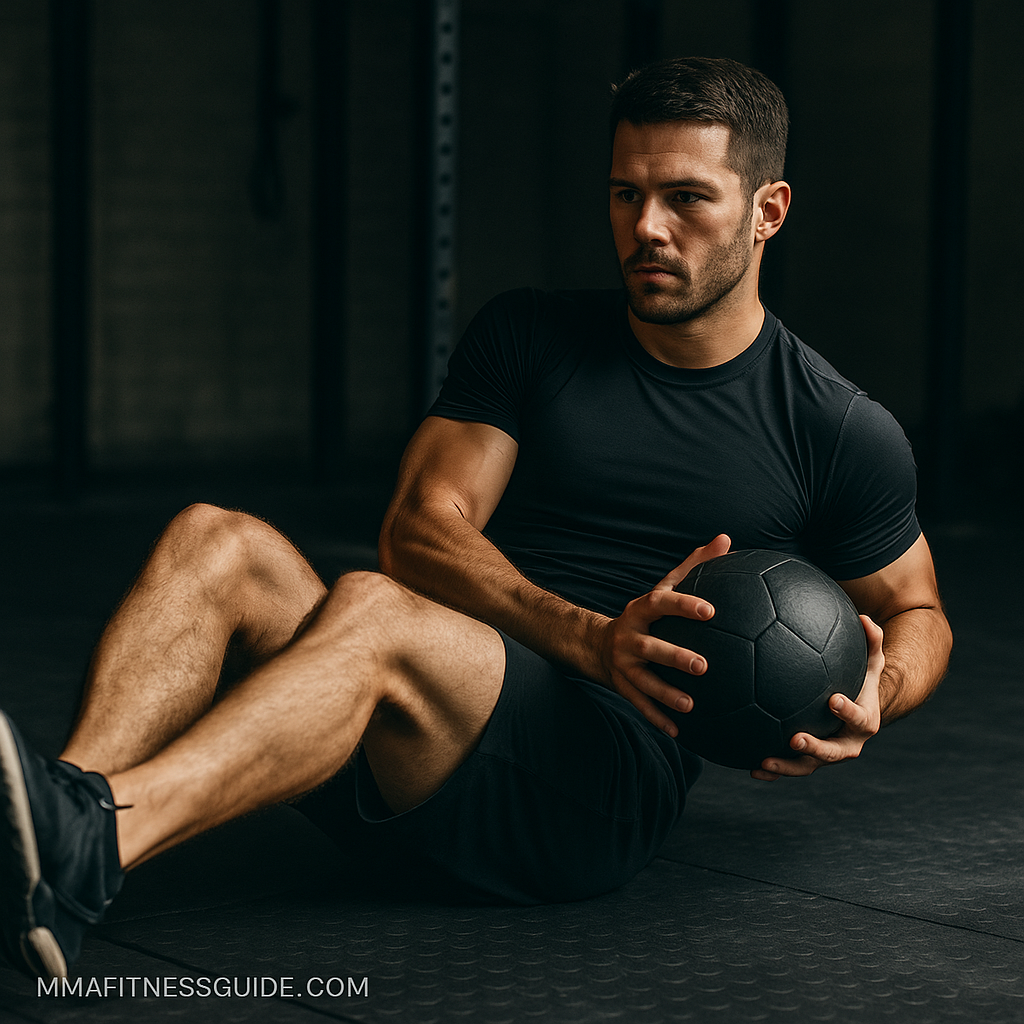
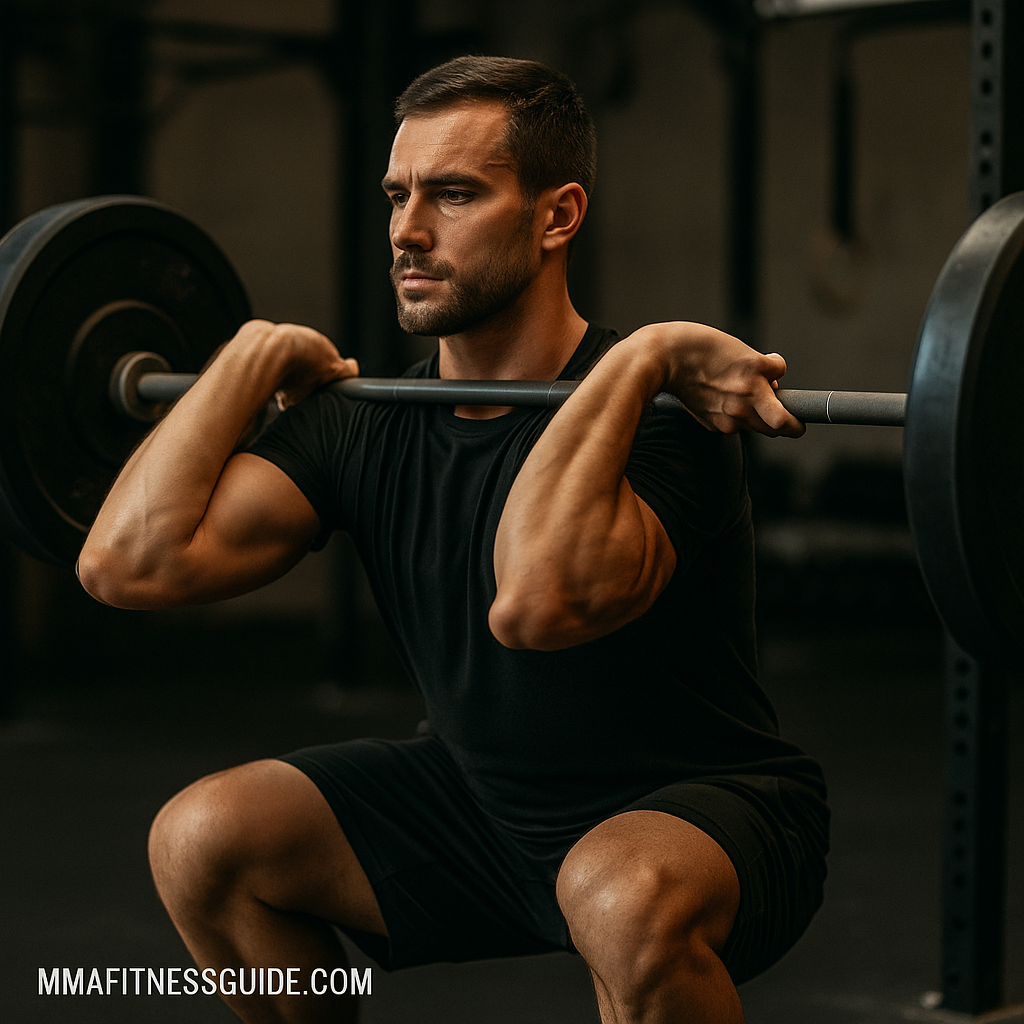
Workout B: Strength and Conditioning (30 Minutes)
Begin with a five-minute warm-up.
Complete the following circuit:
- 10 bodyweight squats
- 8 push-ups, modified if necessary
- 8 reverse lunges per leg
- 12 resistance-band rows
- 20–30 seconds of plank holds
Rest for approximately 60–90 seconds between rounds, adjusting as needed.
Complete two or three rounds according to your fitness level.
Use the remaining time for light conditioning and a cooldown.
The objective is to perform controlled repetitions while maintaining good technique.
Stop or modify an exercise if it causes pain, dizziness, or unusual discomfort.
Workout C: Mobility and Recovery (20 Minutes)
Use this session on lighter training days.
Begin with five minutes of easy movement.
Then perform controlled mobility exercises targeting the hips, shoulders, ankles, and upper back.
Examples include:
- Hip circles
- Thoracic rotations
- Ankle mobility movements
- Gentle hip-flexor stretches
- Controlled shoulder rotations
Avoid forcing joints beyond a comfortable range.
Finish with relaxed breathing and easy movement.
This session provides an opportunity to maintain mobility without adding another demanding workout.
Step 7: Build a Weekly Training Schedule
A home workout space becomes more useful when you have a realistic schedule.
For beginners, consistency is more valuable than attempting intense workouts every day.
Here is one example:
| Day | Training |
|---|---|
| Monday | Striking and footwork |
| Tuesday | Strength and conditioning |
| Wednesday | Rest or light mobility |
| Thursday | Striking and footwork |
| Friday | Strength and conditioning |
| Saturday | MMA class or optional light activity |
| Sunday | Rest |
Adjust the schedule around any existing martial arts classes.
If you’re already attending demanding MMA sessions several times per week, additional home workouts should complement that training rather than simply increase fatigue.
Allow time for recovery, especially after challenging strength or conditioning sessions.
How Much Should You Spend on a Home MMA Setup?
You can create a functional training area at several budget levels.
These are illustrative planning ranges rather than verified retail prices.
| Budget | Suggested Setup |
|---|---|
| $0–$50 | Clear floor space, smartphone timer, basic resistance bands |
| $50–$150 | Suitable exercise mats, resistance bands, jump rope |
| $150–$350 | Basic setup plus gloves, wraps, and entry-level strength equipment |
| $350+ | Additional weights or a properly installed punching bag |
Costs vary considerably depending on equipment quality, available space, and installation requirements.
A punching bag may also involve additional expenses for mounting hardware or professional installation.
Don’t purchase equipment simply because it appears in a professional fighter’s training facility.
Start with what you’ll use consistently, then expand as your training needs become clearer.
Common Home MMA Setup Mistakes to Avoid
Several mistakes can make a home training space less effective or unnecessarily dangerous.
Buying equipment before measuring: A heavy bag is not useful if there isn’t enough clearance to move around it.
Using unsuitable flooring: Soft or slippery mats can interfere with balance, while ordinary exercise mats may not provide adequate protection for impact-based grappling.
Ignoring installation requirements: Improperly mounted bags and pull-up bars can fail under load.
Training too intensely: Adding daily conditioning sessions on top of regular MMA classes can interfere with recovery.
Practicing advanced techniques without instruction: Spinning kicks, takedowns, and complex grappling movements require appropriate technical guidance and safe training conditions.
Overcrowding the room: Leave enough open space for every movement you intend to perform.
A smaller, carefully planned setup is more useful than a crowded room filled with equipment you rarely touch.
Frequently Asked Questions
Can I train MMA at home without equipment?
Yes. Shadowboxing, basic footwork, bodyweight strength exercises, and mobility work require little or no equipment.
However, developing complete MMA skills requires qualified coaching and appropriate partner training.
Is a punching bag necessary for beginners?
No. Beginners can develop basic movement patterns and conditioning without a punching bag.
A bag becomes useful when you have sufficient space, appropriate hand protection, and an understanding of proper striking technique.
Can I practice grappling at home?
You can perform selected solo movements and conditioning exercises.
However, throws, takedowns, submissions, and live grappling require appropriate mats, training partners, and qualified supervision.
Avoid practicing high-impact techniques on household flooring.
What is the first piece of equipment I should buy?
It depends on your training goals and existing space.
If you have no suitable exercise surface, appropriate flooring may be the first priority.
If your floor is already suitable, a resistance band and timer can support a wide range of inexpensive workouts.
Final Thoughts: Start Small and Build Around Your Training
Building a home MMA workout space doesn’t require a large budget or a dedicated room.
A clear floor area, suitable exercise surface, and a few versatile pieces of equipment can support striking practice, strength training, conditioning, and mobility.
The key is choosing equipment based on how you actually train.
Start with enough room to move safely. Add basic tools, establish a consistent routine, and expand only when you identify a genuine need.
Most importantly, use home training to reinforce the techniques you learn through qualified instruction.
A home workout space won’t replace the experience of training with coaches and partners, but it can give you more opportunities to practice, stay active, and develop the physical foundation needed for MMA.