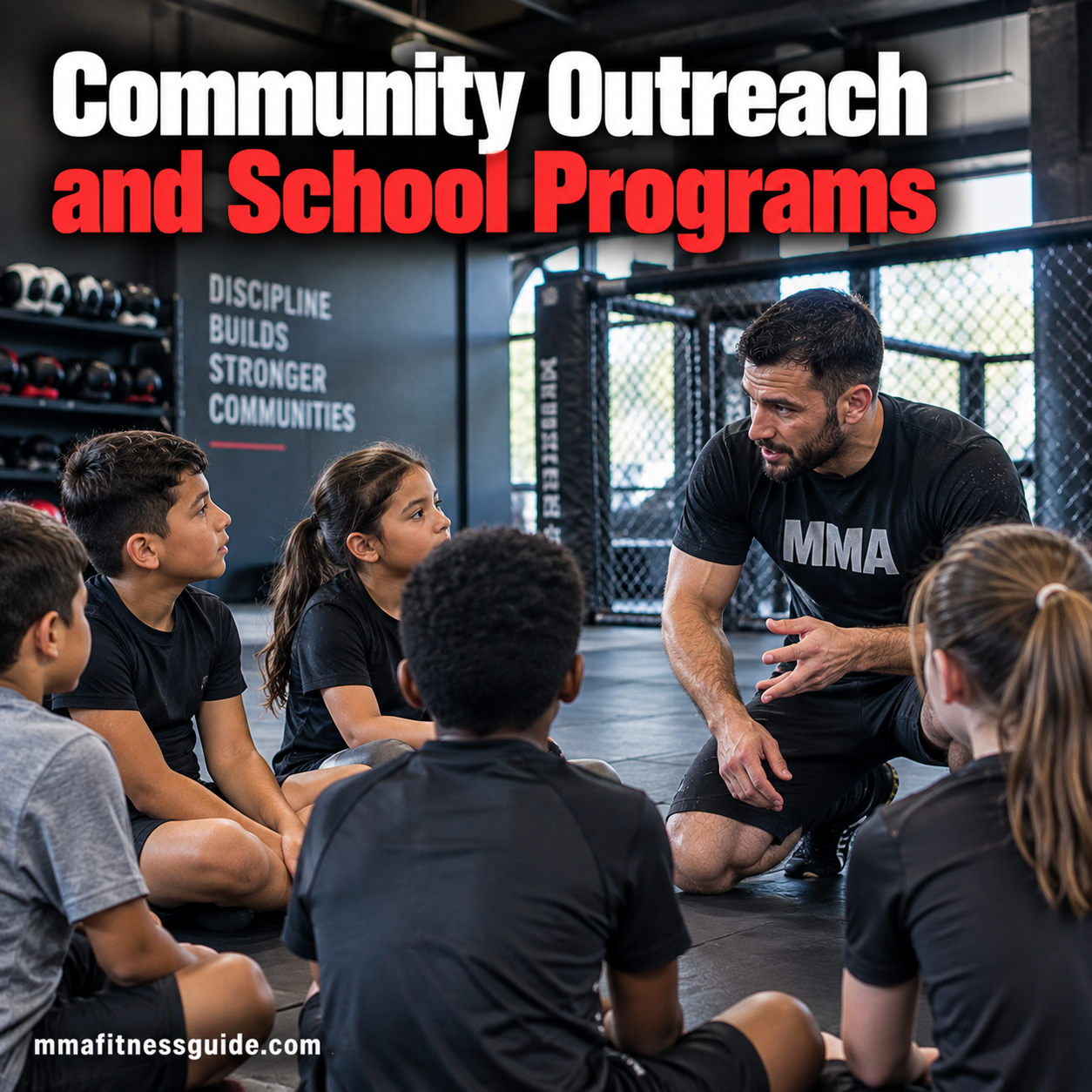
An MMA coach does not have to teach takedowns or submissions to introduce martial arts concepts in a school. A 45-minute session might involve stance and movement drills, coordination exercises, basic fitness, discussions about avoiding confrontation, and simple partner activities built around control and respect.
Programs like these give gyms, coaches, and fighters a way to work with families and organizations that may never otherwise enter an MMA facility.
They can also create professional opportunities outside competition, from after-school coaching and youth programs to workshops, community partnerships, and contracted instruction.
What MMA Outreach Can Look Like
Community outreach is broader than offering free MMA classes.
A gym might provide an after-school movement program, send coaches to a community event, run a youth fitness workshop, support a local nonprofit, or work with educators on age-appropriate martial arts activities.
Depending on the organization and instructor qualifications, programs might address:
- Physical activity
- Coordination and balance
- Martial arts fundamentals
- Confidence
- Goal setting
- Teamwork
- Respectful partner interaction
- Situational awareness
- Conflict avoidance
The emphasis should match the setting.
A school program for elementary students should look very different from an adult MMA class or competitive fight practice.
MMA in Youth Programs
Youth martial arts programs often work best when technical instruction is paired with clear behavioral expectations.
Students may learn how to:
- Follow instructions
- Work safely with a partner
- Control their movements
- Wait for their turn
- Practice a skill repeatedly
- Respond appropriately when frustrated
- Respect physical boundaries
These lessons happen through the structure of the session rather than through speeches alone.
For example, a partner drill can require students to maintain control, stop immediately when instructed, switch roles, and help one another complete the activity correctly.
That gives instructors opportunities to reinforce behavior while teaching movement.
School-Based Martial Arts Programs
Schools can provide several possible settings for martial arts-related instruction.
Depending on school policies and available facilities, a program could involve:
- Physical education sessions
- After-school clubs
- Fitness workshops
- Martial arts demonstrations
- Movement and coordination sessions
- Personal-safety education
- School assemblies
The content should be designed around the students’ ages, available space, supervision, and school requirements.
An introductory school program generally does not need to resemble competitive MMA practice.
Heavy contact, hard sparring, submissions, and other higher-risk activities may be inappropriate for the environment. Movement drills, fitness, basic technique, and controlled partner exercises can communicate martial arts principles without recreating a fight gym.
Anti-Bullying and Personal-Safety Programs
Martial arts gyms are sometimes invited to participate in anti-bullying or personal-safety education.
These programs require careful framing.
Teaching children to fight should not be presented as the primary solution to bullying. Physical skills are only one small part of personal safety, and school policies regarding bullying and student conflict still apply.
A broader workshop can address:
- Recognizing potentially unsafe situations
- Creating distance
- Clear verbal boundaries
- Seeking help from trusted adults
- Avoiding unnecessary confrontation
- Leaving when possible
- Basic situational awareness
If physical self-defense techniques are included, instruction should be age-appropriate and consistent with the organization’s policies.
Coaches should also avoid promising that a particular technique will guarantee a student’s safety.
Community Centers and Youth Organizations
Schools are not the only potential partners.
Gyms and instructors may also work with:
- Recreation centers
- Youth organizations
- Community centers
- Nonprofits
- Local sports programs
- Summer camps
- Parks and recreation departments
These organizations may have different facilities, budgets, program goals, and participant demographics.
That flexibility can allow instructors to develop programs that would not fit within a traditional school environment.
What Outreach Can Do for an MMA Gym
Community involvement puts coaches in front of people who may know very little about MMA beyond what they have seen in professional competition.
A well-run youth clinic or community workshop gives families an opportunity to see how the gym actually teaches.
They can observe:
- How instructors communicate
- How safety is handled
- How students are treated
- Whether activities are organized
- How coaches respond to mistakes
- What standards the gym expects
Those interactions can shape the gym’s local reputation more effectively than simply advertising that it offers youth classes.
Outreach as a Potential Revenue Stream
Some outreach activities are volunteer-based. Others can become paid services.
Depending on the arrangement, revenue might come from:
- Contracted instruction
- After-school programs
- Workshops
- Camps
- Community classes
- Private group programs
- Sponsorships
- Eligible grants or nonprofit partnerships
A school workshop may also introduce families to the gym, but enrollment should be treated as a possible secondary benefit rather than the primary purpose of the program.
Schools and community organizations are more likely to value a program designed around participant needs than one functioning mainly as an advertisement for memberships.
Career Opportunities Beyond Fighting
Competitive MMA careers are limited by age, injuries, performance, opportunities, and personal circumstances.
Community programming provides another way to use martial arts experience.
Possible roles include:
- Youth martial arts instructor
- After-school coach
- Program coordinator
- Community outreach coordinator
- Camp instructor
- Workshop facilitator
- Gym youth-program director
- Curriculum contributor
Experienced athletes may also participate in speaking events or educational sessions when their background is relevant to the organization’s goals.
The skills required can differ considerably from fighting. Working with children, parents, educators, and administrators requires communication, patience, organization, and appropriate professional boundaries.
Building a School or Community Program
A useful program begins with a specific audience and purpose.
Instead of approaching a school with “We want to teach MMA,” define what the session actually provides.
For example:
Audience: Middle-school students
Format: Six-week after-school program
Session length: 45 minutes
Focus: Fitness, movement, martial arts fundamentals, and controlled partner drills
Contact level: Non-contact or appropriately controlled
Equipment: Pads, cones, and floor markers
Progression: Basic stance and movement through increasingly coordinated drills
Specifics make it easier for administrators to understand what students will actually be doing.
Start With the Organization’s Needs
Before designing the curriculum, learn what the school or community organization wants.
They may be looking for:
- Additional physical activity
- An after-school option
- Summer programming
- Youth recreation
- Fitness education
- A one-time workshop
- Personal-safety education
- Activities for a community event
A six-week martial arts curriculum is unnecessary if the organization actually needs a 30-minute activity for a wellness day.
Build around the problem being solved.
Present the Program Professionally
Administrators need more information than a list of martial arts credentials.
A simple program proposal can explain:
- Who the program serves
- What participants will do
- Session length
- Number of sessions
- Instructor qualifications
- Equipment requirements
- Space requirements
- Safety procedures
- Contact level
- Cost
- Insurance information when applicable
Avoid vague claims such as “builds champions” or “eliminates bullying.”
Concrete program details are easier for organizations and parents to evaluate.
Working With Schools
The appropriate contact varies by organization.
Depending on the program, that could include:
- School administrators
- Physical education staff
- Athletic departments
- After-school coordinators
- Parent organizations
- District program staff
A short introductory proposal is generally more useful than sending a long explanation of MMA.
Explain what the program is, who it is designed for, what students will do, and what you are requesting from the school.
If the organization is interested, the details can be developed from there.
Safety and Risk Management
Youth martial arts programs require clear safety procedures.
Before operating a program, determine what the school, organization, insurer, and applicable laws require.
Considerations may include:
- Appropriate liability insurance
- Participant waivers or consent procedures
- Emergency plans
- Instructor-to-student ratios
- Equipment inspection
- Contact restrictions
- Injury procedures
- Parent or guardian communication
- Safe partner matching
- Facility requirements
Requirements differ by jurisdiction and organization, so gym owners should verify the rules that apply to their specific program.
Background Checks and Instructor Qualifications
Organizations working with minors commonly have screening and qualification requirements for adults participating in youth programs.
Depending on the organization, these could involve:
- Background screening
- CPR/AED certification
- First-aid training
- Coaching credentials
- Child-safety training
- Organization-specific orientation
Do not assume the requirements are identical everywhere.
Ask the school or organization what documentation instructors must provide before developing the program around a particular coach.
Choosing the Right Instructor
Competitive success does not automatically make someone effective with children.
Youth instructors need to be able to:
- Give clear instructions
- Maintain control of a group
- Demonstrate patience
- Adjust activities for different abilities
- Recognize unsafe behavior
- Communicate with parents and staff
- Keep students engaged without creating unnecessary risk
A less accomplished fighter with excellent teaching skills may be a better youth instructor than a decorated competitor who struggles to manage a class.
Measuring Whether the Program Works
Program evaluation does not need to be complicated.
Useful information might include:
- Attendance
- Repeat participation
- Completion rates
- Student feedback
- Parent feedback
- Educator or staff feedback
- Safety incidents
- Instructor observations
For recurring programs, this information can reveal which activities students engage with and where the curriculum needs adjustment.
If a school is considering renewing a program, documented participation and feedback also provide something more useful than simply saying the sessions went well.
Converting a Pilot Into a Recurring Program
A one-time workshop can serve as a test.
Afterward, ask the organization:
- What worked?
- What did students respond to?
- Were there safety or logistical concerns?
- Would a different age group be a better fit?
- Would shorter or longer sessions work better?
- Is there interest in another session?
Use the answers to improve the next version.
A recurring partnership is more likely to develop from a program that reliably solves an organization’s needs than from aggressive follow-up selling.
Keep Outreach and Marketing in the Right Order
Community programs can increase awareness of a gym, but participants should not feel that a school activity is simply a sales funnel.
Lead with the program itself.
Provide useful instruction. Run sessions professionally. Communicate clearly with staff and families.
If parents later want to learn more about regular classes, the gym can provide appropriate information through channels approved by the organization.
Trust develops from how the program is operated.
Creating Opportunities for Fighters and Coaches
Outreach can also give developing coaches experience they may not receive from teaching regular MMA classes.
They learn how to:
- Plan sessions
- Communicate with different age groups
- Manage groups
- Modify drills
- Work within organizational rules
- Document programs
- Interact with parents and administrators
Those skills can transfer into coaching, gym management, youth-program leadership, and other roles after competition.
Showing a Different Side of MMA
Someone who has only watched professional MMA may associate the sport primarily with knockouts, submissions, and intense competition.
A school or community program can show another part of martial arts culture.
Participants may see athletes practicing controlled technique, helping partners learn, following rules, repeating basic movements, and stopping immediately when instructed.
That distinction matters when presenting MMA to families and educators.
The objective is not to pretend combat sports are nonviolent. Fighting is part of MMA. The objective is to demonstrate that responsible training takes place within rules, supervision, technical instruction, and controlled environments.
Build the Program Around Service First
Community outreach works differently from running a normal MMA class.
The audience changes. The environment changes. The acceptable level of contact changes. The organization’s objectives may have little to do with producing competitive fighters.
Start with those realities.
Identify what the school or community group needs, design an age-appropriate program, establish clear safety procedures, choose instructors who can work effectively with the participants, and measure whether the program delivers what was promised.
Done well, the result can benefit both sides: the community receives structured martial arts or fitness programming, while fighters and gyms develop relationships, teaching experience, and potential professional opportunities beyond competition.