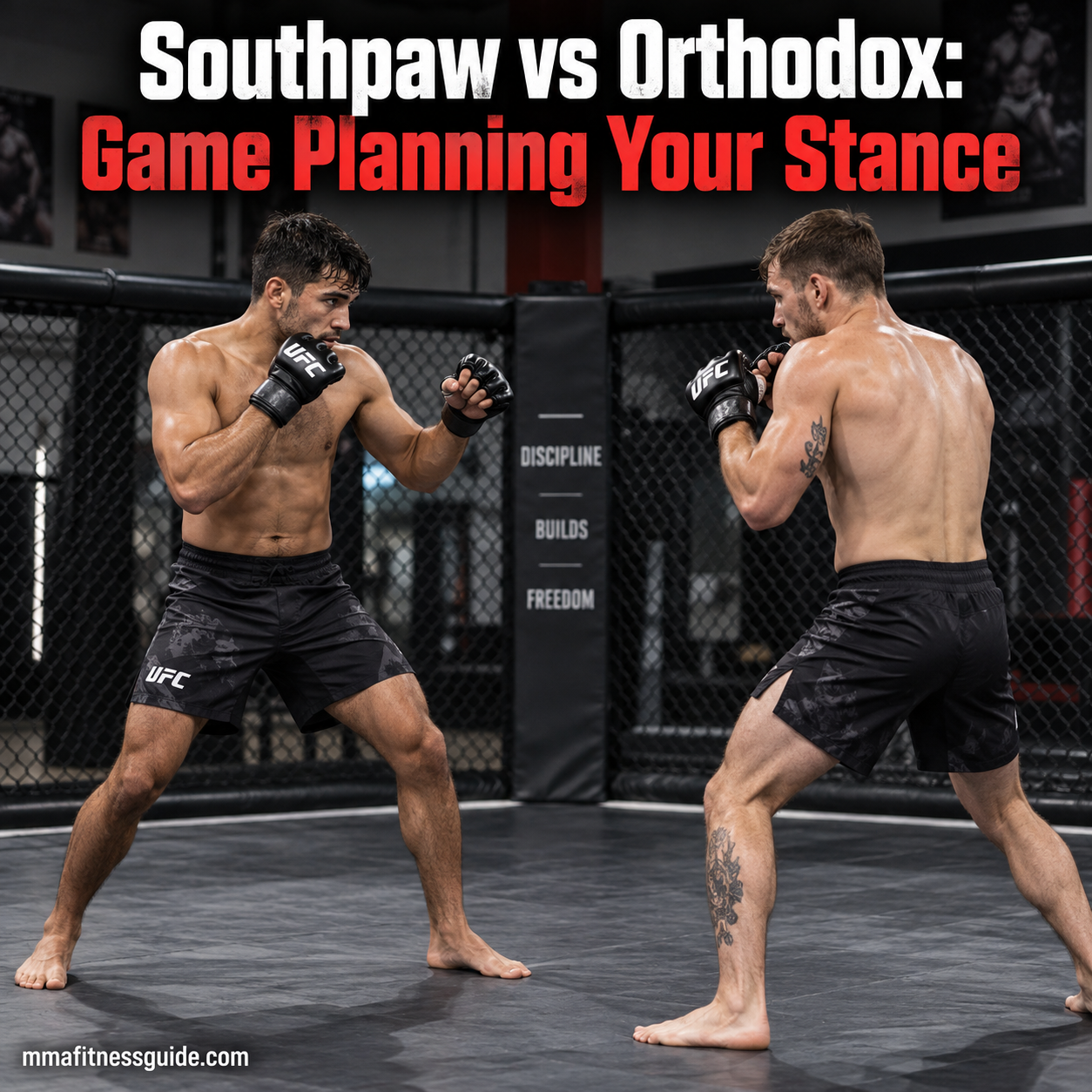
Choosing between an orthodox and southpaw stance is one of the most fundamental decisions in mixed martial arts. Your stance influences how you punch, kick, defend takedowns, manage distance, and create angles against an opponent.
An orthodox fighter leads with the left foot and typically uses the right hand as the rear power hand. A southpaw leads with the right foot and generally uses the left hand as the rear power hand.
The difference might seem simple, but it changes the geometry of almost every striking exchange.
When two orthodox fighters meet, they operate in a closed-stance matchup. When an orthodox fighter faces a southpaw, the matchup becomes open stance, creating different opportunities for straight punches, body kicks, lead-hand control, and foot positioning.
Neither stance automatically gives a fighter an advantage. Success depends on how effectively you use your position, understand your opponent’s weapons, and adapt your game plan.
This comprehensive guide breaks down the strengths and weaknesses of both stances, explains how to win the lead-foot battle, explores offensive and defensive strategies, and provides practical drills for developing a stance-based MMA game plan.
What Is the Orthodox Stance in MMA?
The orthodox stance is the most common fighting stance in boxing and MMA.
An orthodox fighter positions the left foot forward, keeps the right foot behind, and typically uses the right hand as the primary rear power hand.
Most right-handed beginners naturally gravitate toward orthodox because placing their dominant hand in the rear position often makes powerful straight punches feel more comfortable.
However, hand dominance does not automatically determine the best fighting stance. Balance, coordination, kicking ability, grappling preferences, and training experience all matter.
Proper Orthodox Stance Position
A basic orthodox stance includes:
- Left foot forward and right foot behind.
- Feet approximately shoulder-width apart, with enough lateral separation for balance.
- Knees slightly bent and weight distributed so either foot can move.
- Left hand positioned to jab, frame, and control distance.
- Right hand protecting the chin and ready to throw the cross.
- Chin slightly tucked with the shoulders relaxed.
Avoid standing with both feet on a straight line. A narrow stance makes it easier to lose balance when throwing combinations, absorbing strikes, or defending takedowns.
Your feet should provide a stable platform without becoming so wide that movement feels restricted.
Strengths of the Orthodox Stance
1. Familiar training environment
Because orthodox is common, beginners frequently encounter orthodox training partners.
This provides regular opportunities to practice familiar jab exchanges, defensive reactions, and combinations.
However, it also means your opponents may have considerable experience defending against orthodox attacks.
2. Powerful rear-hand attacks
For a right-handed fighter, the orthodox stance places the dominant hand in the rear position.
The right cross can become a primary offensive weapon, particularly when combined with hip rotation, proper weight transfer, and accurate foot positioning.
3. Established defensive fundamentals
Orthodox fighters can develop reliable defensive habits through repeated practice against other orthodox opponents.
These include defending the jab, slipping the right cross, checking kicks, and exiting after combinations.
The stance itself does not create better defense. Familiarity and technical repetition are responsible for those improvements.
4. Effective combination development
Common combinations include:
- Jab → right cross.
- Jab → cross → left hook.
- Double jab → right cross.
- Left hook → right low kick.
- Jab → right body kick.
These combinations provide a foundation for developing more complex offensive sequences.
Weaknesses of the Orthodox Stance
The primary disadvantage of orthodox is not a technical flaw in the stance itself. It is that many opponents are accustomed to facing it.
An experienced opponent may recognize familiar entries, anticipate the right cross, and prepare counters against standard combinations.
Orthodox fighters can also struggle when encountering southpaws if they have spent most of their training time against same-stance opponents.
The open-stance matchup changes punching lanes, kicking targets, and the direction of defensive movement.
An orthodox fighter who automatically circles in the same direction against every opponent may repeatedly move into a southpaw’s rear left hand.
The solution is to develop specific strategies for both orthodox and southpaw opponents rather than relying on one universal approach.
What Is the Southpaw Stance in MMA?
Southpaw is the opposite of orthodox.
A southpaw fighter leads with the right foot, keeps the left foot behind, and typically uses the left hand as the rear power hand.
Many naturally left-handed fighters prefer southpaw, although some right-handed fighters adopt it because they feel more comfortable leading with their dominant hand or using their left side for rear-leg attacks.
Southpaw is sometimes described as an awkward stance because many fighters have less experience facing it.
That unfamiliarity can create opportunities, but it does not guarantee an advantage.
Proper Southpaw Stance Position
A basic southpaw stance includes:
- Right foot forward and left foot behind.
- Right hand positioned for jabs, frames, and lead-hand control.
- Left hand protecting the chin and ready to deliver straight punches.
- Knees slightly bent with a stable, mobile base.
- Weight distributed to allow punching, kicking, and defensive movement.
The same fundamental principles apply to orthodox and southpaw.
Both require balance, controlled footwork, defensive awareness, and the ability to generate power without overcommitting.
Strengths of the Southpaw Stance
1. Unfamiliar attacking angles
An orthodox opponent who rarely trains against southpaws may struggle to recognize the correct defensive reactions.
The southpaw’s rear left hand travels along a different line than the rear right hand of an orthodox opponent.
This changes the timing and positioning required for effective defense.
2. Strong rear-left straight
The straight left is a signature southpaw weapon.
Against an orthodox fighter, the punch can travel through the open-stance lane toward the head or body.
A small outside step may improve the angle, although the punch can also land from neutral foot positioning when timing and distance are correct.
3. Open-side kicking opportunities
The southpaw rear-left roundhouse kick can attack an orthodox opponent’s right side.
Depending on distance and defensive positioning, the kick may target the body, arm, or head.
These opportunities are not exclusive to southpaws. Orthodox fighters have corresponding rear-right kicking opportunities in the same matchup.
4. Counterstriking possibilities
Southpaws can use the rear-left straight to counter an orthodox jab or punish an opponent who advances without protecting the centerline.
The lead right hook also provides a useful counter when an opponent overcommits.
For a deeper explanation of timing, distance, and counter selection, see our guide to counter-striking strategies for stand-up fighting .
Weaknesses of the Southpaw Stance
Southpaw fighters face several challenges.
They may have fewer southpaw training partners available, making same-stance preparation more difficult.
They must also defend against an orthodox fighter’s rear-right cross and rear-right body kick.
Poor foot positioning can leave a southpaw exposed to these attacks, particularly when stepping forward without maintaining defensive structure.
Another common problem occurs when a fighter adopts southpaw solely to confuse opponents without developing the fundamentals.
An unfamiliar stance is not useful if the fighter cannot defend, move, or generate power effectively.
Southpaw works best when it is a fully developed fighting position rather than a temporary trick.
Orthodox vs Southpaw: Understanding Open and Closed Stance
Before building a game plan, understand the two primary stance matchups.
Closed-Stance Matchups
A closed-stance matchup occurs when both fighters use the same stance.
Examples include:
- Orthodox vs orthodox.
- Southpaw vs southpaw.
Both fighters have their lead feet on the same side.
Their jabs, rear hands, and kicking lanes generally mirror one another.
The lead-foot battle still matters, but the geometry differs from an open-stance matchup.
Open-Stance Matchups
An open-stance matchup occurs when fighters use opposite stances.
Examples include:
- Orthodox vs southpaw.
- Southpaw vs orthodox.
The lead feet face one another, creating opportunities for outside foot positioning and lead-hand control.
Both fighters also have access to rear straight punches and rear roundhouse kicks directed toward the opponent’s open side.
Open stance is particularly important because a fighter’s usual defensive habits may need adjustment.
For example, slipping outside a rear straight requires movement in a different direction depending on which hand the opponent throws.
Understanding the matchup before exchanging strikes prevents unnecessary mistakes.
The Battle of Lead Foot Position
One of the most important concepts in orthodox-versus-southpaw striking is the lead-foot battle.
In an open-stance matchup, both fighters frequently attempt to position their lead foot outside the opponent’s lead foot.
An orthodox fighter tries to move the left foot outside the southpaw’s right foot.
A southpaw tries to move the right foot outside the orthodox fighter’s left foot.
The purpose is to create a favorable attacking angle while making the opponent’s return attacks more difficult.
Why Outside Foot Position Matters
An effective outside angle can provide several advantages.
A clearer rear-hand punching lane
Outside positioning can align your rear straight with the opponent’s centerline.
For an orthodox fighter, this may improve the right cross.
For a southpaw, it may improve the straight left.
Better access to the open side
An outside step can create opportunities for body punches and rear-leg kicks.
The opponent may need to turn or reposition before responding effectively.
Improved defensive positioning
Moving outside the opponent’s lead foot can help take your head away from the direct path of their rear hand.
However, this depends on your upper-body position and timing.
Stepping outside while leaving your head directly in front of the opponent does not automatically make you safer.
More effective exits
After throwing a combination, an outside angle may allow you to exit without retreating directly backward.
This is particularly useful against aggressive pressure fighters.
How to Win the Lead-Foot Battle
Avoid making exaggerated steps.
A large outside step can telegraph your intentions, compromise your balance, and expose you to low kicks or takedowns.
Instead, use small adjustments.
A practical sequence is:
- Establish your preferred striking distance.
- Use a jab or feint to occupy the opponent’s attention.
- Move your lead foot slightly outside theirs.
- Throw your rear straight when the angle and distance are favorable.
- Recover your stance and exit before the counter.
You can also use a double jab to disguise the step.
The first jab measures distance, while the second occupies the opponent as you reposition.
Is Outside Foot Position Always Necessary?
No.
The outside angle is valuable, but it should not become an obsession.
Experienced fighters can attack from inside foot position, neutral positioning, or while the opponent is stepping.
A fighter who constantly chases the outside angle may become predictable.
An opponent can anticipate the step and respond with a hook, low kick, knee, or takedown.
The objective is not simply to place your foot outside.
The objective is to create a useful angle without sacrificing balance or defensive awareness.
For practical movement exercises, explore our footwork drills to create angles .
Best Attacks for Orthodox Fighters Against Southpaws
An orthodox fighter should develop a game plan that addresses the southpaw’s straight left, lead-hand control, and rear-left kicking opportunities.
The following attacks provide a useful starting point.
1. Outside Foot Step Into the Right Cross
The right cross is one of the orthodox fighter’s primary weapons against a southpaw.
A small outside step can improve alignment and create a more direct punching lane.
Start by using the jab to establish distance.
As the opponent reacts, adjust your lead foot and throw the right cross.
Keep your chin protected and avoid leaning excessively over the lead knee.
If the cross misses, recover your position rather than falling forward into a counter.
2. Outside Angle Into the Right Body Kick
The orthodox rear-right body kick can attack the southpaw’s open side.
Set it up with punches rather than throwing it repeatedly from a stationary position.
A useful combination is:
Jab → right cross → right body kick.
The punches encourage the opponent to raise their guard, potentially creating an opportunity to attack the body.
However, the southpaw can counter with a straight left, catch the kick, or change levels.
Maintain balance and recover your kicking leg quickly.
3. Right Cross Into the Left Hook
The right cross and left hook complement one another.
The cross attacks along a straight line, while the hook targets the side of the opponent’s guard.
A southpaw who moves aggressively away from the cross may encounter the hook.
Keep the hook compact.
Overextending can leave you vulnerable to a straight-left counter or a level change.
4. Double Jab Into an Angle Step
The double jab is useful for closing distance without immediately committing to a powerful rear-hand attack.
The first jab measures distance.
The second jab occupies the opponent while you reposition.
Once your feet are set, you can follow with a cross, hook, or body kick.
Avoid stepping both feet together during the entry.
Your stance should remain wide enough to defend a sudden counter or takedown.
5. Right Low Kick
The orthodox rear-right low kick can attack the southpaw’s lead right leg.
Depending on the angle, the kick may target the inside or outside of the thigh.
It can be particularly effective when the southpaw places substantial weight on the lead leg while reaching for an outside angle.
However, southpaws can check low kicks, withdraw the leg, or counter.
Do not assume that opposite-stance positioning makes the kick impossible to defend.
Learn how to recognize checking opportunities and respond safely in our guide to checking and countering leg kicks in MMA .
Best Attacks for Southpaw Fighters Against Orthodox Opponents
Southpaw fighters can use similar principles but must adjust their attacking direction and defensive responsibilities.
1. Straight Left Down the Middle
The straight left is a foundational southpaw attack.
Against an orthodox opponent, it can exploit openings created by the jab or an overly aggressive forward step.
A simple setup is:
Right jab → outside step → straight left.
The jab occupies the opponent while the step improves your alignment.
The straight left should travel directly toward the target without excessive looping.
Return your hand to guard immediately after punching.
2. Rear-Left Body Kick
The rear-left roundhouse kick is an important weapon against orthodox opponents.
It can attack the opponent’s right side, particularly when the opponent raises their guard to defend straight punches.
A useful setup is:
Right jab → straight left → left body kick.
The punching combination creates a reaction before the kick.
Do not automatically throw the kick if the opponent moves out of range or begins changing levels.
The same setup can eventually create head-kick opportunities, but head kicks require careful preparation and balance.
Our guide to setting up high kicks safely explains how to use feints, combinations, and positioning to reduce unnecessary exposure.
3. Right Hook Into an Exit
The southpaw lead-right hook can interrupt an orthodox fighter moving forward.
It can also follow the straight left when the opponent shifts their guard toward the center.
After throwing the hook, pivot or step away from the opponent’s strongest countering line.
Do not remain stationary after a wide hook.
Your exit should leave you balanced and ready to defend another exchange.
4. Lead-Hand Control
Lead-hand fighting is especially important in open-stance matchups.
Because the lead hands face each other, fighters can use light touches, parries, and hand positioning to disrupt the opponent’s jab.
A southpaw can briefly occupy the orthodox fighter’s lead hand before throwing the straight left.
However, reaching too far creates openings.
Keep your hand movements compact and avoid extending your arm so much that the opponent can counter over the top or change levels underneath it.
5. Straight Left Into a Rear Uppercut
A southpaw can combine the straight left with a rear-left uppercut when the opponent’s defensive reaction creates the appropriate opening.
This is a situational combination, not an automatic follow-up.
The uppercut may be useful if an orthodox opponent repeatedly lowers their head or slips into a predictable position.
Reset your feet and create the correct distance before throwing it.
Uppercuts require close-range positioning, so attempting one from too far away can leave your chin exposed.
Defense Changes Based on Stance
Offensive opportunities receive considerable attention in stance discussions, but defensive adjustments are equally important.
The direction of an opponent’s rear hand changes when you move from a closed-stance matchup to an open-stance matchup.
Your defensive movement must account for that difference.
Orthodox Defensive Priorities Against Southpaw
An orthodox fighter should prioritize several defensive responsibilities.
Recognize the straight left. Watch the southpaw’s rear shoulder, foot positioning, and distance rather than reacting only when the punch is already traveling.
Maintain an active lead hand. Use the jab, parries, and controlled hand fighting to interfere with the opponent’s setup.
Avoid predictable movement toward the rear left. Repeatedly circling into the southpaw’s preferred punching lane can create unnecessary exposure.
Protect the right side. The southpaw’s rear-left body kick and straight left can threaten this side, depending on the angle.
Recover after throwing the cross. An orthodox fighter who overcommits to the right cross may be vulnerable to a counter left or a level change.
Southpaw Defensive Priorities Against Orthodox
Southpaws should develop corresponding habits.
Defend the right cross. The orthodox rear-right hand is a major threat in open stance.
Use controlled lead-hand frames. Frames and hand positioning can manage distance, but they should not replace proper footwork and guard recovery.
Protect the lead-side entry. Keep the right shoulder and guard positioned appropriately when stepping into range.
Avoid walking into the right body kick. Pay attention to the opponent’s hip rotation and kicking distance.
Use the outside slip selectively. Slipping outside the orthodox right hand can create countering opportunities, but excessive head movement may expose you to kicks, knees, or follow-up punches.
Why Head Movement Must Match the Opponent’s Stance
A defensive movement that works against one stance may put you directly in the path of another attack against the opposite stance.
For example, repeatedly slipping in one direction without recognizing which rear hand is coming can move your head toward the opponent’s power.
Head movement should be based on the actual punch, your relative position, and the opponent’s follow-up options.
Practice defensive movements slowly before increasing speed.
Our head movement drills for defense provide exercises for developing controlled slips, rolls, and defensive positioning.
How Stance Affects Kicking and Kick Defense
MMA stance selection involves more than punching.
Kicking changes the distance, balance, and defensive responsibilities of both fighters.
Rear-Leg Kicks in Open Stance
When orthodox and southpaw fighters face one another, both have opportunities to attack the opponent’s open side with rear-leg roundhouse kicks.
The orthodox fighter uses the right leg.
The southpaw uses the left leg.
The effectiveness of these kicks depends on foot positioning, distance, timing, and the opponent’s defensive reactions.
A kick thrown from too far away may miss or become easy to counter.
A kick thrown from too close may be smothered or caught.
Lead-Leg Kicks
Lead-leg kicks can interrupt forward movement and create opportunities to reposition.
They are particularly useful when an opponent places significant weight on the lead foot.
However, targeting the lead leg repeatedly without varying your attacks makes your timing predictable.
Mix low kicks with punches, feints, and movement.
Checking and Countering
Both orthodox and southpaw fighters must practice checking kicks against opposite-stance opponents.
The required defensive leg and angle depend on the kick’s trajectory.
Train to recognize the opponent’s hip movement and determine whether checking, withdrawing, blocking, or moving away is appropriate.
Avoid relying on one defensive reaction for every kick.
How Stance Affects Wrestling and Takedown Defense
MMA introduces a major consideration that pure boxing does not: takedowns.
A stance that feels comfortable for punching may create different opportunities and vulnerabilities during wrestling exchanges.
Lead-Leg Exposure
Your lead leg is often the closest leg to the opponent.
A fighter who places too much weight on it or reaches excessively with punches may become vulnerable to single-leg attacks.
This applies to both orthodox and southpaw fighters.
Maintain enough balance to move the lead leg, lower your hips, and respond to a level change.
Striking Into Takedowns
Punches can create takedown opportunities by encouraging an opponent to raise their guard or shift their weight.
For example, a fighter might use a jab-cross combination to force a defensive reaction before changing levels.
The correct entry depends on the opponent’s stance, foot position, and defensive movement.
Do not assume the outside-foot angle used for a rear straight is automatically the ideal position for every takedown.
Wrestling entries require their own positioning and timing.
Defending Takedowns While Switching Stances
Stance switches can temporarily create vulnerable moments.
If your feet come too close together or cross during a switch, you may lose the ability to sprawl or defend a sudden shot.
Practice stance transitions while maintaining a stable base.
Your striking stance should support your wrestling defense rather than interfere with it.
Should You Switch Stances in MMA?
Stance switching allows fighters to change attacking angles, alter their rhythm, and present different threats.
A fighter who can operate effectively in both orthodox and southpaw has more tactical options.
However, switching stances is not automatically superior to developing one excellent stance.
Some fighters build successful systems around a consistent stance, while others use frequent transitions.
The important question is whether switching provides a specific benefit without compromising your defense.
Benefits of Stance Switching
Stance switching can help you:
- Change the angle of your rear-hand attacks.
- Alter kicking opportunities.
- Disrupt an opponent’s established defensive rhythm.
- Create new entries and exits.
- Change which leg is positioned forward.
- Respond to an opponent’s movement or stance adjustment.
For example, an orthodox fighter might switch to southpaw after exiting a combination, creating a new straight-left threat.
The switch should serve a tactical purpose rather than simply making the fighter look unpredictable.
When Stance Switching Becomes Dangerous
Avoid switching carelessly when:
- Your feet cross during the transition.
- You cannot defend punches from the new stance.
- Your balance deteriorates.
- You lose track of the opponent’s rear hand.
- You switch while an opponent is entering for a takedown.
- You become stationary immediately after switching.
A fighter who switches only when tired may also develop predictable habits.
Build stance-switching skills deliberately instead of treating them as an emergency movement.
How to Learn Stance Switching
Start with controlled shadowboxing.
Practice moving from orthodox to southpaw without crossing your feet or allowing your head to drift too far forward.
Next, introduce basic punches from the new stance.
Progress to padwork, partner drills, and controlled sparring.
Only increase complexity when your defensive positioning remains consistent.
For a complete progression, read Stance Switching: When and Why to Use It .
How to Choose the Right Stance for Your Fighting Style
Choosing a stance should involve more than identifying your dominant hand.
Consider how you move, which techniques feel natural, and how effectively you can defend from each position.
1. Are You Right-Hand Dominant?
Many right-handed fighters prefer orthodox because the dominant hand becomes the rear power hand.
However, some right-handed fighters prefer southpaw because they value a strong lead jab, hook, or hand-control game.
Test both positions before making a decision.
2. Are You Long and Rangy?
Longer fighters may benefit from using the lead hand to manage distance.
Southpaw can create unfamiliar angles against orthodox opponents, but orthodox fighters can also develop excellent long-range striking systems.
Reach alone should not determine stance selection.
The more important factor is whether you can maintain distance, attack accurately, and recover safely.
3. Are You a Pressure Fighter?
Orthodox may feel more natural for some pressure fighters, particularly those who have developed strong right-hand combinations.
However, southpaw fighters can also apply effective pressure.
Pressure depends on positioning, cutting off exits, maintaining balance, and controlling distance.
It is not an inherent advantage of either stance.
4. Do You Prefer Counterstriking?
Southpaw can provide useful countering opportunities against orthodox opponents who are unfamiliar with open-stance exchanges.
The straight left is particularly valuable when an opponent overcommits to the jab.
Orthodox fighters have corresponding opportunities with the right cross.
Counterstriking effectiveness depends more on timing, recognition, and positioning than stance alone.
5. Do You Kick Frequently?
Consider which leg produces your most reliable rear-leg kicks.
An orthodox fighter generally uses the right leg for rear roundhouse kicks.
A southpaw uses the left.
If one side feels significantly more coordinated, that may influence your preference.
However, MMA fighters should develop both legs because stance changes, opponent movement, and defensive situations can require either side.
6. Which Stance Supports Your Wrestling?
Evaluate how naturally you change levels, defend shots, and enter takedowns from each stance.
Your preferred wrestling lead may influence your striking stance, although the two do not always need to match.
Work with your coach to find a position that supports both striking and grappling.
A Simple Stance-Based Game Plan Template
A useful game plan should identify your preferred range, primary attacks, defensive responsibilities, and exit routes.
Do not attempt to use every available technique.
Choose a few reliable actions and develop combinations around them.
Orthodox Game Plan Against Southpaw
Primary objective: Establish distance and create opportunities for the right cross and rear-right kick.
Use the following priorities:
- Establish the jab without reaching.
- Contest the outside lead-foot angle when appropriate.
- Use the double jab to disguise entries.
- Attack with the right cross when the punching lane opens.
- Mix in rear-right body kicks and low kicks.
- Avoid repeatedly circling into the straight left.
- Exit with your guard intact and feet balanced.
A sample combination is:
Double jab → outside step → right cross → left hook → exit.
Practice the sequence slowly before introducing a resisting partner.
Southpaw Game Plan Against Orthodox
Primary objective: Control the lead-hand exchange and create opportunities for the straight left and rear-left body kick.
Use these priorities:
- Establish the right jab.
- Use controlled lead-hand fighting.
- Create small outside-foot adjustments.
- Attack with the straight left when the opponent commits.
- Mix body attacks with head attacks.
- Maintain awareness of the orthodox right cross.
- Use feints and controlled exits to reset distance.
A sample combination is:
Right jab → straight left → right hook → angle exit.
The combination should be adjusted according to the opponent’s movement and defensive reactions.
Practical Drills for Developing Your Stance Game Plan
Understanding stance theory is only the beginning.
You need repeated practice to recognize positioning and respond correctly under pressure.
The following drills can be incorporated into regular MMA training.
Drill 1: Lead-Foot Positioning
Work with a partner in an open-stance matchup.
Begin at a comfortable striking distance without throwing punches.
Both fighters attempt to establish an outside lead-foot angle while maintaining balance.
Move slowly and avoid crossing your feet.
Practice for two-minute rounds, switching roles and stances between rounds.
The goal is to recognize positioning without looking down constantly.
Drill 2: Jab and Angle Step
Start in orthodox against a southpaw partner.
Throw a controlled jab while making a small outside adjustment.
Follow with a light right cross to a pad or designated target.
Reset and repeat.
Then reverse the stances and practice the southpaw version.
Focus on keeping your feet underneath you throughout the movement.
Drill 3: Rear-Hand Counter Recognition
Have a partner throw controlled jabs and rear straight punches.
Identify the incoming punch and practice the appropriate defensive response.
Use small slips, parries, blocks, or footwork rather than exaggerated movement.
Switch the partner’s stance periodically.
This teaches you to recognize the actual attack instead of relying on a memorized defensive direction.
Drill 4: Combination and Exit
Choose one stance-specific combination.
For example:
Jab → cross → hook → angle exit.
Perform the combination on pads, then immediately recover your stance.
Your coach or partner can introduce a light counter after the final punch to test whether your exit leaves you protected.
Drill 5: Controlled Stance-Switching Rounds
Shadowbox for three minutes.
Spend the first minute in your primary stance.
Spend the second minute in your secondary stance.
During the final minute, switch only after completing a combination or creating a clear movement opportunity.
Focus on balance and defensive positioning rather than speed.
For additional movement development, incorporate our agility and footwork drills for fighters .
Common Orthodox vs Southpaw Mistakes
Even experienced fighters can develop habits that become problematic in open-stance matchups.
Recognizing these mistakes helps you improve your training.
Obsessing Over Outside Foot Position
Outside positioning is useful, but constantly chasing it makes your movement predictable.
Use the angle when it supports an attack or defensive exit.
Do not sacrifice balance simply to win the foot-position battle.
Throwing the Rear Hand Without a Setup
Both the orthodox right cross and southpaw straight left are powerful weapons.
However, throwing them repeatedly without a jab, feint, or timing advantage makes them easier to anticipate.
Create openings before committing.
Circling in Only One Direction
Repeated movement in one direction allows an opponent to anticipate your positioning.
It may also carry you toward their rear hand or kicking side.
Practice changing direction while maintaining your stance.
Neglecting the Body
Many fighters focus heavily on head strikes during open-stance exchanges.
Body punches and kicks can provide additional targets when the opponent’s guard is high.
Use them selectively and maintain awareness of counters and takedowns.
Switching Without Defensive Awareness
A stance switch should not leave your chin exposed or your feet crossed.
If you cannot defend immediately after switching, reduce the speed and complexity of your transitions.
Training Against Only One Stance
A fighter who trains almost exclusively against orthodox opponents may struggle to recognize southpaw attacks.
Include both open-stance and closed-stance rounds in your training whenever suitable partners are available.
Frequently Asked Questions About Orthodox and Southpaw Stances
Is southpaw better than orthodox in MMA?
Neither stance is inherently better.
Southpaw can create unfamiliar angles against orthodox opponents, while orthodox provides a familiar foundation for many fighters.
The effectiveness of either stance depends on technical development, opponent preparation, and tactical execution.
Should a right-handed fighter use orthodox?
Orthodox is a common starting point for right-handed fighters because it places the dominant hand in the rear position.
However, some right-handed fighters prefer southpaw.
Try both stances and evaluate balance, defensive comfort, kicking ability, and coordination with a qualified coach.
Can an orthodox fighter beat a southpaw without switching?
Yes.
An orthodox fighter can develop a complete open-stance strategy using the jab, right cross, footwork, kicks, and defensive positioning.
Stance switching is an optional tactical skill, not a requirement.
Why do southpaws often seem awkward to fight?
Many fighters have less experience facing southpaws.
The opposite stance changes punching lanes, foot positioning, and defensive movement.
Repeated training against southpaw partners can reduce that unfamiliarity.
Is outside foot position always an advantage?
No.
Outside positioning can create useful attacking angles, but it is not automatically favorable in every exchange.
Timing, distance, upper-body positioning, and the opponent’s available counters determine whether the angle is useful.
Should beginners learn both stances immediately?
Beginners generally benefit from establishing a reliable primary stance first.
Once they can move, punch, defend, and maintain balance consistently, they can gradually introduce secondary-stance training.
The progression should be guided by technical readiness rather than a fixed timeline.
Final Thoughts: Build Your Game Plan Around Positioning, Not Just Stance
Your fighting stance is more than a preference for which foot goes forward.
It determines the starting position for your punches, kicks, defensive movements, and wrestling exchanges.
Orthodox provides a familiar foundation for many fighters, while southpaw creates different angles and attacking opportunities in open-stance matchups.
Neither stance guarantees success.
The important skills are recognizing your opponent’s position, understanding the available attacking lanes, maintaining balance, and adapting when the matchup changes.
Develop a reliable primary stance, practice against both orthodox and southpaw opponents, and learn to create angles without compromising your defense.
When you understand how foot positioning connects to timing, distance, and technique, your stance becomes an effective part of your overall MMA strategy.
Continue Building Your MMA Striking Skills
Stance selection is only one part of developing a complete striking game. Once you understand orthodox and southpaw positioning, expand your training with these related guides:
- Boxing for MMA: Footwork, Defense, and Combos — Develop punching combinations, defensive fundamentals, and movement that translate to MMA.
- Footwork Drills to Create Angles — Practice the positioning skills needed to create attacking opportunities and safer exits.
- Stance Switching: When and Why to Use It — Learn how to introduce stance transitions without sacrificing balance or defensive awareness.
- Counter-Striking Strategies for Stand-Up Fighting — Improve your ability to recognize openings and respond to an opponent’s attacks.