Building a Website That Converts Students

MMA gym owner reviewing a website designed to attract new students while athletes train in the background.
A clear MMA gym website can help prospective students find classes, learn about coaches, and take the next step toward booking a trial.

A potential student searches for MMA training in their area, opens your website, and starts looking for answers. What classes do you offer? Are beginners welcome? When are classes held? Who are the coaches? How much does training cost? And most importantly, how do they get started?

If those answers are difficult to find, that visitor may leave and check another gym.

For MMA gyms, martial arts academies, and personal trainers, a website should make the path from interested visitor to trial student as straightforward as possible. Clear class information, authentic training photos, visible calls to action, reviews, and an easy way to book or make contact all help remove uncertainty.

Every major section of the site should move a prospective student closer to one decision: “I’m ready to try a class.”

Continue reading “Building a Website That Converts Students”


Healthy Eating on a Tight Budget

MMA athlete preparing affordable healthy meals with chicken, rice, eggs, vegetables, oats, beans, and other budget-friendly foods.
Affordable staples such as rice, eggs, chicken, oats, beans, and frozen vegetables can form the foundation of nutritious meals for training and recovery.

A bag of rice, a carton of eggs, frozen vegetables, oats, potatoes, beans, and a family pack of chicken can cover a surprising number of an athlete’s meals without filling the cart with expensive “fitness” foods.

For fighters and active people who need plenty of calories, protein, and carbohydrates, the grocery bill can climb quickly. Protein bars, ready-made meals, supplements, takeout, and individually packaged snacks make it climb even faster.

The solution isn’t to eat less or sacrifice the foods that support your training. It’s to spend more of your grocery budget on versatile staples, choose affordable protein sources, reduce food waste, and have simple meals ready when you come home hungry from training.

With those habits in place, eating for performance can fit a tight budget without turning every grocery trip into a compromise.

Continue reading “Healthy Eating on a Tight Budget”

Cooldowns That Help You Recover Faster

MMA athletes stretching and cooling down on gym mats after a training session.
Light movement, controlled breathing, and comfortable stretching can help MMA trainees transition gradually from a hard workout into recovery.

After the final round, it’s tempting to take off your gloves, grab your water bottle, and head straight for the door. But your heart may still be racing, your shoulders and hips are tight, and your breathing hasn’t fully settled from the last few minutes of work.

Spending another five to ten minutes walking, breathing slowly, and moving through a few comfortable stretches gives your body a gradual transition from hard training back toward rest.

For MMA beginners, that short period is also a useful check-in. Once the intensity drops, you can notice which muscles feel unusually tight, whether anything hurts, and how well your breathing and heart rate are settling before you leave the gym.

Continue reading “Cooldowns That Help You Recover Faster”

Cross-Discipline Champions and Trailblazers

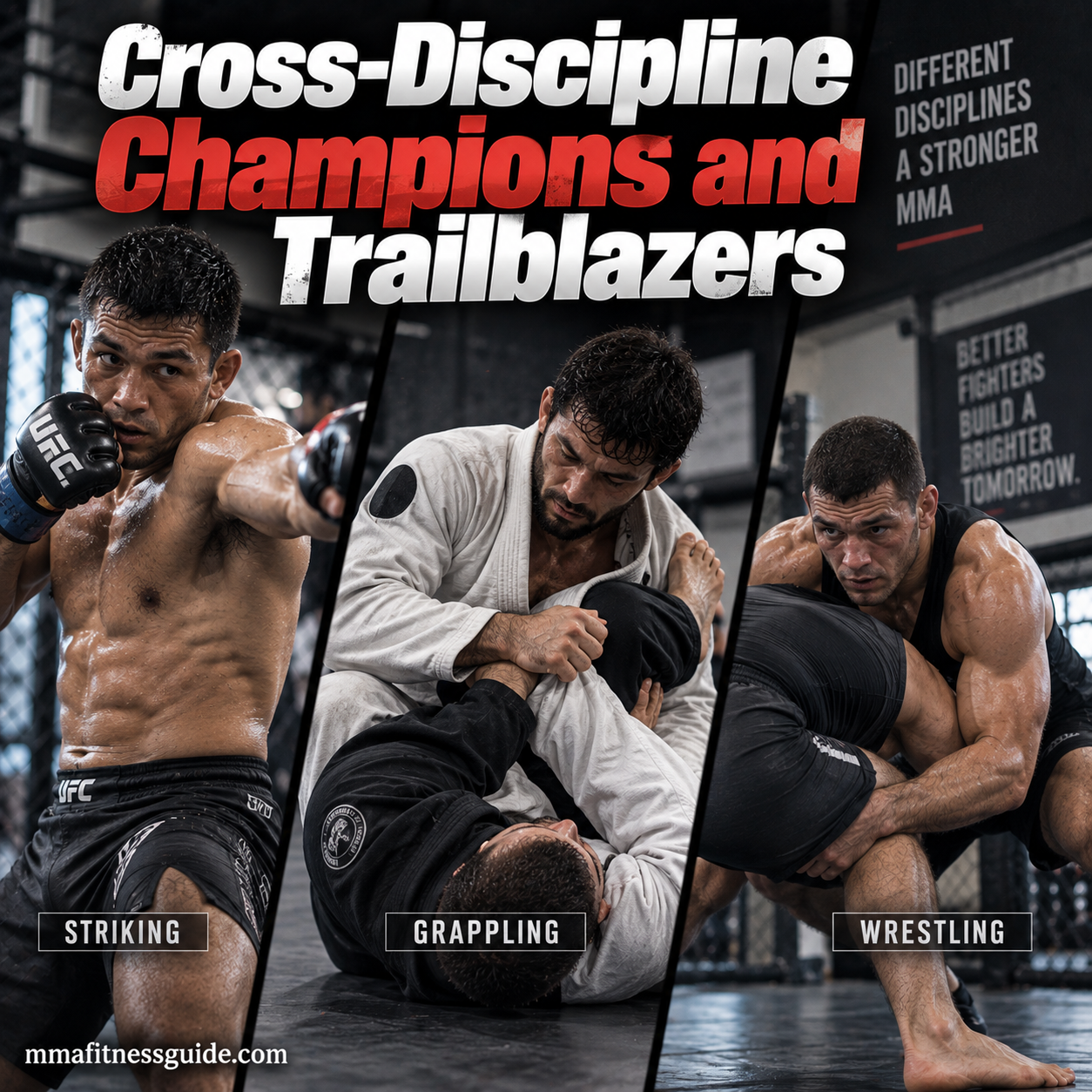
MMA athletes training in striking, grappling, and wrestling, representing cross-discipline champions and trailblazers.
Cross-discipline champions helped transform MMA by adapting techniques from striking, wrestling, grappling, and other combat sports.

Royce Gracie entered the early UFC representing Brazilian jiu-jitsu and demonstrated the importance of ground fighting. Mirko “Cro Cop” Filipović brought elite kickboxing into MMA. Holly Holm went from championship boxing to capturing a UFC title, while Randy Couture transformed high-level wrestling into a foundation for success across multiple weight classes.

Their backgrounds were different, but each demonstrated the same principle: success in combat sports often depends on adapting specialized skills to unfamiliar rules, opponents, and situations.

As MMA developed from style-versus-style contests into a sport of increasingly complete fighters, athletes who crossed disciplines became crucial to that evolution. Their successes—and the problems opponents had to solve because of them—helped make cross-training, transitional skills, and tactical adaptability fundamental parts of modern MMA.

Continue reading “Cross-Discipline Champions and Trailblazers”

Identity Beyond Fighting: Staying Balanced

A female MMA athlete wearing colored shorts sitting on the gym mats in front of a chain-link wall, paired with the article title and mmafitnessguide.com watermark.
A female fighter seated on the gym mats wearing colored shorts, representing the theme of finding identity and balance beyond fighting.

For many fighters, MMA becomes more than a sport — it becomes an identity. You train, eat, sleep, and live like a fighter. The gym becomes home. Your teammates feel like family. The grind shapes your routines, friendships, confidence, and even your sense of purpose.

But if fighting becomes the only thing that defines you, it can create pressure, burnout, and emotional instability, especially during injuries, layoffs, or transitions. True mental fitness comes from knowing who you are outside the cage, not just inside it.

This guide helps fighters stay grounded, balanced, and mentally resilient by building an identity that’s deeper and more stable than wins, losses, or training sessions.

Continue reading “Identity Beyond Fighting: Staying Balanced”

Shin Splints: Prevention and Care

A male athlete sitting on the gym floor massaging his shin, illustrating shin splint pain, with the article title and mmafitnessguide.com watermark displayed.
A fighter seated on the gym mats checking his lower leg, visually representing shin splint prevention and care.

Shin splints are one of the most common overuse injuries in MMA and combat sports. Whether you’re drilling kicks, running for conditioning, or pushing through long training sessions, the repeated impact can irritate the muscles and connective tissue along the shin.
Left unchecked, shin splints can turn from a minor annoyance into a serious setback.

Understanding what causes shin splints — and how to prevent and treat them — helps you stay consistent, reduce pain, and protect your long-term performance.

Continue reading “Shin Splints: Prevention and Care”

Best Mouthguard Cases and Hygiene Training Tips

MMA fighter storing a mouthguard in a ventilated protective case after training
A ventilated mouthguard case combined with regular cleaning and thorough drying helps keep protective gear cleaner between MMA training sessions.

A mouthguard goes straight from your mouth into an environment filled with sweat, saliva, damp clothing, and shared gym surfaces. Drop it loose into a closed gym bag after sparring, and the moisture trapped on its surface can linger for hours—along with the odor and microbial buildup that comes with poor storage.

A ventilated case gives the mouthguard physical protection while allowing moisture to escape, but the case only solves part of the problem. Rinsing after use, cleaning the material properly, letting it dry, and keeping it away from excessive heat all affect how clean it stays and how long it maintains its shape.

For MMA fighters who use a mouthguard several times a week, a simple clean-dry-store routine can prevent a lot of the grime and unpleasant smells that otherwise build up between sessions.

Continue reading “Best Mouthguard Cases and Hygiene Training Tips”

MMA: Check and Counter Leg Kicks

MMA fighter checking an opponent’s leg kick with his shin during a fight.
A properly timed leg-kick check can limit damage and create an immediate opportunity to counter.

A clean leg kick can immediately change how an MMA fighter moves. After enough damage to the thigh or calf, pushing off, changing direction, planting for punches, and defending takedowns can all become harder. Letting those kicks accumulate gives an opponent more control over range and movement.

Checking changes that exchange. Instead of allowing the kick to land cleanly on the leg, the defender raises and turns the shin to meet the incoming strike. From there, a quick punch, returned low kick, or takedown entry can make the opponent pay for committing to the kick.

The key is connecting the defense and counter into one sequence: recognize the kick, check it without losing position, regain your stance, and respond while the opponent is still recovering.

Continue reading “MMA: Check and Counter Leg Kicks”

Managing Weight Between Fights

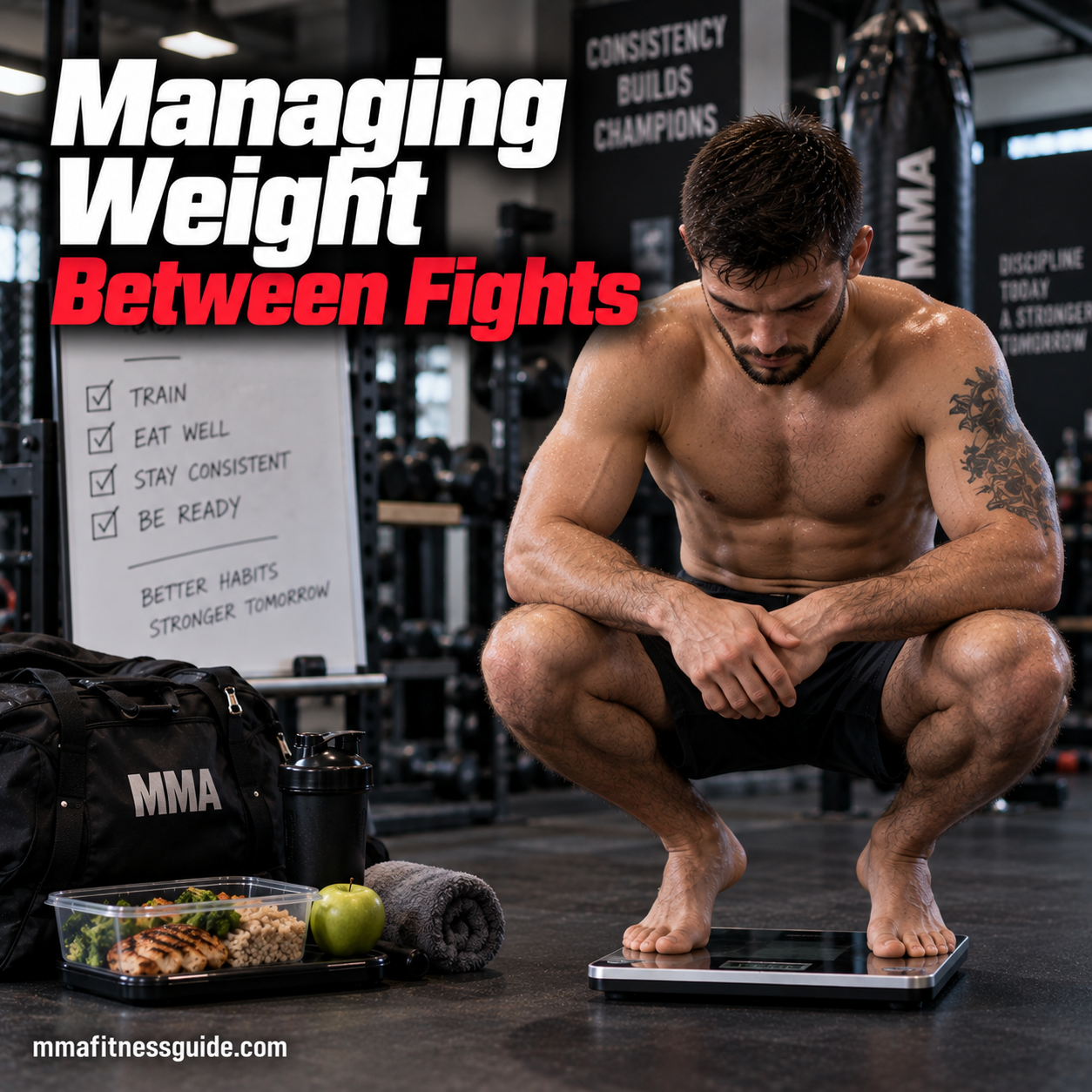
MMA fighter checking his weight on a digital scale in a gym, with a prepared meal, water bottle, and training equipment nearby.
Maintaining a healthy walking weight through consistent nutrition and training can reduce pressure to make drastic weight changes before competition.

The fight is over, the weigh-in pressure is gone, and you can finally enjoy meals without counting every calorie. A few days later, the scale jumps as your body replenishes fluids and glycogen. But when a few relaxed days turn into months of inconsistent eating and reduced training, you might enter your next fight camp carrying considerably more weight than expected.

For MMA fighters, boxers, and other combat athletes, the time between competitions is an opportunity to recover, rebuild strength, and establish sustainable nutrition habits. Staying at an appropriate walking weight can reduce the pressure to pursue aggressive weight cuts while allowing enough food and recovery to support productive training.

The goal isn’t to stay at fight weight year-round or restrict yourself after every meal. It’s to maintain a healthy, manageable weight that fits your body, training demands, and competition schedule. Consistent eating habits, appropriate training, and realistic weight targets can make the transition into your next fight camp less stressful without sacrificing strength or recovery.

Continue reading “Managing Weight Between Fights”

MMA: Prevent Overtraining in MMA

A tired MMA athlete sitting against the padded gym wall with his hands wrapped, representing the importance of preventing overtraining in mixed martial arts.
A fatigued fighter resting against the gym wall, illustrating the need for smart training habits to avoid overtraining in MMA.

Overtraining is one of the biggest threats to a fighter’s long-term progress. When training volume, intensity, and stress stack up faster than your body can recover, performance drops — sometimes sharply.
For beginners and experienced fighters alike, learning how to recognize and prevent overtraining is essential for staying healthy, improving consistently, and avoiding unnecessary injuries.

Overtraining isn’t about being “weak” or “unmotivated.” It’s a physiological state where your body can’t keep up with the workload. The best fighters train hard — but they also train smart. This guide shows you how.

Continue reading “MMA: Prevent Overtraining in MMA”