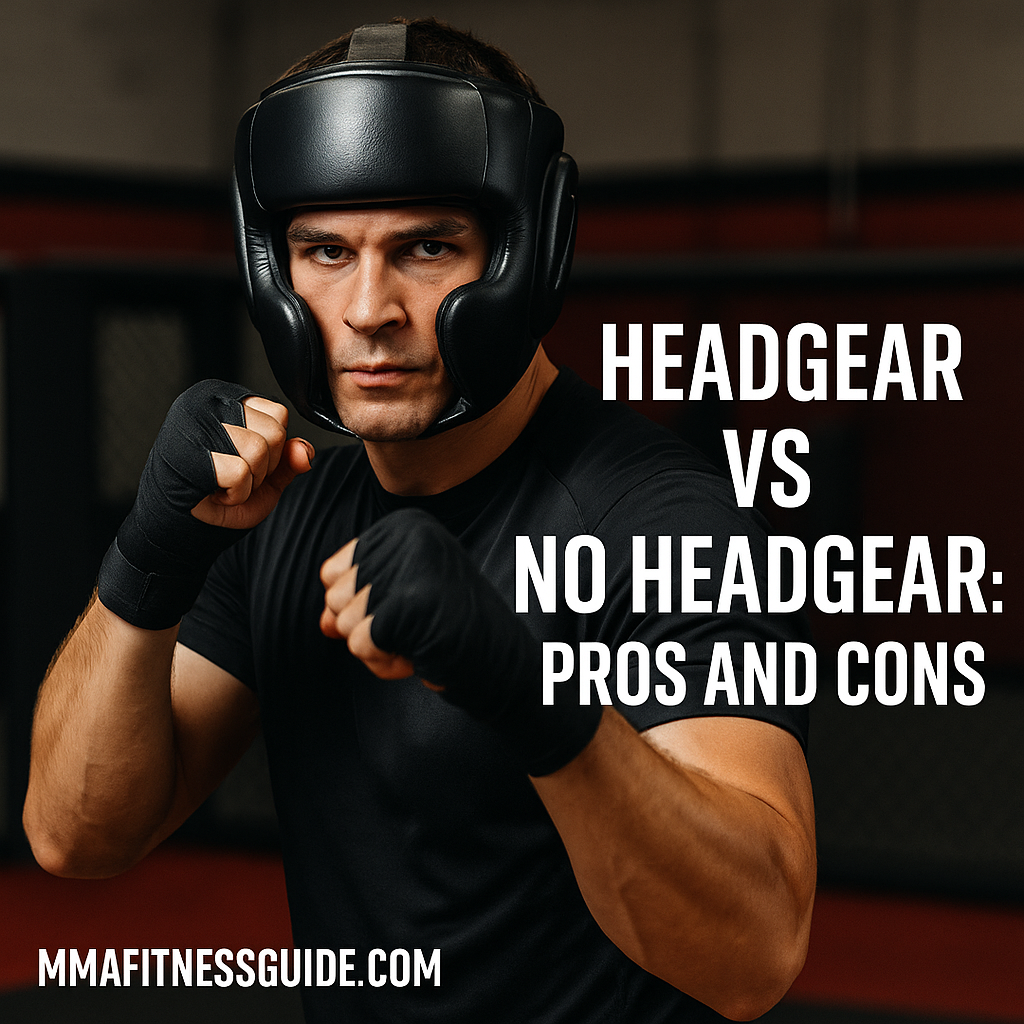
Introduction
Should you wear headgear during MMA sparring, or is it better to train without it?
It’s a common question among beginners, recreational athletes, and competitive fighters. Some prefer the additional padding because it helps reduce cuts and facial abrasions. Others find that headgear obstructs their vision, changes their sense of distance, and makes them uncomfortable during longer rounds.
Both approaches have practical advantages and limitations, but one distinction matters more than anything else:
Headgear may help protect against certain superficial injuries, but it cannot be relied upon to prevent concussions or other brain injuries.
A fighter can experience a concussion while wearing expensive, well-fitted headgear. Likewise, removing headgear doesn’t automatically make someone a more technically responsible sparring partner.
The appropriate choice depends on your gym’s rules, the type of training, your experience, the equipment’s fit, and the level of contact involved.
This guide examines the advantages and disadvantages of wearing headgear during MMA sparring, explains what protective equipment can realistically accomplish, and provides practical considerations for choosing, maintaining, and using it.
Most importantly, it explains why controlling sparring intensity matters more than simply adding or removing padding.
Why the Headgear Debate Matters
MMA combines striking, clinch work, takedowns, and ground fighting. These activities create different demands on protective equipment.
A boxer may primarily need to consider punches and occasional accidental head clashes. An MMA fighter must also account for kicks, clinch exchanges, takedowns, and the possibility of equipment shifting during grappling.
Headgear can influence several aspects of training:
- Safety and superficial injury protection.
- Peripheral vision and awareness.
- Perceived sparring intensity.
- Defensive habits and distance management.
- Comfort, heat, and mobility.
- Compatibility with grappling and clinch work.
The discussion becomes complicated because athletes often use the word protection to describe very different outcomes.
Preventing a cut above the eyebrow is not the same as preventing a concussion.
Reducing discomfort from an accidental collision is not the same as reducing the forces transmitted to the brain.
A piece of equipment may help with one outcome without reliably addressing another.
The Three Questions Every Fighter Should Ask
Before deciding whether to wear headgear, consider three separate issues.
What injury are you trying to reduce?
If your concern is facial cuts or abrasions, appropriate headgear may offer a practical benefit.
If your concern is concussion, headgear should not be considered a reliable preventive measure.
What type of training are you doing?
Light boxing drills, controlled MMA sparring, clinch work, and live grappling have different equipment requirements.
Will the equipment change how you or your partner behaves?
If wearing headgear encourages either athlete to strike harder, the intended benefit may be undermined.
These questions provide a more useful foundation than treating headgear as universally necessary or universally harmful.
The Pros of Wearing Headgear
Headgear has several practical advantages, particularly when it is properly fitted and used for an appropriate training activity.
Its benefits are most relevant to superficial injuries and comfort rather than guaranteed protection against serious head trauma.
1. Reduced Surface Damage
One of the clearest reasons to wear headgear is to help reduce cuts, scrapes, and certain bruises.
During sparring, gloves can scrape against the forehead and cheekbones. Accidental contact may also occur during clinch exchanges.
Headgear with appropriate padding and coverage can provide a barrier between these contact points and the skin.
Depending on its design, it may help protect:
- The forehead.
- The eyebrows.
- The cheekbones.
- Portions of the ears.
- Other covered facial areas.
This can be particularly relevant for athletes who have experienced repeated cuts around the eyebrows.
However, coverage varies significantly between models.
Open-face headgear generally provides less facial coverage than models with cheek protectors.
Even full-face designs cannot eliminate cuts or other injuries.
2. Confidence for Newer Fighters
Beginners sometimes feel more comfortable participating in controlled sparring when wearing protective equipment.
The additional padding may reduce anxiety about superficial contact and help them concentrate on instructions.
For example, a new student learning to maintain a guard may feel more comfortable practicing with a familiar partner while wearing properly fitted headgear.
That confidence can be useful when it supports controlled technical learning.
However, headgear should not be used to push beginners into contact levels they aren’t ready for.
A student who is flinching, turning away, or losing control may need slower drills, lighter contact, or additional instruction rather than more equipment.
Confidence should develop through progressive training and appropriate coaching.
3. Reducing Superficial Injuries During Fight Preparation
Competitive fighters sometimes use headgear during selected sparring sessions to reduce the likelihood of cuts and facial abrasions.
A cut shortly before competition may interrupt training or require medical attention.
Appropriate headgear may help limit some superficial damage, although its effectiveness depends on coverage, fit, and the nature of the contact.
This does not make hard sparring safe during fight camp.
Repeated head impacts remain a concern regardless of equipment.
Coaches should manage contact exposure, training intensity, and recovery rather than relying on headgear to compensate for aggressive sparring.
4. Additional Coverage During Accidental Contact
Close-range exchanges can involve accidental contact between heads or contact from other body parts.
Headgear may cushion some contact to covered areas, depending on its design.
For example, padding around the forehead or ears may reduce certain superficial injuries during accidental collisions.
However, the equipment does not guarantee protection against injury from elbows, knees, head clashes, or falls.
These situations can involve substantial forces, and a concussion can occur even without visible external damage.
Appropriate rules, partner control, and supervision remain essential.
The Cons of Wearing Headgear
Headgear can help with certain superficial injuries, but it also introduces practical disadvantages.
Some drawbacks depend heavily on the design and fit of the equipment, while others involve how athletes behave when they feel protected.
1. Reduced Visibility
Headgear with thick cheek protectors or a prominent forehead section can restrict peripheral vision.
This may make it more difficult to track punches approaching from wide angles, particularly hooks and certain overhand punches.
In MMA, fighters also need to recognize high kicks, level changes, and clinch entries.
Poorly positioned padding can interfere with these visual cues.
A properly fitted open-face model may provide better visibility than a bulky full-face design, but the trade-off is reduced facial coverage.
Before purchasing headgear, put it on and check whether you can comfortably see punches approaching from different angles.
2. Creates a Larger Target
Headgear adds material around the head.
Depending on its design, the increased size may change how easily an opponent can make contact with it.
Some fighters also find that bulky headgear changes their perception of distance.
However, the claim that headgear necessarily makes athletes absorb more punches is not established for every design or training situation.
The practical concern is whether the equipment interferes with normal defensive movement or encourages careless exchanges.
3. A False Sense of Safety
This is arguably the most important disadvantage.
An athlete wearing headgear may feel comfortable absorbing punches that would otherwise encourage them to disengage.
Their sparring partner may also assume that additional padding makes harder contact acceptable.
Neither assumption is justified.
The Association of Ringside Physicians’ 2024 position statement explains that headguards should not be relied upon to prevent concussions or traumatic brain injuries. It also identifies risk-taking behavior as a potential factor that could offset protective benefits.
PubMed
+1
Headgear should never be treated as permission to increase striking intensity.
4. Heat, Weight, and Discomfort
Headgear can become uncomfortable during long training sessions.
Common complaints include:
- Heat accumulating around the forehead.
- Sweat entering the eyes.
- Pressure around the ears.
- Straps rubbing against the skin.
- Padding shifting during movement.
Poorly fitted equipment can become especially distracting when transitioning between striking and grappling.
If your headgear repeatedly shifts, obstructs your vision, or creates significant discomfort, stop and correct the fit before continuing.
The Pros of Sparring Without Headgear
Sparring without headgear can be useful in carefully controlled training environments.
The advantages relate primarily to visibility, comfort, and equipment-free movement—not to a proven reduction in head injury risk.
1. Better Visibility and Awareness
Without padding surrounding the eyes and cheeks, fighters have an unobstructed view of their surroundings.
This can make it easier to observe:
- Punches approaching from wide angles.
- Changes in an opponent’s stance.
- Kicking movements.
- Level changes.
- Clinch entries.
For technical drills, unrestricted vision can make it easier to concentrate on timing and positioning.
However, improved visibility doesn’t guarantee faster reactions or better defense.
Those abilities must still be developed through practice.
2. More Realistic Fight Feel
Professional MMA competition generally takes place without padded sparring headgear.
Training without it may provide a closer approximation of competition conditions in terms of visibility, head movement, and equipment bulk.
This can be relevant when practicing distance management and defensive positioning.
However, realistic preparation does not require repeated hard contact to the head.
Competition-specific skills can be developed through controlled drills, movement exercises, pad work, and carefully supervised technical sparring.
3. Encourages Attention to Defensive Responsibility
Some fighters feel more aware of their defensive mistakes when they aren’t wearing headgear.
Without additional padding, they may pay closer attention to maintaining their guard, controlling distance, and avoiding unnecessary contact.
This is a possible training effect, not a guaranteed benefit.
A fighter can develop poor defensive habits with or without headgear.
Good coaching and appropriately structured drills are more dependable ways to develop defense.
4. Less Weight and Heat
Removing headgear eliminates its additional weight and insulation.
This can improve comfort during longer technical sessions.
It also removes concerns about straps loosening or padding shifting during movement.
For athletes who find headgear particularly uncomfortable, these differences may make controlled training feel more natural.
The Cons of Sparring Without Headgear
Removing headgear eliminates its coverage against superficial injuries.
It also leaves the athlete without any cushioning that the equipment might otherwise provide during accidental contact.
1. Greater Exposure to Cuts and Bruising
Without headgear, the forehead, eyebrows, and cheekbones are exposed.
Gloves can scrape the skin, and accidental collisions may produce cuts.
This is particularly relevant during close-range boxing exchanges.
Research summarized by the Association of Ringside Physicians supports headguards for reducing facial lacerations in amateur boxing and identifies appropriate uses in other combat sports.
PubMed
+1
Fighters who are prone to facial cuts may therefore have a practical reason to use headgear during selected sessions.
2. Less Confidence for Beginners
Some new athletes feel uncomfortable receiving even light contact to the head.
Removing headgear may increase hesitation or cause them to turn away from punches.
However, the solution isn’t necessarily to add headgear and continue sparring.
Beginners should first develop defensive skills through predictable, controlled drills.
For example, a coach might introduce single-punch defense before progressing to combinations and limited technical sparring.
Protective equipment can be incorporated according to gym rules, but it should support appropriate progression rather than replace it.
3. Hard Sparring Without Headgear Carries Significant Risks
Heavy head contact can cause concussion and other injuries regardless of whether headgear is worn.
Without headgear, fighters also lose its potential protection against facial cuts and abrasions.
The safer response is not simply to add headgear before hard sparring.
It is to limit unnecessary head impacts, manage training intensity, and use appropriate medical and coaching oversight.
4. Accidental Impacts Can Cause More Surface Damage
During MMA exchanges, fighters may experience accidental head clashes, scraping contact, or collisions during clinch work.
Without headgear, covered areas of the face and head no longer have that protective barrier.
This can increase exposure to superficial injury.
However, neither approach makes accidental collisions harmless.
Headgear vs No Headgear: Side-by-Side Comparison
| Factor | With headgear | Without headgear |
|---|---|---|
| Facial cuts | May reduce certain cuts | Less coverage against cuts |
| Concussion prevention | Not reliably demonstrated | No headgear protection |
| Peripheral vision | May be restricted | Unobstructed by headgear |
| Comfort | Can feel hot or bulky | No additional equipment |
| Distance perception | May feel different | Closer to competition conditions |
| Defensive habits | Risk of overconfidence | Still requires disciplined defense |
| Clinch work | May shift or interfere | No headgear interference |
| Equipment maintenance | Requires cleaning and inspection | No headgear to maintain |
The important distinction is that these differences do not establish one approach as universally safer.
Sparring intensity, contact frequency, supervision, and athlete behavior remain central considerations.
Does Headgear Actually Prevent Concussions?
This question deserves a separate explanation because it is frequently misunderstood.
A concussion is a traumatic brain injury that can occur when forces cause the brain to move or deform within the skull.
A direct blow to the head is one possible cause, but an impact elsewhere on the body can also transmit forces to the head.
Headgear may change some impact characteristics, but this does not establish that it prevents concussion.
What Does the Research Say?
The Association of Ringside Physicians reviewed the available evidence and concluded that headguards are useful for certain facial and ear injuries but should not be relied upon to prevent concussion or traumatic brain injury.
The organization noted that biomechanical research suggests headguards may reduce some measured acceleration forces, but high-quality human evidence establishing concussion prevention is lacking.
PubMed
+1
This distinction matters.
Reducing a measurement in a laboratory does not automatically establish that an athlete will experience fewer concussions during actual sparring.
Why Padding Cannot Eliminate Brain Injury Risk
The brain can experience harmful forces even when the skin and skull are covered.
Padding may reduce some external impact effects, but it cannot eliminate all acceleration and rotational forces.
A fighter can therefore sustain a concussion without a visible cut or bruise.
Likewise, feeling less pain after a punch doesn’t prove that the impact was harmless.
Recognizing a Possible Concussion
Warning signs can include:
- Headache.
- Dizziness.
- Confusion.
- Blurred or double vision.
- Nausea.
- Balance problems.
- Memory difficulties.
If a concussion is suspected, stop training immediately, remove the athlete from contact, and arrange prompt medical evaluation. Do not return to sparring that day.
Worsening headache, repeated vomiting, seizures, increasing confusion, weakness, or difficulty waking require emergency medical attention.
The Association of Ringside Physicians recommends particularly cautious concussion management in combat sports because intentional head contact is part of competition.
PubMed
+1
For a detailed explanation of symptoms, recovery, and return-to-training considerations, read our Concussion Awareness and Protocols guide.
When Should You Wear Headgear?
Headgear can be appropriate when its specific protective benefits match the activity.
The decision should involve your coach, applicable gym rules, and any relevant medical advice.
During Selected Sparring Sessions
Headgear may help reduce superficial facial injuries during sparring.
However, it should not be used as justification for harder contact.
If a session requires repeated heavy blows to the head, the training intensity itself deserves reconsideration.
During Fight Camp
A facial cut shortly before competition can interrupt preparation.
Appropriate headgear may help reduce certain lacerations during selected training activities.
However, preventing cuts is only one part of injury management.
Reducing unnecessary head-impact exposure is particularly important during competition preparation.
When Facial Coverage Is Specifically Needed
Some athletes have practical reasons to prioritize facial coverage, such as a history of cuts around the eyebrows.
Headgear may be useful when appropriate, provided there are no unresolved injuries requiring medical assessment.
Do not use it to conceal an injury or continue training against medical advice.
When Required by Your Gym
Some gyms have mandatory headgear policies for specific classes.
Follow those requirements and confirm which designs are acceptable.
A gym may permit open-face headgear but prohibit bulky full-face models during certain activities.
When Should You Skip Headgear?
Training without headgear may be appropriate when gym rules permit it and the activity is structured to minimize unnecessary head contact.
Light Technical Sparring
Controlled technical sparring can allow athletes to practice timing, distance, and defensive movement without relying on additional padding.
However, light sparring must actually remain light.
If either partner begins escalating contact, the coach should intervene.
Defensive Movement Drills
Headgear may be unnecessary during non-contact exercises involving:
- Footwork.
- Slipping.
- Blocking.
- Shadowboxing.
- Distance management.
These activities allow fighters to practice defensive skills without intentionally absorbing punches.
Competition-Specific Movement
Advanced athletes may practice movement and positioning without headgear to become familiar with competition conditions.
This does not require full-contact sparring.
Controlled drills can provide valuable preparation without unnecessary head impacts.
Best Approach for Most Fighters: Match Equipment to the Activity
There is no universal rule that technical sparring must be performed without headgear or that hard sparring becomes acceptable when headgear is worn.
A better approach is to match equipment to the activity while controlling contact.
| Training activity | Headgear consideration |
|---|---|
| Shadowboxing | Generally unnecessary |
| Pad work | Generally unnecessary |
| Non-contact defensive drills | Generally unnecessary |
| Light technical sparring | Follow gym rules and individual needs |
| Controlled sparring with facial contact | May help reduce superficial injuries |
| Clinch and dirty boxing drills | Consider coverage, fit, and interference |
| Hard sparring | Headgear does not make repeated head impacts safe |
| Live grappling | Use discipline-appropriate equipment when needed |
The central principle is simple: adjust the intensity to the athlete, not the intensity to the amount of padding.
A beginner wearing headgear should not be expected to absorb harder punches than a beginner without it.
How to Choose the Right MMA Headgear
If you decide to purchase headgear, focus on fit, coverage, visibility, and compatibility with your training.
Price alone is not a reliable indicator of protection.
Open-Face Headgear
Open-face designs generally leave the front of the face more exposed.
Potential advantages include improved visibility and reduced bulk.
The trade-off is less coverage around the cheeks and other facial areas.
Cheek-Protector Headgear
These models include additional padding around the cheekbones.
They may provide greater coverage against certain superficial injuries but can restrict peripheral vision.
Check visibility carefully before purchasing.
Full-Face Headgear
Some designs include additional facial structures or bars.
They may provide more coverage for particular training purposes, but they can also interfere with visibility, movement, or grappling.
Confirm that your gym permits the specific design.
Wrestling Ear Guards
Wrestling-style ear guards serve a different purpose from striking headgear.
They are designed primarily to protect the ears during grappling.
They should not be treated as substitutes for appropriate striking equipment.
For more information about ear protection, see Ear Care for Grapplers: Preventing Cauliflower Ear .
How Should MMA Headgear Fit?
Even expensive headgear can become problematic if it doesn’t fit correctly.
Before buying, check several details.
Secure Positioning
The headgear should remain stable when you move your head.
It should not slide over your eyes or rotate excessively.
Clear Vision
Look straight ahead and to both sides.
Check whether the padding obstructs important parts of your field of vision.
Comfortable Pressure
The headgear should feel secure without causing significant pressure around your forehead, jaw, or ears.
Reliable Closures
Inspect the straps and fasteners.
They should remain secure during ordinary movement without creating exposed hard surfaces that could injure a partner.
Compatibility With Other Equipment
Check whether the headgear interferes with your mouthguard, gloves, or permitted training movements.
Ask your coach to inspect the fit before using new equipment during sparring.
Budget vs Premium Headgear: Is Expensive Equipment Worth It?
Premium headgear may offer improvements in materials, construction, fit adjustments, and durability.
However, expensive equipment is not automatically more protective against brain injury.
When comparing products, consider:
- Padding coverage.
- Fit and adjustability.
- Visibility.
- Construction quality.
- Secure closures.
- Cleaning requirements.
- Intended training use.
A well-fitting mid-range model may meet your needs better than a premium model that obstructs your vision.
Avoid paying extra solely for a recognizable logo or professional endorsement.
Our Budget vs Premium: Where to Spend First guide explains how to prioritize equipment purchases.
You can also explore Top Brands Making Quality MMA Equipment when comparing manufacturers.
Headgear for Beginners and Younger Martial Artists
Beginners require appropriate instruction, progressive skill development, and carefully controlled training.
Headgear may be part of a gym’s protective equipment requirements, but it should never replace these safeguards.
For children and younger martial artists, decisions about contact training require particular caution.
Parents should discuss training rules, protective equipment, and head-contact policies with qualified coaches and appropriate healthcare professionals.
Headgear does not make repeated head impacts safe for children.
Age-appropriate training should emphasize technical development, movement, and controlled activities rather than unnecessary head contact.
For equipment considerations specific to younger athletes, see our Kid-Friendly Gear Picks for Young Martial Artists .
Beginners building their first training kit can also read Essential Gear for Beginner MMA Fighters .
How to Clean and Maintain MMA Headgear
Headgear comes into contact with sweat, skin oils, and shared training environments.
Regular cleaning helps maintain hygiene and keeps the equipment in usable condition.
Clean It After Training
Follow the manufacturer’s cleaning instructions.
For many models, this involves wiping suitable surfaces with an approved cleaning product and allowing the equipment to dry thoroughly.
Avoid soaking headgear unless the manufacturer permits it.
Some padding materials can retain moisture internally.
Dry It Properly
Remove headgear from your gym bag after training.
Allow it to dry in a well-ventilated area.
Avoid excessive heat, which may damage padding, adhesives, or synthetic materials.
Inspect It Regularly
Check for:
- Flattened padding.
- Torn seams.
- Damaged straps.
- Loose closures.
- Exposed hard components.
- Changes in fit.
If the equipment becomes damaged or no longer stays securely positioned, stop using it until it has been appropriately repaired or replaced.
Our guide on How Often to Replace Training Equipment provides additional replacement considerations.
Common Headgear Mistakes to Avoid
Assuming Headgear Makes Hard Sparring Safe
This is the most serious misconception.
Headgear cannot be relied upon to prevent concussion.
Keep contact controlled regardless of equipment.
Choosing Maximum Padding Without Checking Visibility
More coverage may help with some superficial injuries, but bulky designs can interfere with peripheral vision.
Evaluate the complete fit rather than focusing only on padding thickness.
Using Headgear That Moves During Sparring
Loose equipment can obstruct vision or become distracting.
Correct the fit before continuing.
Ignoring Concussion Symptoms
A fighter may experience a concussion without losing consciousness or developing a visible injury.
Stop training when concussion is suspected and obtain medical evaluation.
Using the Wrong Headgear for Grappling
Striking headgear and wrestling ear guards are designed for different purposes.
Use equipment appropriate for the activity and permitted by your gym.
Replacing Defensive Skills With Protective Equipment
Headgear does not replace proper guarding, distance management, footwork, or controlled sparring.
Technical development should remain the priority.
For a broader discussion of training injuries, read Common MMA Injuries and How to Prevent Them .
Frequently Asked Questions About MMA Headgear
Is it safer to spar with headgear?
Headgear may reduce certain facial cuts and superficial injuries.
However, it has not been established as reliable protection against concussion.
Overall safety also depends on contact intensity, supervision, and training conditions.
Does headgear prevent brain damage?
Headgear should not be relied upon to prevent traumatic brain injury.
It may affect some impact forces, but this does not establish that it prevents concussions or long-term neurological harm.
Should beginners wear headgear?
Beginners should follow their gym’s requirements.
Headgear may be appropriate for certain activities, but progressive instruction and controlled contact are more important than equipment alone.
Does headgear make you easier to hit?
Some designs increase the size of the head’s external profile and may affect distance perception.
However, the effect varies by model and athlete.
It should not be assumed that all headgear necessarily causes fighters to absorb more punches.
Can you spar without headgear?
Some gyms permit controlled sparring without headgear.
The decision should depend on gym rules, the activity, and individual circumstances.
Removing headgear does not make hard contact safe.
Should you wear headgear during fight camp?
Headgear may help reduce facial lacerations during selected training sessions.
However, it should not be used to justify repeated hard head contact, particularly close to competition.
Is expensive headgear more protective?
Not necessarily.
Fit, coverage, construction, and suitability matter more than price alone.
No price category guarantees concussion prevention.
Final Takeaway
Headgear and no headgear each have practical advantages and limitations during MMA training.
Headgear may help reduce facial cuts, abrasions, and certain ear injuries. It can also provide useful coverage during selected sparring activities.
However, it may restrict visibility, create discomfort, or contribute to a false sense of security.
Training without headgear offers unobstructed vision and less equipment interference, but it also removes protection against certain superficial injuries.
Neither option eliminates the risks associated with repeated head impacts.
The most important decisions involve how frequently athletes receive head contact, how intensely they spar, how carefully coaches supervise training, and whether injuries are recognized and managed appropriately.
Choose headgear for its specific benefits, not as permission to absorb harder punches. Prioritize controlled training, sound technique, and long-term health.
Related MMA Safety and Equipment Guides
Continue exploring protective equipment and injury prevention with these articles from MMA Fitness Guide:
- Concussion Awareness and Protocols — Understand concussion symptoms, medical evaluation, and return-to-training considerations.
- Common MMA Injuries and How to Prevent Them — Explore common training injuries and practical risk-reduction strategies.
- Essential Gear for Beginner MMA Fighters — Learn which protective equipment belongs in a beginner’s training kit.
- Ear Care for Grapplers: Preventing Cauliflower Ear — Understand ear protection and injury considerations during grappling.
- How Often to Replace Training Equipment — Recognize when worn or damaged protective equipment needs replacing.