
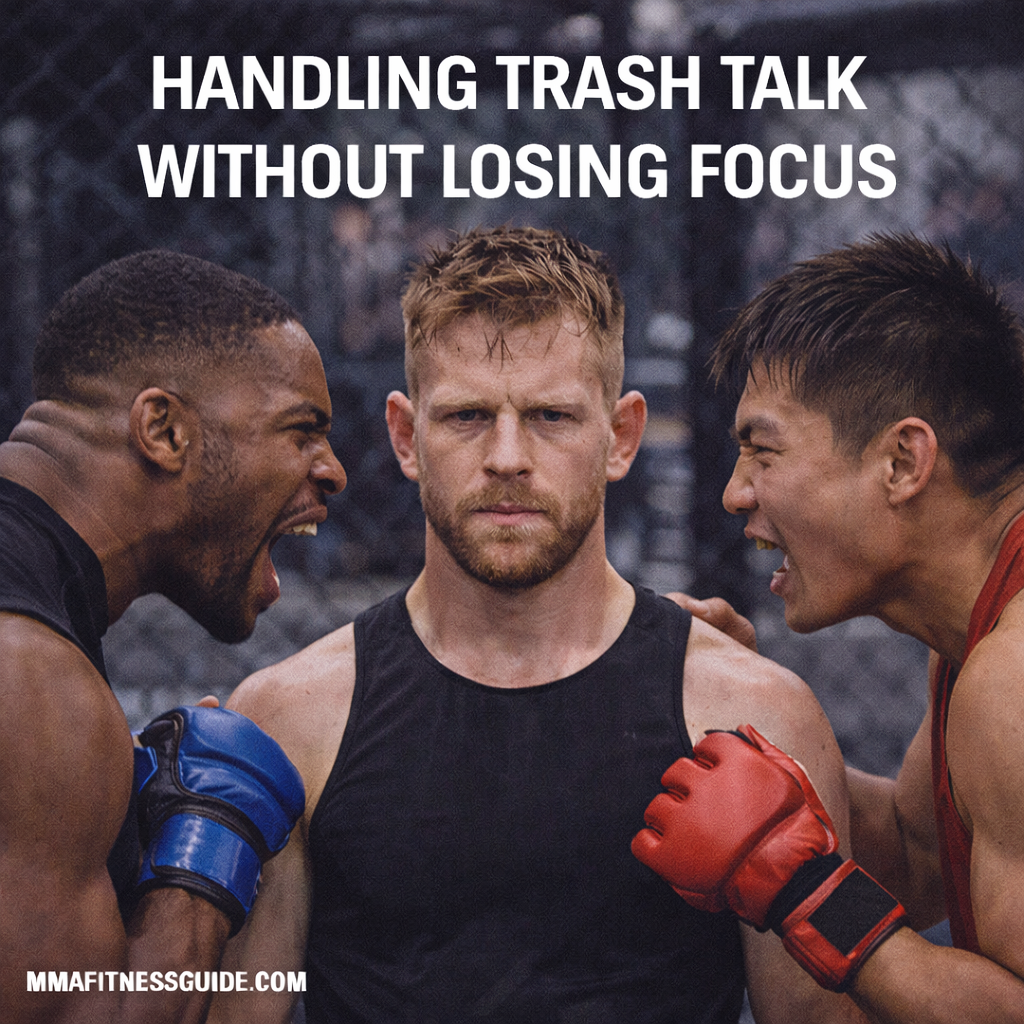
Your opponent posts a video mocking your striking a week before the fight. Within hours, teammates are sending you clips, fans are tagging you in comments, and you’re tempted to fire back. Instead of reviewing your game plan, you spend the evening thinking about what they said. By the next morning, you’re more concerned with proving them wrong than executing the strategy you’ve spent weeks preparing.
Trash talk can create distractions long before two fighters enter the cage. Whether it comes from an opponent, a training partner, or someone online, the challenge is recognizing when an emotional reaction starts influencing your decisions. Setting boundaries, limiting unnecessary engagement, and returning your attention to specific training objectives can help you manage provocation without allowing it to dictate your preparation or fighting style.
Why Trash Talk Exists in MMA
Trash talk isn’t random—it serves specific purposes.
Common reasons fighters use trash talk include:
- Gaining a psychological edge
- Forcing emotional reactions
- Distracting opponents from preparation
- Building hype or attention
- Masking their own insecurity
Understanding the intent behind trash talk makes it easier to neutralize its effect.
How Trash Talk Affects Performance
Trash talk can influence performance in both positive and negative ways.
Negative effects include:
- Loss of focus during training
- Emotional decision-making
- Over-aggression in sparring or fights
- Increased stress and anxiety
- Mental fatigue before competition
When emotions rise, clarity often drops.
The Difference Between Confidence and Reactivity
Responding emotionally to trash talk often feels like confidence—but it’s usually reactivity.
True confidence looks like:
- Staying calm under pressure
- Trusting preparation
- Executing game plans
- Letting performance speak
Reacting to trash talk shifts attention away from execution and toward ego.
Separate Noise From Reality
Trash talk is rarely an accurate assessment of skill.
Ask yourself:
- Does this change my preparation?
- Does this affect my conditioning?
- Does this improve my technique?
If the answer is no, it’s noise—not information.
Use Trash Talk as a Focus Filter
Instead of fighting distraction, redirect it.
Healthy reframing includes:
- Viewing trash talk as proof you’re relevant
- Using it to reinforce discipline
- Treating it as background noise
- Letting it sharpen—not scatter—attention
Focus is a skill that improves with practice.
Avoid the Trap of Over-Responding
Engaging too much drains energy.
Common over-responses:
- Constant verbal retaliation
- Social media arguments
- Proving points in training
- Taking unnecessary risks
Energy spent reacting is energy not spent preparing.
Control What You Can Control
Trash talk is outside your control. Preparation is not.
Focus on:
- Training consistency
- Recovery habits
- Nutrition and sleep
- Game planning
- Mental preparation
Strong routines create mental stability.
Set Clear Mental Boundaries
Boundaries protect focus.
Examples:
- Ignoring comments before training
- Limiting social media during camp
- Choosing not to engage verbally
- Keeping competition talk brief and neutral
Boundaries reduce emotional leakage.
When Trash Talk Comes From Inside the Gym
Trash talk isn’t always external.
If it comes from teammates:
- Address it calmly if it crosses lines
- Involve coaches if necessary
- Avoid escalation
- Protect gym culture and safety
Respectful environments support mental health and performance.
Using Trash Talk as Motivation—Safely
Some athletes thrive on external fuel—but it must be controlled.
Safe motivation looks like:
- Increased training focus
- Sharper execution
- Calm confidence
- Discipline, not anger
Anger burns fast. Focus lasts longer.
Mental Techniques to Stay Centered
Simple tools help manage emotional reactions.
Effective techniques include:
- Deep breathing before training
- Visualization of calm execution
- Refocusing on process goals
- Short mental cues or mantras
These tools keep emotions from hijacking performance.
Confidence Comes From Preparation
The strongest defense against trash talk is preparation.
When you trust your:
- Conditioning
- Skills
- Strategy
- Work ethic
Outside opinions lose power.
Teaching Younger Fighters to Handle Trash Talk
For beginners and youth athletes:
- Normalize trash talk as part of sport
- Emphasize respect and discipline
- Model calm responses
- Reinforce focus on effort, not ego
Mental habits formed early last longer.
Signs Trash Talk Is Affecting You Too Much
Watch for:
- Obsessive thinking about comments
- Changes in sleep or mood
- Increased aggression in training
- Loss of enjoyment
These are signals to reset focus and perspective.
Final Thoughts
Handling trash talk without losing focus is a key mental skill in MMA. Trash talk only works when it pulls attention away from preparation and execution. By setting boundaries, controlling emotional responses, and trusting your work, you protect your mindset and performance.
In the end, the most powerful response to trash talk isn’t words—it’s composure, consistency, and results.