You’re halfway through a hard round when everything starts going wrong.
A punch you didn’t see coming snaps your head back. Your takedown gets stuffed. Your opponent starts pressing forward, and suddenly the pace feels much faster than it did a minute ago. Your breathing gets heavier, your reactions slow down, and the game plan you felt confident about before the round starts slipping away.
This is where confidence in MMA actually matters.
Confidence isn’t believing you’ll dominate every opponent or convincing yourself that nothing can go wrong. Fighting is too unpredictable for that. Real confidence is knowing that when something does go wrong, you can stay composed enough to respond.
That kind of belief has to be earned.
It develops through preparation, repetition, pressure, honest assessment, and experiencing difficult situations often enough that they stop feeling unfamiliar.
What Unshakeable Confidence Really Means
Unshakeable confidence doesn’t mean you never experience doubt, nerves, or fear.
Even experienced fighters can feel anxious before sparring, competition, or a difficult training session. The difference is that confident fighters don’t need those feelings to disappear before they act.
They can feel nervous and still execute.
In practical terms, confidence means being able to:
- Trust the work you’ve already done
- Commit to techniques without unnecessary hesitation
- Stay composed after making a mistake
- Adjust when the original strategy isn’t working
- Continue working when tired or uncomfortable
- Accept feedback without seeing it as a personal attack
- Stay grounded after both good and bad performances
Think of confidence less as a feeling and more as trust in your ability to respond.
You don’t have to know exactly how a round will unfold. You need to believe you can deal with what happens next.
Why Confidence Matters So Much in MMA
MMA requires constant decision-making.
Should you throw the combination or wait? Shoot the takedown or keep striking? Scramble immediately or establish position first?
Hesitation can turn a good opportunity into a missed one.
Imagine repeatedly drilling a jab-cross-to-double-leg combination in training. During sparring, you see exactly the opening you’ve practiced. If you doubt yourself and hesitate, the opening disappears.
Confidence allows you to recognize the situation and commit.
It also matters when things go badly.
Getting hit cleanly, losing a scramble, or being taken down can trigger panic. A fighter who becomes mentally overwhelmed may abandon technique and start forcing movements.
A more confident response is simpler:
Recognize the problem, stabilize, and solve the next problem in front of you.
That mindset keeps one bad moment from becoming an entire bad round.
Confidence Comes From Preparation
One of the strongest sources of confidence is evidence.
You believe you can do something because you’ve done the work required to make that belief reasonable.
If you’ve spent weeks improving your takedown defense, drilled escapes hundreds of times, completed difficult conditioning sessions, and repeatedly practiced under pressure, you enter difficult situations with evidence behind you.
That creates a very different type of confidence than simply telling yourself you’re good.
Preparation should include more than your strengths.
If you’re an excellent striker but consistently avoid grappling because it makes you uncomfortable, part of your confidence remains fragile. You know there is an area of the fight you’re hoping to avoid.
Addressing weaknesses changes that.
You don’t necessarily need every weakness to become a strength. You need enough competence that difficult situations don’t immediately create panic.
Build Confidence Through Small Wins
Confidence rarely arrives through one dramatic breakthrough.
It accumulates.
Suppose you’ve struggled escaping bottom side control. Instead of defining success as suddenly dominating every grappling round, track smaller improvements.
Maybe this week you remembered to establish your frames immediately.
Next week you stopped getting flattened.
Then you successfully recovered half guard several times.
Eventually, you’re escaping consistently.
Each improvement becomes evidence.
The same approach works with striking, wrestling, conditioning, and mental performance.
Pay attention to improvements such as:
- Maintaining your stance when pressured
- Keeping your hands up when tired
- Successfully defending more takedowns
- Recovering your breathing between exchanges
- Remaining calm after getting hit
- Completing difficult rounds without mentally checking out
- Executing a technique you’ve been drilling
- Returning consistently after difficult training sessions
These victories might seem small individually, but together they create durable confidence.
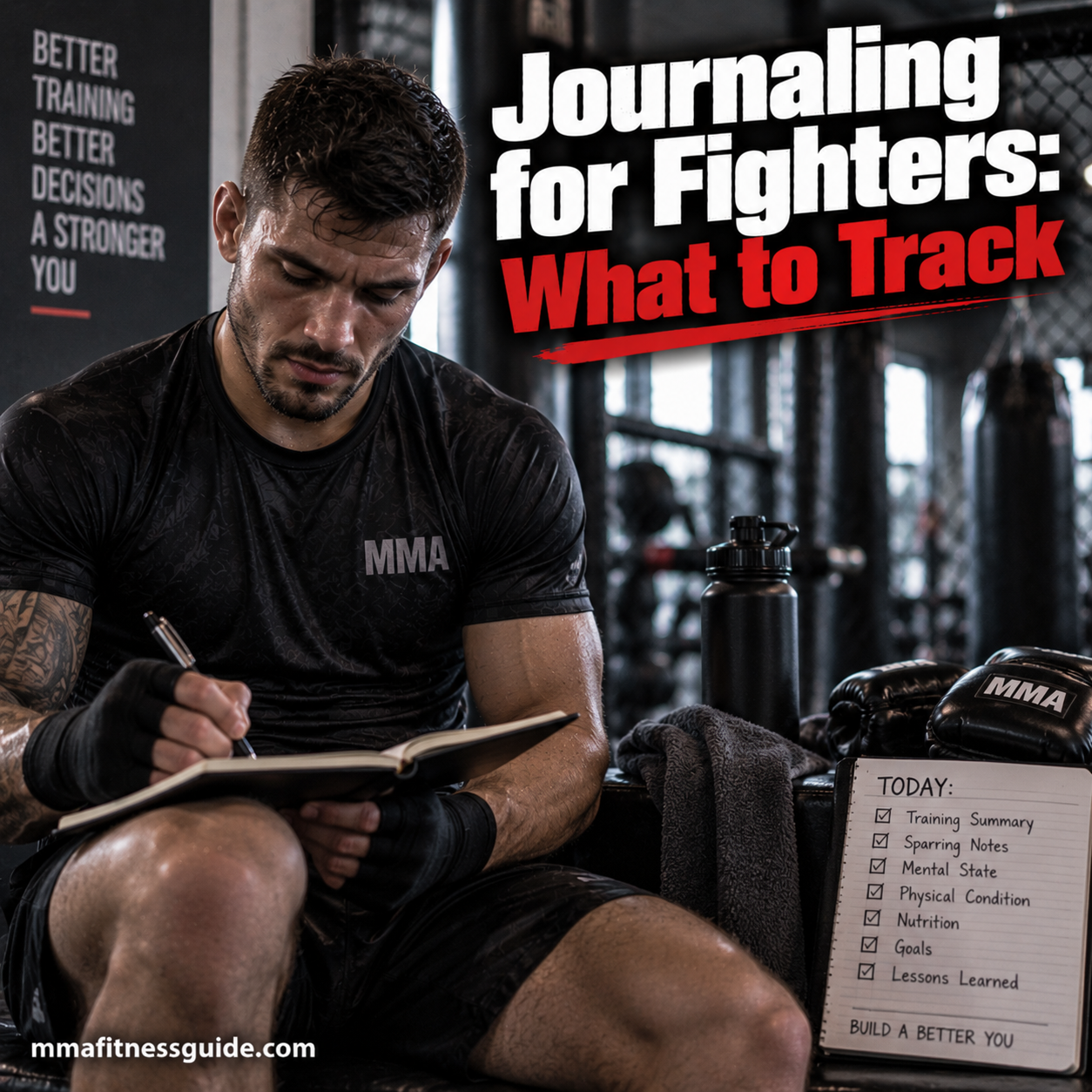
A simple training journal can help. After practice, record one thing you did well, one problem you noticed, and one specific priority for the next session.
Over several months, you’ll have a record of actual progress instead of relying on how you happen to feel that day.
Separate Confidence From Winning
One of the fastest ways to create fragile confidence is to make winning its only source.
Winning feels good, but MMA contains too many variables for your confidence to depend entirely on results.
You can perform well and lose.
You can perform poorly and still win.
The same applies to sparring. “Winning” every gym round doesn’t necessarily mean you’re developing effectively.
Instead, evaluate the parts of performance you can control.
Ask yourself:
- Did I execute what we practiced?
- Did I stay disciplined?
- Did I make useful adjustments?
- Did I maintain composure?
- Did I recognize my mistakes?
- Did I continue working when the round became difficult?
Outcome still matters in competition, but process gives you something useful to evaluate regardless of the result.
This keeps confidence from swinging wildly after every training session.
Train Your Response to Mistakes
A mistake becomes especially dangerous when it causes another mistake.
You miss a kick.
You become frustrated.
You rush forward trying to immediately make up for it.
Now you walk into a counter.
The original missed kick wasn’t necessarily the biggest problem. Your emotional reaction was.
Train yourself to reset quickly.
A simple mental sequence is:
Recognize → Reset → Respond
Recognize what happened without dramatizing it.
Reset your stance, breathing, position, or attention.
Then respond to the current situation rather than trying to erase the previous mistake.
You can practice this during sparring.
Whenever you get caught cleanly or lose a position, deliberately return your attention to the next task.
Hands up.
Find your stance.
Establish your frames.
Control your breathing.
Get back to work.
Over time, recovery itself becomes a trained skill.
Train Under Pressure Intentionally
Confidence developed only under comfortable conditions can disappear when intensity rises.
Pressure training teaches you that difficult situations are manageable.
Examples include:
- Starting grappling rounds from bottom mount
- Beginning against the cage with an opponent controlling position
- Practicing escapes with limited time remaining
- Defending takedowns after a conditioning drill
- Starting a round after your partner has already established a dominant grip
- Performing technical combinations while fatigued
- Completing situational sparring where your opponent has a specific advantage
The goal isn’t to make every session miserable.
Pressure should be controlled and purposeful.
For example, if you struggle when trapped against the cage, you might begin several short rounds there. Your partner’s objective is to maintain control or finish the takedown while your objective is to escape and return to open space.
Repeated exposure turns a frightening situation into a familiar technical problem.
That familiarity builds confidence.
Use Visualization for Difficult Moments
Visualization shouldn’t only involve imagining yourself dominating.
Visualize adversity too.
Picture yourself getting taken down and calmly establishing your frames.
Imagine getting hit cleanly and immediately returning to your stance.
Visualize feeling exhausted late in a round while still making intelligent decisions.
The mental rehearsal should be realistic.
Spend a few minutes imagining the environment, sounds, physical sensations, and emotions involved. Then mentally rehearse the response you want.
This can be especially useful before competition because you’re practicing your reaction to situations you cannot perfectly reproduce beforehand.
Create a Reliable Pre-Training and Pre-Fight Routine
Confidence often drops when fighters start searching for reassurance immediately before performing.
A routine gives your mind something familiar to follow.
Your routine doesn’t need to be elaborate.
It might include:
- A short mobility sequence
- Several controlled breaths
- Technical shadowboxing
- Reviewing one or two tactical priorities
- A brief visualization
- A simple mental cue
Useful cues might be:
- “Stay present.”
- “See it and react.”
- “One exchange at a time.”
- “Breathe and work.”
- “Position first.”
Avoid giving yourself ten different instructions.
Under pressure, simple cues are easier to use.
The purpose of a routine isn’t to guarantee that you’ll feel confident. It’s to give you a stable process even when you don’t.
Use Self-Talk That Leads to Action
Positive self-talk can help, but it needs to be believable.
If you’re exhausted and getting pressured, repeating “I’m unstoppable” probably doesn’t give you much useful information.
Action-oriented self-talk works better.
Instead of:
“I’m getting destroyed.”
Try:
“Get my guard back.”
Instead of:
“I’m exhausted.”
Try:
“Breathe. Hands up. Move.”
Instead of:
“I can’t let him take me down again.”
Try:
“Win inside position.”
The second version gives your attention somewhere productive to go.
Your internal language should direct behavior rather than simply describe your emotions.
Learn to Reframe Setbacks
Bad training sessions happen.
So do losses.
Confidence becomes fragile when every setback is interpreted as evidence that you aren’t good enough.
Instead, separate the emotional reaction from the technical information.
After a difficult session, ask:
What actually happened?
Maybe you repeatedly got caught entering the pocket with your chin high.
That’s useful information.
Now ask:
What can I train?
Perhaps the next priority becomes entering behind your jab while maintaining better defensive positioning.
The setback has now produced a training objective.
This doesn’t mean pretending losses don’t hurt or convincing yourself that poor performances were secretly good. Honest disappointment can coexist with productive analysis.
The goal is to turn the experience into information you can use.
Avoid Common Confidence Killers
Some habits slowly weaken confidence even when training is going well.
Constant comparison is one.
There will almost always be someone stronger, faster, more experienced, or technically sharper than you. Comparing your entire development to someone else’s strongest qualities creates a distorted picture.
Another problem is chasing reassurance.
If you constantly need coaches, teammates, friends, or social media to confirm that you’re improving, confidence becomes dependent on external validation.
Negative self-talk can have the same effect.
There is a major difference between:
“My takedown entries need work.”
and:
“I’m terrible at wrestling.”
The first identifies a skill problem.
The second turns a correctable weakness into an identity.
Keep your assessments specific enough that they lead to action.
Confidence vs. Arrogance
Confidence and arrogance can look similar from a distance, but they function very differently.
Confidence says, “I’m prepared to deal with this.”
Arrogance says, “This can’t happen to me.”
That distinction matters in MMA.
A confident fighter respects an opponent’s strengths and prepares accordingly. An arrogant fighter may ignore weaknesses because acknowledging them feels threatening.
Confidence allows you to ask questions.
It allows you to admit when someone caught you.
It allows you to work on techniques you’re bad at.
Most importantly, confidence can survive being wrong.
Arrogance often cannot.
Confidence Grows Outside the Gym Too
Your mental state during training isn’t completely separate from the rest of your life.
Poor sleep, inadequate nutrition, constant stress, and lack of recovery can make normal training challenges feel much larger.
Basic habits matter:
- Get enough sleep to recover from training
- Eat appropriately for your workload
- Give your body genuine recovery time
- Keep your schedule organized when possible
- Maintain relationships and interests outside fighting
- Avoid constantly analyzing your performance
Sometimes the most productive thing you can do for tomorrow’s training is recover properly tonight.
A stable routine outside the gym gives you more physical and mental capacity inside it.
A Simple Confidence-Building System
You don’t need an elaborate mental-performance program to begin developing stronger confidence.
Start with four habits.
After each training session: Write down one thing that improved and one thing that needs work.
Each week: Choose one weakness to deliberately expose during controlled training rather than avoiding it.
Before difficult sessions: Spend two or three minutes visualizing yourself handling adversity calmly.
During training: When something goes wrong, immediately identify your next useful action.
This creates a cycle:
Prepare → Test → Assess → Adjust → Repeat
Over time, confidence becomes less dependent on whether today’s training felt good.
You’re building evidence that you can improve, solve problems, and continue functioning when things aren’t going your way.
Final Thoughts
The most useful kind of confidence in MMA isn’t the feeling that you’re unbeatable.
It’s knowing you’ve prepared seriously and can continue making good decisions when the fight becomes uncomfortable.
You’ll still get caught sometimes. You’ll lose positions. You’ll have exhausting rounds, frustrating practices, and opponents who expose weaknesses you didn’t know you had.
None of those things automatically destroy confidence.
They can actually strengthen it when you learn to respond correctly.
Train your weaknesses instead of hiding them. Put yourself in controlled difficult situations. Track genuine improvements. Learn to reset quickly after mistakes. Build routines that don’t depend on feeling perfect.
Eventually, confidence stops being something you need to manufacture before a hard round.
It becomes something you’ve earned through enough difficult rounds to know you can handle the next one.