Why Fighter Resilience Matters
A single punch can change a fight. An injury can erase months of preparation. A losing streak can force an athlete to question the training methods that once brought success.
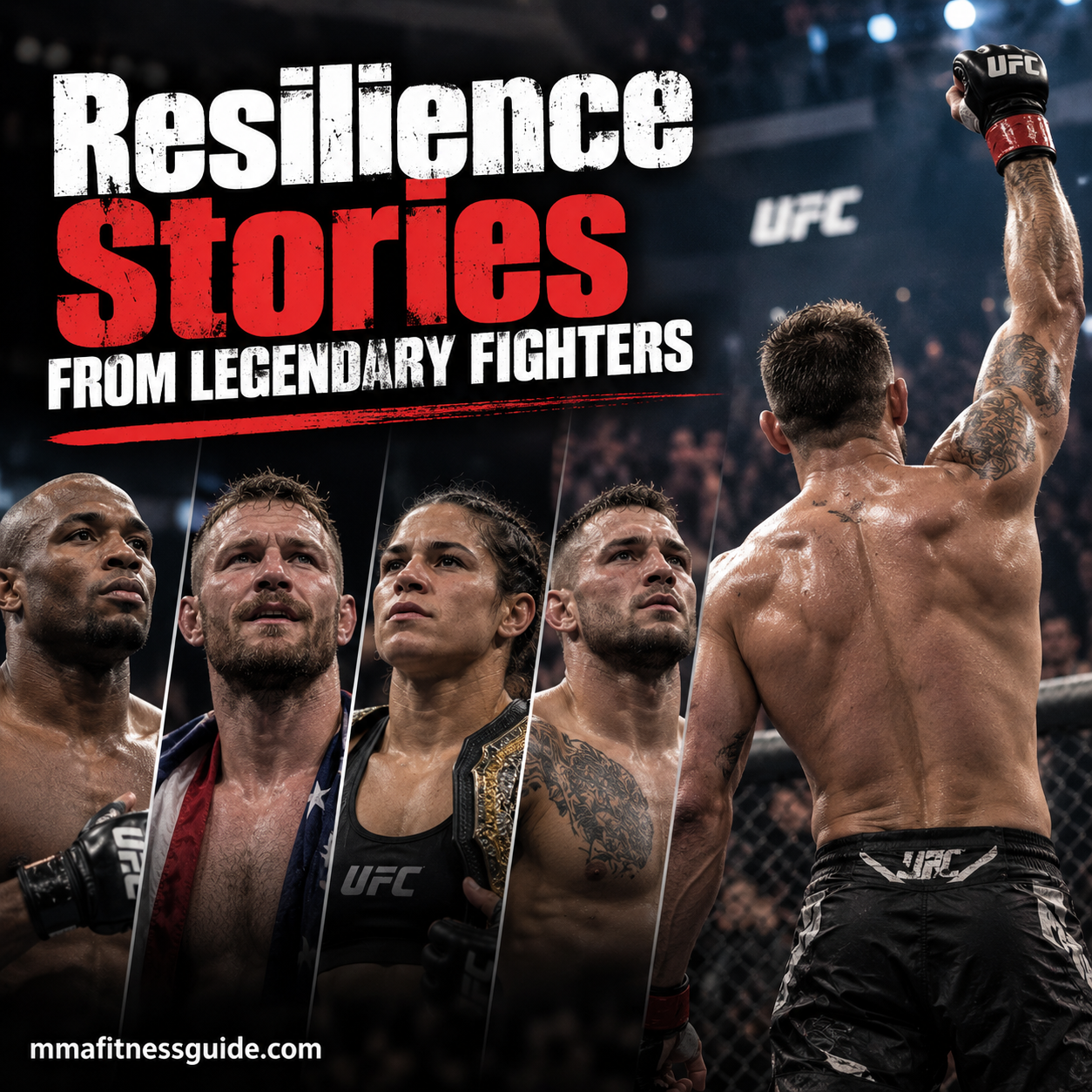
Georges St-Pierre lost his welterweight title in a stunning upset. Michael Bisping spent years pursuing a championship while dealing with a serious eye injury. Anderson Silva suffered a broken leg that threatened to end his career.
Their stories show different responses to adversity. Some fighters changed training environments, others adjusted their techniques, and some had to reconsider what competing meant to them.
For MMA athletes, these experiences offer practical lessons about recovering from defeat, recognizing when change is necessary, and maintaining perspective when progress stalls.
Georges St-Pierre: Rebuilding After a Shocking Defeat
In April 2007, Georges St-Pierre entered UFC 69 as the welterweight champion and lost his title to Matt Serra by first-round TKO.
The defeat forced St-Pierre to reconsider his preparation and approach to competition. He has spoken publicly about the pressure and fear he experienced throughout his fighting career, challenging the assumption that elite athletes enter every contest feeling fearless.
Rather than relying on motivation alone, St-Pierre continued developing a disciplined approach to training and mental preparation.
His response included:
- Working with specialists to strengthen his mental approach.
- Studying opponents and developing detailed strategies.
- Maintaining structured training routines.
- Treating fear as something to manage rather than eliminate.
In April 2008, St-Pierre defeated Serra by second-round TKO at UFC 83, reclaiming the welterweight championship.
The result demonstrated how a fighter could return from a major upset with a more developed game plan and renewed focus.
Lesson: After a disappointing performance, identify what needs to change. Review your preparation, work with your coaches, and address specific weaknesses rather than allowing one result to define your abilities.
Amanda Nunes: Changing Her Approach After Early Defeats
Amanda Nunes’ path to becoming a two-division UFC champion included setbacks that exposed weaknesses in her performances.
In 2014, she faced Cat Zingano at UFC 178. Nunes started strongly but faded as the fight progressed, eventually losing by third-round TKO.
UFC
The loss highlighted the importance of maintaining performance beyond the opening exchanges.
Nunes continued developing her skills at American Top Team, where she trained alongside experienced coaches and high-level fighters.
Her development involved:
- Improving conditioning for longer fights.
- Refining her striking and grappling.
- Developing more consistent pacing.
- Working within a structured training environment.
In 2016, she defeated Miesha Tate to capture the UFC women’s bantamweight championship. She later added the featherweight title by defeating Cris Cyborg.
Her career illustrates how weaknesses exposed during competition can become priorities for future training.
Lesson: When the same problem appears repeatedly, change the preparation. If you consistently fade late in sparring, examine your pacing, conditioning, and recovery with your coaches rather than simply adding more rounds.
Michael Bisping: A Championship After Years of Setbacks
Michael Bisping spent nearly a decade in the UFC before winning a championship.
Along the way, he experienced difficult losses, underwent treatment for a serious eye injury, and repeatedly fell short of securing a title opportunity.
In 2014, Luke Rockhold submitted Bisping in their first meeting. The defeat appeared to push him further from a championship opportunity.
Bisping continued competing and recorded victories over CB Dollaway, Thales Leites, and Anderson Silva.
Then an unexpected opportunity arrived.
When Chris Weidman withdrew from UFC 199, Bisping accepted a short-notice rematch against Rockhold.
On June 4, 2016, he knocked Rockhold out in the first round to become UFC middleweight champion at age 37.
UFC
+1
His championship came after years of professional setbacks and a serious medical challenge.
However, his eye injury also provides an important caution: competing with impaired vision can carry serious risks. Medical problems should be assessed by qualified professionals, not treated as obstacles to overcome through determination alone.
Lesson: A previous defeat doesn’t guarantee the same result in a rematch. Continue developing your skills, but recognize that protecting your long-term health matters more than extending a fighting career.
Dustin Poirier: Finding Consistency Through Experience
Dustin Poirier entered the UFC with an aggressive fighting style and a willingness to engage in demanding exchanges.
His early career included notable victories, but losses to opponents such as Chan Sung Jung and Conor McGregor interrupted his progress.
After losing to McGregor in 2014, Poirier moved from featherweight to lightweight.
The change marked a new phase in his career.
At lightweight, he developed into a more experienced competitor, combining his boxing combinations with improved pacing, defensive awareness, and tactical adjustments.
His progress was visible in several major performances:
- Defeating Justin Gaethje in a demanding five-round fight in 2018.
- Beating Max Holloway in 2019 to capture the interim UFC lightweight championship.
- Defeating Conor McGregor twice in 2021.
Poirier’s career was not a continuous climb. He experienced further losses while competing against elite opposition, including unsuccessful undisputed title challenges.
His longevity demonstrates how an athlete can continue refining a fighting style after years of competition.
Lesson: Review whether your current approach still serves your development. A change in weight class, improved defensive habits, or adjustments to your training schedule may address problems that extra effort alone cannot solve.
Holly Holm: Years of Preparation Behind One Historic Victory
Holly Holm entered MMA after an extensive professional boxing career.
Although her striking credentials were established, transitioning to mixed martial arts required her to develop skills that boxing did not demand.
She had to learn to defend takedowns, navigate clinch exchanges, and respond to opponents who could threaten submissions.
These adjustments became particularly important when she faced Ronda Rousey at UFC 193 in November 2015.
Rousey entered the fight as the undefeated UFC women’s bantamweight champion.
Holm used movement, distance management, and precise counterstriking to disrupt Rousey’s attacks.
In the second round, she landed a head kick and finished the fight with follow-up strikes, capturing the championship.
UFC
+1
The performance reflected skills developed across years of boxing and MMA preparation.
Holm’s subsequent career included title losses and further challenges, demonstrating that even a career-defining victory does not eliminate future adversity.
Lesson: Prepare for the specific problems your opponent presents. Confidence becomes more useful when supported by practiced responses to takedowns, pressure, and unfamiliar positions.
Tony Ferguson: When Persistence Meets Physical Limits
Tony Ferguson’s career demonstrates both the value and the limitations of persistence.
Between 2013 and 2019, Ferguson assembled a 12-fight UFC winning streak.
His unconventional striking, relentless pace, and submission skills made him a difficult opponent.
Yet his pursuit of an undisputed lightweight title was repeatedly disrupted by injuries and canceled fights.
In 2018, he suffered a knee injury shortly before a scheduled championship bout against Khabib Nurmagomedov.
He underwent surgery and returned to competition later that year.
In May 2020, Ferguson lost to Justin Gaethje by fifth-round TKO. The defeat ended his winning streak and began a prolonged period of unsuccessful results.
Ferguson continued competing, experimenting with training arrangements and seeking ways to regain his previous form.
His story raises a question that applies to every combat sports athlete: when does persistence help, and when is it time to change direction?
Resilience does not require an athlete to ignore accumulating damage, declining performance, or medical advice.
Lesson: Set goals that account for your health and changing circumstances. Sometimes the appropriate response to repeated setbacks is a different training approach, an extended recovery period, or a decision to stop competing.
Anderson Silva: Returning After a Career-Threatening Injury
At UFC 168 in December 2013, Anderson Silva suffered a severe leg fracture while throwing a low kick against Chris Weidman.
The injury required surgery and extensive rehabilitation. His future in professional MMA was uncertain.
UFC
+1
Silva faced a demanding recovery process before returning to the Octagon in January 2015 against Nick Diaz.
The comeback required more than restoring physical strength.
A fighter recovering from a serious leg injury must also rebuild movement, coordination, and confidence in the affected limb under appropriate medical supervision.
Silva continued competing after his return, although he did not reproduce the lengthy championship winning streak that defined his earlier career.
His experience shows that a successful recovery does not have to mean returning to an identical level of performance.
Rehabilitation, regaining everyday function, and eventually resuming a chosen activity can each represent meaningful progress.
Lesson: Treat recovery as a process with measurable stages. Follow medical guidance, rebuild physical capacity gradually, and avoid judging your progress solely by how quickly you return to competition.
What These Fighters Teach About Resilience
These careers reveal several distinct ways athletes respond when their original plans fail.
| Fighter | Setback | Practical lesson |
|---|---|---|
| Georges St-Pierre | Losing his title to Matt Serra | Reassess preparation and develop a better strategy. |
| Amanda Nunes | Early losses and conditioning challenges | Identify weaknesses and adjust training. |
| Michael Bisping | Defeats and serious injury | Continue developing while respecting health risks. |
| Dustin Poirier | Career setbacks and weight-class changes | Adapt your approach as circumstances change. |
| Holly Holm | Transitioning from boxing to MMA | Develop the skills required for new challenges. |
| Tony Ferguson | Injuries and prolonged losing streaks | Balance persistence with honest evaluation. |
| Anderson Silva | Severe leg fracture | Respect rehabilitation and redefine progress when necessary. |
The common thread is adaptation.
St-Pierre returned with a different strategy. Poirier developed his career in a new weight class. Silva had to work through rehabilitation before competing again.
Their experiences also show that resilience does not guarantee a championship or a successful comeback.
What matters is responding to setbacks with decisions that support long-term development and well-being.
How to Build Resilience in Your Own MMA Training
The lessons from these fighters become more useful when translated into specific training habits.
1. Review your performance after difficult sessions
After sparring, identify one or two problems that repeatedly occurred.
Did you struggle to defend takedowns? Lose your balance during exchanges? Become exhausted because you started too aggressively?
Write down the issue and discuss it with your coach.
Choose a specific drill or adjustment to address it during your next session.
2. Make changes when progress stalls
Repeating the same routine for months without improvement can lead to frustration.
If your conditioning has plateaued, examine your training intensity, recovery, and programming.
If your striking defense remains inconsistent, dedicate time to controlled defensive drills rather than relying exclusively on hard sparring.
Use measurable feedback to determine whether changes are working.
3. Build a reliable support system
Coaches and training partners can identify problems that are difficult to recognize on your own.
Seek feedback from people who can provide specific technical observations rather than criticism without direction.
A productive training environment should encourage improvement while maintaining appropriate safety standards.
4. Take recovery seriously
Injuries, persistent fatigue, and declining performance deserve attention.
Schedule rest days, prioritize sleep, and seek medical assessment when symptoms warrant it.
Avoid using the experiences of professional fighters as justification for training through injuries.
5. Track progress beyond wins and losses
Competition results provide feedback, but they do not capture every improvement.
Record developments such as:
- Defending more takedowns during positional sparring.
- Maintaining better technique late in a round.
- Recovering more effectively between sessions.
- Remaining composed after making mistakes.
- Executing a technique that previously caused difficulty.
These observations give you concrete evidence of progress, even during periods without competition.
Final Takeaway
Georges St-Pierre lost his title and reclaimed it. Michael Bisping became champion after years of setbacks. Anderson Silva returned to competition following a severe leg fracture.
Their paths were different, and not every comeback ended in victory.
The practical lesson is to examine what happened, identify what remains within your control, and make adjustments that support your next stage of development.
After a difficult sparring session, that might mean spending 20 minutes improving your guard retention. Following an injury, it could mean completing rehabilitation before returning to contact training. After a competition loss, it may involve reviewing footage with your coach and developing a more effective game plan.
Resilience is demonstrated through the decisions you make after a setback—not simply how much punishment you’re willing to endure.