Introduction
MMA progress rarely moves in a straight line. Your striking may improve while your grappling feels stuck. You might handle five hard rounds comfortably one week and struggle through three the next because of sleep, workload, or accumulated fatigue.
That makes progress difficult to judge from individual training sessions.
Tracking a few useful indicators—rounds completed, technical goals, conditioning benchmarks, sparring observations, recovery, and video—gives you something concrete to compare over weeks and months.
The goal isn’t to record everything. Track enough information to recognize patterns and decide what deserves more attention in training.
Why Track Your MMA Training?
Without a record, it’s easy to judge progress based on your most recent session.
A difficult sparring round can make you feel like you’re getting worse even though your defense, conditioning, and decision-making have improved considerably over the previous three months.
Tracking can help you:
- Compare current performance with previous weeks
- Identify techniques that repeatedly cause problems
- See whether conditioning is improving
- Recognize periods of excessive fatigue
- Set specific technical goals
- Measure training consistency
- Give coaches more useful information
The measurements don’t have to be complicated. A few consistently recorded details are more useful than an elaborate system you stop using after two weeks.
Method 1: Track Rounds and Training Volume
Start by recording what you actually complete during training.
Depending on the session, this could include:
- Pad-work rounds
- Heavy-bag rounds
- Sparring rounds
- Wrestling rounds
- Grappling rounds
- Conditioning intervals
- Strength sessions
For example, completing five three-minute bag rounds doesn’t automatically mean you’re fitter than when you completed four. But if you can perform more rounds at a similar intensity while maintaining technique and recovering well, that provides more useful evidence of improved work capacity.
Volume should also be considered alongside intensity. Six light technical rounds and six hard sparring rounds place very different demands on the body.
Method 2: Use Repeatable Conditioning Benchmarks
Conditioning tests are useful when the test remains consistent.
Instead of changing exercises every time, choose a few benchmarks and repeat them under similar conditions every two to four weeks.
Examples include:
- Push-ups completed in one minute
- Air squats completed in one minute
- Jump-rope time without stopping
- Burpees completed in one minute
- A fixed-distance run or row
- Heart-rate recovery after a standardized interval
Choose tests that fit your training goals rather than testing everything.
More repetitions aren’t always the only sign of improvement. Completing the same workload with better technique, lower perceived effort, or faster recovery can also indicate progress.
Method 3: Record How Training Felt
Numbers don’t capture everything that happens during an MMA session.
After training, record one or two sentences about what stood out.
For example:
- “Stayed relaxed during the final sparring round.”
- “Kept dropping my right hand after the jab.”
- “Escaped mount twice using the technique from Tuesday.”
- “Felt unusually tired during wrestling.”
- “Footwork stayed balanced while throwing combinations.”
Over several weeks, repeated observations begin to reveal patterns.
If “lost position because I couldn’t establish an underhook” appears repeatedly in your notes, you have identified something specific to work on.
Method 4: Measure Sparring Progress by Decisions and Execution
Winning and losing sparring rounds isn’t a particularly reliable training metric. Partners have different experience levels, physical attributes, styles, and goals for each round.
Instead, monitor specific behaviors.
Ask yourself:
- Am I staying composed after getting hit?
- Am I breathing consistently?
- Am I maintaining my stance under pressure?
- Am I recognizing attacks earlier?
- Am I defending takedowns with better positioning?
- Am I escaping bad positions more efficiently?
- Am I creating openings rather than forcing attacks?
- Am I remembering what my coach asked me to practice?
This shifts the focus from “Did I beat my partner?” to “Did I execute the skills I’m developing?”
That provides a much clearer picture of technical progress.
Method 5: Track Grappling Positions
Grappling becomes easier to measure when you break rounds into specific positions.
Choose positions that regularly occur in your training and track what happens.
Examples include:
- Mount escapes
- Side-control escapes
- Back escapes
- Guard retention
- Guard passing
- Takedown finishes
- Takedown defense
- Maintaining top control
- Underhook battles
- Submission setups
Suppose you’re repeatedly trapped underneath side control. Rather than writing “grappling was bad,” record what happened.
For example:
“Started underneath side control four times. Escaped twice using the underhook and hip escape.”
That gives you something specific to compare during future sessions.
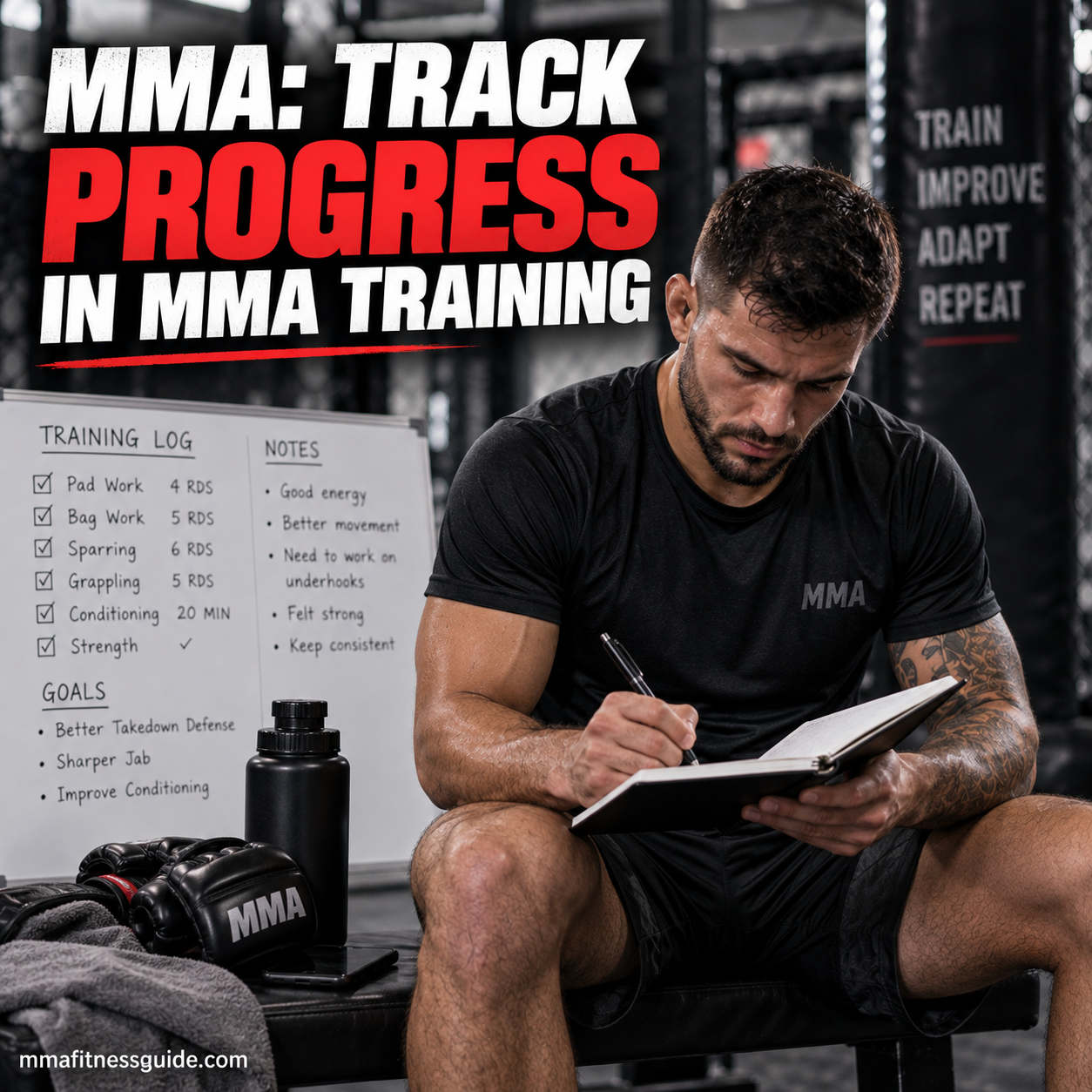
Method 6: Keep a Weekly MMA Training Log
A useful training log can take only a few minutes each week.
Record:
- Number and type of sessions completed
- Main techniques practiced
- Something that improved
- Something that caused difficulty
- General energy and recovery
- One priority for the following week
A weekly entry might look like this:
Sessions: 4 MMA, 1 strength, 1 conditioning
Improved: Jab-to-double-leg transition
Problem: Losing underhooks against the cage
Recovery: Good except after Thursday sparring
Next week’s focus: Fight for inside position earlier
This creates a running history of your development without turning training into a data-entry project.
Method 7: Use Video to Review Technique
Video can reveal technical details that are difficult to notice while you’re moving.
With permission from your gym, coaches, and training partners, record occasional clips of:
- Pad work
- Heavy-bag rounds
- Shadowboxing
- Footwork drills
- Wrestling entries
- Grappling drills
- Sparring
When reviewing footage, choose specific details instead of simply deciding whether you “look good.”
For striking, examine:
- Guard position
- Balance
- Foot placement
- Head movement
- Hip rotation
- Defensive recovery after combinations
For grappling and wrestling, look at:
- Posture
- Hand position
- Head position
- Hip placement
- Base
- Transition timing
Compare similar footage several weeks apart. Changes in balance, speed, positioning, and movement efficiency often become easier to recognize on video.
Method 8: Track Recovery and Energy
Performance can drop because of fatigue rather than a loss of fitness or skill.
A simple recovery log can include:
- Hours of sleep
- Sleep quality
- General energy
- Muscle soreness
- Appetite
- Motivation to train
- Rest days
You can use a simple 1–5 rating instead of writing detailed notes.
For example:
Sleep: 4/5
Energy: 3/5
Soreness: 2/5
Training: Normal
One low-energy day isn’t necessarily meaningful. Several days of declining energy, poor sleep, persistent soreness, and worsening training performance deserve more attention.
Method 9: Set Specific Technique Goals
“Get better at striking” is difficult to measure.
“Keep my rear hand at my cheek after throwing the jab” gives you a specific behavior to practice and review.
Technique goals could include:
- Establishing a sharper jab
- Improving hip escapes
- Finishing the double-leg against resistance
- Maintaining balance after kicks
- Recovering the guard from side control
- Defending the rear hand
- Establishing underhooks against the cage
- Escaping back control
Pick one or two priorities rather than trying to fix ten weaknesses simultaneously.
Once a skill becomes more reliable during drilling, begin testing it against increasing resistance.
Method 10: Track Body Weight When Relevant
Body weight can be useful information for competitors or athletes working toward a particular weight class.
If relevant, record:
- Morning body weight
- Longer-term weight trend
- Energy during training
- Strength and conditioning performance
- Recovery
Daily weight naturally fluctuates because of hydration, food intake, sodium, and other factors. Looking at trends across multiple measurements is generally more informative than reacting to a single weigh-in.
For recreational MMA athletes without weight-class goals, performance and recovery may provide more useful information than frequent scale measurements.
How Often Should You Track MMA Progress?
Different measurements work on different timelines.
A practical schedule could be:
- After training: One or two short observations
- Weekly: Review sessions, skills, workload, and recovery
- Every 2–4 weeks: Repeat selected conditioning benchmarks
- Monthly: Review technical goals
- Every 4–6 weeks: Compare video footage
Avoid testing yourself constantly. Training and testing serve different purposes, and repeatedly trying to set personal records can interfere with normal skill development.
Signs Your MMA Training Is Progressing
Improvement isn’t limited to punching harder or completing more rounds.
Technical and tactical progress may appear as:
- Recognizing attacks earlier
- Making fewer unnecessary movements
- Maintaining balance during combinations
- Recovering position faster
- Escaping positions that previously trapped you
- Staying composed during difficult rounds
- Using less energy to accomplish the same task
- Remembering and applying coaching instructions
- Creating attacks from setups rather than forcing them
- Recovering more efficiently between rounds
Some of these changes happen gradually enough that they’re difficult to notice without previous notes or footage for comparison.
Keep Your Tracking System Simple
A training tracker only works if you continue using it.
You don’t need to record every punch, takedown, submission attempt, heart-rate reading, or minute spent training.
Start with four categories:
- Training completed
- Technical focus
- Performance observation
- Recovery
Add more detail only when it helps you make better training decisions.
After several months, those short entries can provide a useful record of how your skills, conditioning, workload, and recovery have changed.
Final Thoughts
MMA development can be difficult to judge from memory because every session presents different partners, positions, techniques, and levels of fatigue.
Tracking creates reference points.
Record what you trained, identify specific technical successes and problems, repeat a few conditioning benchmarks, review occasional video, and monitor recovery. Over time, you’ll have evidence of where you’ve improved and clearer direction for what to work on next.
The purpose isn’t to turn every MMA session into a spreadsheet. It’s to make your training history useful enough that you can learn from it.