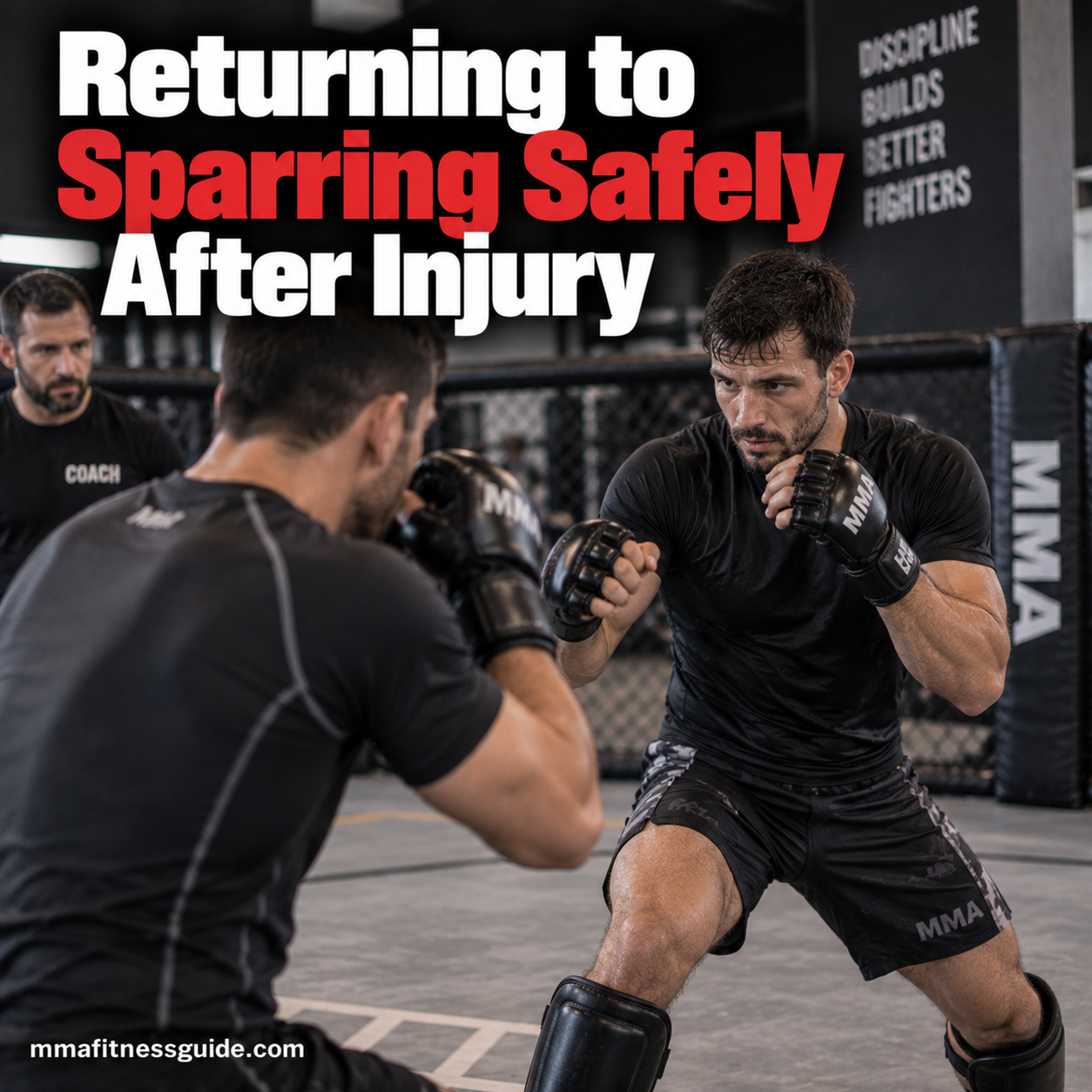
Hitting pads without pain doesn’t necessarily mean you’re ready for an opponent who changes direction, shoots unexpectedly, or fires back. Sparring adds reactions, fatigue, impact, awkward positions, and split-second decisions that controlled rehabilitation exercises cannot fully reproduce.
That gap is where a gradual return matters. Instead of using one hard round to “test” an injured knee, shoulder, wrist, or other body part, fighters can progressively add movement, resistance, contact, and unpredictability while monitoring how the injury responds.
The objective isn’t simply completing a sparring session. It’s being able to train, recover afterward, and return for the next session without symptoms escalating.
Why Returning to Sparring Requires a Progression
Rehabilitation exercises are predictable. Sparring isn’t.
A partner can suddenly change levels, force you to post, catch a kick, push you against the cage, or put you into a position you didn’t anticipate. Even light rounds require movements that may be difficult to recreate during isolated rehab work.
Returning before the injured area can tolerate those demands may lead to:
- Recurrence of symptoms
- Reinjury
- Compensating with another part of the body
- Hesitation during defensive movements
- Reduced confidence in certain positions
- Difficulty maintaining technique as fatigue increases
The transition back should therefore expose the fighter to progressively more realistic demands rather than jumping directly from rehabilitation into unrestricted rounds.
Medical Clearance and Sparring Readiness Aren’t the Same Thing
Being cleared to resume physical activity doesn’t automatically mean you’re prepared for unrestricted MMA sparring.
Depending on the injury, clinical recovery may involve restoring acceptable:
- Range of motion
- Strength
- Joint stability
- Tissue healing
- Basic functional movement
Sparring adds another layer.
A fighter may also need to tolerate:
- Explosive movements
- Repeated efforts
- Fatigue
- Partner resistance
- Contact
- Rapid changes of direction
- Unpredictable defensive reactions
The exact criteria should reflect the injury. Returning from an ankle sprain, shoulder dislocation, muscle strain, fracture, and concussion should not follow identical timelines.
Signs You May Not Be Ready for Live Rounds
Pay attention to how the injured area responds during training that comes before sparring.
Reasons to delay or reassess progression can include:
- Persistent or increasing swelling
- Sharp pain
- Reduced range of motion
- Noticeable strength loss
- Instability or giving way
- Significant symptoms during explosive movements
- Protecting or favoring one side
- Symptoms that worsen several hours after training
- Difficulty performing sport-specific movements normally
Repeatedly changing your technique to protect the injured area is particularly important to notice.
If you’re unable to move naturally during controlled drilling, adding an unpredictable opponent is unlikely to improve the situation.
Step 1: Rebuild the Physical Base
Before contact returns, rebuild the qualities the injury interrupted.
Depending on the affected area, rehabilitation may address:
- Range of motion
- Strength
- Balance
- Stability
- Coordination
- Power
- Endurance
Eventually, those qualities should be challenged in movements that resemble MMA.
For example, a fighter returning from a lower-body injury may progress toward controlled:
- Stance changes
- Level changes
- Lateral movement
- Pivots
- Shots
- Sprawls
- Kicks
- Direction changes
An upper-body injury may need to tolerate punching, framing, posting, pulling, pummeling, and controlled grappling resistance.
Step 2: Reintroduce Technical Drilling
Partner drilling adds timing and interaction without immediately introducing unrestricted resistance.
Start with predictable movements.
Options might include:
- Controlled striking combinations
- Defensive movement drills
- Technical takedown entries
- Pummeling at low intensity
- Grappling sequences with cooperative resistance
- Position-specific movement
The fighter should be able to execute the technique without obvious guarding or compensation.
If symptoms increase, adjust the drill rather than forcing more repetitions.
Step 3: Add Resistance
Once predictable drilling is tolerated, begin making the partner less cooperative.
For example:
Grappling progression:
Cooperative drilling → light resistance → positional resistance → controlled positional sparring
Striking progression:
Shadowboxing → pads or bag → controlled partner drills → limited-contact technical sparring
Resistance gives the injured area a more realistic challenge while the coach still controls the situation.
Step 4: Use Positional or Restricted Sparring
Full MMA sparring introduces many variables simultaneously. Restricted rounds let you add some without adding everything.
Examples include:
- Boxing-only technical rounds
- Limited-target striking
- Wall wrestling from a predetermined position
- Ground rounds beginning from a specific position
- Takedown rounds without strikes
- Short rounds at reduced intensity
The restrictions should reflect the injury.
A fighter returning from a shoulder problem, for instance, may need different boundaries than someone returning from an ankle injury.
Step 5: Increase Intensity and Volume Separately
A common mistake is increasing everything at once.
If you go from three short technical rounds to six hard rounds, you’ve increased intensity, duration, fatigue, and total workload simultaneously.
A more controlled progression changes one major variable at a time.
For example:
Session 1: Short, light rounds
Session 2: More light rounds
Session 3: Short rounds at moderate intensity
Session 4: Gradually increase moderate-volume work
The actual progression depends on the injury and individual response.
What matters is giving yourself enough information to know which increase caused symptoms if they return.
Check How You Feel After Training, Not Just During It
Getting through a round without pain is only part of the test.
Pay attention to what happens later that day and the following morning.
Monitor for:
- Increased pain
- Returning swelling
- Unusual stiffness
- Reduced movement
- Loss of strength
- Instability
- Symptoms that are progressively worsening
If the injured area repeatedly flares after training, the current workload may be exceeding what it can tolerate.
Managing Hesitation After an Injury
A previously injured body part can feel different even after physical function has improved.
A fighter returning from a knee injury might hesitate during takedown defense. Someone recovering from a shoulder injury may avoid posting. A fighter who injured an ankle while kicking may unconsciously reduce commitment to that side.
Controlled exposure can help rebuild familiarity.
Start with the specific movement that creates hesitation, practice it under predictable conditions, and gradually introduce resistance or unpredictability.
There’s no benefit in trying to prove confidence by immediately recreating the hardest possible version of the movement.
Communicate With Coaches and Training Partners
Your partner needs to know that the round has restrictions before it begins.
Be specific.
Instead of simply saying, “Take it easy, I’m coming back from an injury,” communicate useful boundaries such as:
- Keep striking technical
- Don’t attack a particular injured joint
- Avoid explosive takedowns
- Start from a specific grappling position
- Stop immediately if requested
A coach can also select appropriate partners and control round duration and intensity.
A technically skilled partner who respects boundaries is generally a better return-to-sparring choice than someone unpredictable or overly competitive.
Common Return-to-Sparring Mistakes
Using Hard Sparring as a Test
You shouldn’t need an uncontrolled round to discover whether an injury can tolerate contact.
Build toward that information progressively.
Ignoring Symptoms That Keep Returning
A small symptom that repeatedly becomes worse after each session deserves attention.
Letting a Good Day Dictate the Entire Progression
Feeling good during one session doesn’t erase the need to see how the body responds afterward.
Changing Too Many Variables
Adding more rounds, harder contact, and more frequent sessions simultaneously makes workload harder to manage.
Hiding the Injury From Training Partners
If your partner doesn’t know you’re returning from an injury, they can’t appropriately adjust the round.
Injury-Specific Considerations
Different injuries create different return-to-sport requirements.
Joint Injuries
Knee, ankle, shoulder, wrist, and elbow injuries may require restoration of:
- Stability
- Strength
- Range of motion
- Sport-specific control
The joint should eventually tolerate the movements it will encounter during MMA, including appropriately progressed resistance and fatigue.
Muscle Strains
A muscle may feel comfortable during everyday activities before it’s prepared for explosive sport.
Progressively reintroduce movements such as:
- Sprinting
- Kicking
- Shooting
- Bridging
- Pulling
- Explosive direction changes
The relevant movement depends on which muscle was injured.
Head Injuries and Suspected Concussion
A suspected concussion should not be managed by simply waiting until you “feel fine” and then trying light sparring.
Stop contact training and obtain appropriate medical evaluation. Return to sport should follow a graduated process, with contact reintroduced only when medically appropriate.
Symptoms such as headache, dizziness, confusion, balance problems, visual changes, nausea, or unusual sensitivity to light or noise after a head impact warrant particular caution.
If symptoms return during a return-to-sport progression, stop and seek guidance from an appropriate healthcare professional.
How Often Should You Spar When You Return?
There isn’t a universal number of weekly sessions that applies to every injury.
Instead of automatically starting at one or two sessions per week, base frequency on factors such as:
- Injury type
- Time away from training
- Current rehabilitation stage
- Intensity of the rounds
- Symptoms afterward
- Other training performed that week
Early sessions may need additional recovery time so you can evaluate the response before repeating the same workload.
When to Stop and Reassess
Stop the progression and seek appropriate guidance when you develop concerning symptoms such as:
- Sharp or increasing pain
- Significant swelling
- Joint instability
- Sudden loss of strength
- Numbness or tingling
- Reduced function
- New neurological symptoms
- Recurring concussion symptoms
An injury that continues worsening as training increases needs reassessment rather than another harder test.
A Simple Return-to-Sparring Framework
The progression can be summarized as:
Rehabilitation → individual MMA movement → technical partner drilling → resistance → restricted sparring → controlled live rounds → normal training
Not every fighter will move through those stages at the same speed.
An uncomplicated muscle strain and a surgically repaired knee clearly require different rehabilitation timelines. Progress according to the injury, clinical guidance when needed, and how your body responds to increasing demands.
Final Thoughts
The first sparring session after an injury shouldn’t be the first time you’ve tested the movements that caused concern.
Before returning to unrestricted rounds, progressively rebuild those demands in environments you can control. Restore movement and strength, practice sport-specific actions, add partner resistance, and then introduce increasingly unpredictable contact.
Pay attention to the hours after each session as closely as the session itself. Being able to complete a round matters, but being able to recover from it and train again without a significant flare-up tells you much more about whether the progression is working.
In MMA, returning isn’t a single moment. It’s a series of increasingly demanding training sessions that eventually make normal sparring feel normal again.