Breathing and posture are two of the most overlooked foundations of exercise, especially for beginners. Many people concentrate on repetitions, sets, and workout intensity without considering how their breathing patterns and body positioning affect their movements.
You might hold your breath while lifting weights, tense your shoulders during push-ups, or arch your lower back excessively when performing an overhead press. These habits can make exercises feel more difficult and interfere with movement control.
Learning basic breathing and posture techniques can help you move more efficiently, manage exercise intensity, and develop better coordination.
These skills are particularly useful for beginners interested in strength training, cardiovascular fitness, and combat sports such as MMA, where breathing and body positioning must constantly adapt to changing demands.
This guide explains how breathing and posture work together, common mistakes to avoid, practical techniques for different exercises, and a simple routine you can incorporate into your workouts.
Why Breathing and Posture Matter Together
Breathing and posture are closely connected because several muscles involved in breathing also contribute to trunk stability.
Your diaphragm, abdominal muscles, pelvic floor, and muscles surrounding your spine work together to manage pressure inside your torso and support movement.
When you inhale, your diaphragm contracts and moves downward, allowing your lungs to expand. Your ribcage moves outward, and your abdomen may expand as pressure changes inside your torso.
Your body position can influence how comfortably these movements occur.
For example, sitting in an excessively compressed position may make deep breathing feel less comfortable. Similarly, holding your shoulders rigidly elevated can create unnecessary tension while exercising.
However, good posture does not mean keeping your body perfectly straight at all times.
Different exercises require different positions. A squat involves bending at the hips and knees, while a boxing stance typically includes a slightly lowered posture with the hands protecting the face.
The objective is to maintain appropriate alignment and control for the movement you are performing.
Benefits of Coordinating Breathing and Posture
Developing these skills can help you:
- Maintain a comfortable breathing rhythm during exercise.
- Improve trunk stability during resistance training.
- Reduce unnecessary neck and shoulder tension.
- Develop better balance and movement awareness.
- Coordinate breathing with muscular effort.
- Maintain more consistent exercise technique.
For beginners, breathing and posture awareness also make it easier to recognize when an exercise becomes too demanding.
If you suddenly start holding your breath, losing balance, or moving uncontrollably, you may need to reduce the resistance or take a short break.
Common Breathing Mistakes Beginners Make
Breathing is automatic, but exercise introduces additional physical demands that can change your breathing patterns.
Some habits become particularly noticeable when you begin lifting weights or performing demanding cardiovascular workouts.
Shallow Chest Breathing
Shallow breathing involves taking relatively small breaths, sometimes accompanied by excessive movement in the upper chest and shoulders.
This pattern may become more noticeable during stress or fatigue.
Instead of forcing large breaths, focus on allowing your lower ribcage to expand comfortably.
Your chest will still move naturally. The objective is to avoid unnecessary tension.
Holding Your Breath During Exercise
Many beginners unintentionally hold their breath when an exercise becomes difficult.
This commonly happens during squats, push-ups, planks, and weightlifting exercises.
Although deliberate breath-holding is used in some advanced strength-training techniques, it can substantially increase blood pressure and is not necessary for most beginner workouts.
Learning to coordinate breathing with movement provides a practical starting point.
Rapid, Uncontrolled Breathing
Breathing faster is a normal response to increasing exercise intensity.
However, breathing much faster than necessary may contribute to discomfort or lightheadedness.
If you begin gasping during a relatively easy workout, reduce your pace and allow your breathing to settle.
Forcing Nasal Breathing
Nasal breathing can feel comfortable during walking, stretching, and other low-intensity activities.
As exercise becomes more demanding, breathing through your mouth or using both your nose and mouth is completely normal.
Do not force nasal breathing if it makes you feel short of air.
What Proper Breathing Looks Like During Exercise
There is no single breathing pattern that works for every exercise.
A person walking at a relaxed pace will breathe differently from someone performing heavy squats or completing an intense MMA conditioning circuit.
Effective exercise breathing involves adapting your breathing to the activity while avoiding unnecessary tension.
Maintain a Natural Rhythm
Your breathing should generally match the intensity of your workout.
During light exercise, breathing may remain relatively slow and quiet.
During demanding cardio, your breathing naturally becomes faster and deeper to meet your body’s increased ventilation requirements.
Avoid forcing an artificially slow rhythm when you need more air.
Allow Your Ribcage to Expand
During inhalation, your diaphragm contracts and your ribcage expands.
You may notice movement around your lower ribs and abdomen.
Your shoulders should remain relatively relaxed rather than rising dramatically with every breath.
Coordinate Breathing With Movement
During beginner strength exercises, a useful guideline is to exhale during the demanding portion of a repetition and inhale during the easier portion.
For example, inhale while lowering into a squat and exhale while standing.
This establishes a predictable rhythm and helps reduce accidental breath-holding.
Diaphragmatic Breathing Basics
Diaphragmatic breathing is a technique that emphasizes comfortable movement of the diaphragm and lower ribcage.
The diaphragm is a dome-shaped muscle located beneath your lungs.
When you inhale, it contracts and moves downward, helping draw air into your lungs. As you exhale, it relaxes and moves upward.
Your diaphragm is active during ordinary breathing, even when you are not consciously practicing a breathing technique.
Diaphragmatic breathing exercises are designed to improve awareness and encourage relaxed, coordinated breathing.
What Should Diaphragmatic Breathing Feel Like?
During a comfortable inhale:
- Your lower ribs expand outward.
- Your abdomen may gently rise.
- Your shoulders remain relaxed.
- Your neck does not need to strain.
During an exhale, your ribs and abdomen gradually return toward their starting positions.
Your chest does not need to remain completely motionless. Natural breathing involves movement throughout the ribcage.
Avoid forcing your abdomen outward or taking excessively large breaths.
The goal is comfortable breathing rather than exaggerated movement.
How to Practice Diaphragmatic Breathing
Beginners can practice diaphragmatic breathing at home without any equipment.
Start in a comfortable position where you can concentrate on your breathing without worrying about balance or exercise technique.
Step-by-Step Breathing Exercise
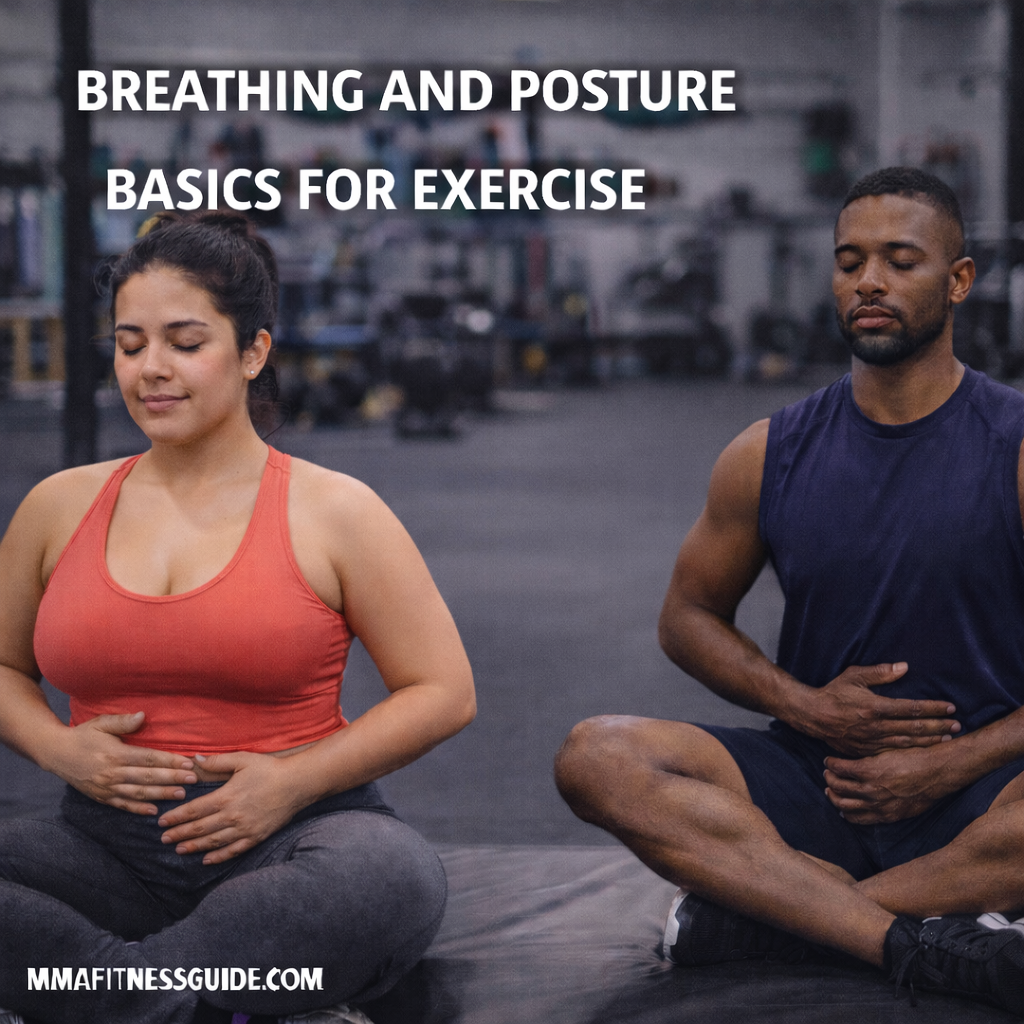
- Lie on your back with your knees bent, or sit comfortably in a chair.
- Place one hand on your upper chest and the other near your lower ribs or abdomen.
- Inhale gently through your nose if comfortable.
- Notice your lower ribs expanding and your abdomen moving naturally.
- Exhale slowly through your nose or mouth.
- Keep your shoulders relaxed and avoid forcing the breath.
Continue for approximately three to five minutes.
If you feel dizzy or uncomfortable, stop and return to your normal breathing pattern.
Progressing Your Breathing Practice
Once you become comfortable practicing while lying down, try the same technique while sitting.
Next, practice while standing.
Finally, incorporate breathing awareness into simple movements such as bodyweight squats.
This progression helps you transfer breathing skills into actual exercise.
For more techniques designed around aerobic training, read our guide to breathing techniques for better cardio .
Breathing During Strength Exercises
Strength training requires you to coordinate breathing with muscular effort.
For most beginner resistance exercises, a simple approach is to inhale during the easier or lowering phase and exhale during the more demanding phase.
This is a general guideline rather than an absolute rule for every exercise.
Breathing Examples for Common Exercises
| Exercise | Inhale | Exhale |
|---|---|---|
| Bodyweight squat | Lowering your body | Standing up |
| Push-up | Lowering your chest | Pushing upward |
| Dumbbell curl | Lowering the weight | Curling upward |
| Glute bridge | Lowering your hips | Raising your hips |
| Seated row | Extending your arms | Pulling the handles |
Practice these patterns with light resistance until they become familiar.
Understanding Core Bracing
Core bracing involves creating muscular tension around your torso to help stabilize your spine during demanding movements.
Imagine gently preparing your abdomen for someone to press against it.
You should feel tension around your midsection without aggressively sucking in your stomach.
Beginners can practice gentle abdominal engagement while maintaining controlled breathing.
Heavy lifting may require different bracing strategies. Qualified coaching is particularly useful when learning advanced lifting techniques.
People with cardiovascular conditions or blood pressure concerns should seek individualized guidance before using deliberate breath-holding techniques.
Breathing During Cardio and Conditioning
Cardiovascular exercise places increasing demands on your respiratory system as intensity rises.
During walking or easy cycling, you may breathe comfortably through your nose.
During running, hill climbs, or high-intensity intervals, breathing through your mouth often becomes more natural.
The objective is to maintain a manageable exercise intensity rather than force a particular breathing method.
Use the Talk Test
The talk test is a practical way to estimate cardiovascular exercise intensity.
Light intensity: You can speak comfortably and may be able to sing.
Moderate intensity: You can talk, but singing becomes difficult.
Vigorous intensity: You can generally say only a few words before needing another breath.
Beginners can use this method to avoid making every cardio session unnecessarily exhausting.
Breathing During MMA Conditioning
Combat sports introduce additional challenges because athletes must breathe while punching, moving, defending, and reacting.
During shadowboxing, try using short, natural exhales when throwing punches while continuing to breathe between combinations.
Avoid holding your breath throughout an entire sequence.
When fatigue increases, reduce your pace briefly and restore a comfortable breathing rhythm before continuing.
Understanding Proper Exercise Posture
Posture refers to how your body is positioned and aligned during movement and at rest.
During exercise, posture constantly changes.
Your body must adjust as you squat, reach, rotate, push, pull, and change direction.
Good exercise posture does not mean maintaining a perfectly straight back or keeping your shoulders pulled backward throughout every movement.
Instead, it involves positioning your body appropriately for the exercise while maintaining control.
Head and Neck Alignment
Keep your neck in a comfortable position relative to your torso.
Avoid excessively lifting your chin during exercises such as squats and push-ups.
Your gaze should support the movement without forcing your neck into an uncomfortable position.
Shoulder Position
Allow your shoulders to move naturally.
Your shoulder blades need to rotate and move during many exercises, particularly overhead movements.
Constantly forcing your shoulders backward can interfere with this natural movement.
Ribcage and Pelvis
Maintain a comfortable relationship between your ribcage and pelvis.
Avoid excessive rib flaring or lower-back arching when the exercise does not require it.
Weight Distribution
Maintain an appropriate base of support.
During a standard bodyweight squat, keep your feet grounded and distribute pressure across them.
Avoid allowing your weight to shift uncontrollably toward your toes or heels.
Common Posture Issues in Beginners
Beginners often encounter recurring positioning problems when learning new exercises.
These habits do not necessarily indicate structural problems. They may simply reflect unfamiliarity with a movement or difficulty controlling a particular exercise.
Rounded Shoulders
Rounded shoulders are common during desk work and certain exercise positions.
They are not automatically harmful.
However, excessive rounding may interfere with some exercises if it causes you to lose your intended position.
During a rowing exercise, focus on controlled shoulder-blade movement rather than allowing your upper body to collapse forward.
Forward Head Position
Some beginners push their chin forward while lifting weights.
This can create unnecessary neck tension.
Try maintaining a comfortable head position that follows the alignment of your torso.
Excessive Lower-Back Arching
Excessive lower-back arching may occur during overhead presses, planks, and other exercises.
Sometimes this happens because the weight is too heavy or the person is compensating for limited mobility.
Reducing resistance and adjusting your torso position may improve control.
Collapsed Chest
Allowing your upper body to collapse during a squat or loaded carry can make it harder to maintain balance and control.
However, forward torso lean is normal during many exercises.
The important distinction is between controlled movement and losing your intended position.
Neutral Spine Explained
A neutral spine refers to a position that maintains the spine’s natural curves without forcing it into excessive flexion or extension.
Your spine is not naturally straight.
It has curves in the neck, upper back, and lower back that vary between individuals.
Neutral alignment is therefore a comfortable range rather than one exact position.
How to Find a Comfortable Neutral Spine
Try this simple standing exercise:
- Stand with your feet approximately hip-width apart.
- Gently tilt your pelvis forward, allowing your lower back to arch.
- Slowly tilt your pelvis backward, reducing that arch.
- Move between these positions several times.
- Settle into a comfortable position somewhere between the extremes.
This provides a reference point for exercises that benefit from a relatively stable torso.
Neutral spine is useful during many loaded movements, but spinal bending and rotation are also normal human movements.
The objective is to develop control across different positions rather than avoid moving your spine entirely.
How Posture Affects Strength and Balance
Body positioning influences how forces travel through your muscles and joints.
Consider a bodyweight squat.
If your heels lift unexpectedly, your torso shifts excessively, or your knees move beyond your ability to control them, maintaining balance may become difficult.
Adjusting your stance, range of motion, or exercise difficulty can make the movement easier to perform.
Posture and Strength
Appropriate positioning allows you to perform an exercise through its intended range of motion.
During a dumbbell row, stabilizing your torso can help you concentrate on moving the weight with your back and arm muscles rather than swinging your entire body.
Posture and Balance
Balance depends partly on the relationship between your center of mass and base of support.
A wider stance generally provides a larger base of support.
Standing on one leg creates a greater balance challenge.
Beginners can develop balance by practicing controlled movements before adding speed, instability, or resistance.
For combat-sports-specific applications, explore our article on how MMA training can improve posture for combat sports .
Connecting Breathing to Core Stability
Your diaphragm and abdominal muscles contribute to pressure regulation inside your torso.
This pressure, combined with muscular activation, can help stabilize your trunk during exercise.
However, breathing and bracing are not identical.
You can breathe deeply without strongly bracing your abdomen, and you can create substantial abdominal tension while temporarily restricting your breathing.
Beginners should learn to coordinate these skills.
Simple Breathing and Core Exercise
- Lie on your back with your knees bent.
- Take a comfortable breath and allow your lower ribs to expand.
- Exhale gently while creating mild abdominal tension.
- Maintain that tension briefly without holding your breath.
- Relax and repeat.
Once comfortable, practice maintaining gentle abdominal engagement during a glute bridge or controlled bodyweight squat.
Avoid aggressively tightening your abdomen throughout an entire workout.
Different exercises require different levels of trunk stiffness.
Simple Posture Cues for Beginners
Too many coaching instructions can make exercise confusing.
Choose one or two cues that address the specific movement you are practicing.
| Posture Cue | When to Use It |
|---|---|
| Stand tall | Walking and standing exercises |
| Keep your neck comfortable | Push-ups and rows |
| Keep your feet grounded | Squats and lunges |
| Move with control | Most resistance exercises |
| Exhale as you push | Beginner pressing movements |
| Coordinate your ribs and pelvis | Planks and overhead exercises |
Avoid forcing every cue simultaneously.
For example, constantly pulling your shoulders backward may interfere with natural shoulder-blade movement during an overhead press.
A useful cue should make the exercise easier to understand and perform rather than create additional tension.
Posture and Breathing in Everyday Life
Your exercise habits are influenced by what you do throughout the day.
Long periods of sitting, limited movement variety, and repetitive activities can contribute to stiffness or reduced movement tolerance.
However, sitting with a rounded back is not inherently dangerous, and there is no single sitting position that must be maintained all day.
Changing positions regularly is often more practical than attempting to maintain perfect posture.
Sitting at Your Desk
Adjust your workspace so you can sit comfortably without constantly reaching or straining.
Change positions periodically and stand or walk when convenient.
Using Your Phone
If your neck becomes uncomfortable, raise your phone or change your position.
You do not need to maintain an upright neck angle every second.
Walking
Allow your arms to swing naturally and maintain a comfortable stride.
Avoid forcing your chest upward or holding your abdomen rigid.
Taking Movement Breaks
A short routine involving shoulder movements, gentle spinal rotations, and hip mobility can provide useful movement variety.
Our guide to simple mobility routines for everyday life provides additional exercises you can incorporate into your daily schedule.
Common Beginner Mistakes to Avoid
Even when you understand breathing and posture principles, it is easy to overcorrect.
Trying to Maintain Perfect Posture
Constantly monitoring every joint can make movement unnecessarily rigid.
Focus on comfortable control rather than maintaining one ideal position.
Taking Excessively Deep Breaths
Forcing large breaths repeatedly can cause dizziness or discomfort.
Allow your breathing to match your activity.
Overarching the Lower Back
If you notice excessive arching during a plank or overhead press, adjust the exercise difficulty and torso position.
Shrugging During Every Lift
Unnecessary shoulder elevation may increase tension, although some exercises naturally require the shoulders to elevate.
Holding Your Breath Under Stress
Develop awareness of when you unintentionally stop breathing during challenging movements.
Ignoring Exercise Difficulty
Poor movement control may indicate that the load, speed, or range of motion is too demanding.
Sometimes the appropriate solution is simply to make the exercise easier.
How Long It Takes to Improve Breathing and Posture
There is no universal timeline for improving breathing coordination or movement habits.
Progress depends on your starting point, exercise experience, mobility, training frequency, and the specific skill you are practicing.
Some beginners notice greater breathing awareness after a few practice sessions.
Developing consistent movement patterns during strength training may take several weeks or longer.
More complex skills, such as maintaining posture while wrestling or striking under fatigue, require continued practice.
Signs of Improvement
Look for practical changes rather than expecting your body to maintain a particular appearance.
Examples include:
- Remembering to breathe during difficult repetitions.
- Feeling less unnecessary tension during exercise.
- Maintaining balance more consistently.
- Performing movements with less conscious correction.
- Recovering a comfortable breathing rhythm after moderate activity.
Improvement does not mean eliminating every unusual posture or never experiencing fatigue.
It means developing greater control and adaptability.
A Simple 10-Minute Breathing and Posture Routine
This beginner-friendly routine combines breathing awareness, mobility, and basic movement practice.
You can complete it before a workout or as a standalone session. No equipment is required.
1. Relaxed Diaphragmatic Breathing (2 Minutes)
Sit or lie comfortably.
Breathe gently and focus on allowing your lower ribs to expand.
Keep your shoulders relaxed and avoid forcing deep breaths.
2. Shoulder and Upper-Back Mobility (2 Minutes)
Perform slow shoulder rolls and gentle upper-back rotations.
Move through a comfortable range without forcing your joints.
3. Standing Alignment Practice (1 Minute)
Stand with your feet approximately hip-width apart.
Explore small adjustments in your pelvic and ribcage positions until you find a comfortable, balanced stance.
4. Controlled Bodyweight Squats (2 Minutes)
Perform slow bodyweight squats.
Inhale while lowering and exhale as you stand.
Use a chair for support if necessary.
5. Standing Marches (2 Minutes)
Alternate lifting your knees while maintaining balance.
Keep your breathing natural and avoid unnecessary tension in your shoulders.
6. Relaxed Breathing Reset (1 Minute)
Walk slowly or stand comfortably while allowing your breathing to settle.
Relax your shoulders and return to your normal breathing rhythm.
Perform this routine at a comfortable pace. Stop any movement that causes pain, dizziness, or unusual symptoms.
As your coordination improves, apply these breathing and posture principles to your regular workouts.
Breathing and Posture for MMA and Combat Sports
Combat sports require athletes to maintain effective positioning while moving rapidly, absorbing pressure, and responding to opponents.
Unlike many basic gym exercises, MMA involves constant changes in posture.
A fighter may transition between striking, defending takedowns, wrestling against the cage, and grappling on the ground.
Each situation requires different body positioning.
Breathing During Striking
Avoid holding your breath throughout long combinations.
Short exhales during punches can help establish a rhythm, but continue breathing naturally between strikes.
Posture During Wrestling
Wrestling often requires a lowered stance, bent knees, and forward torso inclination.
These positions are intentional rather than examples of universally poor posture.
The objective is to maintain balance, mobility, and control while responding to an opponent.
Posture During Grappling
In grappling, posture influences balance, pressure, and vulnerability to attacks.
Maintaining a stable base and understanding how your spine and hips interact can help you execute techniques more effectively.
For a focused explanation, read how to control posture in guard .
Breathing Under Pressure
Beginners sometimes tense their entire body during sparring, making breathing feel more difficult.
Learning to recognize unnecessary tension and breathe between exchanges can help with pacing.
Our article on breathwork for staying calm under pressure explores this topic in greater detail.
When to Slow Down and Reset
There will be moments when your breathing becomes irregular or your movement technique deteriorates.
This is particularly common during demanding workouts.
If you notice that you are losing control, reduce the exercise intensity.
A simple reset involves:
- Pausing or slowing the movement.
- Returning to a comfortable position.
- Allowing your breathing to settle naturally.
- Checking your balance and body positioning.
- Resuming at a manageable difficulty.
Do not attempt to correct severe fatigue simply by forcing deeper breaths.
Sometimes the appropriate response is to rest or end the session.
Stop exercising and seek urgent medical attention for symptoms such as chest pain, fainting, or severe or unexpected shortness of breath. Persistent breathing difficulty, recurring dizziness, or ongoing pain warrants evaluation by a healthcare professional.
Breathing, Relaxation, and Workout Recovery
Breathing awareness can also be useful after exercise.
Following a demanding workout, your breathing and heart rate gradually return toward resting levels.
A low-intensity cooldown allows this transition to happen progressively.
You might walk slowly for several minutes before performing comfortable mobility exercises.
Once your breathing settles, relaxed breathing can help you shift your attention away from the intensity of the workout.
However, breathing exercises alone do not guarantee faster muscle repair or prevent delayed-onset muscle soreness.
Recovery also depends on adequate sleep, nutrition, hydration, and appropriate training volume.
For additional recovery strategies, explore our guides to breathing and relaxation for faster healing and cooldowns that help you recover faster .
Frequently Asked Questions About Exercise Breathing and Posture
Should I Breathe Through My Nose or Mouth During Exercise?
Both are acceptable.
Nasal breathing may feel comfortable during low-intensity exercise, while mouth breathing becomes useful as ventilation demands increase.
Choose a method that allows you to breathe comfortably rather than forcing one approach.
Should I Always Keep My Back Straight?
No.
Your spine has natural curves, and many exercises involve controlled spinal movement.
A relatively neutral spine is useful during certain loaded exercises, but bending and rotating are normal movements.
Should I Inhale or Exhale When Lifting Weights?
For most beginner resistance exercises, exhale during the demanding phase and inhale during the easier or lowering phase.
More advanced lifting techniques may require different breathing strategies.
Can Poor Posture Cause Breathing Problems?
Certain positions can make breathing feel restricted, particularly when the torso is compressed or held rigidly.
However, persistent shortness of breath should not automatically be attributed to posture.
Medical conditions and other factors may be involved.
Can Breathing Exercises Improve Endurance?
Breathing practice can improve awareness and help you coordinate breathing with movement.
However, meaningful cardiovascular endurance improvements primarily require appropriately structured aerobic training.
Breathing exercises should complement conditioning rather than replace it.
How Often Should Beginners Practice?
A few minutes of breathing awareness most days can be a reasonable starting point.
Posture and movement skills can be practiced during regular workouts.
There is no need to spend hours attempting to maintain perfect alignment.
Final Thoughts
Breathing and posture are foundational exercise skills, but they do not need to become complicated.
Start by developing awareness of how your body moves and how your breathing changes with effort.
Practice comfortable lower-rib expansion, coordinate breathing with basic strength exercises, and learn to recognize when unnecessary tension interferes with movement.
Remember that posture is dynamic. Your body needs to bend, rotate, stabilize, and adapt to different activities.
The objective is not to maintain one perfect position or control every breath. It is to develop the ability to move comfortably, manage effort, and adjust your technique when necessary.
With consistent practice, these habits can become a natural part of your workouts, whether you are learning basic exercises, improving cardiovascular fitness, or preparing for MMA training.
Related Articles: Continue Building Your Fitness Foundation
Breathing and posture are only part of developing a sustainable exercise routine. Once you understand these fundamentals, explore these related guides to build on what you have learned.
- Breathing Techniques for Better Cardio — Learn practical breathing strategies for aerobic exercise and conditioning.
- Simple Mobility Routines for Everyday Life — Improve movement variety and address everyday stiffness with accessible exercises.
- Gentle Workouts for Stress Relief — Explore low-intensity exercise options that combine comfortable movement with relaxation.
These guides provide practical next steps for building a fitness routine that supports strength, mobility, endurance, and long-term consistency.