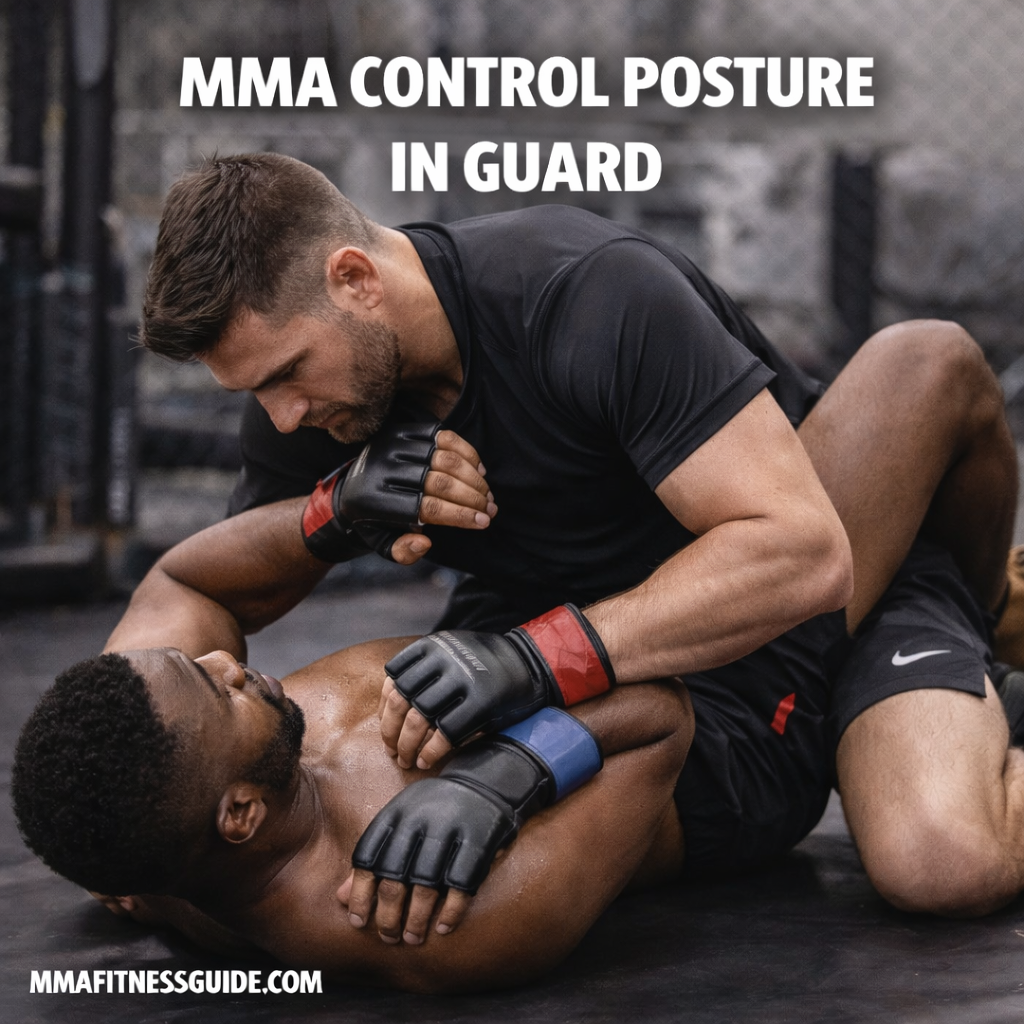
When a fighter on top of closed guard gets their head pulled toward the opponent’s chest, their options change immediately. Full-power punches become harder to generate, their balance shifts forward, and attacks such as triangles, arm bars, and sweeps become easier to set up. If they regain an upright base, the bottom fighter has a different problem: strikes and guard passes become easier to initiate.
That push and pull over head, spine, hip, and arm position is the posture battle in MMA guard. The top fighter wants enough structure to strike, defend submissions, and begin passing. The bottom fighter wants to disrupt that structure before creating angles for offense or escape.
Because punches and elbows are available, neither fighter can treat posture as a static position. It changes continuously as grips, strikes, hip movement, and submission threats force adjustments.
What Does “Posture” Mean in MMA Guard?
Posture describes how the top fighter organizes their head, spine, hips, arms, and base while inside an opponent’s guard.
For the bottom fighter, posture control means disrupting that alignment and preventing the opponent from freely establishing a stable striking or passing position.
In a typical guard exchange:
- Upright, balanced posture can create room for strikes and passing
- Broken posture can reduce striking space
- Poor arm placement can expose submission opportunities
- Weak base can make sweeps and off-balancing easier
- Effective frames can help either fighter recover position
The battle is not simply about sitting upright or pulling someone downward. Each fighter is trying to create a structure that supports what they want to do next.
How MMA Changes the Posture Battle
Guard strategy in MMA has to account for strikes in addition to submissions, sweeps, and passes.
A top fighter who creates separation may have enough room to punch or elbow. A bottom fighter who allows that separation without controlling the wrists, arms, or distance can absorb damage even if their guard remains technically intact.
This creates different priorities for both positions.
The top fighter generally wants to:
- Maintain balance
- Protect the neck and arms
- Create controlled striking space
- Prevent effective angles from the bottom
- Open or pass the guard when opportunities appear
The bottom fighter generally wants to:
- Limit clean striking space
- Control wrists, arms, or head position
- Disrupt the opponent’s balance
- Create angles rather than remaining flat
- Build toward sweeps, submissions, escapes, or stand-ups
The presence of strikes means positional control and defensive awareness must remain connected.
Common Posture Mistakes From Top Position
Many problems begin when the top fighter sacrifices structure to reach for offense.
Common mistakes include:
- Leaning too far forward while punching
- Leaving an arm extended
- Allowing the head to be pulled down without addressing the grip
- Sitting tall while leaving the hips uncontrolled
- Narrowing the base unnecessarily
- Posting a hand where it can be isolated
- Throwing repeated strikes without resetting position
For example, reaching forward with a long punch may create temporary striking range, but an extended arm can also give the bottom fighter something to control.
The goal is not simply to stay upright. The fighter needs usable posture that can survive resistance.
How the Top Fighter Maintains Strong Posture
Head and Spine Alignment
The head should remain connected to the rest of the fighter’s structure rather than drifting far ahead of the hips.
Useful principles include:
- Keep the spine organized rather than excessively rounded
- Avoid allowing the head to be dragged far forward
- Keep the chin protected
- Maintain awareness of head and arm control
- Recover alignment after striking
Exact posture will change depending on whether the fighter is striking, opening the guard, defending a submission, or beginning a pass.
Think of posture as something that is repeatedly established, used, and recovered.
Hip Position and Base
A fighter can appear upright and still be easy to off-balance.
The hips and knees provide the foundation underneath the upper body.
Depending on the guard and situation, the top fighter may need to:
- Maintain a stable knee position
- Keep weight distributed appropriately
- Adjust the base as the opponent shifts their hips
- Avoid letting both knees collapse toward the same direction
- Move the lower body when the upper body moves
If the bottom fighter shifts sharply to one side, the top fighter should expect the base to be tested.
Remaining rigid can make that off-balancing easier.
Hand Placement and Framing
Hands can help maintain distance and posture, but careless placement gives the bottom fighter opportunities to isolate an arm.
The top fighter should consider:
- Where the opponent can establish wrist control
- Whether an arm is becoming extended
- How frames affect balance
- Whether hand placement exposes a submission
- Whether striking will compromise the current base
Instead of treating hand position as fixed, adjust it according to the opponent’s grips and hip movement.
Before committing to a strike, know what is preventing the bottom fighter from immediately breaking your posture.
How the Bottom Fighter Breaks Posture
The bottom fighter usually needs more than arm strength to pull an opponent forward.
Effective posture disruption combines upper-body control with the legs and hips.
Head and Upper-Body Control
Controlling the head can prevent the top fighter from freely creating striking distance.
Depending on the position, the bottom fighter may use:
- Head control
- Collar ties
- Overhooks
- Wrist control
- Elbow control
- Two-on-one grips
Pulling alone is often inefficient if the top fighter has a strong base.
The better approach is to connect the upper-body control to movement from the hips and legs.
Hip Movement and Angle Creation
A fighter lying square and flat underneath an opponent has fewer directions from which to attack.
Moving the hips changes that geometry.
Bottom fighters can use hip movement to:
- Create an angle on an arm
- Change the direction of a posture break
- Set up sweeps
- Improve submission positioning
- Build space for an escape
- Make clean strikes harder to line up
Instead of pulling the opponent directly toward the center of the chest every time, shifting to an angle can force them to adjust their base.
That adjustment may create the next opening.
Leg Engagement and Guard Control
The legs can influence the top fighter’s posture while the hands control the upper body.
Examples include:
- Closed guard pressure with the knees
- High guard positions that isolate an arm
- Butterfly hooks that affect balance
- Half-guard structures combined with frames
- Open-guard hooks used to manage distance
The legs should not simply hang around the opponent’s body.
They can pull, elevate, redirect, frame, and help create angles depending on the guard being used.
Striking Considerations in MMA Guard
Striking makes posture management more dynamic.
A top fighter may create distance specifically to land a punch, only to have the bottom fighter use that movement to establish a new guard position. The bottom fighter may pull the opponent close to reduce punching space, but staying attached without improving position can also leave them trapped underneath.
From the Top
Before striking, consider:
- Is your base stable?
- Are your arms protected?
- Can the opponent immediately attack your neck or an extended limb?
- Will the strike compromise your balance?
- Can you recover your position afterward?
Short, controlled strikes may require less positional commitment than large swinging attacks.
After striking, reassess the position instead of assuming the previous posture still exists.
From the Bottom
The bottom fighter should account for striking distance before committing to offense.
Useful priorities include:
- Managing wrists and arms
- Breaking or disrupting striking posture
- Moving the head
- Creating angles with the hips
- Using frames when separation is needed
- Avoiding extended periods flat underneath the opponent
Submission attempts should also account for strikes. An attack that leaves the fighter exposed to clean punches may not be worth forcing.
Submissions That Can Develop From Broken Posture
When the top fighter’s posture changes, certain attacks may become easier to build.
Depending on the guard and grips, possibilities include:
- Triangle chokes
- Arm bars
- Guillotine variations
- Kimuras
- Omoplatas
The posture break itself does not guarantee a submission.
Instead, it can provide the conditions needed to isolate an arm, control the head, change an angle, or disrupt balance.
For example, pulling the opponent forward may expose an arm. Moving the hips to the side can then improve the angle required for the next attack.
The submission develops from the sequence rather than from the posture break alone.
Sweeps and Scrambles From Posture Control
Not every successful posture break needs to lead to a submission.
If the top fighter posts a hand to avoid falling forward, that post may become something to attack or remove. If they widen their base, another direction may become easier to exploit.
Posture disruption can lead to:
- Hip-bump variations
- Butterfly elevations
- Pendulum-style sweeps
- Technical stand-ups
- Scrambles
- Back exposure
The bottom fighter should respond to the reaction rather than forcing a predetermined attack.
Drilling Posture Control for MMA
Posture becomes more useful when it is trained against increasing resistance rather than only practiced as a static position.
Posture Maintenance Drill
Start with one fighter inside closed guard.
The bottom fighter attempts to break posture while the top fighter works on:
- Maintaining balance
- Protecting the arms
- Recovering head position
- Rebuilding posture when it is lost
Begin without strikes so both fighters can concentrate on positioning.
Posture Break and Attack Drill
Give the bottom fighter a specific objective:
Break posture → create an angle → attempt a sweep or submission.
The top fighter provides gradually increasing resistance.
This teaches the bottom fighter to connect posture control to an actual positional goal.
Strike-Aware Guard Rounds
Once both fighters understand the mechanics, introduce controlled MMA gloves and light striking under qualified coaching.
The top fighter works on creating safe striking opportunities while the bottom fighter practices limiting damage and improving position.
Intensity should remain appropriate to the athletes’ experience and the purpose of the session.
Coaching Posture Control
Instead of repeatedly telling an athlete to “posture up” or “break posture,” coaches can identify the specific structural problem.
For the top fighter, ask:
- Where is your head relative to your hips?
- Which arm is the opponent controlling?
- Where is your weight?
- What happens to your base when you strike?
- Can you recover your position after the attack?
For the bottom fighter, ask:
- What are you controlling?
- Are your legs helping your upper body?
- Can you move your hips?
- What reaction are you trying to create?
- What attack follows that reaction?
These questions give athletes something concrete to correct.
Common Misconceptions About Guard Posture
“Good Posture Means Sitting Completely Upright”
Not always.
Posture needs to fit the immediate task. Striking, defending a submission, opening the guard, and beginning a pass may require different body positions.
The underlying goal is maintaining a structure that supports the action without giving the opponent easy control.
“Breaking Posture Means a Submission Is Available”
A posture break creates possibilities, not guarantees.
The bottom fighter still needs control, angle, timing, and the appropriate reaction from the opponent.
“Guard Is a Place to Rest”
In MMA, remaining inactive underneath an opponent can allow them to establish striking space, improve position, or convince the referee that the bottom fighter is not progressing.
Even when conserving energy, the fighter needs awareness of grips, posture, strikes, and positional changes.
Final Thoughts
Watch what happens when the top fighter’s head moves away from their hips or when the bottom fighter creates enough space for the opponent to sit upright. Those small positional changes affect what both fighters can do next.
From the top, posture should provide a stable platform for defending submissions, creating striking opportunities, and progressing toward a pass. From the bottom, disrupting that structure can reduce striking space and create angles for sweeps, submissions, scrambles, or escapes.
Neither fighter controls posture permanently. It is established, disrupted, recovered, and adjusted throughout the exchange.
Training those transitions—not simply memorizing an ideal body position—makes posture control useful once strikes and live resistance are added.