Women’s combat sports didn’t become mainstream overnight.
Long before women headlined UFC pay-per-views, fought for major boxing championships, and competed in internationally televised MMA events, female athletes were fighting for opportunities that male competitors often took for granted.
They faced limited competition schedules, smaller purses, fewer sponsorship opportunities, and promoters who questioned whether audiences would watch women’s fights.
Yet women continued to compete in boxing, judo, wrestling, kickboxing, Brazilian jiu-jitsu, and mixed martial arts.
Some built their reputations in small venues. Others became stars in Japan before American promotions embraced women’s MMA. A later generation used championship performances, memorable rivalries, and mainstream media exposure to bring women’s combat sports to larger audiences.
The development of women’s combat sports cannot be credited to one athlete or organization. It reflects decades of work by fighters, coaches, promoters, and advocates across multiple disciplines.
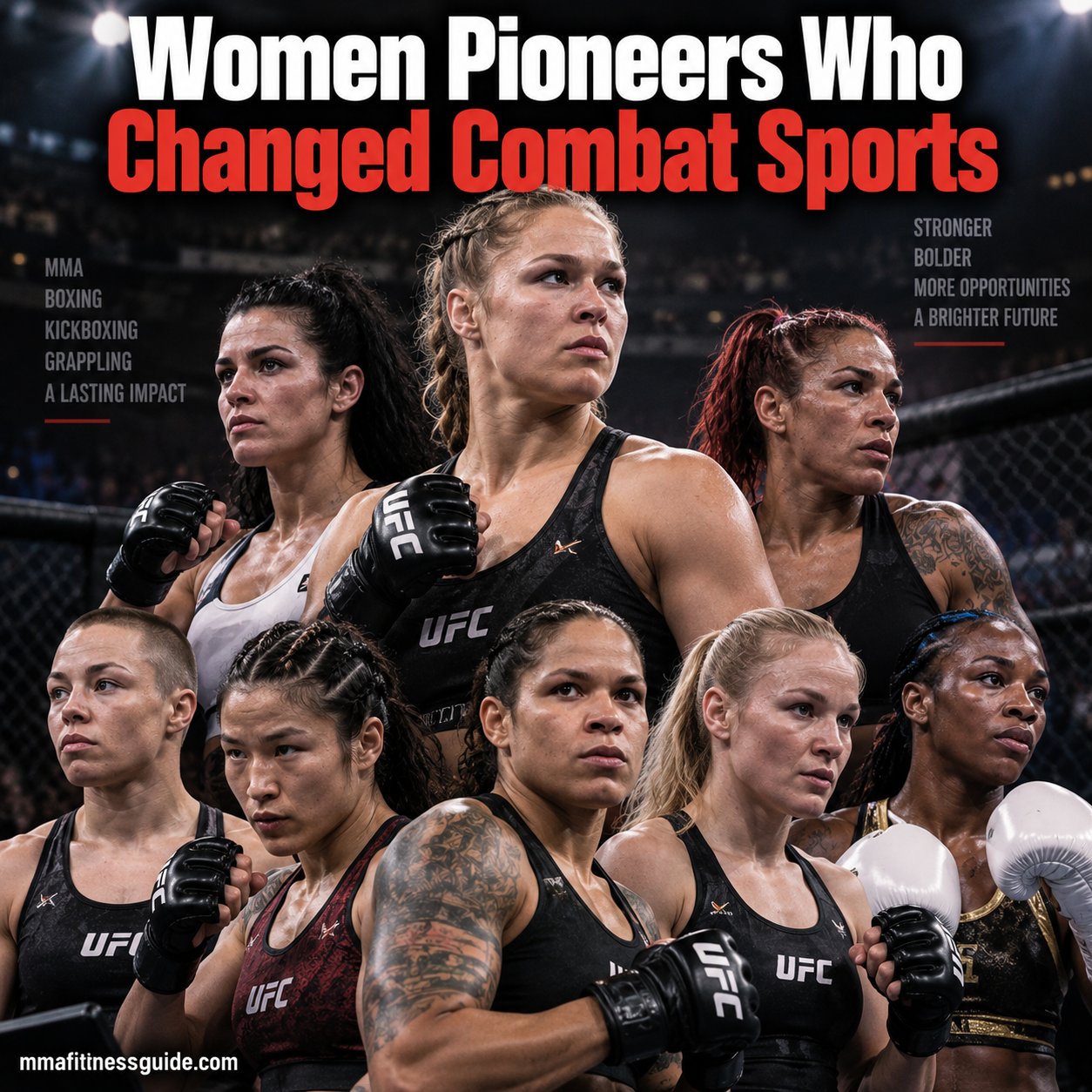
Nine women helped transform combat sports — here are the barriers they broke, what they accomplished, and the lasting changes they brought to MMA and boxing.
It also examines the earlier pioneers who made their careers possible and what modern fighters can learn from their contributions.
The Early History of Women’s Combat Sports
Before examining individual fighters, it’s important to understand the environment in which women’s combat sports developed.
Women’s boxing existed long before modern MMA, but opportunities to compete professionally were inconsistent. Athletic commissions, promoters, and sporting institutions frequently restricted participation.
Women’s boxing appeared at the 1904 Olympics as a demonstration event but did not become an official Olympic medal sport until London 2012.
Women also established competitive traditions in judo, wrestling, and kickboxing before MMA became a major international business.
Women’s judo became an official Olympic medal sport in 1992, while women’s freestyle wrestling made its Olympic debut in 2004.
These developments expanded opportunities for female athletes to receive structured coaching, compete internationally, and build careers in combat sports.
Women’s MMA Before the UFC
Female mixed martial artists were competing years before the UFC introduced women’s divisions.
Japan played an important role through organizations such as ReMix and Smackgirl, which provided platforms for female competitors during the sport’s early development.
In the United States, promotions including EliteXC and Strikeforce eventually brought women’s MMA to larger television audiences.
This history matters because the UFC’s adoption of women’s divisions was a major commercial milestone, but it was not the beginning of women’s MMA.
The sport’s earlier development also reflects the broader regulatory changes discussed in our article on the early days of the UFC: rules, chaos, and change .
1. Ronda Rousey — The Fighter Who Brought Women’s MMA to the UFC
Ronda Rousey helped transform women’s MMA from a developing attraction into a major part of the UFC’s business.
Before entering MMA, Rousey established herself as an elite judoka. At the 2008 Beijing Olympics, she earned bronze in judo, becoming the first American woman to win an Olympic judo medal.
Her transition into MMA introduced a distinctive style built around aggressive clinch entries, hip throws, positional control, and armbar submissions.
Opponents knew what she wanted to do. Stopping it was another matter.
Breaking the UFC’s Gender Barrier
In 2012, Rousey became the first woman signed to the UFC and was named its inaugural women’s bantamweight champion.
Her first UFC fight took place against Liz Carmouche at UFC 157 in February 2013.
The event marked the first women’s fight in UFC history and the first UFC event headlined by female competitors.
Rousey won by first-round armbar.
She subsequently defended her championship against opponents including Miesha Tate, Sara McMann, Alexis Davis, Cat Zingano, and Bethe Correia.
Her ability to finish fights quickly became central to her public identity.
Why Rousey’s Impact Extended Beyond Fighting
Rousey’s popularity demonstrated that a female fighter could headline major events, attract mainstream attention, and become a recognizable sports celebrity.
She appeared in films, received extensive media coverage, and became one of the UFC’s most prominent athletes.
Her rivalry with Miesha Tate also helped establish women’s MMA as a source of compelling competitive storylines.
Their encounters remain part of the broader history covered in our guide to the greatest rivalries in MMA history .
Rousey’s undefeated run ended when Holly Holm knocked her out at UFC 193 in November 2015.
That result became one of the defining moments in the sport’s history, demonstrating how quickly a division could evolve as more athletes developed the skills to challenge its champion.
Read more about such moments in the most shocking upsets in the UFC .
Her legacy: Rousey helped establish women’s MMA as a commercially significant part of the UFC while introducing a wider audience to elite judo and submission grappling.
2. Gina Carano — The Star Who Brought Women’s MMA to Mainstream Television
Before Ronda Rousey became a UFC superstar, Gina Carano was one of the most recognizable faces in women’s mixed martial arts.
Carano developed her combat sports background in Muay Thai before transitioning to MMA.
Her striking style, athleticism, and media presence helped attract attention during a period when women’s fights received limited exposure from major American promotions.
Building an Audience Before the UFC
Carano competed in organizations including EliteXC and Strikeforce.
Her appearances on nationally televised events helped introduce women’s MMA to audiences who had primarily watched male fighters.
At a time when many promoters remained uncertain about women’s MMA, Carano demonstrated that female athletes could generate substantial media interest.
Her performances also showed that women’s fights could be featured prominently rather than treated as minor additions to a fight card.
The Historic Fight Against Cris Cyborg
In August 2009, Carano faced Cris Cyborg in the main event of Strikeforce: Carano vs. Cyborg.
The contest was a major milestone for women’s MMA in the United States.
It was the first women’s MMA bout to headline a major American promotion’s event, and it was contested for the inaugural Strikeforce women’s featherweight championship.
Cyborg won by first-round technical knockout.
Although Carano lost, the event demonstrated that a women’s championship fight could serve as the centerpiece of a nationally televised promotion.
Carano subsequently moved into acting rather than continuing her MMA career.
Her relatively short competitive career illustrates an important distinction: an athlete’s influence is not determined exclusively by championship totals or longevity.
Her legacy: Carano helped establish a mainstream television audience for women’s MMA before the UFC introduced women’s divisions.
3. Cris Cyborg — The Champion Who Built a Legacy Across Promotions
Cris Cyborg became one of the defining figures in women’s featherweight MMA through her aggressive striking, physical strength, and lengthy championship career.
Her fighting style combines pressure, powerful combinations, and a willingness to exchange strikes at close range.
While other fighters built their reputations through grappling or technical counterstriking, Cyborg became associated with sustained offensive pressure.
Championship Success Across Organizations
Cyborg captured major titles in several organizations, including:
- Strikeforce.
- Invicta Fighting Championships.
- UFC.
- Bellator.
Her championship victories across different promotions demonstrated an ability to remain competitive through changes in opponents, organizations, and competitive environments.
Her 2009 victory over Gina Carano was particularly significant because of the event’s historical importance and television exposure.
Years later, Cyborg became the UFC women’s featherweight champion, adding another major championship to her career.
The Importance of the Featherweight Division
Women’s MMA has not developed equally across every weight class.
The featherweight division has historically faced challenges involving roster depth, available opponents, and promotional investment.
Cyborg’s career helped maintain visibility for athletes competing at approximately 145 pounds.
Her championship appearances gave the division a recognizable figure during periods when lighter women’s weight classes received greater organizational attention.
The importance of creating competitive opportunities across different divisions is explored further in the evolution of weight classes in MMA .
The Amanda Nunes Fight
In December 2018, Cyborg faced Amanda Nunes at UFC 232.
Nunes won by first-round knockout, ending Cyborg’s long unbeaten stretch.
The fight became a defining moment for both athletes and demonstrated the depth of talent emerging in women’s MMA.
Cyborg continued competing and winning championships afterward, showing that one defeat did not erase her broader achievements.
Her legacy: Cyborg helped sustain women’s featherweight MMA and established a championship record spanning multiple major promotions.
4. Megumi Fujii — The Grappling Pioneer Who Shaped Japanese Women’s MMA
Megumi Fujii, widely known as “Mega Megu,” developed her reputation through exceptional grappling and a lengthy undefeated run.
She competed primarily in Japan and established herself during a period when women’s MMA received relatively little international mainstream coverage.
Her technical approach emphasized positional control, transitions, and submission attacks.
A Remarkable Undefeated Streak
Fujii began her professional MMA career with 22 consecutive victories.
Her success came against opponents with different styles and backgrounds, demonstrating the effectiveness of her grappling system.
She developed a reputation for attacking submissions from numerous positions rather than relying on a single finishing technique.
Her performances illustrated how technical precision, timing, and positional awareness could overcome physical disadvantages.
Building Women’s MMA in Japan
Japanese promotions provided important opportunities for women to compete before major American organizations embraced female divisions.
Fujii became one of the recognizable figures associated with this period.
Her fights helped demonstrate the technical sophistication of women’s MMA and gave emerging grapplers an athlete whose performances they could study.
Her influence also extended beyond mainstream recognition.
Many casual UFC viewers may be unfamiliar with her accomplishments, but her competitive record occupies an important place in the sport’s development.
Our guide to underrated MMA legends you should know explores other influential competitors whose achievements deserve attention.
Her legacy: Fujii demonstrated the effectiveness of advanced submission grappling and helped establish Japan as an important center for women’s MMA.
5. Joanna Jędrzejczyk — The Striker Who Transformed Women’s Strawweight MMA
Joanna Jędrzejczyk entered MMA with an extensive Muay Thai and kickboxing background.
Her technical striking, conditioning, and sustained offensive output helped establish a distinctive competitive identity.
Rather than depending on one powerful punch, she used combinations, footwork, distance management, and accumulated damage to control opponents.
Establishing the Strawweight Division
Jędrzejczyk won the UFC women’s strawweight championship by defeating Carla Esparza at UFC 185 in March 2015.
She subsequently defended the title five times.
Her championship run helped establish strawweight as a division featuring high-level striking and technically sophisticated competition.
Her approach demonstrated how a fighter could maintain pressure while using accurate combinations and effective defensive movement.
The Rivalry With Zhang Weili
Jędrzejczyk’s first fight against Zhang Weili at UFC 248 in March 2020 became one of the most celebrated contests in women’s MMA history.
The five-round championship fight featured sustained exchanges, tactical adjustments, and exceptional offensive output from both athletes.
Zhang won by split decision.
Their rematch at UFC 275 in June 2022 ended with Zhang winning by spinning backfist knockout.
Jędrzejczyk announced her retirement afterward.
Her performances against Zhang illustrated how far women’s MMA striking had progressed from the sport’s earlier years.
Her legacy: Jędrzejczyk helped establish women’s strawweight as a prominent UFC division and demonstrated the effectiveness of elite Muay Thai fundamentals in mixed martial arts.
6. Amanda Nunes — The Two-Division Champion Who Redefined Women’s MMA
Amanda Nunes built one of the most accomplished championship careers in women’s MMA.
Known for powerful boxing, aggressive combinations, and well-rounded fighting skills, the Brazilian athlete defeated numerous former and reigning champions.
Her career reflected the development of MMA into a sport requiring proficiency across striking, wrestling, and grappling.
Becoming the First Female UFC Double Champion
Nunes won the UFC women’s bantamweight championship by defeating Miesha Tate at UFC 200 in July 2016.
She followed that victory with a first-round stoppage of Ronda Rousey in December of the same year.
At UFC 232 in December 2018, Nunes knocked out Cris Cyborg to capture the women’s featherweight championship.
The victory made her the first woman to hold UFC titles in two weight classes simultaneously.
A Championship Record Across Two Divisions
Nunes’ notable victories include wins over:
- Ronda Rousey.
- Cris Cyborg.
- Miesha Tate.
- Holly Holm.
- Valentina Shevchenko.
- Germaine de Randamie.
Her first fight against Julianna Peña in December 2021 ended in a submission loss.
Nunes reclaimed the bantamweight championship in their rematch at UFC 277 in July 2022.
She announced her retirement in June 2023 after defeating Irene Aldana.
Nunes’ championship achievements made her a central figure in discussions about the greatest female mixed martial artists.
Her career also demonstrated that an athlete could build sustained success across different divisions while adapting to opponents with contrasting styles.
Her legacy: Nunes established the first simultaneous two-division championship reign by a woman in the UFC and helped define the standard for well-rounded championship-level MMA.
7. Valentina Shevchenko — The Complete Martial Artist
Valentina Shevchenko entered MMA with extensive experience in Muay Thai and other martial arts.
Her technical approach emphasizes distance management, timing, counterstriking, and the ability to transition between striking and grappling.
She became particularly well known for controlling opponents through calculated movement rather than relying exclusively on forward pressure.
Establishing a Championship Reign at Flyweight
Shevchenko captured the UFC women’s flyweight championship by defeating Joanna Jędrzejczyk at UFC 231 in December 2018.
She went on to defend the title seven consecutive times.
Her championship performances included victories over Jessica Eye, Liz Carmouche, Katlyn Cerminara, Jennifer Maia, Jéssica Andrade, Lauren Murphy, and Taila Santos.
The reign helped establish the women’s flyweight division following its introduction to the UFC.
Technical Precision and Adaptability
Shevchenko’s style illustrates the importance of combining multiple martial arts disciplines.
Her striking background provides tools for controlling distance and countering attacks, while her grappling allows her to operate effectively when fights move to the ground.
Her rivalry with Alexa Grasso added another chapter to the division’s history.
Grasso submitted Shevchenko in March 2023, their September rematch ended in a split draw, and Shevchenko regained the title in September 2024.
Her career provides an example of the cross-disciplinary development explored in our article on cross-discipline champions and trailblazers .
Her legacy: Shevchenko helped establish women’s flyweight as a major UFC division while demonstrating the effectiveness of combining technical striking with comprehensive grappling skills.
8. Rose Namajunas — The Champion Who Brought Mental Preparation Into the Conversation
Rose Namajunas developed from a promising submission-oriented fighter into a two-time UFC women’s strawweight champion.
Her career has included significant victories, difficult setbacks, and public discussions about the psychological demands of competition.
Her fighting style combines creative movement, technical striking, and submission grappling.
Two Championship Victories
Namajunas first captured the UFC strawweight championship by defeating Joanna Jędrzejczyk at UFC 217 in November 2017.
The first-round knockout ended Jędrzejczyk’s championship reign.
Namajunas successfully defended the title in their rematch before losing it to Jéssica Andrade in 2019.
In April 2021, she regained the championship by knocking out Zhang Weili with a head kick at UFC 261.
The victory made her the first woman to regain the UFC strawweight title.
Discussing the Mental Demands of Fighting
Namajunas has spoken publicly about personal adversity and the psychological pressures associated with competition.
Her willingness to discuss these subjects contributed to broader conversations about mental health in combat sports.
Fighters experience demands that extend beyond physical conditioning, including public scrutiny, uncertainty about competition schedules, and the pressure associated with high-profile events.
Mental preparation can involve working with qualified professionals, maintaining supportive relationships, developing consistent routines, and recognizing when additional help is needed.
Namajunas’ career illustrates that athletes can discuss psychological challenges openly while continuing to compete at an elite level.
Her legacy: Namajunas became a two-time UFC champion and contributed to greater visibility for conversations about mental preparation and personal well-being in combat sports.
9. Claressa Shields — The Boxing Trailblazer Who Crossed Into MMA
Claressa Shields became a defining figure in modern women’s boxing through her Olympic achievements and professional championship career.
Her success began in amateur boxing, where she established herself internationally before transitioning to the professional ranks.
Making Olympic History
At the 2012 London Olympics, Shields won gold in the women’s middleweight division.
The achievement came during the first Olympic Games to feature women’s boxing as an official medal sport.
She won another gold medal at the 2016 Rio Olympics, becoming the first American boxer, male or female, to win consecutive Olympic gold medals.
Her accomplishments provided a prominent example of the competitive opportunities created when women’s boxing gained Olympic recognition.
Building a Professional Championship Career
Shields subsequently captured professional world championships across multiple weight divisions.
Her achievements included becoming an undisputed champion and participating in major women’s boxing events.
She helped bring attention to questions surrounding television exposure, athlete compensation, and promotional investment in women’s boxing.
Crossing Into Mixed Martial Arts
Shields also entered professional MMA through the Professional Fighters League.
The transition required her to develop wrestling defense, submission awareness, and other skills that differ significantly from traditional boxing.
Her crossover demonstrated both the possibilities and challenges facing athletes who move between combat sports.
Success in one discipline does not automatically translate into mastery of another.
Her legacy: Shields helped expand the visibility of women’s boxing through Olympic and professional championship achievements while demonstrating the growing opportunities for athletes to compete across combat sports.
Other Women Who Helped Build Combat Sports
The nine athletes discussed above represent only part of a much larger history.
Several additional pioneers deserve recognition.
Christy Martin
Christy Martin helped bring women’s professional boxing to mainstream audiences during the 1990s.
Her appearance on the undercard of Mike Tyson versus Frank Bruno II in 1996 introduced her to a large pay-per-view audience.
Her career demonstrated that women’s boxing could attract attention on major fight cards.
Laila Ali
Laila Ali built an undefeated professional boxing career and became one of the sport’s most recognizable athletes.
Her success helped maintain mainstream interest in women’s boxing during the 2000s.
Lucia Rijker
Lucia Rijker established an accomplished career in kickboxing and professional boxing.
Her technical striking and competitive achievements influenced perceptions of women’s participation in full-contact combat sports.
Marloes Coenen
Marloes Coenen became the Strikeforce women’s bantamweight champion and competed against several prominent athletes during the development of women’s MMA.
Her career contributed to the visibility of women’s grappling and submission fighting.
Miesha Tate
Miesha Tate won championships in Strikeforce and the UFC.
Her rivalry with Ronda Rousey became a major storyline during the early years of women’s UFC competition.
Tate’s career also illustrates the importance of wrestling and positional grappling in MMA.
These athletes remind us that the sport developed through overlapping generations rather than the accomplishments of one individual.
How These Pioneers Changed Combat Sports
The influence of these athletes extends beyond individual victories.
Their careers contributed to changes in promotion, participation, technical development, and public awareness.
1. They Expanded Opportunities for Female Athletes
Early pioneers competed when women’s divisions were limited or absent from major organizations.
As women’s MMA gained audiences, promotions introduced additional divisions, championships, and events.
The UFC’s introduction of women’s bantamweight competition in 2013 was followed by strawweight, flyweight, and featherweight divisions.
Opportunities still vary considerably between organizations and weight classes, but the competitive landscape is substantially broader than it was during the sport’s early years.
2. They Demonstrated Different Paths to Success
These fighters did not succeed using one universal style.
Rousey relied heavily on judo and submissions. Jędrzejczyk established herself through technical striking. Fujii demonstrated advanced grappling, while Nunes combined powerful boxing with a comprehensive MMA skill set.
Their contrasting approaches helped illustrate the importance of developing multiple disciplines.
Modern fighters can study these athletes to understand how different techniques, physical attributes, and strategic approaches influence competition.
The role of instruction in developing these skills is explored further in the most influential coaches in MMA history .
3. They Created New Commercial Opportunities
High-profile women’s fights demonstrated that female athletes could attract audiences, headline major events, and build recognizable brands.
Those developments supported opportunities involving sponsorships, broadcasting, media appearances, and promotional partnerships.
However, increased visibility has not eliminated differences in compensation, promotional resources, or opportunities across combat sports.
Continued growth depends on sustained investment rather than isolated high-profile events.
4. They Helped Normalize Women’s Participation
The visibility of successful female fighters gave aspiring athletes examples of what competitive careers could look like.
More women could see themselves participating in boxing, MMA, wrestling, and Brazilian jiu-jitsu.
As participation expands, gyms also need to consider practical requirements involving equipment, appropriate training partners, coaching, and inclusive facilities.
Women entering MMA or grappling can consult our women’s gear guide for MMA and BJJ for information about selecting suitable training equipment.
What Modern Fighters and Fans Can Learn From These Pioneers
The careers of these athletes provide several lessons for people involved in combat sports.
Technical Development Matters
Fighters such as Fujii, Jędrzejczyk, and Shevchenko demonstrated how specialized skills can be adapted to mixed martial arts.
Their careers highlight the importance of developing a strong technical foundation rather than relying exclusively on physical attributes.
Adaptability Is Essential
Nunes, Namajunas, and other champions experienced setbacks and made adjustments throughout their careers.
A loss can reveal weaknesses in technique, strategy, or preparation.
Successful long-term development requires athletes to evaluate performances and make appropriate changes.
Opportunities Often Require Persistence
Earlier generations competed with fewer available promotions, divisions, and commercial resources.
Their continued participation helped establish competitive pathways for future athletes.
Professional Identity Extends Beyond Competition
Rousey, Carano, and Shields demonstrated how athletic achievements can create opportunities in media, entertainment, and other industries.
Building communication skills and professional relationships can benefit fighters beyond their competitive careers.
Progress Depends on Collective Contributions
No single fighter created women’s combat sports.
Athletes across different countries, organizations, and generations helped establish the opportunities available today.
For aspiring fighters, these lessons provide reasons to study the sport’s history alongside technical training.
Understanding how earlier athletes developed their skills and navigated limited opportunities offers useful context for building a modern competitive career.
Final Thoughts
Women’s combat sports reached their current level of visibility through decades of competition, persistence, and gradual institutional change.
Ronda Rousey helped introduce women’s MMA to the UFC. Gina Carano demonstrated its mainstream television appeal. Cris Cyborg maintained visibility for featherweight competition, while Megumi Fujii established an influential grappling legacy in Japan.
Joanna Jędrzejczyk, Amanda Nunes, Valentina Shevchenko, and Rose Namajunas contributed to the technical and competitive development of women’s MMA.
Claressa Shields expanded the visibility of women’s boxing through historic Olympic achievements and professional championship success.
Their careers represent different generations, fighting styles, and paths through the combat sports industry.
Together with earlier pioneers and countless lesser-known athletes, they helped create opportunities that previous generations did not have.
Their accomplishments remain important not simply because they broke barriers, but because they established competitive standards, attracted audiences, and helped build a foundation for the athletes who followed.