You throw a low kick during sparring, and your shin guard rotates halfway around your calf. You stop to straighten it, tighten the straps, and get back into position. Two exchanges later, it happens again.
A shin guard that constantly shifts is distracting. It may also leave part of your shin or foot exposed when you expected it to be covered.
On the other hand, a guard that’s too bulky can make movement awkward, while one with insufficient padding may be unsuitable for the contact level of your training.
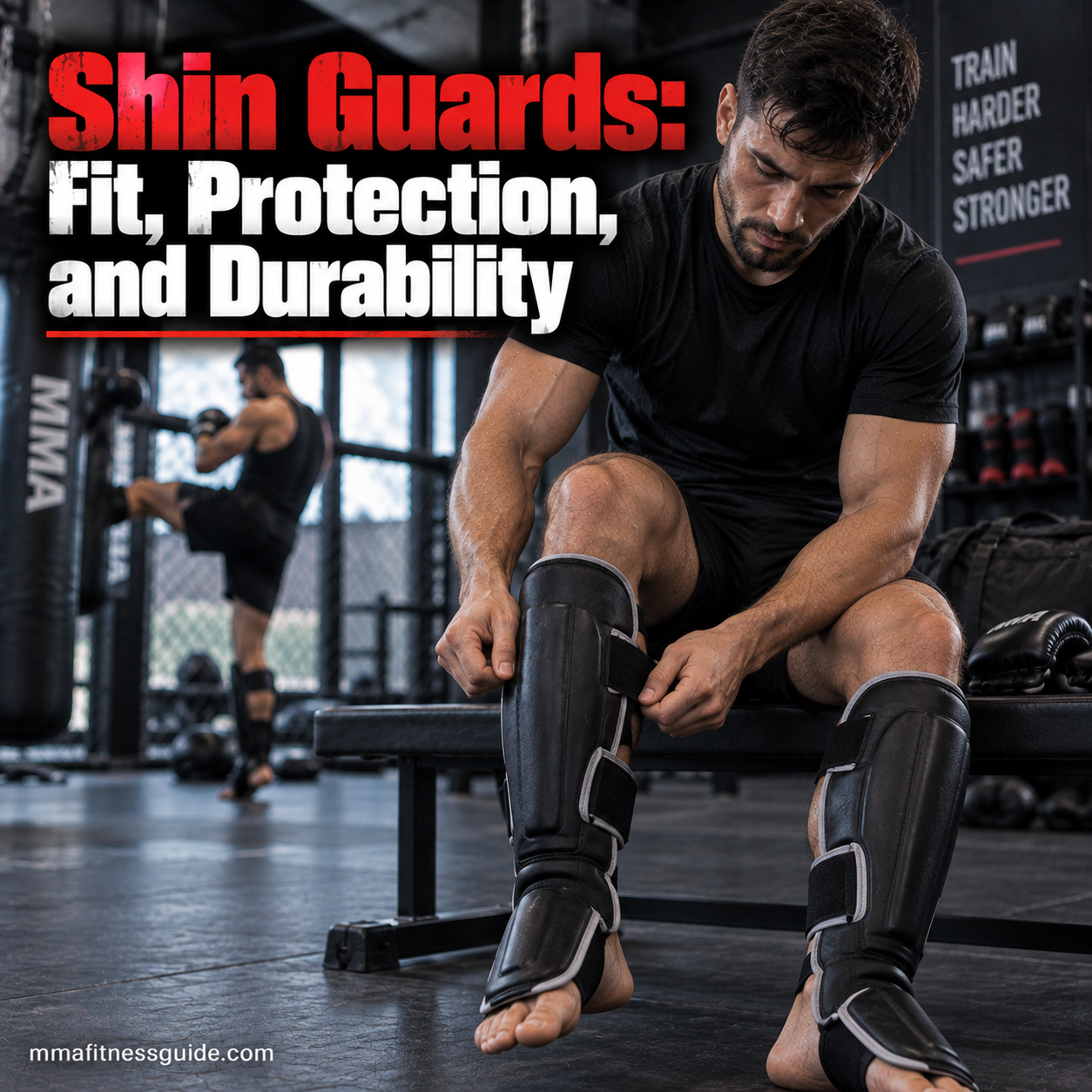
Choosing shin guards involves balancing three qualities: a secure fit, appropriate impact protection, and construction that withstands regular use.
The right pair depends on whether you’re practicing controlled kicks, sparring in Muay Thai, or combining striking and grappling in MMA. Your gym’s equipment requirements matter, too.
Here’s what to examine before buying, how to test the fit, and how to recognize when your guards need replacing.
Why Shin Guards Matter in MMA and Muay Thai
Shin guards are designed to cushion contact between your legs and another surface, particularly during partner drills and sparring.
They can help reduce superficial injuries such as bruising and abrasions while making controlled contact more comfortable for both athletes.
During a typical striking session, your shins and feet may encounter:
- A training partner’s legs during low kicks and checks.
- Forearms and elbows during blocked kicks.
- Another athlete’s shin during simultaneous attacks.
- Accidental contact during close-range exchanges.
The padding helps manage some of that contact, but its protective effect has limits.
Shin guards cannot guarantee protection against fractures, joint injuries, or other significant trauma. Wearing thicker guards doesn’t make uncontrolled, full-power sparring safe.
They also aren’t required for every training activity. Many gyms use them for kick sparring and certain partner drills but not for every heavy bag or pad session.
Follow your coach’s instructions about when to wear them and what level of contact is appropriate.
1. Understanding the Main Types of Shin Guards
Different designs prioritize different activities.
Before comparing brands, decide whether you need guards primarily for stand-up striking, MMA sparring with grappling, or light technical work.
Traditional Strap-On Shin Guards
Traditional strap-on guards generally feature a padded shin section, an instep protector, and adjustable straps around the calf.
Some use elastic bands beneath the foot and around the heel to help keep the guard positioned.
They are common in Muay Thai and kickboxing gyms.
Advantages:
- Often provide substantial shin and instep padding.
- Adjustable straps accommodate different calf sizes.
- Many models offer extensive front-of-leg coverage.
- Suitable options are available for regular stand-up sparring.
Potential drawbacks:
Bulkier designs can interfere with certain grappling movements. Straps may also shift or catch during wrestling exchanges.
A traditional Muay Thai guard may work well for kickboxing but feel cumbersome during MMA rounds that include takedowns.
Slip-On or Sleeve-Style Shin Guards
Sleeve-style guards use elastic or compression-like fabric to hold padding against the leg.
They generally have a more streamlined shape and fewer external straps.
Advantages:
- Less bulky than many traditional guards.
- Often convenient for movement between striking and grappling.
- Fewer exposed straps to catch during scrambles.
- Can feel more natural during ground work.
Potential drawbacks:
Some models offer relatively thin padding, and the fit depends heavily on the sleeve’s elasticity and sizing.
A sleeve that’s too loose may slide. One that’s too tight may become uncomfortable during longer sessions.
Don’t assume every sleeve-style guard provides adequate protection for hard kick sparring.
Hybrid MMA Shin Guards
Hybrid designs combine features from traditional strap-on guards and streamlined sleeves.
They may use adjustable straps, elastic sections, and a lower-profile padded shell.
These can be worth considering if your MMA classes regularly transition from striking to wrestling and ground work.
However, hybrid isn’t a standardized product category.
Compare the actual padding, closures, and fit rather than relying on the label.
2. Match the Shin Guards to Your Training
A guard that feels excellent during stand-up sparring may be awkward during grappling.
Likewise, a thin sleeve designed for technical MMA rounds may not provide the cushioning your gym expects for Muay Thai sparring.
Use the following comparison as a starting point.
| Training Activity | Features to Prioritize |
|---|---|
| Muay Thai sparring | Substantial shin and instep padding, secure straps |
| Kickboxing sparring | Protective coverage, stable fit, comfortable movement |
| MMA sparring with grappling | Streamlined construction, secure fit, fewer exposed closures |
| Light technical drills | Comfortable fit and padding appropriate to the drill |
| Heavy bag and pad work | Follow gym guidance; shin guards may not be necessary |
Ask your coach what equipment is expected for your specific classes.
Some gyms require a particular level of padding for sparring. Others distinguish between equipment for striking-only sessions and MMA rounds involving takedowns.
If you’re buying your first pair, matching your gym’s requirements is more useful than choosing based on appearance.
3. How Shin Guards Should Fit
Fit determines whether the padding stays where it belongs.
A correctly sized guard should sit securely against the front of your lower leg without squeezing excessively or shifting during normal movement.
Check the Shin Coverage
The main padded section should cover the front of your shin.
The upper edge generally sits below the knee so that you can bend your leg comfortably.
The lower section should connect appropriately with the instep protector without creating an awkward gap.
Coverage varies by design and body proportions.
Avoid choosing a guard that leaves a substantial section of your shin exposed during the movements you’ll perform.
Check the Instep Protector
The instep is the upper surface of your foot.
Many kickboxing and Muay Thai guards include padding that extends over this area.
The protector should sit over the intended portion of your foot without sliding toward your toes or pulling uncomfortably against your ankle.
If the instep section is too short, it may leave more of your foot exposed than expected.
If it’s excessively long, it may bunch when you point your toes or move around the mat.
Check the Calf Fit
Your guard should stay centered on your shin.
Adjustable straps can help, but they shouldn’t need to be tightened to the point of discomfort.
Excessive pressure, tingling, numbness, or changes in foot sensation are signs that the fit is inappropriate.
A guard that rotates repeatedly despite proper adjustment may have the wrong shape or size for your leg.
4. How to Measure Your Legs Before Buying
Shin guard sizing is not consistent across manufacturers.
One company’s medium may fit differently from another’s, and some size charts use height while others include shin length or calf circumference.
Use the manufacturer’s specific instructions whenever possible.
Step 1: Measure Your Shin Length
Sit with your knee bent.
Measure along the front of your lower leg, from just below the knee toward the ankle, following the points specified by the manufacturer’s size guide.
Don’t assume that your total lower-leg length should equal the guard’s stated length. Different brands may measure their products differently.
Step 2: Measure Your Calf
Wrap a flexible measuring tape around the widest part of your calf.
Keep the tape snug without compressing your skin.
This measurement is particularly useful for sleeve-style guards and models with limited strap adjustment.
Step 3: Compare Both Measurements
Check the manufacturer’s chart rather than selecting a size based solely on your height or weight.
If your shin length and calf circumference suggest different sizes, contact the retailer or manufacturer for guidance.
Step 4: Check the Return Policy
Even accurate measurements cannot guarantee a perfect fit.
The guard’s shape, padding thickness, and strap positioning can affect comfort.
Choose a retailer that allows appropriate fit checks and exchanges, and confirm the conditions before removing tags or using the equipment in training.
5. The Five-Movement Fit Test
Once you’ve received your shin guards, try them on before taking them into a contact session.
Wear them with the clothing you normally use for training.
Fasten all straps or adjust the sleeves according to the manufacturer’s instructions.
Then complete these five checks.
Test 1: Walk and Pivot
Walk around the room and perform a few controlled pivots.
The guards should remain centered.
If they immediately rotate or slide, adjust the fit and repeat the test.
Test 2: Raise Your Knee
Lift one knee toward your chest.
Check whether the upper edge presses uncomfortably against your knee or the instep section pulls against your foot.
Test 3: Perform a Controlled Kick
Throw a slow, low-to-moderate-height kick without making contact.
The guard shouldn’t shift dramatically as your leg extends and returns.
Test 4: Change Levels
Assume your fighting stance and perform several controlled level changes.
This is particularly useful if you intend to use the guards for MMA.
Notice whether the straps catch, the padding shifts, or the guard restricts your ankle.
Test 5: Practice a Gentle Ground Movement
If the guards are intended for MMA grappling, perform a controlled hip escape or move between seated and kneeling positions on a clean mat.
Look for excessive bunching or shifting.
A guard that repeatedly moves out of position during basic testing is unlikely to become more convenient during sparring.
Don’t attempt to solve a fundamentally poor fit by overtightening the straps.
6. How Much Padding Do You Need?
Padding thickness is an important consideration, but more padding isn’t automatically better in every situation.
Thicker guards may provide greater cushioning for certain impacts, but they can also increase bulk and interfere with movement.
Thinner guards may feel more natural during grappling but provide less cushioning.
The appropriate choice depends on the activity and expected contact level.
For Striking-Only Sparring
Look for adequate padding across the shin and instep.
Your coach may recommend a traditional Muay Thai or kickboxing design.
The padding should remain positioned over the intended areas when you kick and check.
For MMA Sparring
Consider how the guards behave during takedowns and ground transitions.
A lower-profile design may be easier to use, provided it meets your gym’s protective requirements.
For Beginners
Don’t assume that minimal padding is necessary to develop tougher shins.
Choose appropriate equipment for controlled training and follow your coach’s guidance on contact intensity.
Shin guards are not a substitute for gradual skill development.
7. Materials: What Actually Affects Durability?
Shin guards commonly use synthetic coverings, leather, foam padding, elastic, and hook-and-loop fasteners.
Each component affects how the equipment feels and wears over time.
Synthetic Leather
Synthetic coverings are common across a wide range of shin guards.
Their quality varies considerably.
Some resist abrasion well, while others may crack or peel after repeated use.
You cannot reliably determine longevity from the term synthetic leather alone.
Look at construction, warranty information, and evidence of wear in reviews from people who have used the product over time.
Genuine Leather
Leather is used in some traditional shin guards.
It can be durable when properly constructed and maintained, but the material alone doesn’t guarantee superior performance.
Stitching, padding, closures, and overall workmanship remain important.
Leather may also require specific cleaning and conditioning instructions.
Foam Padding
Many guards use layered or molded foam.
The padding should feel reasonably consistent across the intended protective area.
Avoid models with obvious gaps, uneven sections, or padding that shifts inside the outer covering.
Terms such as high-density foam can be useful product descriptions, but they don’t establish how well a particular guard performs in every impact scenario.
Straps and Elastic
Straps experience repeated pulling and adjustment.
Inspect where they attach to the guard.
Loose stitching, weak closures, and elastic that loses tension can shorten the useful life of otherwise serviceable equipment.
8. How to Evaluate Construction Before Buying
Product photographs can reveal some details, but they don’t tell the whole story.
If you can examine a pair in person, pay attention to the following areas.
Stitching: Look for secure, evenly finished seams without obvious loose sections.
Padding: Check for consistent coverage and a shape that follows the leg.
Strap attachment: Gently examine where the straps connect to the guard.
Inner lining: Look for a surface that feels comfortable and doesn’t have rough edges.
Instep connection: Check whether the foot protector moves naturally with the ankle.
When shopping online, prioritize listings with clear photographs of the front, back, sides, and closures.
A detailed size chart and understandable return policy are also valuable.
Don’t treat a high price or familiar brand name as proof that a particular model will fit your legs.
9. Common Shin Guard Buying Mistakes
Buying the Bulkiest Pair Available
Thick padding can be useful for certain sparring sessions, but excessively bulky guards may be uncomfortable during MMA grappling.
Choose according to the training you’ll actually perform.
Choosing Based Only on Height
Height-based sizing may not account for differences in calf circumference or lower-leg proportions.
Use all available measurements.
Ignoring Instep Coverage
A guard may fit your shin well but leave the instep protector in the wrong position.
Check both sections during the movement test.
Overtightening the Straps
Straps should secure the guard, not cause numbness or painful pressure.
If the guard slips unless you tighten it excessively, try a different size or shape.
Assuming Shin Guards Make Hard Sparring Safe
Padding cannot eliminate the risk of serious injury.
Control, communication, appropriate partner matching, and coaching remain essential.
Buying Before Checking Gym Rules
Some MMA classes permit only particular styles, especially when grappling is involved.
Ask before spending money.
10. How to Clean and Maintain Shin Guards
Shin guards collect sweat and are repeatedly exposed to friction.
Poor storage can leave them damp and unpleasant to wear.
A simple care routine helps preserve their condition.
After Every Session
Remove the guards from your gym bag as soon as practical.
Wipe the surfaces according to the manufacturer’s cleaning instructions.
Pay attention to the inner lining, where sweat accumulates.
Avoid soaking the guards unless the manufacturer specifically allows it.
Allow Them to Dry Thoroughly
Open the straps and place the guards in a well-ventilated area.
Keep them away from excessive heat and prolonged direct sunlight unless the care instructions say otherwise.
Don’t leave damp guards inside a sealed gym bag.
Use Cleaning Products Carefully
Choose products compatible with the guard’s covering and lining.
Some sprays or harsh cleaners can damage finishes, adhesives, or other materials.
Follow the product’s instructions and avoid combining cleaning chemicals.
Check the Straps Regularly
Remove lint and debris from hook-and-loop closures when appropriate.
Inspect the stitching and elastic for signs of deterioration.
Avoid Machine Washing Unless Approved
Many padded shin guards are not designed for machine washing or tumble drying.
Agitation and heat may damage the padding, outer covering, or adhesives.
Always follow the manufacturer’s instructions.
11. When Should You Replace Your Shin Guards?
There’s no universal replacement schedule.
A pair used twice a week for controlled technical work may wear differently from one used frequently in demanding sparring.
Inspect your guards regularly.
Consider replacement when you notice:
- Padding that has become noticeably compressed or uneven.
- Torn coverings that expose internal materials.
- Straps that no longer hold securely.
- Elastic sleeves that repeatedly slide out of position.
- Seams separating around important structural areas.
- Instep protection that no longer stays correctly positioned.
A small cosmetic scuff doesn’t necessarily make a guard unusable.
However, significant padding deterioration or a failure to stay secure can affect its suitability for training.
If you’re unsure, ask your coach to inspect the equipment.
Don’t continue using damaged guards simply because they were expensive.
12. What Should Beginners Prioritize?
If you’re buying your first pair, keep the decision straightforward.
Start by asking your gym which style is appropriate for its classes.
Then look for a pair that meets four basic requirements:
- It covers the shin and instep as intended.
- It stays secure during movement.
- It provides padding appropriate for the expected contact.
- It fits your budget without sacrificing essential construction quality.
You don’t need professional-level equipment for every beginner drill.
You also shouldn’t choose the cheapest available pair if it fits poorly or fails to meet your gym’s requirements.
Try one suitable pair before purchasing additional equipment.
After several weeks, you’ll have a clearer idea of whether you prefer a traditional strap-on design or a more streamlined MMA model.
Frequently Asked Questions
Are Shin Guards Necessary for MMA Training?
They are commonly required for kick sparring and certain partner drills, but requirements vary by gym and activity.
Ask your coach when shin guards should be worn and which styles are permitted.
Are Muay Thai Shin Guards Suitable for MMA?
They can work well for stand-up striking, but bulky designs and exposed straps may interfere with wrestling and grappling.
For MMA sessions involving ground work, check whether your gym prefers a streamlined design.
Should Shin Guards Feel Tight?
They should feel secure, not excessively tight.
You should be able to move comfortably without numbness, tingling, or painful pressure.
Do Thicker Shin Guards Prevent Injuries?
Thicker padding may provide more cushioning in certain situations, but no shin guard guarantees protection against fractures or other serious injuries.
Appropriate contact intensity and controlled technique remain essential.
Can I Use Shin Guards on a Heavy Bag?
You can use them if your coach recommends it, but they aren’t required for every bag session.
Don’t assume that wearing guards makes it appropriate to strike harder than your current technique and conditioning allow.
How Long Do Shin Guards Last?
Their lifespan depends on construction, frequency of use, contact intensity, storage, and maintenance.
Inspect the padding, straps, and seams rather than relying on a fixed replacement timeline.
Can I Wash Shin Guards in a Washing Machine?
Only if the manufacturer explicitly permits it.
Many padded models should be wiped clean and air-dried instead.
Final Thoughts: Find the Right Balance
Good shin guards should provide appropriate coverage without becoming a distraction.
Start with your training requirements. Choose a style suited to your classes, measure your legs carefully, and test the guards through realistic movements before using them for contact training.
Pay attention to padding, strap security, instep coverage, and construction quality. Maintain your equipment after each session and replace it when wear affects its fit or protective function.
Above all, remember that shin guards are only one part of safer training. They work alongside controlled contact, good coaching, and appropriate training partners—not in place of them.
Choose the pair that stays in position, suits your training, and lets you focus on developing your skills.