A boxer with both gloves tight to the temples is solving a different defensive problem from a fighter standing sideways with the lead shoulder protecting the chin. Both positions can defend punches, but they create different openings for counters—and expose different targets.
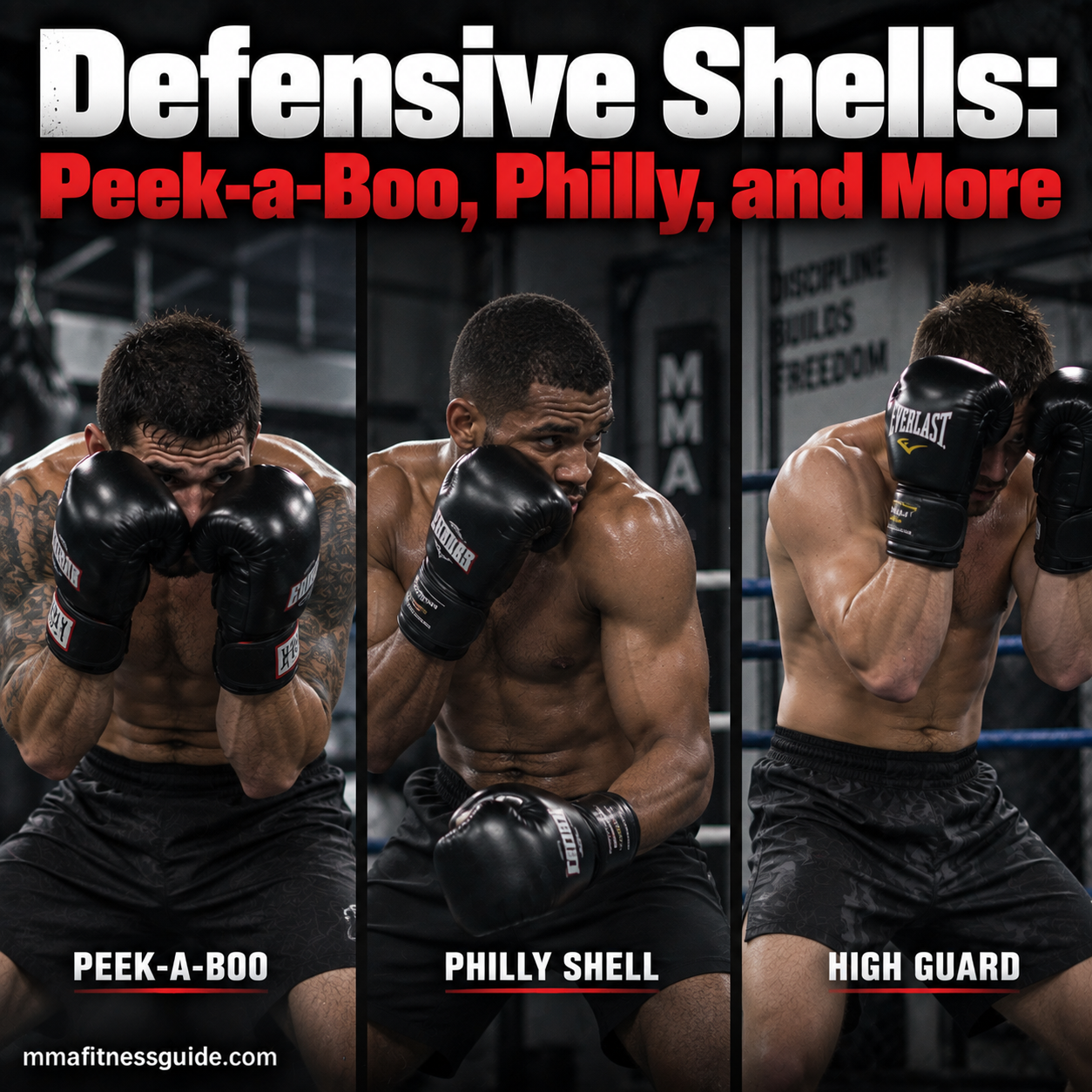
These positions are commonly described as defensive shells. The high guard emphasizes coverage, the Peek-a-Boo combines a compact guard with active head movement, the Philly Shell uses shoulder positioning and deflections, and the long guard creates distance with frames and extended hand positioning.
The ruleset changes how each approach can be used. A defensive position developed for boxing may need significant adjustment in MMA, where kicks, knees, clinches, takedowns, smaller gloves, and cage pressure introduce threats that aren’t present in a boxing match.
Rather than treating one shell as the answer to every exchange, it helps to understand what each guard protects, where it creates openings, and how footwork and positioning complete the defense.
What Is a Defensive Shell?
A defensive shell is a guard system that uses arm positioning, shoulder movement, head placement, and footwork to:
- Protect the head and torso
- Deflect or absorb strikes
- Create counterattacking opportunities
- Control angles and distance
Shells are not static blocks—they are dynamic defensive frameworks that rely on timing and positioning.
Why Defensive Shells Matter in Combat Sports
Effective defense does more than prevent damage.
Defensive shells help fighters:
- Conserve energy
- Stay calm under pressure
- Read opponents more clearly
- Set up counters
- Extend longevity and durability
Strong defensive habits often separate experienced fighters from reckless ones.
The Peek-a-Boo Guard
The Peek-a-Boo style is one of the most aggressive defensive shells in striking.
Core Characteristics
Key elements include:
- Hands held high and tight to the cheeks
- Elbows tucked in to protect the body
- Chin down
- Constant head movement
The guard resembles “peeking” through the gloves, which is where the name comes from.
Strengths of the Peek-a-Boo
The Peek-a-Boo excels at close-range pressure.
Advantages include:
- Strong head protection
- Effective against straight punches
- Natural setup for hooks and uppercuts
- Works well for shorter fighters
When paired with footwork and head movement, it becomes difficult to penetrate cleanly.
Limitations of the Peek-a-Boo
This shell requires excellent conditioning and timing.
Challenges include:
- Energy-intensive head movement
- Vulnerability to body shots
- Limited vision if posture breaks
- Less effective without pressure
Without constant motion, the guard can become predictable.
The Philly Shell (Shoulder Roll)
The Philly Shell is a more relaxed, counter-focused defensive system.
Core Characteristics
Key features include:
- Lead shoulder raised to protect the chin
- Rear hand guarding the face
- Lead hand lower to bait shots
- Slight bladed stance
This shell relies heavily on shoulder rotation and subtle movement.
Strengths of the Philly Shell
The Philly Shell is designed for counterstriking.
Benefits include:
- Efficient energy use
- Excellent counter opportunities
- Strong against single punches
- Clear vision of incoming strikes
It works best for fighters with strong timing and confidence.
Limitations of the Philly Shell
This shell has higher risk if misused.
Potential drawbacks:
- Vulnerable to combinations
- Exposed to kicks in MMA
- Requires precise timing
- Less forgiving for beginners
In MMA, the Philly Shell must be adapted to account for kicks, clinches, and takedowns.
High Guard Shell
The high guard is one of the most widely used defensive shells across combat sports.
Core Characteristics
Key elements include:
- Both gloves held high
- Elbows tight to the ribs
- Minimal shoulder rotation
- Stable stance
This shell prioritizes protection over countering.
Strengths of the High Guard
The high guard is reliable and versatile.
Advantages include:
- Strong overall coverage
- Easy to learn
- Effective against combinations
- Adaptable to MMA, boxing, and kickboxing
It’s often the first shell fighters learn.
Limitations of the High Guard
Despite its safety, it has drawbacks.
Challenges include:
- Reduced vision
- Absorbing damage instead of deflecting it
- Fatigue from sustained pressure
- Limited counter angles without movement
Without footwork, the high guard can lead to prolonged damage accumulation.
Long Guard and Extended Shells
The long guard is commonly used in Muay Thai and MMA.
Core Characteristics
This shell emphasizes:
- Extended lead arm
- Distance control
- Hand fighting
- Frame-based defense
It’s designed to manage range rather than absorb strikes.
Strengths of the Long Guard
Benefits include:
- Excellent range control
- Disrupts opponent rhythm
- Sets up elbows and knees
- Works well against aggressive fighters
It’s especially useful in clinch-heavy environments.
Limitations of the Long Guard
Drawbacks include:
- Vulnerability if hands are cleared
- Requires strong hand control
- Less effective at close boxing range
Timing and awareness are essential.
Defensive Shells in MMA vs Boxing
Shells must be adapted for MMA.
Key differences include:
- Kicks bypass traditional boxing shells
- Clinch threats limit shoulder roll use
- Takedowns require posture awareness
- Gloves are smaller, reducing block reliability
MMA fighters often blend shells rather than relying on one exclusively.
Choosing the Right Defensive Shell
The best shell depends on multiple factors.
Consider:
- Body type and reach
- Fighting style (pressure vs counter)
- Conditioning level
- Ruleset (boxing vs MMA)
- Opponent tendencies
Most high-level fighters switch shells fluidly during exchanges.
Training Defensive Shells Effectively
To develop strong shell defense:
- Drill slow, controlled defense rounds
- Focus on head position and posture
- Add counters gradually
- Use light sparring to build comfort
- Emphasize footwork and exits
Defense improves through repetition and awareness, not force.
Common Mistakes With Defensive Shells
Avoid these issues:
- Holding static guards
- Ignoring body defense
- Relying on shells without footwork
- Overusing advanced shells too early
- Forgetting exits after blocks
Defense should always lead to movement or counters.
Final Thoughts
Defensive shells like the Peek-a-Boo, Philly Shell, high guard, and long guard are tools—not rigid rules. Each offers unique strengths and vulnerabilities, and the most effective fighters learn how to blend them seamlessly. Strong defense reduces damage, builds confidence, and creates opportunities to control fights rather than survive them.
Mastering defensive shells turns defense into one of the most powerful weapons in martial arts.