Your trusted source for MMA fitness, nutrition, and fighter-level health.
Category: Famous Fighters & History
Famous Fighters & History highlights the people, moments, and eras that shaped MMA. This category explores legendary careers, historic fights, coaching influences, and how the sport has evolved over time.
An iconic MMA fight night moment capturing the intensity of walkouts and unforgettable octagon experiences.
Introduction
Few moments in combat sports are as emotionally charged as a fighter’s walkout or a defining fight night moment. Before the first punch is thrown, walkouts set the tone—revealing confidence, intimidation, culture, and mindset. Inside the cage or ring, iconic moments become etched into history, shaping legacies and defining eras.
From legendary entrances to unforgettable finishes, these moments are why fight fans remember names, not just records.
MMA fighters listening to the referee inside the octagon, highlighting the role of judging and scoring in professional bouts.
Judging and scoring have shaped MMA just as much as techniques and rules. From the early days of no-time-limit bouts to today’s structured rounds and scorecards, how fights are evaluated has influenced fighter strategy, pacing, and even the evolution of entire fighting styles.
Understanding the evolution of MMA judging and scoring helps fans, fighters, and coaches better understand why fights look the way they do today — and why judging remains one of the most debated aspects of the sport.
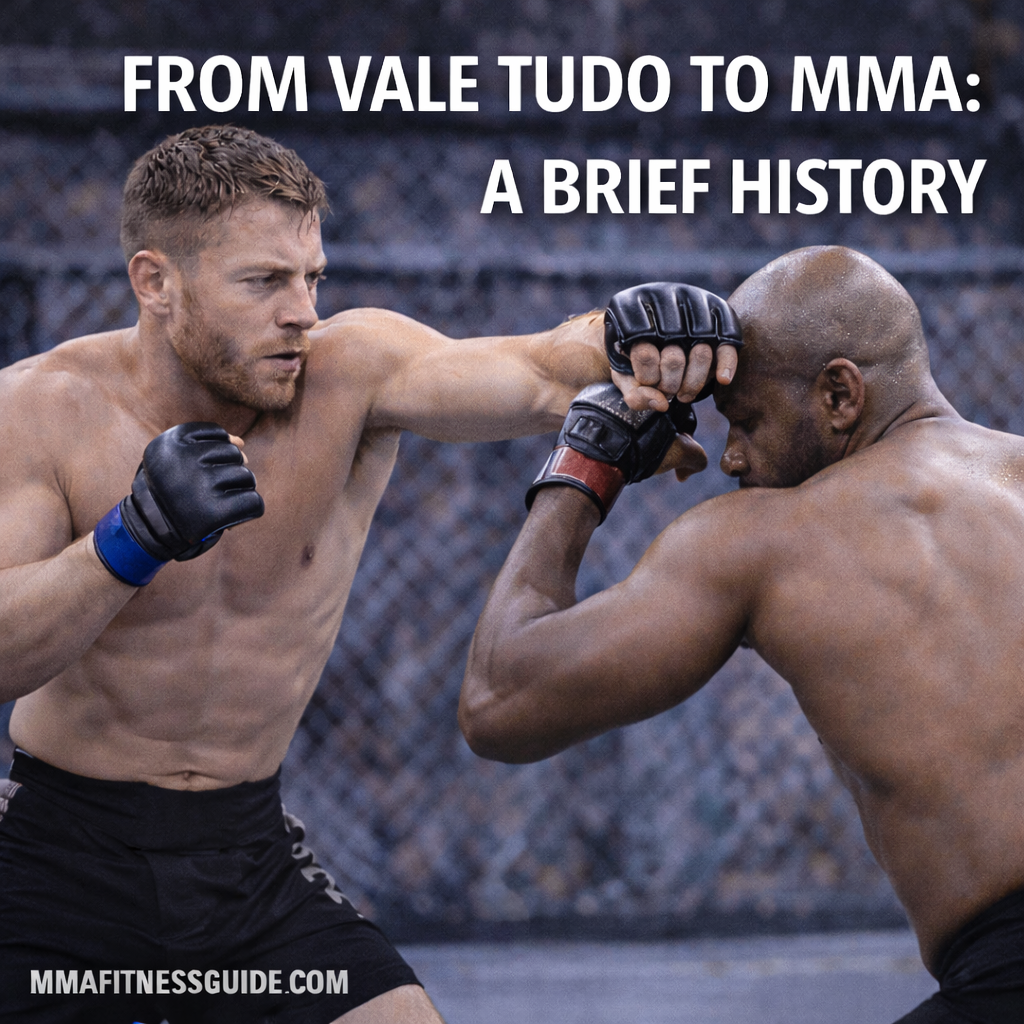
MMA fighters engaging in a controlled exchange that reflects the evolution from Vale Tudo to modern MMA.
Modern MMA didn’t appear overnight. It evolved through decades of experimentation, cultural exchange, and real-world fighting challenges. At the heart of MMA’s origins is Vale Tudo, a no-holds-barred combat style that tested martial arts in the rawest way possible.
Understanding how Vale Tudo transformed into modern MMA helps explain why today’s fighters train the way they do — and why versatility, conditioning, and adaptability are essential in the sport.
MMA fighters using modern sports science tools to track performance and recovery during training.
Modern MMA is no longer driven by toughness alone. While grit and experience still matter, today’s elite fighters are supported by sports science at nearly every stage of training and competition. From strength and conditioning to recovery, nutrition, and data tracking, science has reshaped how fighters prepare and how long they stay competitive.
Understanding the role of sports science in MMA helps explain why fighters are faster, more durable, and more strategic than ever before — and why longevity is becoming a realistic goal instead of an exception.
Elite MMA fighters representing powerful gym lineages and teams known for developing champions across generations.
Georges St-Pierre sharpened his game under the guidance of coaches at Jackson-Wink, Khabib Nurmagomedov rose from the wrestling-heavy culture surrounding American Kickboxing Academy, and American Top Team has produced champions across multiple divisions and generations. Different fighters and different systems—but each demonstrates how much of a champion is built long before the cage door closes.
Elite MMA gyms are more than rooms filled with mats, bags, and sparring partners. Over years of competition, successful teams develop their own coaching philosophies, technical systems, training cultures, and methods for preparing fighters under pressure. That knowledge passes from coaches to athletes and eventually to new generations of competitors.
When the same team repeatedly produces world-class fighters, the pattern is rarely accidental. Gym lineages help explain why certain camps become associated with particular fighting styles, why some teams dominate entire periods of MMA, and how championship knowledge can outlast the careers of the fighters who first put those gyms on the map.
Iconic MMA brothers and fighting families showcasing the legacy, loyalty, and shared history that shape mixed martial arts.
Nick and Nate Diaz brought the same relentless pressure and unmistakable Stockton identity into the cage. Maurício “Shogun” Rua and Murilo “Ninja” Rua emerged from the same Brazilian fighting culture. Long before either pair became famous, the Gracie family had already demonstrated how martial arts knowledge could pass from one generation to the next and ultimately influence an entire sport.
MMA may appear to be an individual pursuit once the cage door closes, but some of its most important stories begin within families. Brothers become training partners, younger generations inherit decades of knowledge, and relatives often provide the support and competitive environment that shape a fighter long before a professional debut.
From the Diaz and Rua brothers to sprawling martial arts dynasties such as the Gracies, family connections have left a distinctive mark on MMA’s techniques, personalities, rivalries, and history.
Legendary MMA fights combine elite skill, momentum swings, resilience, and unforgettable moments that continue to define each era of the sport.
Forrest Griffin and Stephan Bonnar trading punches for three exhausting rounds. Dan Henderson and Shogun Rua surviving knockdowns and momentum swings across five. Zhang Weili and Joanna Jędrzejczyk maintaining a punishing pace for 25 minutes. MMA history is filled with fights where neither competitor seemed willing to give the other an inch.
These bouts become more than exciting matchups. They capture a particular moment in the sport, revealing the fighting styles, technical standards, championship stakes, and level of competition that defined an era.
From the unpredictable style clashes of early MMA to today’s highly technical battles between well-rounded athletes, Fight of the Year contenders provide a unique timeline of the sport’s evolution. The techniques have changed and the athletes have become more complete, but the ingredients of an unforgettable fight—skill, momentum shifts, resilience, and drama—remain remarkably consistent.
Iconic MMA champions showcasing historic title reigns and multiple championship defenses.
Winning an MMA championship can take one perfect performance. Keeping that championship means beating the next top contender—and then doing it again while the entire division studies how to defeat you.
That is what separates a memorable title win from a legendary championship reign. Anderson Silva defended the UFC middleweight title 10 times, Georges St-Pierre built a dominant run at welterweight, and Demetrious Johnson reached a record-setting 11 consecutive UFC title defenses. Other champions established their greatness by conquering multiple divisions or remaining at the top through generations of challengers.
The greatest title reigns in MMA weren’t simply long. They were built on repeated victories against elite opposition, constant adaptation, and the ability to perform when every challenger entered the cage specifically prepared to take the belt away.
Collage featuring four female MMA fighters in dramatic UFC moments with title text highlighting the most shocking upsets.
Why UFC Upsets Captivate Fans
Few things electrify MMA fans like a true upset — the moment when the entire world predicts one outcome and reality delivers the opposite. Upsets shake rankings, rewrite narratives, humble legends, and inspire new generations of fighters.
But more importantly, they reveal the heart of MMA: unpredictability. In a sport with four-ounce gloves, elite athletes, and endless stylistic clashes, anything is possible.
Here are the most shocking UFC upsets in history — the ones that shook arenas, silenced crowds, and instantly became part of MMA lore.
Silhouetted fighters inside an MMA cage under arena lights, representing the history and evolution of iconic submission moments in the sport.
Submissions have shaped some of the most iconic moments in MMA history. From championship upsets to last-second comebacks, these techniques showcase skill, timing, and a deep understanding of grappling mechanics. Historic submissions don’t just win fights — they influence how athletes train, how coaches teach, and how the sport evolves.
This guide looks at legendary submission moments and breaks down the mechanics behind why they worked.