
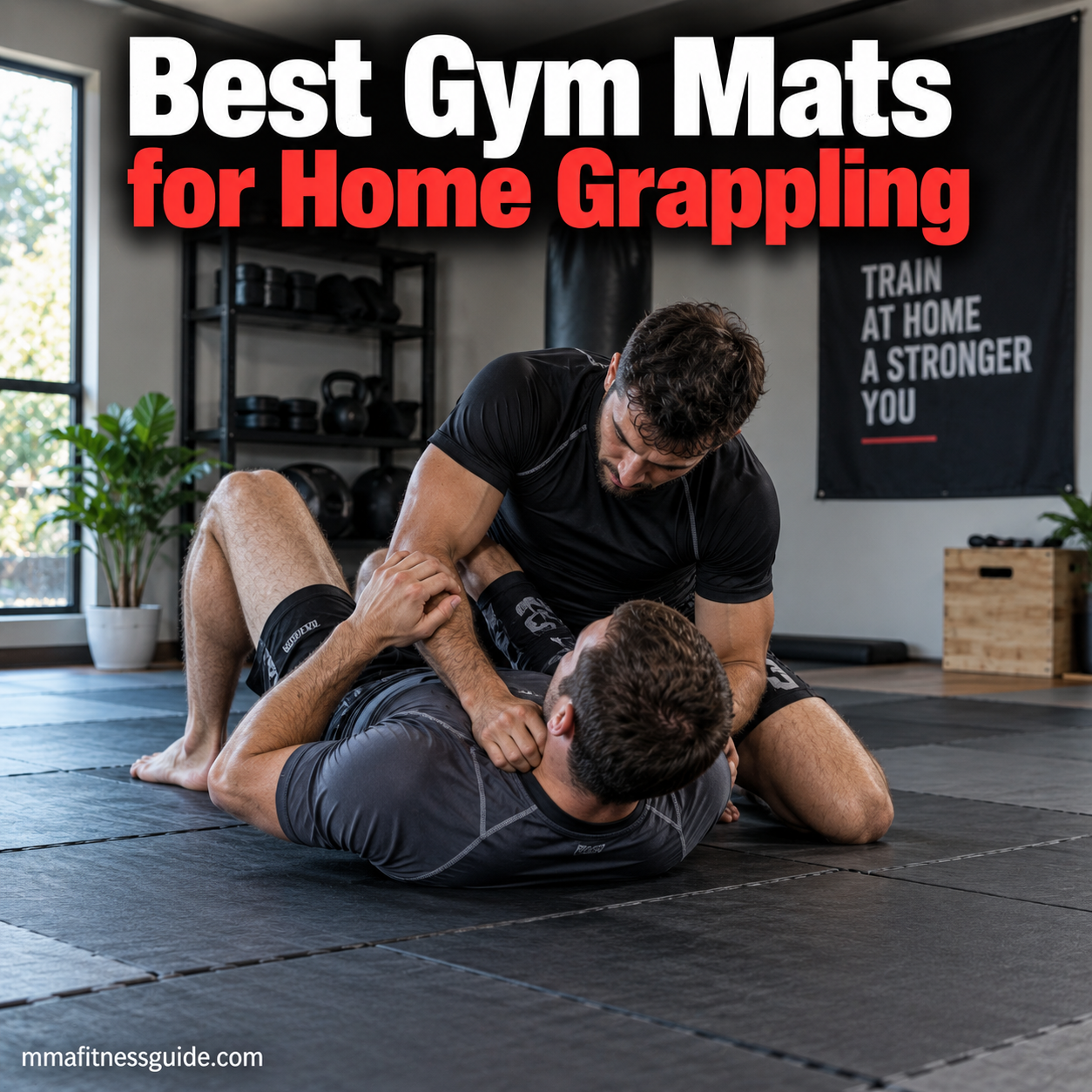
Training grappling at home is an effective way to sharpen techniques, improve conditioning, and supplement regular gym sessions. Whether you practice Brazilian Jiu-Jitsu (BJJ), wrestling, judo, or MMA, having a dedicated training surface makes it easier to drill movements and maintain consistency between classes.
However, grappling places unique demands on flooring. Knees repeatedly contact the ground, athletes shift their weight during scrambles, and takedowns can generate substantial impact. Training directly on hardwood, tile, or concrete increases the risk of painful contact and injury.
Choosing the best gym mats for home grappling requires more than finding the thickest foam available. Mat density, surface texture, available space, stability, and the type of training you perform all influence which flooring is appropriate.
A compact setup for solo movement drills has different requirements from a dedicated room used for partner rolling.
This guide explains how to compare home grappling mats, choose suitable thickness and density, evaluate puzzle mats against roll-out systems, and build a practical training area. It also covers cleaning, floor protection, storage, budgeting, and the limitations of home training.
The goal is to help you create a durable training surface that supports your practice without overlooking important safety considerations.
Why Proper Mats Matter for Grappling
Grappling involves constant contact with the ground.
During a typical session, you might practice guard retention, transition between positions, perform wrestling shots, or work through controlled takedown entries.
Each movement places different demands on the training surface.
A suitable grappling mat provides cushioning while maintaining enough stability for athletes to move without sinking excessively into the foam.
Impact Protection
Knees, elbows, hips, shoulders, and the back frequently contact the mat during grappling.
Properly constructed mats help absorb and distribute some of the force generated during these movements.
This is particularly important during repetitive drills, when the same body parts may contact the floor dozens of times.
However, no mat can guarantee protection against injury. High-impact throws and uncontrolled falls can cause serious injuries even on professional training surfaces.
Joint Comfort During Drilling
Thin flooring over concrete can make kneeling, shrimping, and positional transitions uncomfortable.
Appropriate cushioning can reduce direct pressure during routine movements.
For athletes who practice frequently, this may make home drilling more comfortable and sustainable.
Surface Grip and Stability
Grapplers need traction to push, pivot, and change direction.
A slippery floor makes it difficult to establish stable positions, while excessive grip can restrict foot rotation.
The ideal surface provides controlled traction without creating unnecessary friction.
Floor Protection
Mats also protect the underlying flooring.
Repeated movement, sweat, and equipment contact can damage hardwood, laminate, and other residential surfaces.
A properly installed mat system creates a barrier between training activity and the floor, although additional moisture protection or underlayment may be necessary.
If you are planning a larger training area, our guide to building a home MMA workout space explains how flooring fits into the overall setup.
Key Features to Look for in Home Grappling Mats
Before comparing brands or prices, evaluate the characteristics that affect everyday training.
The most important features include thickness, shock absorption, density, surface texture, durability, cleaning requirements, and storage.
Thickness and Shock Absorption
Thickness determines how much cushioning material separates you from the underlying floor.
However, thickness alone does not establish whether a mat is suitable for takedowns.
Foam construction, density, impact testing, the subfloor, and installation all influence protection.
A thick mat that compresses completely under impact may provide less protection than expected.
Surface Texture
The surface should allow controlled movement without becoming excessively slippery.
Look for a finish designed specifically for martial arts rather than general-purpose exercise flooring.
Density and Firmness
A stable mat should support body weight without creating a sinking sensation.
Excessively soft foam can make standing movements unstable.
Very firm flooring may provide insufficient cushioning for repeated ground contact.
Durability
Grappling mats experience repeated compression, twisting, friction, and moisture exposure.
Inspect product specifications for:
- Foam construction.
- Surface material.
- Seam design.
- Resistance to tearing.
- Manufacturer-recommended activities.
- Cleaning compatibility.
Ease of Installation and Storage
A permanent training room can accommodate large roll-out mats or professionally installed flooring.
A living room that doubles as a workout space may require modular mats that can be assembled and stored after each session.
Choose a system that matches how you will actually use the space.
Ideal Thickness for Home Grappling
Mat thickness is one of the first specifications buyers compare.
Common home training options range from approximately one inch to two inches or more.
The following ranges are useful starting points, not universal safety standards. Manufacturer ratings, mat construction, subfloor conditions, and the intended activity must determine whether a particular product is appropriate.
1 to 1.25 Inches: Light Drilling and Mobility
Mats around one inch thick are commonly used for lighter activities.
Potential applications include:
- Solo shrimping drills.
- Technical stand-ups.
- Mobility exercises.
- Ground movement patterns.
- Controlled positional transitions.
They may be practical for a small apartment or multipurpose room.
However, thin mats over concrete are generally inappropriate for high-impact throws or uncontrolled takedowns.
1.5 to 2 Inches: General Grappling and Rolling
Mats in this range are often considered for dedicated home grappling areas.
Depending on their construction and manufacturer specifications, they may support controlled partner drilling, positional sparring, and rolling.
For many home setups, this range offers a useful balance between cushioning and stability.
Nevertheless, thickness does not automatically make a mat suitable for takedowns.
Confirm the manufacturer’s intended use before purchasing.
2 Inches or More: Additional Cushioning
Thicker mats may provide additional cushioning for certain activities.
However, a two-inch mat placed directly over concrete is not necessarily sufficient for repeated high-impact throws.
Judo and wrestling facilities may use specialized flooring systems, including engineered underlayment or sprung subfloors, to manage impact.
If your primary goal involves practicing throws, consult a qualified coach and a flooring manufacturer about an appropriate installation.
Practical recommendation: For ordinary home drilling and controlled rolling, consider martial-arts-specific mats around 1.5–2 inches thick, subject to the product’s ratings. Avoid treating any thickness as a guarantee of safety for throws.
Mat Density: Soft vs. Firm
Density matters just as much as thickness.
Two mats with identical dimensions can feel completely different because of their foam construction.
Why Very Soft Mats Can Be a Problem
Soft foam may feel comfortable when kneeling, but excessive compression creates instability.
During standing drills, your feet may sink into the surface.
This can interfere with balance, footwork, and directional changes.
Very soft mats may also compress nearly completely during impact, reducing the cushioning available at the point of contact.
Why Very Firm Mats Can Be Uncomfortable
Firm mats provide stable footing but may transfer more impact to the body.
Repeated knee drops and ground transitions can become uncomfortable when the flooring provides insufficient cushioning.
Finding the Right Balance
Look for high-quality foam designed for grappling.
Common materials include ethylene-vinyl acetate (EVA) foam and specialized polyethylene-based foam systems.
Different foam formulations offer different combinations of firmness, resilience, and durability.
Density numbers alone do not tell the complete story. Foam stiffness, compression behavior, and impact performance also matter.
When comparing products, prioritize martial-arts-specific performance information rather than assuming that the highest density is automatically the safest choice.
Puzzle Mats vs. Roll-Out Mats
Puzzle mats and roll-out mats are two popular options for home grappling.
Both can work well, but they suit different spaces and training requirements.
Puzzle Mats
Puzzle mats consist of individual foam tiles with interlocking edges.
They are popular because they can be assembled without permanent installation.
Advantages of Puzzle Mats
Modular design: You can create a training area that fits your available floor space.
Expandable layout: Additional tiles can be added later if you move into a larger room.
Individual replacement: Damaged sections can often be replaced without purchasing an entirely new floor.
Storage flexibility: Tiles can be disassembled and stacked when not in use.
Disadvantages of Puzzle Mats
Interlocking seams may separate during aggressive movement, particularly if the installation is loose or lacks a secure perimeter.
Edges can also become trip hazards when tiles shift.
Lower-quality puzzle mats may develop uneven connections or lose their shape with repeated assembly.
Best Uses
Puzzle mats are practical for:
- Solo technical drills.
- Mobility exercises.
- Controlled positional work.
- Light partner rolling.
- Multipurpose training rooms.
Choose interlocking mats specifically designed for martial arts rather than thin children’s play mats or generic foam floor tiles.
For active partner training, the system should be securely installed according to the manufacturer’s instructions.
Roll-Out Mats
Roll-out mats are typically manufactured as large foam sections with a durable surface bonded to the cushioning layer.
They can cover substantial areas with fewer seams than modular puzzle mats.
Advantages of Roll-Out Mats
Fewer seams: Large sections reduce the number of joints across the training surface.
Consistent surface: A continuous finish can provide a more uniform feel during movement.
Convenient installation: Some systems can be rolled out relatively quickly.
Professional appearance: Roll-out flooring can resemble the surfaces used in dedicated martial arts facilities.
Disadvantages of Roll-Out Mats
Roll-out systems can be more expensive than basic puzzle mats.
Large rolls also require suitable storage space.
Multiple sections may need manufacturer-approved seam tape or fastening systems to prevent separation.
Some mats retain a curl after storage and need time to lie flat.
Best Uses
Roll-out mats are worth considering for dedicated home grappling rooms, regular partner drilling, and controlled live rolling.
They may also be suitable for certain takedown activities when the complete flooring system is specifically rated and installed for that purpose.
Which Type Should You Choose?
| Consideration | Puzzle mats | Roll-out mats |
|---|---|---|
| Small spaces | Convenient | Depends on roll dimensions |
| Expandability | Easy | Requires compatible sections |
| Storage | Stackable tiles | Requires room for rolls |
| Seams | Numerous interlocking joints | Fewer, larger joints |
| Installation | Usually straightforward | May require seam fastening |
| Replacement | Individual tiles | May require replacing larger sections |
For a temporary setup, puzzle mats often offer greater flexibility.
For a dedicated room, roll-out mats may provide a more consistent training surface.
Neither design is automatically suitable for high-impact throws.
Tatami-Style vs. Smooth Surface Mats
Surface texture affects traction, movement, and skin comfort.
Two common options are tatami-style textured surfaces and smoother vinyl finishes.
Tatami-Style Mats
Tatami-style mats have a textured surface that provides grip during grappling.
They are commonly associated with judo and other martial arts training environments.
Potential advantages include:
- Reliable traction during standing movements.
- Stable footing for technical drills.
- A familiar feel for athletes accustomed to textured gym mats.
However, rougher textures may increase friction against exposed skin.
Repeated movement across the surface can contribute to abrasions or mat burn.
Smooth Vinyl Mats
Smooth vinyl surfaces are common on roll-out mats and certain grappling systems.
They can provide a relatively uniform surface and are often straightforward to wipe clean.
Potential advantages include:
- Easy surface cleaning.
- Consistent movement.
- Reduced abrasive texture compared with some tatami finishes.
However, smooth surfaces can become slippery when contaminated with sweat or cleaning residue.
Which Surface Is Better for BJJ?
For Brazilian Jiu-Jitsu, either surface may be appropriate.
Gi practitioners may prefer a familiar textured surface, while no-gi athletes may favor certain smooth finishes.
Personal preference, footwear policies, and the specific mat material all matter.
If possible, test the surface before buying.
Pay attention to how it feels during pivots, guard retention, and movement on exposed knees and elbows.
For related guidance, read our article on foot and toe care for grapplers .
Best Mat Sizes for Home Use
The amount of available space determines which drills you can perform safely.
A mat area that feels spacious during solo mobility work can become restrictive when two athletes begin rolling.
Small Spaces: 8 × 8 or 10 × 10 Feet
These dimensions can support basic solo movement and selected controlled partner drills.
An 8 × 8-foot area provides 64 square feet.
A 10 × 10-foot area provides 100 square feet.
These layouts may work for:
- Shrimping.
- Bridging.
- Technical stand-ups.
- Solo movement combinations.
- Carefully controlled positional drilling.
They are not suitable for unrestricted rolling or takedowns.
Medium Rooms: 12 × 12 Feet
A 12 × 12-foot area provides 144 square feet.
This creates additional room for controlled partner movement.
However, two athletes can still reach the edge quickly during a scramble.
Keep intensity appropriate and reset positions before approaching the boundary.
Dedicated Rooms: 14 × 14 Feet or Larger
Larger areas provide more room for movement.
A 14 × 14-foot layout offers 196 square feet.
This may accommodate a broader range of controlled grappling drills, but it is not automatically sufficient for unrestricted takedowns or competition-style rolling.
The surrounding clearance, wall protection, floor system, and number of athletes must also be considered.
Account for Safety Clearance
Do not measure only the mat dimensions.
Consider nearby hazards such as:
- Walls and door frames.
- Furniture.
- Windows.
- Radiators.
- Exposed structural columns.
- Exercise equipment.
A mat ending directly against an unpadded wall creates an obvious collision hazard.
The appropriate clearance depends on the activity and facility design. When adequate space is unavailable, restrict training to stationary or controlled movements.
Cleaning and Hygiene Considerations
Home grappling mats require regular cleaning even when only one or two people use them.
Sweat, skin oils, dirt, and microorganisms can accumulate on the surface.
Grappling involves frequent skin contact, making hygiene especially important.
Clean After Every Training Session
A practical routine includes:
- Remove loose dirt and debris.
- Clean visible soil using a product compatible with the mat.
- Apply an appropriate disinfectant according to its label when disinfection is needed.
- Keep the surface wet for the product’s required contact time.
- Allow the mats to dry completely before training or storage.
Use a disinfectant appropriate for the surface and follow its label directions. In the United States, EPA-registered disinfectants can be selected according to their approved uses and organism claims.
Do not assume that a quick spray followed by immediate wiping provides effective disinfection.
Clean Between Different Users
If friends or training partners share the space, clean the mats between sessions as appropriate.
Avoid training with uncovered or potentially infectious skin lesions.
Anyone with a suspected contagious skin infection should avoid close-contact training until appropriately assessed and cleared.
Prevent Moisture Accumulation
Moisture trapped beneath mats can damage residential flooring and encourage microbial growth.
Periodically lift removable mats to inspect the underlying surface.
Pay particular attention to basements, concrete slabs, and rooms with limited ventilation.
Our guide to sanitizing shared gym equipment explains additional cleaning principles relevant to training environments.
Noise and Floor Protection
Home grappling can generate considerable noise.
Footwork, knee contact, and body movement can transmit vibration through the floor.
This becomes particularly important in apartments and upstairs rooms.
Consider the Underlying Floor
Concrete provides a rigid foundation but little inherent cushioning.
Hardwood and laminate may be vulnerable to trapped moisture, abrasion, and concentrated pressure.
Carpet can introduce instability beneath certain mat systems.
Check the mat manufacturer’s installation requirements before choosing an underlayment.
Use Appropriate Underlayment
Some flooring systems can be installed over compatible rubber or foam underlayment.
However, adding an arbitrary soft layer beneath mats can make the surface unstable or alter its impact performance.
Use only underlayment approved for the intended mat system.
Reduce Noise Through Training Choices
Avoid high-impact throws in apartments or rooms above occupied spaces.
Focus on controlled drilling, ground movement, and positional exercises.
Additional padding may reduce some noise, but it cannot guarantee that impact vibrations will not travel through the building.
Budget-Friendly Options vs. Premium Mats
Home grappling mats range from basic modular flooring to professional training systems.
The right budget depends on how frequently you train and which activities you intend to perform.
Budget Mats
Budget-friendly mats may be suitable for beginners who primarily practice solo drills and controlled movement.
Potential advantages include:
- Lower initial cost.
- Easy installation.
- Flexible room layouts.
- Convenient replacement of individual tiles.
However, inexpensive products may have weaker interlocking edges, less durable surfaces, or insufficient impact protection.
Avoid choosing thin generic foam simply because it covers more floor area for less money.
Premium Mats
Higher-priced martial arts mats may offer improved foam construction, surface durability, installation systems, or manufacturer-tested performance.
They can be worth considering for frequent training and dedicated spaces.
However, premium pricing alone does not establish safety.
Check product specifications, intended activities, and installation requirements.
Where Should You Spend First?
Prioritize the mat system itself, including appropriate thickness, construction, and secure installation.
Next, address surrounding hazards, moisture protection, and cleaning supplies.
Decorative flooring colors and professional-looking finishes should come after the essential requirements.
Our guide to budget vs. premium MMA equipment explores how to prioritize equipment purchases.
For a broader approach to affordable training equipment, see building a home MMA gym on a budget .
Common Mistakes When Buying Home Mats
A few common mistakes can make an otherwise promising home training setup impractical.
Choosing Mats That Are Too Thin
Thin exercise mats are not substitutes for martial arts flooring.
Yoga mats and lightweight fitness tiles are designed for different activities and generally do not provide appropriate protection for partner grappling.
Ignoring Density and Construction
A thick mat can still perform poorly if the foam compresses excessively or lacks suitable impact characteristics.
Compare construction and intended use rather than thickness alone.
Underestimating Space Requirements
Two athletes can move across a room quickly during a scramble.
A small training area should be used for appropriately restricted drills rather than unrestricted live rolling.
Leaving Edges Unsecured
Loose edges and separating seams create trip hazards.
Install mats according to the manufacturer’s instructions and inspect connections before every session.
Neglecting Cleaning
Even a high-quality mat can become unhygienic when sweat and moisture accumulate.
Establish a cleaning routine from the beginning.
Buying Without Considering Storage
Large roll-out mats can be difficult to store in small homes.
Measure storage space before purchasing.
How to Set Up a Home Grappling Area
A practical home grappling space does not require a commercial facility, but it does require planning.
Step 1: Choose the Location
Select a room with enough unobstructed space for your intended activities.
Ground-floor rooms are often easier to evaluate for impact noise and structural concerns, although the underlying floor still requires inspection.
Avoid areas with low ceilings, exposed fixtures, or nearby furniture.
Step 2: Inspect the Subfloor
Check for uneven surfaces, moisture, loose boards, and other problems.
The flooring should be stable and compatible with the mat manufacturer’s installation requirements.
Resolve moisture problems before covering the floor.
Step 3: Install the Mats
Follow the manufacturer’s directions for layout, seams, perimeter restraints, and underlayment.
Do not improvise permanent adhesives or fastening systems unless approved for the product.
Step 4: Address Surrounding Hazards
Remove furniture and equipment from the training area.
Where walls or structural elements are close to the mats, appropriate wall padding may be necessary.
Wall padding does not make a cramped room suitable for uncontrolled takedowns.
Step 5: Establish Cleaning and Storage Procedures
Keep cleaning supplies accessible.
Allow mats to dry before stacking or rolling them.
Inspect the underlying floor periodically.
Step 6: Define Appropriate Training Activities
Decide which exercises the space can safely accommodate.
A compact room might be designated for solo movement, controlled positional drills, and conditioning.
Do not gradually introduce more aggressive activities without reassessing the space and flooring.
For broader home fitness planning, read creating a home that supports fitness .
Are Home Mats Enough for Serious Training?
Home mats can be valuable for athletes who want additional practice outside scheduled gym sessions.
They are particularly useful for activities that do not require a large training area or high-impact contact.
What You Can Practice at Home
Depending on available space and flooring, suitable activities may include:
- Solo grappling movements.
- Bridging and shrimping.
- Technical stand-ups.
- Controlled guard retention drills.
- Positional transitions.
- Mobility exercises.
- Grappling-specific conditioning.
Partner drills should remain appropriate to the available space and the participants’ experience.
What Should Remain at a Properly Equipped Gym?
Full-intensity takedowns, high-amplitude throws, and unrestricted live sparring require substantially more than basic home flooring.
They benefit from qualified supervision, appropriate space, properly engineered impact protection, and established safety procedures.
Home training should supplement rather than automatically replace structured instruction.
If you are looking for a suitable facility, our guide to choosing the right MMA gym covers considerations for evaluating a training environment.
Athletes planning a commercial facility should also review how to start a martial arts gym for broader planning considerations.
Frequently Asked Questions About Home Grappling Mats
What thickness is best for home BJJ mats?
Martial-arts-specific mats around 1.5–2 inches thick are a common starting point for controlled home grappling and rolling.
However, the correct choice depends on foam construction, manufacturer specifications, subfloor conditions, and intended activity.
Thickness alone does not establish suitability for takedowns.
Can I use puzzle mats for BJJ?
Yes. Properly constructed martial arts puzzle mats can work for solo drills and controlled grappling.
Ensure the tiles remain securely connected and are suitable for the activities you intend to perform.
Are roll-out mats better than puzzle mats?
Roll-out mats generally provide fewer seams, while puzzle mats offer modularity and convenient expansion.
Neither is universally better.
Choose according to your available space, storage requirements, training style, and the product’s performance specifications.
Can I put grappling mats directly on concrete?
Some mat systems are designed for installation over concrete, but the manufacturer’s instructions must be followed.
Concrete provides little inherent impact absorption.
A mat placed directly over concrete should not be assumed suitable for throws simply because it is thick.
How much space do I need for home grappling?
An 8 × 8-foot or 10 × 10-foot area can support selected solo and controlled drills.
Partner rolling requires more space, and unrestricted movement can quickly exceed even larger home layouts.
Account for surrounding clearance and restrict activities to what the space safely accommodates.
How often should I clean home grappling mats?
Clean mats after each training session and disinfect them as appropriate using compatible products according to label instructions.
Allow the surface to dry fully before use or storage.
Can I use regular exercise mats for grappling?
Most thin exercise mats are not designed for partner grappling, repeated ground contact, or takedowns.
Choose flooring specifically manufactured for martial arts and verify its intended use.
Are home grappling mats worth buying?
They can be worthwhile for athletes who regularly practice solo drills, controlled partner movements, and conditioning.
Their value depends on how often you use them, whether the space is appropriate, and whether the flooring matches your training requirements.
Training Safety Notice
Home grappling mats help create a more suitable training surface, but they cannot eliminate injury risk.
Use equipment designed for your intended activities, follow manufacturer installation requirements, and inspect the training area before every session.
Avoid high-impact throws, uncontrolled takedowns, and unrestricted sparring in spaces without appropriate flooring, clearance, and qualified supervision.
Stop training if you experience pain, dizziness, or other concerning symptoms. Seek medical evaluation when appropriate.
Final Thoughts
The best gym mats for home grappling balance impact protection, stability, durability, and practicality.
For many athletes, martial-arts-specific puzzle mats provide a flexible solution for solo drills and controlled partner training. Roll-out mats may be more convenient for dedicated rooms where a consistent surface and fewer seams are priorities.
Thickness matters, but it should never be considered independently of foam construction, manufacturer ratings, subfloor conditions, and the activities being performed.
Measure your available space carefully, account for surrounding hazards, and establish a cleaning routine before beginning regular training.
A properly planned home grappling area can make it easier to practice techniques between gym sessions, improve movement familiarity, and maintain training consistency.
The most effective setup is not necessarily the largest or most expensive. It is the one designed around your available space, realistic training needs, and appropriate safety requirements.
Related MMA Training and Equipment Guides
Continue planning your training environment with these related articles:
- How to Build a Home MMA Workout Space — Plan your flooring, equipment layout, and dedicated training area.
- Building a Home MMA Gym on a Budget — Learn how to prioritize essential equipment without overspending.
- How to Sanitize Shared Gym Equipment — Understand cleaning and hygiene practices for shared training surfaces.
- Foot and Toe Care for Grapplers — Explore practical ways to care for your feet during grappling training.
- Budget vs. Premium: Where to Spend First — Identify which equipment investments deserve priority as your training develops.