The Power of Routine and Consistency

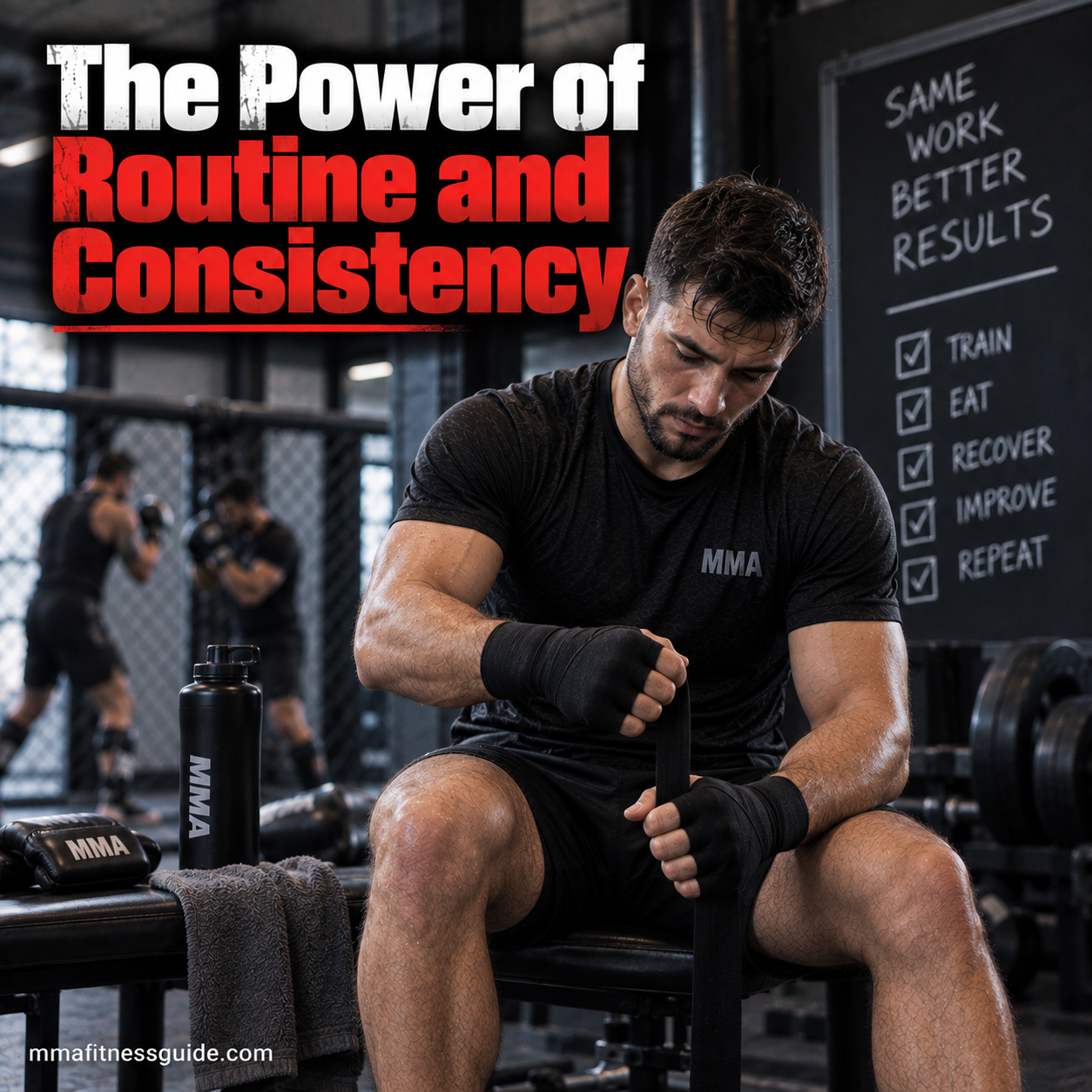
MMA fighter sitting on a gym bench and wrapping his hands before training, with other athletes practicing in the background.
Preparing for training and following a sustainable routine help MMA fighters develop skills through regular, purposeful practice.

It’s Tuesday evening. You had a long day at work, traffic was terrible, and the couch looks considerably more appealing than another hour of wrestling drills.

You aren’t especially motivated. You don’t expect to learn anything spectacular tonight.

But your gym bag is already packed, you’ve planned your training around your schedule, and you know exactly what you’re working on. So you go.

During class, you practice defending single-leg takedowns. Your first few attempts are awkward. By the end, you’re reacting a little earlier and maintaining your balance more consistently.

It isn’t a dramatic breakthrough. It’s simply another useful session.

That is what consistency often looks like in MMA.

Progress rarely comes from one extraordinary workout. It develops through repeated opportunities to practice skills, build physical capacity, receive feedback, and recover.

A good routine makes those opportunities easier to repeat without requiring you to feel motivated every day.

The challenge is building a routine that works alongside your responsibilities, supports your goals, and leaves enough room for recovery.

Continue reading “The Power of Routine and Consistency”

MMA: Track Progress and Stay Motivated

MMA athlete recording training progress in a workout journal at a gym, surrounded by boxing gloves and fitness equipment.
Tracking workouts, technique improvements, and recovery helps MMA athletes identify weaknesses, set realistic goals, and maintain consistent training habits.

You finish a tough MMA class, head home exhausted, and wonder whether you’re actually getting any better.

Your punches still feel awkward. Someone caught you in the same submission twice. You struggled through the final conditioning round.

It’s easy to focus on what went wrong, especially when you’re surrounded by more experienced fighters.

But think back to your first week. Maybe you couldn’t finish a three-minute round without stopping. Perhaps you struggled to remember basic combinations or had no idea how to escape side control.

Those improvements are easy to overlook when you’re concentrating on the next challenge.

Tracking your MMA training helps you recognize progress, identify weaknesses, and make better decisions about what to practice next.

You don’t need complicated software or an elaborate spreadsheet. A simple training journal, a few measurable goals, and a consistent review process can make your workouts more purposeful.

Here’s how to track your development without turning training into another chore.

Continue reading “MMA: Track Progress and Stay Motivated”

Jon Jones: Skill, Reach, and Strategy

Male MMA fighter practicing striking and distance control inside a training cage with focused expression.
Male MMA fighter training alone in a gym, focusing on reach, precision, and strategic movement.

The Architect of Controlled Chaos

Few fighters in MMA history have blended creativity, athleticism, and control quite like Jon “Bones” Jones.

Standing 6’4″ with an 84.5-inch reach, Jones turned his natural advantages into a masterclass in distance management and unpredictable striking.

But beyond his physical gifts lies the true reason for his dominance — his strategic mind and ability to adapt mid-fight like few others in the sport’s history.

Continue reading “Jon Jones: Skill, Reach, and Strategy”

Discipline: The Hidden Key to MMA Success

Female MMA athlete training alone in a gym with a focused and determined expression under morning sunlight.
Female MMA fighter training early in the morning, embodying focus, consistency, and discipline.

Talent Starts the Journey — Discipline Finishes It

In every gym, you’ll find someone with raw talent — quick reflexes, knockout power, natural coordination.

But it’s discipline that separates those who dream from those who dominate.

In mixed martial arts, motivation comes and goes. Discipline is what makes you train when motivation disappears. It’s the unseen factor behind every champion’s success story.

Continue reading “Discipline: The Hidden Key to MMA Success”

Rehabilitation After Knee Surgery for Fighters

MMA fighter performing a supervised knee rehabilitation exercise after surgery in a combat sports gym.
Knee rehabilitation for MMA progresses from restoring basic movement and strength toward controlled sport-specific training.

Knee surgery can temporarily remove many of the movements an MMA fighter relies on most: pivoting into strikes, changing levels for takedowns, sprawling, scrambling, kicking, and driving through an opponent.

Returning to those movements involves more than waiting for the surgical site to heal. The knee has to regain range of motion, strength, stability, coordination, and the ability to tolerate progressively harder athletic loads.

The exact rehabilitation plan depends on the injury and procedure. An ACL reconstruction, meniscus repair, meniscus surgery, or treatment involving multiple knee structures can have substantially different restrictions and timelines. The surgeon and physical therapist should determine when an athlete progresses from one stage to the next.

Continue reading “Rehabilitation After Knee Surgery for Fighters”

Kung Fu Principles for Distance and Timing

Male martial artist practicing Kung Fu form in a gym, demonstrating precise distance and timing control.
Male Kung Fu practitioner training in a gym, applying traditional principles of distance and timing for modern martial arts.

Ancient Roots, Modern Relevance

Kung Fu isn’t just a striking art — it’s a science of rhythm, awareness, and control.
While its techniques were developed centuries ago, the principles of distance and timing remain essential to modern MMA fighters today.

From footwork to counter-striking, mastering when and how to move can make the difference between landing a clean shot and walking into one.

Continue reading “Kung Fu Principles for Distance and Timing”

MMA: Maintain Muscle While Cutting Weight

Male MMA athlete checking his weight on a gym scale with a lean muscular build and focused expression.
Male MMA fighter maintaining lean muscle while monitoring his weight before competition.

The Balancing Act of Cutting Weight

For MMA fighters, cutting weight is part of the game — but losing muscle in the process doesn’t have to be.
The key is maintaining strength, energy, and muscle mass while safely shedding body fat before competition.

Whether you’re dropping a few pounds for a weigh-in or aiming for lean performance, smart planning makes all the difference.

Let’s break down how to cut weight without sacrificing hard-earned muscle.

Continue reading “MMA: Maintain Muscle While Cutting Weight”

MMA: Create a Balanced MMA Training Schedule

Female MMA athlete reviewing a training plan on a clipboard in a gym with gloves and gear in the background.
Female MMA fighter reviewing her weekly training plan to build a balanced and consistent schedule.

Why Balance Matters in MMA Training

MMA demands it all — strength, endurance, speed, technique, and mental focus.
But trying to train everything at once without structure leads to overtraining, burnout, or plateaus.

A well-balanced MMA schedule is the secret to long-term progress. It maximizes results, minimizes fatigue, and ensures every session has purpose.

Whether you’re training for competition or fitness, balance keeps your body performing — and recovering — at its best.

Continue reading “MMA: Create a Balanced MMA Training Schedule”

How Fighters Can Make Money Outside the Cage

MMA fighter planning ways to earn money outside competition through coaching, content creation, sponsorships, and building a personal brand.
MMA fighters can build income beyond fight purses through coaching, content creation, sponsorships, seminars, digital products, and other opportunities tied to their skills and audience.

Beyond the Fight Purse

A fighter can spend months preparing for a bout and receive only a handful of fight checks each year. Meanwhile, gym fees, coaching, equipment, transportation, nutrition, medical expenses, and time away from other work continue between fights.

That makes relying entirely on fight purses difficult for many amateur and professional fighters.

The skills developed through MMA can generate income in other ways. Coaching, content creation, sponsorships, digital products, seminars, and related businesses can produce revenue between fights while also building opportunities for life after competition.

Continue reading “How Fighters Can Make Money Outside the Cage”

MMA: Avoid Burnout on Your Fitness Journey

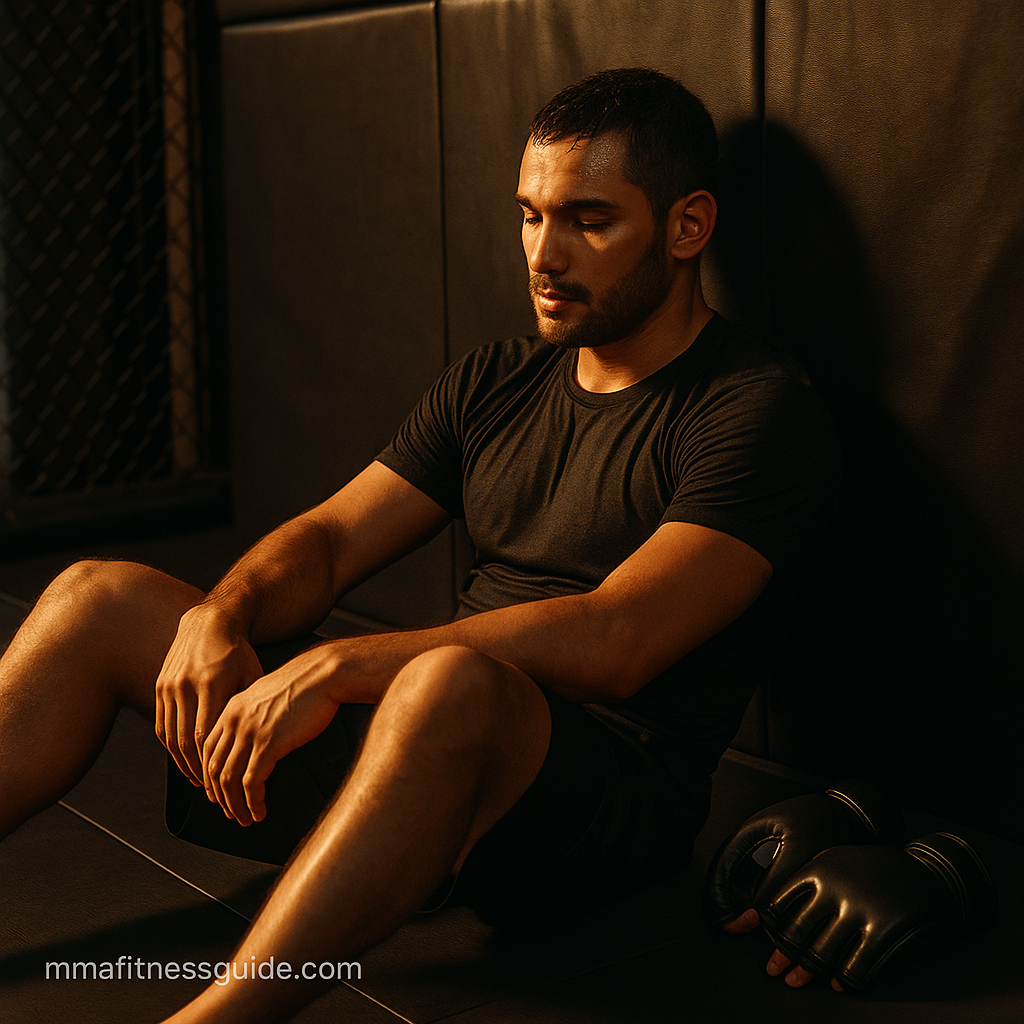
Male MMA fighter sitting against a gym wall after training with gloves beside him under warm lighting.
Male MMA athlete resting after training, reflecting on progress and preventing burnout through balance and recovery.

When Passion Turns Into Pressure

In the world of MMA and fitness, motivation runs high — until it doesn’t.
What starts as excitement can slowly transform into exhaustion, frustration, or even injury.

Burnout is real, and it doesn’t just affect beginners. Even experienced fighters and athletes hit points where training feels like a chore rather than a choice.

Avoiding burnout is about working smarter, not harder — balancing drive with recovery so your passion doesn’t burn out before your progress peaks.

Continue reading “MMA: Avoid Burnout on Your Fitness Journey”