Knee surgery can temporarily remove many of the movements an MMA fighter relies on most: pivoting into strikes, changing levels for takedowns, sprawling, scrambling, kicking, and driving through an opponent.
Returning to those movements involves more than waiting for the surgical site to heal. The knee has to regain range of motion, strength, stability, coordination, and the ability to tolerate progressively harder athletic loads.
The exact rehabilitation plan depends on the injury and procedure. An ACL reconstruction, meniscus repair, meniscus surgery, or treatment involving multiple knee structures can have substantially different restrictions and timelines. The surgeon and physical therapist should determine when an athlete progresses from one stage to the next.
What Determines Knee Surgery Recovery?
Two fighters can undergo knee surgery and have very different rehabilitation experiences.
Factors that influence recovery include:
- The structure that was injured
- The type of surgical procedure
- Whether multiple structures were repaired
- Postoperative restrictions
- Swelling and range of motion
- Quadriceps strength and activation
- Previous injuries
- Overall conditioning
- Response to progressive loading
- Consistency with rehabilitation
For fighters, returning to normal walking or basic strength training is only part of the process. Eventually, the knee must tolerate cutting, pivoting, kicking, wrestling, grappling, jumping, landing, and unpredictable reactions.
That progression should be based on healing and measurable function rather than simply reaching a particular date on the calendar.
Early Rehabilitation: Control Swelling and Restore Movement
The initial stage is usually centered on protecting the surgical repair and restoring basic knee function within the restrictions established by the surgical team.
Depending on the procedure, rehabilitation may include:
- Swelling management
- Gradual restoration of knee extension and flexion
- Quadriceps activation
- Ankle movement
- Assisted walking or gait training
- Heel slides or other prescribed range-of-motion exercises
Weight-bearing restrictions can differ considerably between procedures. Some athletes may begin putting weight through the leg relatively early, while others may need crutches, bracing, or restricted loading for longer.
Follow the postoperative instructions rather than copying another athlete’s recovery plan.
At this stage, MMA-specific pivoting, kicking, scrambling, and other uncontrolled knee loads are generally inappropriate unless specifically cleared.
Rebuilding Lower-Body Strength
Once healing and knee function allow greater loading, rehabilitation typically shifts toward rebuilding the muscles responsible for controlling the knee.
The quadriceps often require particular attention after knee surgery, but rehabilitation may also address the hamstrings, glutes, calves, hips, and trunk.
Exercises may progress through movements such as:
- Straight-leg raises
- Bridges
- Calf raises
- Supported squats
- Step-ups
- Hamstring exercises
- Stationary cycling
- Leg press variations
- Single-leg exercises
The appropriate exercise depends on the operation and stage of recovery.
The objective is not simply to make the injured leg feel tired. Strength needs to return without producing excessive pain, swelling, or loss of movement afterward.
Restoring Single-Leg Control
MMA constantly shifts weight from one leg to the other.
A fighter may plant one leg while throwing a kick, drive from an uneven stance during wrestling, balance during a scramble, or absorb force after being pushed off-line.
Rehabilitation therefore needs to progress beyond two-legged strength exercises.
Later exercises may include:
- Single-leg balance
- Step-downs
- Split squats
- Single-leg strength work
- Controlled lateral movements
- Single-leg reaching exercises
These drills can expose differences between the recovering and uninjured legs that are less noticeable during bilateral exercises.
Quality matters. A fighter who can complete a movement only by allowing the knee, hip, or trunk to compensate may not yet have the control required for harder tasks.
Developing Strength Through the Hips and Trunk
Knee rehabilitation should not isolate the knee from the rest of the body.
The hips and trunk influence how the leg handles force during running, landing, cutting, kicking, and wrestling.
A rehabilitation program may therefore include:
- Glute strengthening
- Hip abduction and adduction exercises
- Hip rotation work
- Dead bugs
- Side planks
- Pallof presses
- Carries
- Other trunk-stability exercises
For fighters, this becomes particularly relevant when movement progresses from predictable gym exercises to rotational and reactive sport situations.
Reintroducing Running, Jumping, and Landing
Running and plyometric work should not automatically begin because a certain number of weeks or months has passed.
Before introducing higher-impact activity, the rehabilitation team may consider factors such as swelling, range of motion, strength, pain, movement quality, and the ability to tolerate previous training loads.
A progression might eventually include:
- Low-impact conditioning
- Basic landing mechanics
- Two-leg jumping
- Single-leg jumping
- Forward and lateral hopping
- Running
- Acceleration and deceleration
- Direction changes
- Reactive movement
Each stage increases the demand placed on the knee.
For an MMA athlete, controlling deceleration can be just as relevant as producing explosive force. The knee needs to handle the moment when the fighter plants, stops, redirects, or reacts unexpectedly.
Returning to MMA-Specific Movement
General athletic rehabilitation does not completely reproduce the demands of fighting.
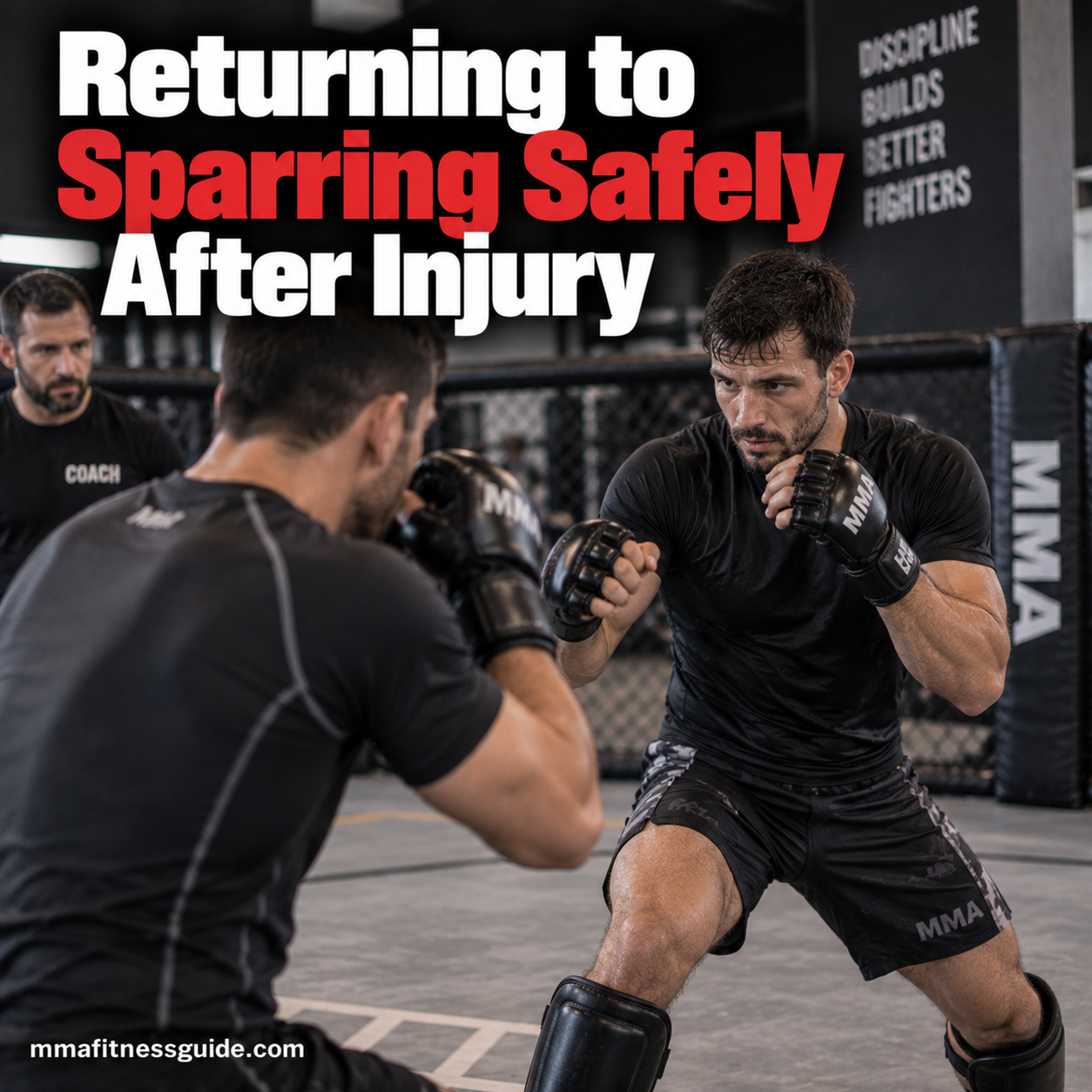
Once appropriately cleared, MMA movements can be reintroduced progressively rather than returning immediately to unrestricted sparring.
Early sport-specific work might include:
- Controlled stance movement
- Shadowboxing
- Straight-line footwork
- Technical upper-body pad work
- Carefully selected drilling
Later stages may introduce:
- Controlled kicking
- Level changes
- Sprawls
- Wrestling entries
- Positional grappling
- Pivoting
- Reactive footwork
- Controlled partner drills
Unrestricted sparring and live grappling introduce another level of unpredictability. An opponent can push, pull, rotate, or land on the recovering leg in ways that cannot always be anticipated.
That makes live training a later-stage progression rather than the first test of whether the knee “feels good.”
Return-to-Sport Testing
Time since surgery is only one piece of the return-to-sport decision.
Depending on the injury and procedure, clinicians may evaluate:
- Knee range of motion
- Swelling
- Quadriceps strength
- Hamstring strength
- Strength differences between legs
- Single-leg control
- Hop performance
- Landing mechanics
- Change-of-direction ability
- Psychological readiness
- Response to progressive sport training
For fighters, testing should eventually reflect the demands they actually face.
Passing basic strength measures does not necessarily demonstrate readiness for hard wrestling rounds or unpredictable MMA sparring.
Common Mistakes During Knee Rehabilitation
Progressing Because the Knee Feels Better
Pain can improve before strength, tissue capacity, and movement control have fully returned.
Feeling normal during everyday activities does not automatically mean the knee is prepared for explosive sport.
Comparing Recovery Timelines
Another fighter’s ACL reconstruction or meniscus surgery does not establish your timeline.
Procedure details and individual responses to rehabilitation can differ substantially.
Favoring the Uninjured Leg
Athletes can unconsciously shift weight away from the recovering side during squats, landings, and athletic movements.
Monitoring technique can help identify these compensations.
Adding Too Much Training at Once
A fighter might tolerate running, strength training, or technical MMA drills individually but experience swelling when several demanding activities are combined.
Training volume needs to progress along with exercise difficulty.
Using Pain as the Only Measure
A pain-free knee can still have strength or control deficits.
Return-to-sport decisions should consider objective function alongside symptoms.
The Psychological Side of Returning
The first hard pivot, takedown attempt, kick, or scramble after knee surgery can feel different even when physical rehabilitation has progressed well.
Some athletes hesitate to load the recovering leg or unconsciously alter their technique because they are concerned about reinjury.
Confidence can be rebuilt progressively.
Start with predictable movements, then introduce greater speed, resistance, partner involvement, and unpredictability as appropriate.
Tracking measurable progress can also help. Improvements in strength, range of motion, running, hopping, or sport-specific drills provide more useful feedback than simply asking whether the knee feels “normal.”
Working With a Physical Therapist
A physical therapist can adjust rehabilitation according to how the knee responds rather than relying on a generic schedule.
That may involve measuring strength, examining movement patterns, modifying exercises, controlling training volume, and determining when more demanding activities are appropriate.
For competitive fighters, working with clinicians who understand return-to-sport demands can be particularly useful. The final objective is not merely completing rehabilitation exercises; it is preparing the athlete for the forces and unpredictability of combat sports.
Surgeon clearance and physical-therapy guidance should take priority over generalized online rehabilitation programs.
Maintaining Knee Capacity After Returning to MMA
Finishing formal rehabilitation does not mean knee-focused training has to disappear.
Strength and movement work can remain part of normal MMA conditioning.
Useful areas to maintain include:
- Quadriceps strength
- Hamstring strength
- Glute and hip strength
- Calf strength
- Single-leg stability
- Landing mechanics
- Deceleration ability
- Hip and ankle mobility
Training load also matters. Sudden increases in sparring, wrestling, running, or conditioning can expose the knee to more stress than it has recently adapted to tolerate.
Gradually rebuilding workload gives the athlete time to adapt.
Key Takeaways
Knee surgery recovery for an MMA fighter should progress from basic knee function toward increasingly demanding athletic and combat-specific tasks.
The process typically involves restoring movement, rebuilding strength, developing single-leg control, reintroducing impact and direction changes, and finally progressing through MMA-specific drills before unrestricted training.
There is no universal return date. The injury, operation, healing response, strength, functional testing, and demands of the athlete’s sport all influence when progression is appropriate.
For a fighter, the meaningful endpoint is not simply having a knee that no longer hurts. It is having a knee—and a complete lower body—that can repeatedly handle striking, wrestling, grappling, scrambling, and conditioning under realistic training demands.