You get caught with a clean punch during sparring, and frustration immediately takes over. Instead of resetting your stance and listening to your coach, you rush forward looking for revenge—leaving yourself open to another counter. The punch was outside your control once it landed, but your response to it wasn’t.
Stoicism offers fighters a way to approach moments like these by separating what they can influence from what they cannot. Drawing on principles associated with philosophers such as Marcus Aurelius, Epictetus, and Seneca, athletes can practice responding deliberately to setbacks, accepting uncertainty, and evaluating their actions without letting pride dictate their decisions. Whether you’re dealing with a difficult training partner, an unexpected loss, or pre-fight nerves, the practical goal is to direct your attention toward your next useful action rather than dwelling on what has already happened.
Why Stoicism Matters for Fighters
Combat sports test more than physical ability — they test the mind.
Stoicism helps fighters by teaching them to:
- Stay calm under pressure
- Avoid emotional swings during training or fights
- Bounce back quickly after mistakes
- Focus on what they can control and ignore what they can’t
- Reduce fear of failure and judgment
- Train with intention instead of emotion
The Stoic mindset doesn’t make you passive — it makes you deliberate.
Core Stoic Principles Fighters Can Use Every Day
The Dichotomy of Control
You control your preparation, mindset, discipline, and effort.
You cannot control judges, opponents, injuries, or outcomes.
Fighters waste enormous energy trying to change things outside their influence. Stoicism sharpens focus by eliminating that noise.
Negative Visualization
This technique means calmly imagining setbacks so they no longer have emotional power.
Examples for fighters:
- Visualize an opponent pressing hard early
- Picture getting clipped and recovering
- Imagine a bad weight cut and still adapting
This reduces fear by removing surprise.
Voluntary Discomfort
Stoics believed in choosing challenges to strengthen the mind and body.
Simple ways fighters apply this:
- Finishing rounds when tired
- Cold showers
- Long runs without music
- Training positional disadvantage
You build confidence by choosing struggle.
Emotional Regulation
Stoicism doesn’t suppress emotions — it prevents emotions from controlling behavior.
A fighter who can stay calm when tired, frustrated, or hurt has an advantage over someone who can’t.
How Stoicism Shows Up in the Gym
Staying Calm After Getting Hit
A Stoic fighter doesn’t react emotionally — they return to strategy.
Accepting Bad Rounds
Instead of spiraling, they assess:
“Was it effort? Was it decision-making? Was it energy management?”
Not Comparing Yourself to Others
Stoicism keeps training internal — your growth is your concern, not someone else’s progress.
Remaining Coachable
Ego blocks improvement. Stoicism embraces criticism without personalizing it.
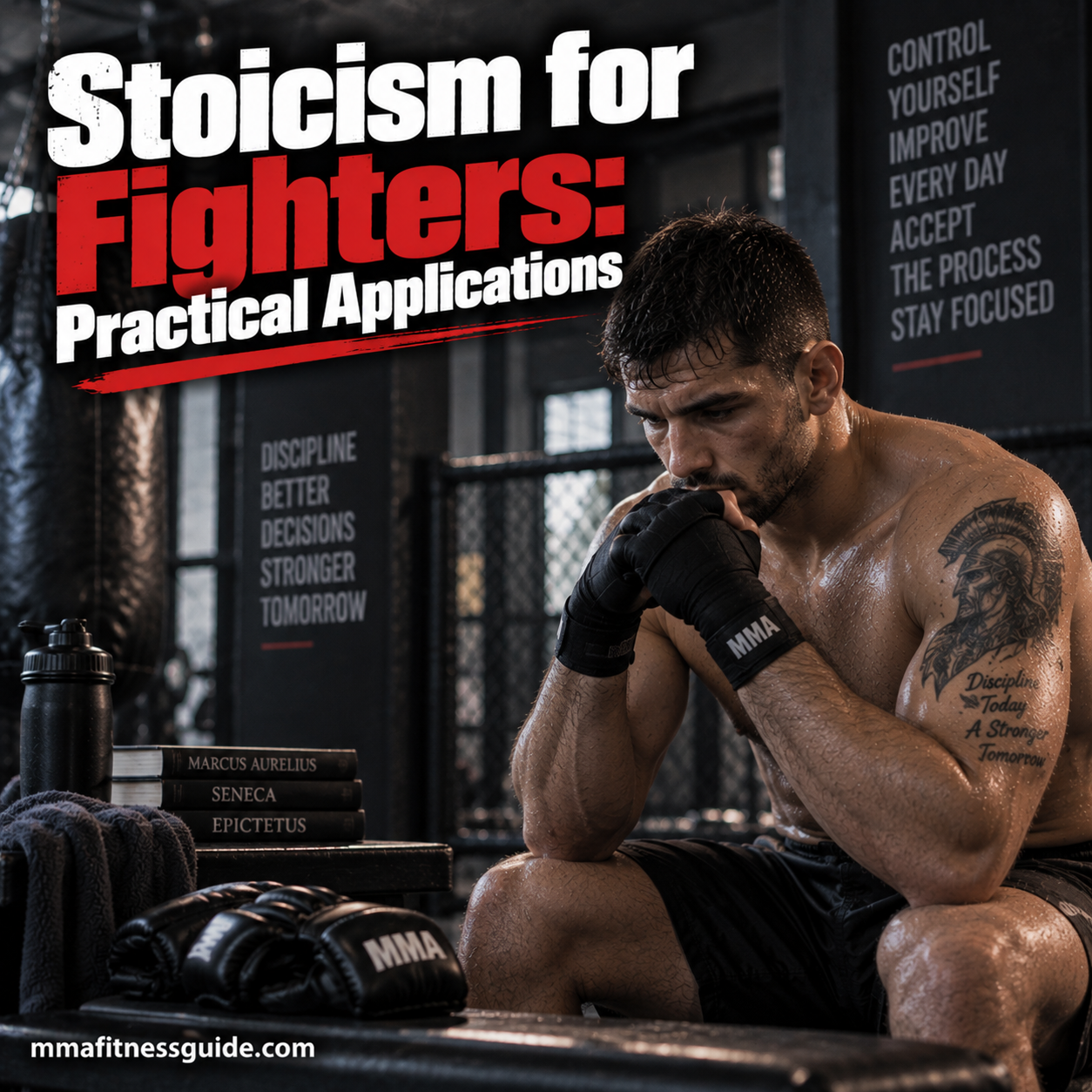
Stoicism in the cage: Practical applications
1. Controlling Before Performing
You don’t control the crowd, opponent, or environment.
You do control breathing, pacing, and tactical choices.
Stoic fighters manage the storm by staying grounded.
2. Between-Round Composure
Stoicism teaches neutrality:
Neither excitement nor panic.
Just presence, control, and clarity.
This makes corner instructions easier to absorb.
3. Making Peace with the Unknown
Accepting uncertainty improves performance under pressure.
Every fight is unpredictable — Stoicism removes fear from that reality.
4. Neutralizing Trash Talk
If it’s outside your control, it’s irrelevant.
If it bothers you, it owns you.
Stoic fighters don’t give opponents emotional power.
5. Handling Defeat
A loss becomes a data point, not an identity crisis.
Stoicism prevents emotional self-destruction and keeps fighters growth-oriented.
Practical Stoic Exercises for Fighters
1. Breath Control (Box Breathing or Diaphragmatic)
Use 1–3 minutes before sparring, drills, or competition to reset the nervous system.
2. Journaling Like Marcus Aurelius
Ask:
- “What can I control today?”
- “What challenge can I face willingly?”
- “Where did emotion override reason?”
A fighter who reflects grows twice as fast.
3. Pre-Round Negative Visualization
Imagine adversity and rehearse your response.
Example:
Opponent rushes → frame, angle, jab.
Bad round → breathe, reset, small adjustments.
4. Discomfort Training
Choose a difficult variation:
- Shark tank rounds
- Extra conditioning
- Sparring from disadvantageous positions
This builds a baseline of resilience.
5. The Stoic Pause
When frustrated in training, take a 2–3 second pause before reacting.
This prevents ego-driven decisions and improves technical discipline.
Stoicism and Emotional Toughness
Emotional toughness isn’t suppressing how you feel — it’s controlling how you act.
Stoicism trains fighters to separate emotion from action:
- Feel fear → still move forward
- Feel frustration → still follow technique
- Feel tired → still stay intelligent
This is the mental edge that wins fights.
Final Thoughts: Fighting Like a Stoic
Stoicism doesn’t replace hard training, conditioning, or strategy — it amplifies them. A Stoic fighter:
- Controls what matters
- Accepts what doesn’t
- Adapts to adversity
- Stays consistent under pressure
- Thinks clearly in chaos
Whether you’re a beginner or a pro, Stoicism gives you the psychological armor to handle the grind of combat sports with more clarity, confidence, and composure.