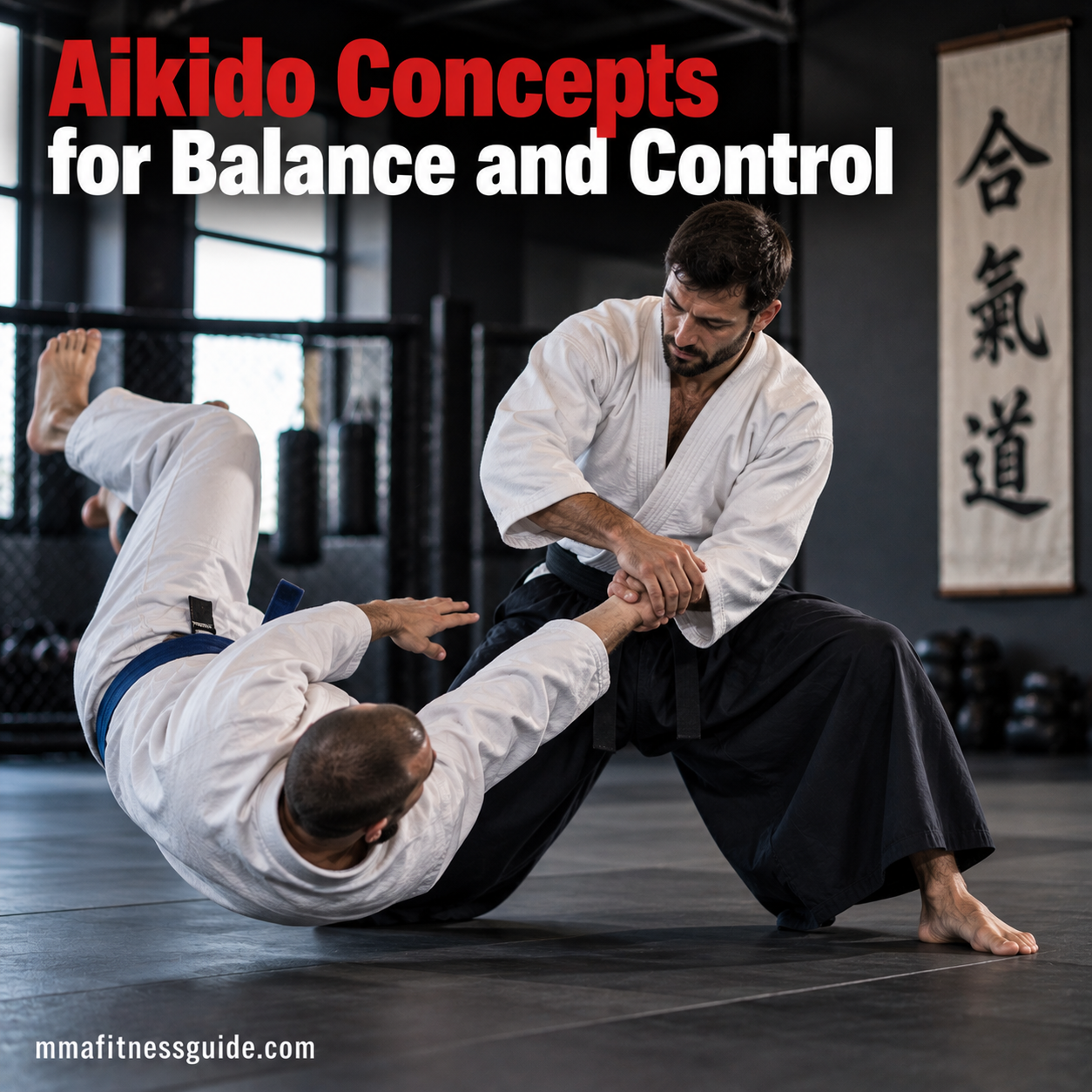
An opponent grabs your wrist and pulls you forward. Your first instinct might be to pull backward, turning the exchange into a contest of strength. But what happens if you adjust your footwork, maintain your posture, and move at an angle instead?
You may create an opportunity to regain your balance, change your position, or break the grip without relying entirely on strength.
This scenario illustrates several concepts associated with Aikido, a Japanese martial art that emphasizes movement, balance, timing, and the redirection of force.
Although Aikido and mixed martial arts approach combat differently, some of their underlying movement principles overlap.
The important distinction is that understanding a principle doesn’t automatically make a technique effective against a resisting opponent. MMA fighters need to test movements through realistic drilling, positional sparring, and live training.
When approached with that distinction in mind, Aikido offers an interesting perspective on how fighters can think about balance, body positioning, and control.
What Is Aikido?
Aikido is a Japanese martial art developed by Morihei Ueshiba during the twentieth century.
Its name is commonly interpreted as the way of harmonizing energy or spirit, although translations vary.
The art emphasizes coordinated movement, balance disruption, joint manipulation, and redirecting an attack rather than simply meeting force with opposing force.
Traditional Aikido training commonly includes wrist controls, joint locks, throws, circular footwork, and falling techniques known as ukemi.
Practitioners frequently train with a partner who initiates an attack and then receives the technique.
This cooperative approach allows students to study movement mechanics and practice potentially dangerous techniques in a controlled environment.
However, training methods differ substantially between Aikido schools. Many do not regularly incorporate the competitive sparring and resistance found in wrestling, judo, Brazilian jiu-jitsu, or MMA.
That difference matters when evaluating how techniques transfer to combat sports.
A movement that works against a cooperative partner may become considerably more difficult against someone who changes direction, retracts their arm, strikes, or actively resists.
For MMA athletes, Aikido is therefore better approached as a source of movement concepts to explore rather than a substitute for established combat-sport training.
1. Centering: Understanding Your Balance
One of Aikido’s recurring concepts is maintaining your center.
In practical terms, this involves controlling your posture, base of support, and body position while moving or interacting with another person.
Your center of mass is the point at which your body’s mass can be considered concentrated.
Its position changes as you move your arms, shift your hips, bend your knees, or lean your torso.
Your base of support is the area defined by your contact points with the ground.
When your center of mass moves toward or beyond the limits of that base, maintaining balance becomes more difficult unless you step or make another adjustment.
How Centering Applies to MMA
Consider an MMA fighter defending a takedown.
If they stand upright with their feet close together, an opponent may find it easier to disrupt their balance.
A fighter who adjusts their stance, lowers their level appropriately, and maintains effective hip positioning may be better prepared to defend.
However, good balance does not mean keeping your weight perfectly centered between your feet at all times.
Striking, wrestling, and grappling frequently require deliberate weight shifts.
A boxer transfers weight during punches. A wrestler moves their center of mass during a penetration step. A grappler shifts their hips to create angles.
The goal is to control these changes rather than remain rigid.
Practical Drill: Stance and Balance Control
Practice the following exercise for two to three minutes.
- Begin in your normal fighting stance.
- Keep your knees slightly bent and your hands in a defensive position.
- Shift your weight gently forward and backward without allowing your heels or toes to lose unnecessary contact with the floor.
- Move laterally while maintaining an appropriate distance between your feet.
- Add small pivots and directional changes.
Once comfortable, have a partner apply light, predictable pressure to your shoulders or upper arms.
Your objective is to maintain balance by adjusting your feet and posture.
Progress gradually to less predictable pressure, but avoid sudden pushes that could cause a fall.
This drill develops awareness of your base and how it changes during movement.
2. Kuzushi: Learning to Disrupt an Opponent’s Balance
Kuzushi is a Japanese term commonly associated with breaking or disrupting balance, particularly in judo. It is also relevant to discussions of Aikido throws and control.
The basic idea is that moving an opponent becomes easier when their posture and balance have already been compromised.
Imagine trying to push someone who is standing in a stable stance.
They can resist by adjusting their feet, engaging their muscles, or pushing back.
Now imagine that same person stepping backward while their upper body continues moving forward.
Their position may create a temporary opportunity for a takedown or positional change.
How Off-Balancing Works in Grappling
Wrestlers and judoka routinely create situations in which an opponent must step, post, or shift their weight.
These reactions can open opportunities for attacks.
For example, a wrestler may pull an opponent’s upper body forward to encourage a step.
As the opponent reacts, the wrestler may change direction or attack a leg.
Similarly, a grappler might use an arm drag to turn an opponent’s shoulders and create an angle toward their back.
These are established grappling applications of balance disruption, not evidence that the techniques originated in Aikido.
The useful connection is the shared mechanical principle.
Practical Drill: Controlled Off-Balancing
Work with a partner in a standing grappling position.
Begin with light contact at the shoulders or upper arms.
Apply gentle pressure in different directions and observe how your partner adjusts their feet.
Your partner should maintain balance rather than deliberately fall.
Alternate roles after one minute.
As your awareness improves, incorporate controlled pummeling or hand-fighting drills under a qualified coach’s supervision.
The objective is to recognize when an opponent’s posture becomes vulnerable.
3. Tai Sabaki: Using Body Movement to Create Angles
Tai sabaki refers broadly to body movement or body management.
In Aikido, it often involves stepping, pivoting, and turning to reposition relative to an incoming attack.
Rather than remaining directly in the path of force, a practitioner may move to a different angle.
This idea has obvious parallels with combat-sport footwork.
Angle Changes in Striking
Imagine an opponent advancing with a straight punching combination.
Retreating directly backward may be appropriate in some situations, but it can also leave you moving toward the cage.
A controlled lateral step or pivot may create a different defensive position.
However, simply moving sideways does not guarantee safety.
Your opponent can adjust their attack, follow your movement, or cut off your escape.
Effective angle changes require distance management, defensive awareness, and timing.
Angle Changes in Wrestling
Wrestlers also use angles to avoid attacking directly into an opponent’s strongest defensive position.
An arm drag, for example, can help move the attacker toward the opponent’s side.
Similarly, circling during hand fighting can change the relationship between the athletes’ hips and shoulders.
These movements demonstrate how positioning can reduce the need to overcome resistance directly.
Practical Drill: Pivot and Reposition
Use a marked square on the gym floor or imagine four points around your starting position.
Begin in your fighting stance.
Step diagonally to one point, pivot, and return to your stance.
Repeat in both directions.
Once comfortable, add a light jab or defensive movement before repositioning.
Practice slowly until you can change angles without crossing your feet unnecessarily or losing balance.
Increase speed only when your movement remains controlled.
4. Redirection: Working With Force Instead of Against It
Aikido frequently emphasizes redirecting an incoming attack.
The concept is sometimes described as blending with an opponent’s movement.
In combat sports, the practical application is more nuanced.
You cannot always redirect an opponent’s force, particularly when they maintain a strong position or quickly change their attack.
Nevertheless, recognizing the direction of pressure can help you choose an appropriate response.
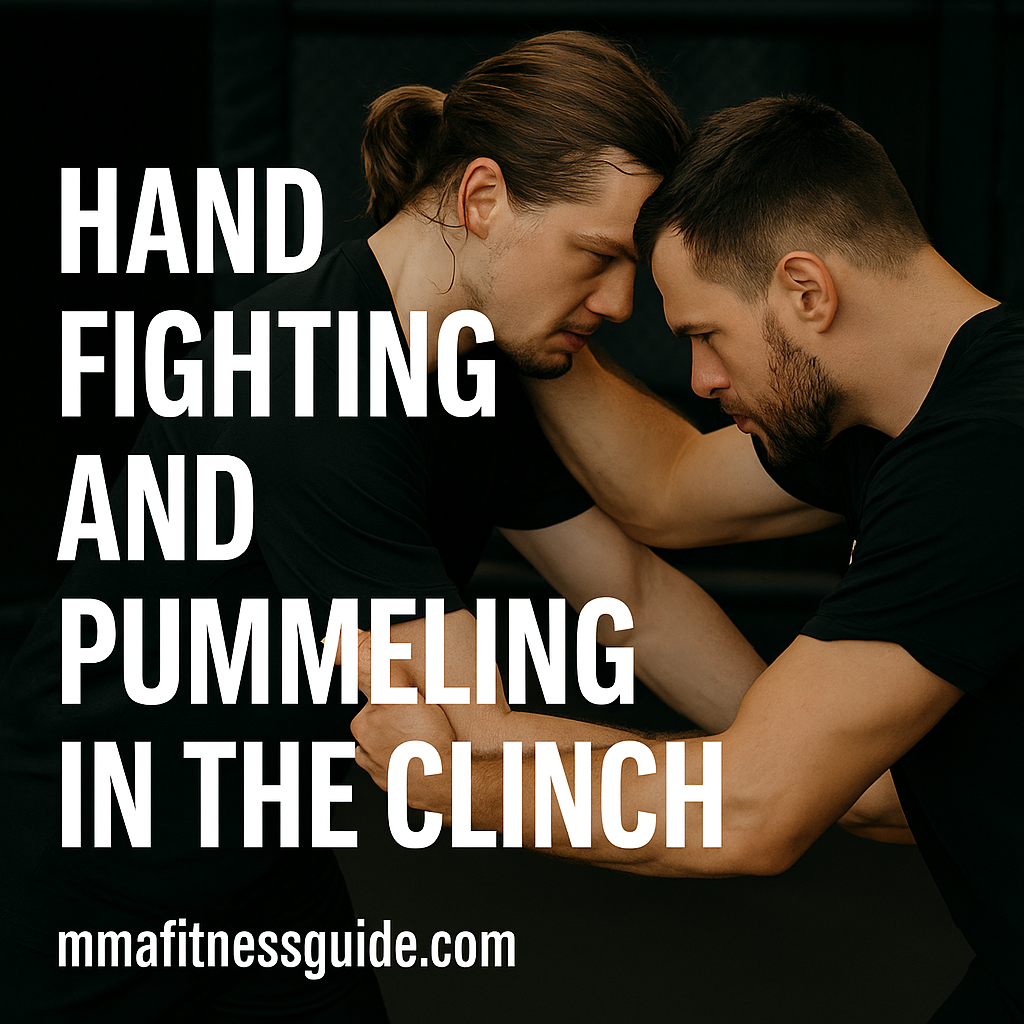
An Example From Clinch Fighting
Imagine an opponent pushing aggressively into you during a clinch exchange.
Pushing directly backward may create a prolonged strength contest.
Depending on your grips, head position, and foot placement, you might instead pivot or change your angle.
This can sometimes create an opening for a positional improvement.
However, successful clinch work requires established wrestling or Muay Thai mechanics.
A pivot performed without controlling the opponent may simply expose your back or allow them to continue driving forward.
An Example From Ground Grappling
A grappler attempting to escape side control might initially push directly against the opponent’s weight.
If the opponent maintains strong pressure, this can become exhausting.
Instead, the grappler may use frames, hip movement, and appropriate timing to create space.
These are Brazilian jiu-jitsu mechanics that illustrate a similar general principle: changing the direction of a movement can be more effective than repeatedly applying force into a stable position.
Practical Drill: Pressure Recognition
Begin with a partner in a light standing clinch.
Have your partner apply gentle forward pressure.
Maintain safe head positioning and adjust your stance to remain balanced.
Practice stepping and pivoting while maintaining appropriate contact.
Switch roles and repeat.
Keep the drill cooperative initially. Progress to controlled resistance under a coach who can correct positioning and prevent unsafe movements.
5. Wrist Control and Grip Awareness
Traditional Aikido contains numerous techniques involving wrist manipulation and joint control.
These include movements intended to influence an opponent’s posture through the wrist, elbow, and shoulder.
However, many classical Aikido wrist-lock entries are difficult to apply reliably against a resisting MMA opponent, particularly when strikes and rapid grip changes are involved.
The more transferable concept is grip awareness.
Why Grip Control Matters
In grappling, controlling an opponent’s wrist can help prevent them from establishing a grip, posting effectively, or freely positioning their arm.
Wrist control also appears in MMA ground fighting, where fighters may temporarily control an opponent’s hand to create striking opportunities.
The effectiveness of these actions depends on positioning, timing, and the opponent’s reactions.
A wrist grip alone rarely provides complete control of a resisting opponent.
Practical Drill: Grip Fighting
Begin with a partner in a neutral standing position.
One person attempts to establish light wrist control while the other practices safely clearing the grip.
Focus on positioning your body and moving your feet rather than relying entirely on arm strength.
Switch roles regularly.
Avoid twisting the wrist into painful positions or attempting joint locks without qualified supervision.
For MMA athletes, established wrestling and Brazilian jiu-jitsu grip-fighting drills provide a practical environment for developing these skills.
6. Ukemi: Learning How to Fall Safely
Ukemi refers to receiving techniques, including the practice of falling and rolling.
It is a significant component of traditional Aikido training.
Students learn to distribute impact, protect vulnerable body parts, and recover from controlled throws.
Breakfall training also exists in judo and other grappling disciplines.
For MMA fighters, falling skills are particularly relevant because takedowns and throws are common.
What Makes Breakfall Training Useful?
A fighter who has practiced controlled falls may be better prepared to respond when their balance is disrupted.
However, no falling technique can eliminate the risk of injury.
MMA takedowns can involve unpredictable angles, body weight, cage contact, and an opponent maintaining control during the fall.
Traditional Aikido rolling techniques also do not transfer directly to every wrestling or MMA situation.
How to Practice Safely
Begin on appropriate mats with a qualified instructor.
Learn basic backward and side breakfalls from low positions before progressing to standing movements.
Practice keeping your head from striking the mat and distributing impact appropriately.
Avoid attempting advanced rolling falls or throws without supervision.
If your primary goal is MMA, prioritize falling techniques taught within wrestling, judo, or MMA training environments.
7. Staying Relaxed Without Losing Structure
Aikido often emphasizes relaxation and avoiding unnecessary muscular tension.
This concept can be useful in combat sports, although relaxation should not be confused with being physically passive.
A fighter needs muscular tension to generate force, stabilize joints, and resist an opponent.
The objective is to apply tension when necessary rather than remaining rigid throughout an entire exchange.
Why Excessive Tension Can Be a Problem
A beginner boxer may clench their fists continuously, raise their shoulders, and hold their breath during combinations.
This can create unnecessary muscular effort.
Similarly, a beginner grappler may squeeze every grip as tightly as possible, even when the grip provides little positional advantage.
Learning when to engage and release muscular tension can improve movement efficiency.
Practical Drill: Controlled Shadowboxing
Perform three rounds of one minute.
During the first round, shadowbox slowly while maintaining a relaxed stance.
During the second, increase your speed while keeping your shoulders relaxed between punches.
During the third, alternate between light movement and short, controlled combinations.
Exhale naturally during strikes and avoid holding your breath unnecessarily.
The goal is not to remain completely relaxed while punching. It is to coordinate muscular effort with the movement.
The Mental Side of Aikido: Composure Under Pressure
Aikido’s philosophical traditions emphasize harmony, awareness, and disciplined practice.
These ideas may encourage practitioners to reflect on how they respond to confrontation.
For combat athletes, composure is relevant because fatigue, frustration, and competitive pressure can interfere with decision-making.
However, practicing Aikido does not automatically improve emotional regulation or make someone mentally tougher.
Mental skills develop through appropriate training, experience, and deliberate practice.
A Simple Breathing Exercise
Before a technical session, try the following:
- Stand or sit in a comfortable position.
- Breathe gently through your nose if comfortable.
- Allow your abdomen and rib cage to expand naturally.
- Exhale slowly without forcing the breath.
- Continue for one or two minutes.
During training, practice recognizing when you are holding your breath or becoming unnecessarily tense.
Return to normal, controlled breathing when the situation allows.
This exercise can support awareness, but it does not replace the experience gained from progressive sparring and realistic training.
Can Aikido Techniques Actually Work in MMA?
This question requires separating general movement principles from specific techniques.
Balance, timing, leverage, positioning, and force redirection are relevant across many martial arts.
However, these concepts are not unique to Aikido.
Wrestling, judo, Brazilian jiu-jitsu, boxing, and Muay Thai all contain sophisticated approaches to balance and movement.
The effectiveness of a particular technique depends on the situation and how it has been trained.
Many traditional Aikido techniques are practiced against cooperative attacks, which makes their reliability under MMA conditions uncertain.
Wrist locks and certain standing joint manipulations can also be difficult to establish against opponents who are actively striking, grappling, and changing position.
Some concepts may transfer, but that transfer must be demonstrated through progressively resistant training.
Aikido should not be presented as a proven replacement for wrestling, Brazilian jiu-jitsu, or other established MMA disciplines.
Fighters interested in Aikido can study its movement principles while continuing to prioritize techniques that have been tested under the rules and conditions of their sport.
A 15-Minute Balance and Control Routine for MMA Fighters
This routine uses general movement concepts associated with Aikido alongside established combat-sport drills.
It requires a training partner for the final two exercises.
| Exercise | Duration |
|---|---|
| Fighting stance and weight shifts | 3 minutes |
| Pivoting and angle changes | 3 minutes |
| Controlled single-leg balance | 2 minutes |
| Light partner pressure drill | 3 minutes |
| Grip awareness and hand fighting | 4 minutes |
| Total | 15 minutes |
Begin with stance and weight shifts, keeping your posture controlled as you move forward, backward, and laterally.
Progress to pivoting drills, focusing on changing direction without compromising your stance.
During single-leg balance work, stand on one leg for approximately 20–30 seconds before switching. Maintain a slight knee bend and use a wall for support if necessary.
For partner pressure drills, practice responding to gentle pushes by adjusting your feet and posture.
Finish with controlled grip fighting, alternating between establishing and clearing wrist control.
Keep the intensity low enough to maintain technical quality.
This routine is intended to supplement normal training rather than replace wrestling, striking, or grappling practice.
Common Mistakes When Applying Aikido Concepts to MMA
Assuming Every Technique Will Work Against Resistance
A cooperative demonstration does not establish effectiveness in live combat.
Test relevant movements gradually against opponents who provide realistic resistance.
Confusing Redirection With Avoiding All Force
Sometimes fighters must resist directly, establish strong frames, or generate explosive force.
Redirection is one option, not a universal solution.
Neglecting Established Grappling Fundamentals
Footwork, balance, and wrist control are useful, but MMA fighters still need reliable takedown defense, clinch skills, positional escapes, and submission awareness.
Practicing Joint Locks Without Supervision
Wrist and elbow manipulation can cause injury when performed carelessly.
Use qualified instruction and controlled training conditions.
Overcomplicating Simple Movements
An elaborate circular movement may be unnecessary when a basic pivot, frame, or grip break solves the problem.
Choose movements according to the situation rather than trying to force a particular martial arts concept into every exchange.
Final Thoughts
Aikido offers an interesting framework for examining balance, posture, timing, and the relationship between movement and force.
Its emphasis on centering, body positioning, and controlled movement has conceptual similarities with techniques found throughout combat sports.
However, similarities between principles should not be mistaken for proof that traditional Aikido techniques are consistently effective in MMA.
For fighters, the practical approach is to explore useful ideas while developing their application through established striking, wrestling, and grappling training.
Practice maintaining your balance while moving. Learn to recognize when an opponent’s posture is compromised. Develop the ability to change angles, control grips, and respond appropriately to pressure.
Most importantly, test these skills against progressively realistic resistance.
The value of any martial arts concept ultimately depends on whether you can apply it safely, consistently, and effectively when your opponent is actively trying to stop you.