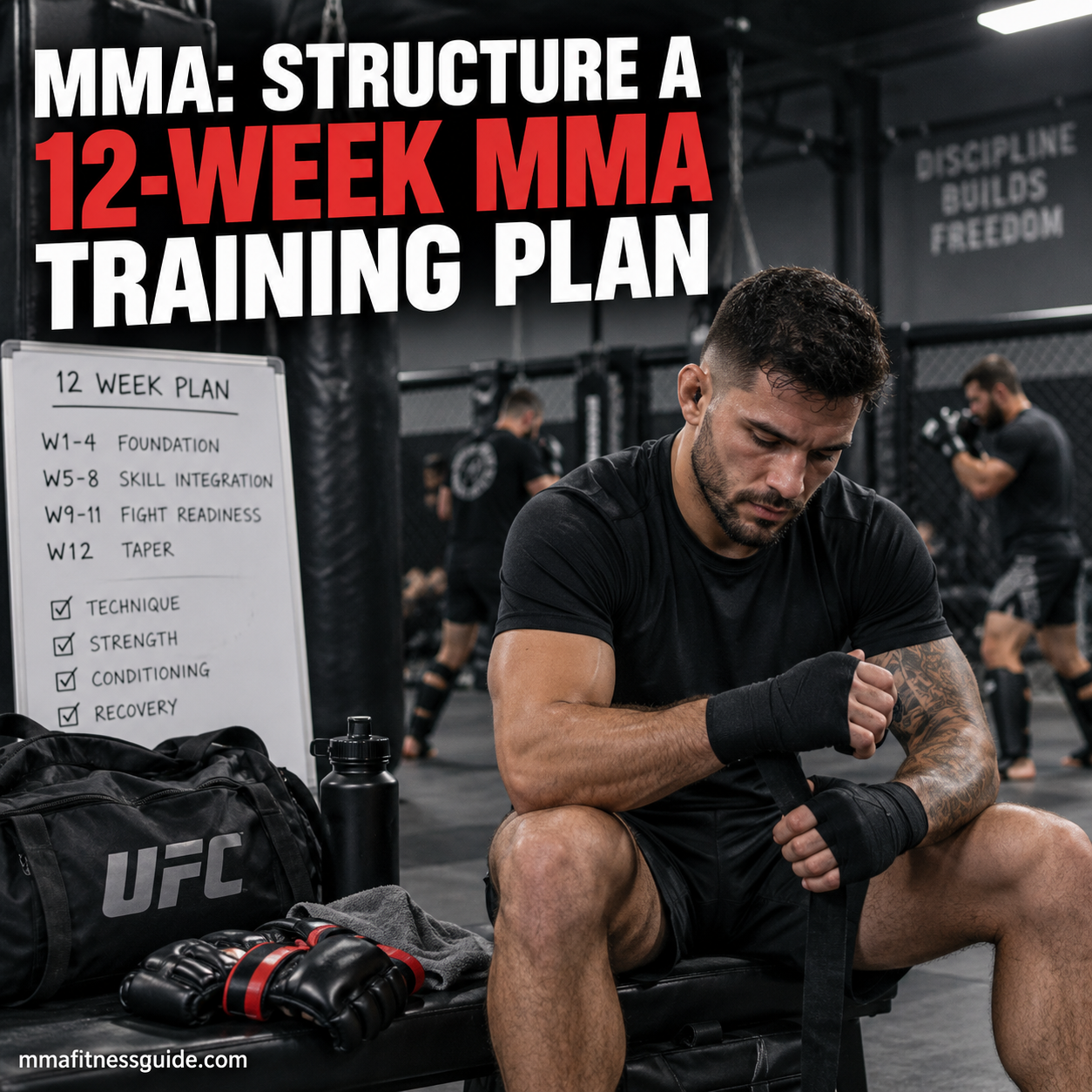
A 12-week MMA training plan gives you enough time to build conditioning, develop technical skills, increase fight-specific intensity, and taper before competition. Instead of pushing every training variable at once, the schedule progresses through phases so your workload becomes more specific as the weeks advance.
Whether you’re preparing for an amateur fight, improving your overall MMA game, or returning to consistent training, the goal is the same: organize striking, grappling, strength, conditioning, and recovery so they complement rather than compete with each other.
This guide breaks a 12-week MMA training cycle into practical phases and explains how training priorities should change along the way.
Why Use a 12-Week MMA Training Structure?
MMA training places competing demands on the body. Fighters need strength and power while also developing endurance, speed, technical precision, and the ability to recover between intense exchanges.
Trying to maximize all of these qualities every week can quickly create excessive fatigue.
A 12-week structure allows you to shift priorities gradually:
- Establish technical and aerobic foundations
- Increase MMA-specific intensity over time
- Introduce harder sparring and conditioning progressively
- Reduce workload before competition
- Track improvements from one phase to the next
Each phase prepares you for the demands of the next rather than simply adding more training.
Core Components of an MMA Training Plan
A balanced MMA schedule generally includes:
- Striking technique, including boxing, Muay Thai, or kickboxing
- Grappling through wrestling, Brazilian jiu-jitsu, and clinch work
- Strength and power training
- Aerobic and anaerobic conditioning
- Mobility and recovery work
- Full rest days
These elements remain present throughout the 12 weeks, but their volume and intensity change as training progresses.
Phase 1: Foundation Building (Weeks 1–4)
The opening four weeks establish the physical and technical base needed for more demanding training later in the cycle.
Goals of Phase 1
Focus on:
- Improving fundamental striking and grappling technique
- Developing aerobic capacity
- Building general strength
- Improving movement quality
- Establishing a sustainable weekly workload
Training intensity should generally remain moderate while athletes adapt to consistent volume.
Weekly Training Focus for Weeks 1–4
A typical week might include:
- 3–4 technical MMA sessions
- 2 strength sessions
- 2–3 low-to-moderate intensity conditioning sessions
- 1–2 dedicated mobility or recovery sessions
- At least 1 full rest day
Technical sessions should emphasize repetition and precision. Instead of turning every drill into a conditioning workout, concentrate on footwork, defensive positioning, combinations, takedown mechanics, escapes, transitions, and other fundamentals.
Conditioning can include steady running, cycling, rowing, swimming, or similar aerobic work.
Strength sessions can use compound movements such as squats, hinges, presses, pulls, carries, and unilateral exercises.
By the end of Week 4, the athlete should be handling regular training volume without persistent soreness or declining performance.
Phase 2: Skill Integration and Intensity (Weeks 5–8)
Weeks 5–8 begin connecting individual skills under greater resistance and fatigue.
A striker may practice finishing combinations with takedown defense. A wrestler may work entries from punches. Grapplers can drill transitions from takedowns into control positions and submissions.
Training starts to resemble the unpredictable transitions of MMA.
Goals of Phase 2
Priorities include:
- Connecting striking, wrestling, and grappling
- Increasing training intensity
- Developing anaerobic conditioning
- Improving timing and reactions
- Producing strength more explosively
Overall weekly volume may remain relatively stable while individual sessions become more demanding.
Weekly Training Focus for Weeks 5–8
A typical week might include:
- 4–5 MMA sessions
- 2 strength or power sessions
- 2 conditioning sessions
- 1–2 recovery sessions
- At least 1 full rest day
Training may now incorporate:
- Higher-intensity pad rounds
- Controlled live sparring
- Wrestling against resistance
- Clinch rounds
- Situational grappling
- Interval conditioning
- Explosive strength exercises
Because sparring and conditioning become harder during this phase, adding intensity everywhere at once can interfere with recovery. Coaches should adjust lifting, conditioning, or sparring volume when performance begins to decline.
Phase 3: Fight Readiness and Peaking (Weeks 9–11)
Weeks 9–11 shift the emphasis toward the situations and energy demands expected during competition.
General fitness work becomes less important than executing specific skills effectively at fight pace.
Goals of Phase 3
Focus on:
- Fight-specific conditioning
- Tactical preparation
- Situational awareness
- Speed and reaction
- Maintaining strength and power
- Managing accumulated fatigue
Training volume can gradually decrease even while selected sessions remain intense.
Weekly Training Focus for Weeks 9–11
A typical week may include:
- 4–5 MMA sessions
- 1–2 reduced-volume strength sessions
- 1–2 high-intensity conditioning sessions
- Regular mobility and recovery work
- At least 1 full rest day
Priorities may include:
- Game-plan sparring
- Fight-paced rounds
- Situational drilling
- Cage or wall work
- Starting rounds from difficult positions
- Short, intense conditioning intervals
- Speed and reaction drills
For a fighter with a scheduled opponent, coaches can also recreate likely tactical situations. That might mean defending repeated takedowns, escaping cage pressure, maintaining distance against an aggressive striker, or controlling specific grappling positions.
Strength training during this phase should preserve qualities developed earlier without creating soreness that interferes with MMA sessions.
Week 12: Taper and Recovery
The final week shifts away from building fitness and toward reducing accumulated fatigue.
Hard training immediately before competition can leave a fighter carrying soreness, slower reactions, or unnecessary fatigue into fight day.
Goals of Week 12
The taper should help the athlete:
- Recover from the previous training block
- Maintain technical sharpness
- Reduce muscular soreness
- Preserve speed and coordination
- Arrive physically and mentally fresh
Taper Week Guidelines
Depending on the athlete and competition schedule:
- Reduce overall training volume substantially
- Keep technical sessions shorter
- Maintain some fast, crisp movements without prolonged fatigue
- Limit or eliminate hard sparring
- Prioritize sleep
- Maintain normal hydration
- Continue light mobility work
If weight cutting is required, it should be managed separately and preferably under qualified coaching, nutrition, and medical guidance rather than treated as another conditioning session.
Strength Training Within a 12-Week MMA Plan
Strength training should improve qualities that transfer to MMA without leaving the athlete too fatigued to practice technical skills.
Weeks 1–4: Build General Strength
Training may emphasize:
- Squats and split squats
- Deadlift or hinge variations
- Pressing movements
- Rows and pull-ups
- Loaded carries
- Trunk stability
Moderate loads and controlled technique provide a useful starting point.
Weeks 5–8: Shift Toward Power
Strength work can gradually include more explosive movements such as:
- Medicine ball throws
- Jumps
- Explosive push-ups
- Kettlebell swings
- Olympic-lift variations when technically appropriate
Total lifting volume may decrease as MMA intensity increases.
Weeks 9–12: Maintain Strength and Speed
Late in the training cycle, lifting should create minimal residual fatigue.
Use lower overall volume while maintaining quality movement and appropriate intensity. Close to competition, mobility, speed, and recovery generally take priority over adding strength.
Conditioning Progression Over 12 Weeks
Conditioning should become increasingly specific to MMA as the training cycle progresses.
Weeks 1–4: Build aerobic capacity with steady and controlled conditioning.
Weeks 5–8: Combine aerobic work with harder intervals and repeated high-intensity efforts.
Weeks 9–11: Emphasize fight-specific intervals, rounds, and recovery periods.
Week 12: Reduce conditioning volume so fatigue can dissipate.
The objective is not simply to perform more conditioning each week. It is to prepare the athlete to repeat explosive efforts while recovering efficiently between exchanges and rounds.
Recovery and Injury Prevention
A demanding MMA schedule only works when recovery is included in the weekly plan.
Useful recovery habits include:
- At least one full rest day each week
- Consistent sleep
- Adequate calories and protein
- Proper hydration
- Light mobility work
- Easy recovery sessions when appropriate
- Monitoring persistent soreness or declining performance
- Communicating injuries and unusual fatigue to coaches
Ice, massage, or other recovery methods may help some athletes manage soreness, but they should not replace adequate sleep, nutrition, sensible workload management, or appropriate medical care when an injury occurs.
Common Mistakes in 12-Week MMA Planning
Several mistakes can disrupt an otherwise solid training cycle:
- Treating every training session as maximum effort
- Adding extra conditioning despite already-heavy MMA sessions
- Sacrificing technical practice for fitness work
- Sparring hard too frequently
- Increasing training volume too quickly
- Continuing heavy lifting close to competition
- Ignoring persistent pain or declining performance
- Changing the entire program during the final weeks
Training should become more specific as competition approaches, not simply harder.
Adjusting the Plan for Beginners vs. Fighters
The same general 12-week framework can be adjusted according to experience.
Beginners
Beginners should place more emphasis on:
- Technical drilling
- Fundamental movement
- Controlled positional work
- Aerobic conditioning
- Strength fundamentals
- Recovery between sessions
Hard sparring should be limited while defensive skills, positioning, and control develop.
Experienced Fighters
More experienced athletes may incorporate:
- Additional live rounds
- Opponent-specific preparation
- Higher-intensity wrestling
- Cage work
- Fight-paced situational rounds
- More individualized conditioning
Experienced fighters still need recovery. Their greater training capacity allows for more specific work, but it does not make unlimited volume productive.
Example 12-Week MMA Progression
A simple overview looks like this:
Weeks 1–4: Build technique, aerobic conditioning, movement quality, and general strength.
Weeks 5–8: Integrate MMA skills, increase live resistance, introduce harder intervals, and develop explosive power.
Weeks 9–11: Prioritize fight-specific rounds, tactical preparation, speed, and high-intensity conditioning while reducing unnecessary volume.
Week 12: Reduce workload, maintain technical sharpness, and allow accumulated fatigue to clear.
This progression moves from general preparation toward increasingly specific MMA demands.
Final Thoughts
A 12-week MMA training plan works best when each phase has a clear purpose. Early weeks establish the conditioning and technical base. Middle weeks introduce greater resistance, integration, and intensity. Later weeks emphasize fight-specific execution before training volume drops during the taper.
The exact number of sessions will vary according to experience, competition schedule, recovery capacity, and coaching environment. Rather than trying to train harder every week, adjust volume and intensity so your highest-quality MMA work happens when it matters.