Running an MMA or martial arts gym takes passion, technical knowledge, and leadership. But building a successful training facility also requires something that receives far less attention: protecting the business from financial, legal, and operational risks.
A student could suffer a serious injury during sparring. A visitor might slip on a wet floor. A coach could get hurt demonstrating a takedown. A member might dispute a cancellation fee, or a landlord could discover that your insurance does not satisfy the lease requirements.
Any of these situations can become expensive, even when you believe you have done everything correctly.
The solution is not simply purchasing an insurance policy and asking members to sign a waiver. Gym owners need a coordinated system involving appropriate insurance, legally reviewed agreements, safe training practices, staff procedures, and accurate documentation.
This guide explains the essential insurance policies, legal considerations, and risk-management practices MMA and martial arts gym owners should understand before opening their doors or expanding an existing facility.
Important: This article provides general educational information, primarily from a U.S. business perspective. Insurance coverage, employment requirements, waiver enforceability, and business regulations vary by jurisdiction. Consult a licensed insurance professional and qualified local attorney before making decisions for your facility.
Why Insurance and Legal Protection Matter for MMA Gyms
Martial arts facilities face risks that differ from those of many conventional fitness businesses.
A traditional gym might primarily offer weightlifting equipment and group exercise classes. An MMA facility may also involve striking, grappling, takedowns, submissions, controlled sparring, and competition preparation.
Each activity introduces different injury exposures.
Common risks include:
- Students suffering injuries during sparring or grappling.
- Beginners using improper technique or ignoring instructions.
- Coaches becoming injured while demonstrating movements.
- Members slipping on wet mats or damaged flooring.
- Equipment falling, breaking, or causing property damage.
- Children getting hurt during youth classes.
- Disputes involving membership fees, cancellations, or refunds.
- Allegations of negligent supervision or inadequate instruction.
Even experienced instructors cannot eliminate every possibility of injury.
The goal is to identify foreseeable hazards, take reasonable steps to reduce them, and establish financial protection when something goes wrong.
Insurance, contracts, and safety procedures serve different purposes. Insurance may respond to covered claims, contracts establish expectations and allocate certain risks, and safety procedures help prevent incidents in the first place.
None replaces the others.
Owners developing their first facility should address these responsibilities during the planning stage rather than waiting until the gym is operating. Our guide to starting a martial arts gym from passion to profit explains how these considerations fit into the broader process of launching a training business.
1. General Liability Insurance: Your Gym’s Foundation
General liability insurance is one of the first policies an MMA gym owner should investigate.
It generally addresses certain third-party claims involving bodily injury, property damage, and associated legal expenses, subject to the policy’s terms. The U.S. Small Business Administration identifies it as a common form of business protection.
U.S. Small Business Administration
Imagine a parent visiting your facility slips near the entrance and breaks an ankle. The parent claims your staff failed to clean up a spill or display a warning sign.
A general liability policy may help with the resulting claim, including covered defense costs and damages.
Other examples include:
- A visitor trips over equipment left in a walkway.
- A staff member accidentally damages a customer’s property.
- A spectator suffers an injury while attending an ordinary gym activity.
Does general liability cover sparring injuries?
Not necessarily.
This distinction matters more for combat sports businesses than most owners realize.
Some policies exclude injuries arising from athletic participation, contact sports, or particular activities. Others provide coverage designed specifically for martial arts instruction.
A general fitness insurance policy may not adequately address MMA training.
Before purchasing coverage, ask your insurance agent to confirm in writing whether your policy covers:
- Boxing and kickboxing instruction.
- Brazilian jiu-jitsu and wrestling.
- Takedowns and submission training.
- Controlled and full-contact sparring.
- Training involving professional fighters.
- Youth martial arts classes.
- Open mats and visiting students.
Do not assume that coverage for a martial arts school automatically includes every discipline or activity.
Understand your coverage limits
Insurance policies commonly establish limits for individual occurrences and aggregate claims.
For example, a hypothetical policy might provide $1 million per occurrence and $2 million in aggregate coverage.
These numbers represent maximum amounts subject to the policy’s provisions, not a guarantee that every claim will be paid.
Also examine deductibles, exclusions, defense-cost provisions, and whether your landlord requires specific coverage limits.
The objective is to obtain protection appropriate for the actual activities and financial exposure of your facility.
2. Professional Liability Insurance: Protecting Your Instruction
Professional liability insurance addresses certain claims involving alleged mistakes, negligence, or failures in the professional services you provide.
For an MMA gym, those services include coaching and instruction.
Consider a beginner who suffers an injury while attempting a complicated submission.
The student alleges that the instructor failed to explain the technique properly, paired them with an unsuitable training partner, or allowed the movement to continue after warning signs appeared.
Professional liability coverage may respond to covered allegations involving negligent instruction.
However, coverage depends on the wording of the policy and its treatment of athletic injuries.
Which instructors need coverage?
Review coverage for everyone who teaches at your facility:
- Owners who personally coach.
- Full-time and part-time instructors.
- Independent contractors.
- Guest instructors.
- Private lesson coaches.
- Visiting fighters conducting seminars.
An instructor should not assume that the gym’s policy automatically protects them individually.
Likewise, a gym should not assume that a contractor’s personal insurance covers the business.
Ask your insurer who qualifies as an insured, whether additional insured endorsements are needed, and how guest instructors are handled.
Establish coaching standards
Insurance is only part of protecting your instruction.
Develop written coaching expectations covering student supervision, appropriate progression, sparring intensity, and instructor qualifications.
A beginner should not be placed into unrestricted sparring simply because they have completed a few classes.
Clear progression standards help instructors make consistent decisions and reduce avoidable exposure.
3. Participant Accident Insurance: Helping With Training Injuries
Participant accident insurance is different from liability insurance.
Liability insurance generally addresses covered claims involving legal responsibility. Participant accident insurance may provide specified medical benefits following an eligible training injury, regardless of whether negligence is established.
Suppose two experienced students collide during a legitimate grappling exchange and one suffers a shoulder injury.
There may be no allegation that the gym acted negligently. Nevertheless, the injured student could face medical expenses.
Participant accident insurance may help with eligible costs, depending on the policy.
Potential benefits include:
- Emergency medical treatment.
- Diagnostic imaging.
- Physician visits.
- Physical therapy.
- Certain out-of-pocket medical expenses.
Primary versus excess coverage
Some participant accident policies operate as excess coverage.
This means the student’s primary health insurance may need to process the claim first. The accident policy may then pay eligible remaining expenses, subject to its limits and conditions.
Other arrangements work differently.
Review the deductible, benefit maximum, covered activities, exclusions, and claim submission deadlines.
Ask whether the policy covers injuries sustained during ordinary classes, open mats, sparring, seminars, and competitions.
Important: Participant accident insurance does not replace personal health insurance or guarantee that all medical bills will be covered.
4. Workers’ Compensation Insurance: Protecting Your Employees
MMA gyms employ people in physically demanding roles.
Coaches demonstrate kicks, takedowns, and submissions. Cleaning staff handle potentially slippery surfaces. Front-desk employees move equipment and work around crowded training areas.
Workers’ compensation insurance can provide benefits for qualifying work-related injuries or illnesses.
Depending on applicable law, benefits may include medical treatment, wage replacement, and rehabilitation.
Workers’ compensation requirements vary by state, employee count, business structure, and other factors. The SBA recommends checking applicable state requirements rather than assuming one national rule applies to every business.
U.S. Small Business Administration
What about independent contractors?
Calling someone an independent contractor does not automatically make them one.
A coach who teaches a fixed schedule, follows your operational rules, uses your equipment, and works primarily for your business may raise classification questions under applicable law.
Misclassification can create tax, wage, insurance, and employment-related consequences.
Have an employment professional review your staffing arrangements before deciding that contractors do not require workers’ compensation consideration.
Don’t overlook yourself
Owners are not always automatically covered by their company’s workers’ compensation policy.
Ask your insurance professional whether you qualify for coverage, must be included, or can elect coverage under your state’s rules.
A gym owner who teaches several classes daily has a different injury exposure from someone who only manages the business.
5. Property and Equipment Insurance: Protecting Your Investment
Outfitting an MMA gym can require a substantial investment.
Even a modest facility may contain thousands of dollars in equipment, including:
- Training mats and wall padding.
- Heavy bags and mounting systems.
- Boxing gloves and protective equipment.
- Strength and conditioning equipment.
- Lockers and changing-room fixtures.
- Computers and payment terminals.
- Cameras and security systems.
- Office furniture and retail inventory.
Property insurance can help protect eligible business property against covered losses.
However, the exact causes of loss depend on the policy.
Fire and certain theft losses may be covered, while flooding, earthquakes, ordinary wear, and equipment breakdown may require separate coverage or endorsements.
Replacement cost versus actual cash value
Two important valuation methods are replacement cost and actual cash value.
Replacement-cost coverage generally values eligible property according to the cost of replacing it with comparable property, subject to policy conditions.
Actual cash value generally accounts for depreciation.
If your gym’s mats are destroyed in a covered fire, the valuation method could significantly affect your reimbursement.
Consider business interruption coverage
Imagine a fire damages your facility and forces you to close for six weeks.
You may lose membership revenue while continuing to owe rent, loan payments, and other expenses.
Business interruption insurance may help replace covered lost income and pay certain continuing expenses when operations are suspended because of a covered event.
It is not automatic protection against every closure.
Review waiting periods, coverage periods, and the types of property damage that trigger benefits.
Create an equipment inventory
Maintain a spreadsheet containing equipment descriptions, purchase dates, receipts, serial numbers where applicable, and estimated replacement costs.
Photograph your training facility and store copies of the records securely outside the premises.
An accurate inventory makes it easier to review coverage and document losses.
Include insurance premiums, deductibles, and an emergency reserve in your financial projections. Our article on budgeting and cash flow for small gyms explains how to account for recurring operating expenses and unexpected costs.
6. Waivers and Membership Agreements: Establishing Clear Expectations
Insurance addresses certain financial consequences of incidents. Written agreements establish the terms under which people participate in your gym.
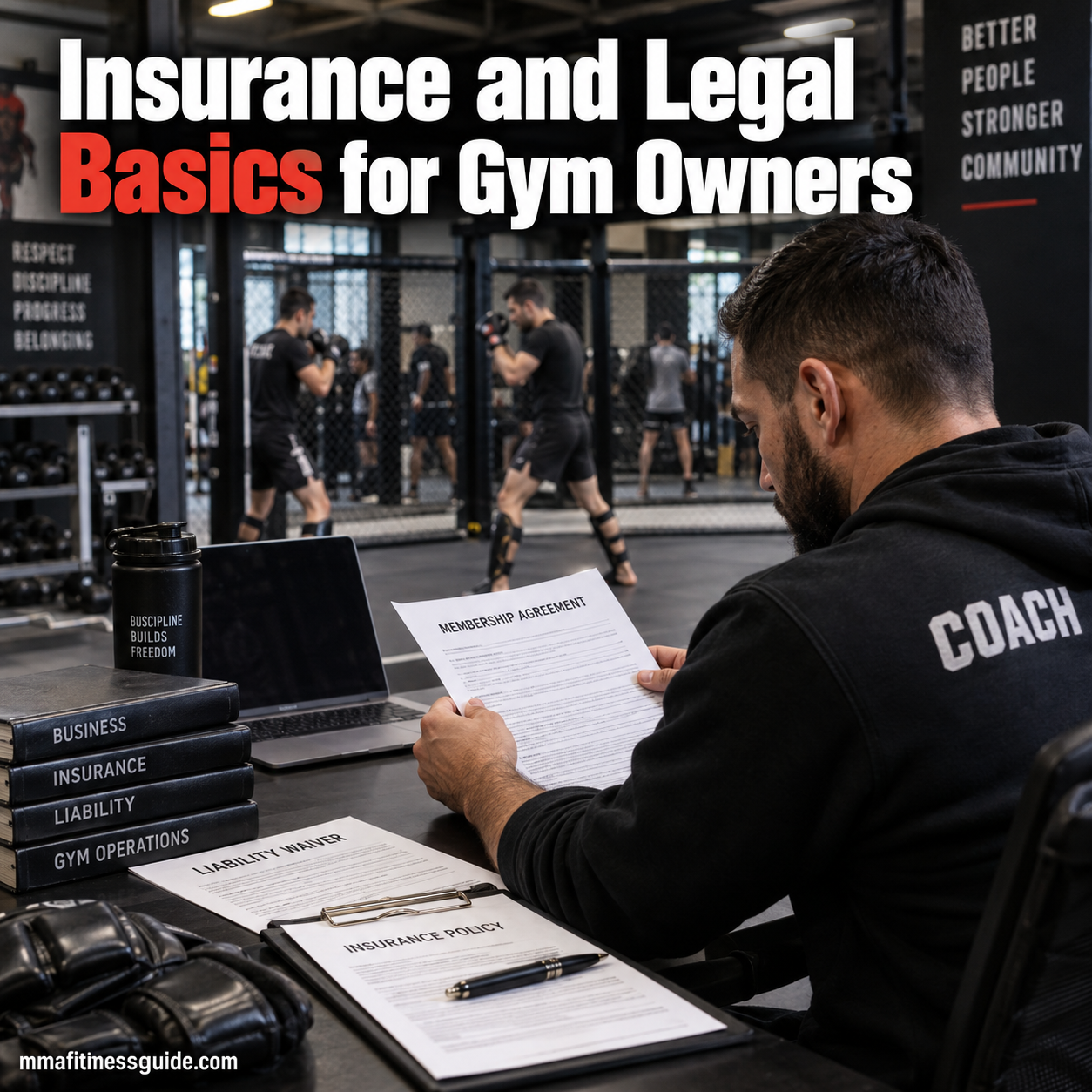
Two documents deserve particular attention: the liability waiver and the membership agreement.
They serve different purposes and should be reviewed by a qualified attorney familiar with your state’s laws.
What should a liability waiver include?
A well-drafted waiver may address:
- The specific activities participants will perform.
- Inherent risks associated with those activities.
- Acknowledgment and assumption of identified risks.
- Any legally permissible release of liability.
- Participant responsibilities.
- Emergency procedures and contact information.
A martial arts waiver should describe the actual activities offered.
Generic language written for a yoga studio may not adequately describe striking, grappling, joint locks, takedowns, and sparring.
Can a waiver prevent every lawsuit?
No.
A signed waiver does not prevent someone from filing a lawsuit, and it does not guarantee that the gym will avoid liability.
Enforceability depends on state law, the wording of the agreement, the circumstances of the incident, and the type of conduct involved.
Certain claims cannot be waived in some jurisdictions.
A waiver should therefore be viewed as one component of risk management, not permission to operate carelessly.
What should a membership agreement include?
Membership contracts should clearly explain the commercial relationship between the gym and its members.
Address:
- Membership prices and billing frequency.
- Enrollment fees.
- Contract duration and renewal terms.
- Cancellation procedures.
- Membership freezes.
- Late payments and failed transactions.
- Refund policies.
- Class access and scheduling changes.
- Rules for suspension or termination.
Make important financial terms easy to find.
If a member must provide written cancellation notice, explain exactly how to submit it and when cancellation becomes effective.
Review applicable consumer protection and automatic-renewal requirements before implementing recurring billing.
Digital signatures and recordkeeping
Electronic signatures may be appropriate where applicable law permits them and the process satisfies relevant requirements.
Use a system that records the signed document, signature date, signer identity, and version of the agreement.
Require completed documentation before participation, including trial classes and open mats.
Keep photo and video consent separate when appropriate, particularly for promotional use.
7. Parental Waivers for Minors: Additional Responsibilities
Youth martial arts programs introduce additional legal and operational responsibilities.
Children may have difficulty recognizing danger, communicating discomfort, or understanding the consequences of particular techniques.
Your enrollment process should collect appropriate information from a parent or legal guardian.
This may include:
- Parent or guardian identification and signature.
- Emergency contact details.
- Relevant medical or accommodation information.
- Authorized pickup arrangements.
- Participation consent.
- Applicable emergency treatment authorization.
Collect only information reasonably necessary for the program and protect it appropriately.
Are parental waivers enforceable?
Rules governing parental releases vary significantly between jurisdictions.
A parent signing a waiver does not necessarily eliminate a child’s ability to pursue a claim.
Have a local attorney review your youth participation documents rather than relying on a generic form.
Establish child-safety procedures
Youth programs should also have written safeguarding standards.
Consider background screening where appropriate or required, staff conduct rules, supervision ratios, authorized pickup procedures, and a process for reporting suspected abuse or misconduct.
Avoid unnecessary one-on-one situations in isolated areas.
Establish clear boundaries around physical contact and communication with minors.
These protections are essential regardless of whether the gym has experienced previous problems.
8. Choose the Right Business Structure
Your business structure influences taxation, administrative requirements, ownership arrangements, and potential personal liability.
Common options include sole proprietorships, limited liability companies, and corporations.
Sole proprietorship
A sole proprietorship is relatively straightforward to establish, but it generally does not create a separate legal liability shield between the owner and business.
That distinction matters for an operation involving physical contact and potential injury claims.
Limited liability company (LLC)
An LLC can separate certain business liabilities from an owner’s personal assets.
However, that protection has limits. It does not automatically protect an owner against personal wrongdoing, personal guarantees, or every other source of individual liability.
The SBA explains that liability protection depends on the business structure and circumstances, and that LLCs may offer protection in many instances.
Small Business Administration
Maintain the separation between your personal and business finances.
Use dedicated business bank accounts, properly execute contracts, and maintain required filings.
S corporation
An S corporation is a federal tax classification rather than a standalone state-law business entity.
An eligible LLC or corporation may elect S corporation tax treatment.
Whether this makes financial sense depends on profitability, compensation, payroll administration, and other considerations.
Consult a CPA before making the election.
Business licenses, zoning, and occupancy
Choosing a legal entity is only one step.
Before signing a commercial lease, investigate whether your proposed location permits martial arts instruction.
Check applicable requirements involving zoning, occupancy, fire safety, accessibility, signage, and business licensing.
A warehouse that looks ideal for a fight gym may not automatically be approved for public training classes.
Your lease should also clearly allocate responsibilities for repairs, improvements, insurance, and property damage.
Address these issues in your fight gym business plan before committing to a location or major equipment purchases.
9. Safety Protocols That Reduce Legal Risk
A written safety program turns general expectations into procedures instructors can consistently follow.
The program should address facility conditions, training activities, emergency response, and incident reporting.
Daily facility inspections
Before classes begin, inspect the training environment.
Check that:
- Mats are secure, clean, and free of dangerous gaps.
- Wall padding is properly installed.
- Heavy bags and mounting hardware are secure.
- Walkways and emergency exits remain unobstructed.
- Equipment is free from obvious damage.
- First-aid supplies are accessible.
Assign responsibility for completing inspections.
If a dangerous condition is identified, restrict access until it is corrected.
Establish sparring protocols
Sparring is a defining activity at many MMA gyms, but it requires careful supervision.
Create clear rules governing experience levels, intensity, protective equipment, partner selection, and instructor authorization.
Do not assume that two students are suitable training partners simply because they weigh approximately the same.
Consider technical ability, experience, control, and current training objectives.
Instructors should have authority to stop rounds immediately when unsafe behavior occurs.
Respond appropriately to injuries
Staff should recognize when training must stop and when emergency medical assistance is necessary.
For suspected concussion, remove the participant from training and require appropriate medical evaluation and clearance before return.
For potentially serious neck or spinal injuries, avoid unnecessary movement and activate emergency services.
Do not allow competitive pressure or a student’s desire to continue to override established safety procedures.
Document significant incidents promptly and accurately.
10. Post Clear Rules and Policies
Visible rules help members understand how your facility operates.
Post important expectations in appropriate locations and include them in your onboarding materials.
Examples include hygiene requirements, footwear restrictions, sparring rules, equipment procedures, and emergency exit information.
Create a code of conduct
Your gym’s code of conduct should address more than athletic behavior.
Include expectations concerning:
- Respectful treatment of members and staff.
- Harassment and discrimination.
- Bullying and intimidation.
- Unauthorized aggressive contact.
- Sexual misconduct.
- Equipment misuse.
- Retaliation against people reporting concerns.
Explain how members can report problems and how complaints will be handled.
Apply rules consistently and document significant disciplinary decisions.
A welcoming training environment depends partly on members understanding what behavior is unacceptable and trusting that management will respond appropriately.
These standards also matter to prospective members evaluating a facility. Our guide on how to choose the right MMA gym explores the factors students should consider when assessing a training environment.
11. Train Your Staff on Safety and Emergency Procedures
Written policies accomplish little if employees do not understand them.
Train new staff before assigning independent responsibility, and conduct periodic refresher sessions.
Every instructor should know the location of emergency equipment, the facility’s address, and the procedure for contacting emergency services.
Prepare an emergency action plan
Your plan should explain what happens when a serious incident occurs.
For example, assign responsibilities for:
- Calling emergency services.
- Providing first aid within the responder’s training.
- Retrieving an automated external defibrillator, if available.
- Clearing the training area.
- Directing emergency responders to the injured person.
- Contacting appropriate emergency contacts.
- Documenting the incident afterward.
Arrange appropriate first-aid, CPR, and AED training for designated personnel.
Conduct drills so employees can practice their responsibilities.
Train staff to manage conflict
Instructors may encounter aggressive students, membership disputes, or disagreements during sparring.
Teach staff how to stop unsafe activity, separate participants, communicate calmly, and involve management.
Establish clear rules for when someone must be removed from a class or facility.
Do not expect employees to handle threatening situations without appropriate procedures.
Protect your instructors from excessive workloads
An exhausted coach may struggle to maintain attention across multiple demanding classes.
Schedule reasonable breaks, distribute responsibilities, and avoid making one person responsible for every operational task.
Our article on avoiding burnout as a gym owner provides additional guidance on building sustainable routines and delegating responsibilities.
12. Keep Accurate Records and Documentation
Good documentation supports daily operations, insurance administration, and the investigation of incidents or disputes.
A gym should maintain an organized system for storing important business records.
These may include:
- Signed waivers and membership agreements.
- Attendance records.
- Staff training and certification records.
- Equipment inspections and maintenance logs.
- Incident reports.
- Insurance policies and renewal documents.
- Payment and cancellation records.
- Relevant communications concerning disputes.
What belongs in an incident report?
Record factual information as soon as reasonably possible after an incident.
Include the date, time, location, people involved, activity underway, observed circumstances, and actions taken.
Identify witnesses and preserve relevant evidence where lawful and appropriate.
Avoid speculation about medical diagnoses or assigning blame.
If an insurer requires prompt notification, follow the policy’s reporting procedures.
Protect sensitive information
Emergency contacts, health disclosures, payment records, and information about minors deserve particular care.
Limit access to employees who genuinely need the information.
Use secure storage, appropriate access controls, and established retention and deletion procedures.
Consult legal and accounting professionals about applicable record-retention requirements.
13. Consult Legal and Insurance Professionals
Gym owners do not necessarily need a lawyer on a monthly retainer, but professional review is particularly valuable before signing major agreements or launching new activities.
An attorney familiar with business and sports-related liability can review your waivers, membership contracts, employment arrangements, commercial lease, and ownership structure.
An insurance professional experienced with combat sports can evaluate whether your policies match the activities you actually offer.
Prepare for your consultation
Bring a description of your programs, expected enrollment, staffing arrangements, facility layout, and planned events.
Explain whether you offer full-contact sparring, youth classes, private instruction, professional fight preparation, or off-site activities.
Ask specific questions.
Does your policy cover injuries during open mats? Are visiting instructors insured? Does your lease require additional insured endorsements? What happens if a student files a claim after leaving the gym?
Request written confirmation of important coverage details and retain copies of the relevant policy documents.
A professional review cannot eliminate all risk, but it can identify gaps before they become expensive problems.
14. Additional Insurance and Legal Issues Gym Owners Should Consider
As a gym grows, its operations may extend beyond ordinary instruction.
New services can introduce risks that existing policies and agreements do not address.
Hosting amateur events and smokers
A regular training policy should not be assumed to cover a public fight event.
Competitions may require separate event insurance, permits, sanctioning arrangements, medical personnel, and participant accident coverage.
Requirements differ by jurisdiction and event format.
For example, Washington provides distinct regulatory procedures for amateur MMA events, including specified licensing, participant, equipment, and medical requirements.
Washington State Department of Licensing
Check the rules of your state athletic commission or other relevant regulator before advertising or organizing an event.
Our guide to hosting amateur MMA events and smokers covers the additional planning involved.
Cyber liability and payment security
Gyms increasingly depend on online membership platforms, digital waivers, scheduling systems, and recurring payment software.
A data breach or ransomware incident could disrupt operations and expose sensitive information.
Cyber insurance may help with certain covered expenses, but prevention remains important.
Use reputable payment processors, enable multifactor authentication, restrict staff access, and maintain secure backups.
Employment practices liability
Employment disputes can involve allegations of discrimination, harassment, retaliation, or wrongful termination.
Employment practices liability insurance may cover certain claims, subject to policy exclusions and conditions.
It does not replace compliance with employment laws or proper staff management.
Umbrella and excess liability insurance
As enrollment increases, your potential financial exposure may grow.
Umbrella or excess liability insurance may provide additional limits above specified underlying policies.
Ask which underlying policies qualify and whether the additional coverage follows the same exclusions.
15. Review Your Protection When Expanding or Selling
Legal and insurance responsibilities change as your business evolves.
Opening a second location may introduce a new lease, additional employees, more equipment, and different operational risks.
Before expanding, confirm that the new premises and activities are properly insured.
Determine whether your existing policies can be amended or whether separate arrangements are necessary.
Our second-location expansion checklist explains the broader operational considerations involved in growing beyond one facility.
Prepare for an eventual sale
Accurate records also become valuable when selling your gym.
Prospective buyers may want to examine insurance claims, leases, employment arrangements, membership contracts, and unresolved disputes.
Organized documentation can make due diligence more efficient and help identify liabilities that must be addressed before closing.
For more information, read our guide to exit strategies and selling a gym .
MMA Gym Insurance and Legal Protection Checklist
Use this checklist as a practical starting point for reviewing your facility.
Gym protection audit
- Confirm general liability coverage includes your actual martial arts activities.
- Review professional liability coverage for every instructor.
- Evaluate participant accident insurance and medical benefit limits.
- Verify workers’ compensation requirements and staff classification.
- Insure equipment and investigate business interruption coverage.
- Have an attorney review waivers and membership agreements.
- Establish appropriate parental consent and child-safety procedures.
- Verify business registration, zoning, permits, and lease requirements.
- Implement daily equipment inspections and sparring protocols.
- Train staff in emergency response and incident reporting.
- Secure member records and maintain organized documentation.
- Review coverage before adding events, locations, or new programs.
Frequently Asked Questions About MMA Gym Insurance
How much does MMA gym insurance cost?
Costs vary according to location, revenue, enrollment, activities, coverage limits, claims history, and other underwriting factors.
A small grappling academy may have different insurance needs from a large facility offering boxing, MMA sparring, youth programs, and public competitions.
Request multiple quotes using the same coverage requirements to make comparisons meaningful.
Does an LLC eliminate the need for insurance?
No. An LLC may protect owners from certain business liabilities, but it does not eliminate all personal exposure or pay the gym’s legal expenses automatically.
Insurance and business structure address different risks.
Can members train without signing a waiver?
Gym owners should establish a consistent pre-participation documentation process.
Requiring a completed, legally reviewed waiver before training is a sensible operational policy, although the legal effect of that waiver varies by jurisdiction.
Do I need separate insurance for private lessons?
Not always, but private instruction must fall within your policy’s covered operations.
Confirm whether lessons conducted off-site, in members’ homes, or by independent instructors are included.
Should I review my insurance every year?
Yes. Review coverage at renewal and whenever your operations materially change.
Adding full-contact sparring, new instructors, children’s programs, competitions, or another location may alter your insurance needs.
Final Thoughts
Protecting an MMA gym requires more than purchasing the cheapest available insurance policy.
The strongest approach combines appropriate coverage, professionally reviewed agreements, clear training standards, properly trained staff, and accurate documentation.
Start with the activities your gym actually offers. Identify the risks associated with each program, confirm your insurance addresses those exposures, and establish procedures that reduce the likelihood of preventable incidents.
Review your protection whenever your business changes.
A well-managed gym protects its members, supports its instructors, and creates a more stable business for the owner.
Insurance and legal preparation may not be the most exciting parts of running a martial arts facility, but they are essential to keeping the doors open and building a business that can last.
Continue Building and Protecting Your MMA Gym
Insurance and legal protection are important parts of running a martial arts gym, but they’re only one piece of the business. From planning your first facility to managing finances, hosting events, and eventually expanding, these related guides cover other areas every gym owner should understand.
- How to Start a Martial Arts Gym: From Passion to Profit — Learn the essential steps involved in turning your martial arts experience into a functioning business.
- Writing a Business Plan for a Fight Gym — Organize your startup costs, business goals, target market, and financial projections before opening your doors.
- Budgeting and Cash Flow for Small Gyms — Manage operating expenses, plan for unexpected costs, and keep your gym financially stable.
- Hosting Amateur MMA Events and Smokers — Understand the planning, safety, and regulatory considerations involved in organizing combat sports events.
- How to Avoid Burnout as a Gym Owner — Find ways to balance coaching, business responsibilities, and personal recovery without becoming overwhelmed.
- Expanding to a Second Location: Checklist — Explore the financial and operational considerations involved in opening another training facility.
- Exit Strategies and Selling a Gym — Prepare for a potential sale and understand what goes into transitioning ownership of your business.
- How to Choose the Right MMA Gym for You — See what students look for in a training facility and how those expectations can help you improve your own gym.