Introduction
Combat sports rarely involve producing force from a perfectly stable position. Fighters punch while moving, kick from one leg, resist opponents pulling them off balance, rotate through takedowns, and repeatedly transition between standing and ground positions.
Functional training can prepare the body for these demands by emphasizing movements that involve several joints and muscle groups working together.
Exercises that develop hip extension, rotation, single-leg stability, grip strength, carrying strength, and explosive movement can complement regular boxing, wrestling, Muay Thai, BJJ, or MMA practice.
Here are 12 exercises that fit particularly well into combat-sports strength and conditioning.
What Functional Training Develops for Fighters
Combat athletes repeatedly rely on several physical qualities:
- Balance and coordination
- Multi-directional movement
- Trunk stability
- Grip strength
- Hip extension
- Rotational power
- Single-leg strength
- Explosive force production
Strength exercises don’t duplicate fighting techniques, nor should they try to. Their purpose is to develop physical qualities that support the movements athletes perform during technical training.
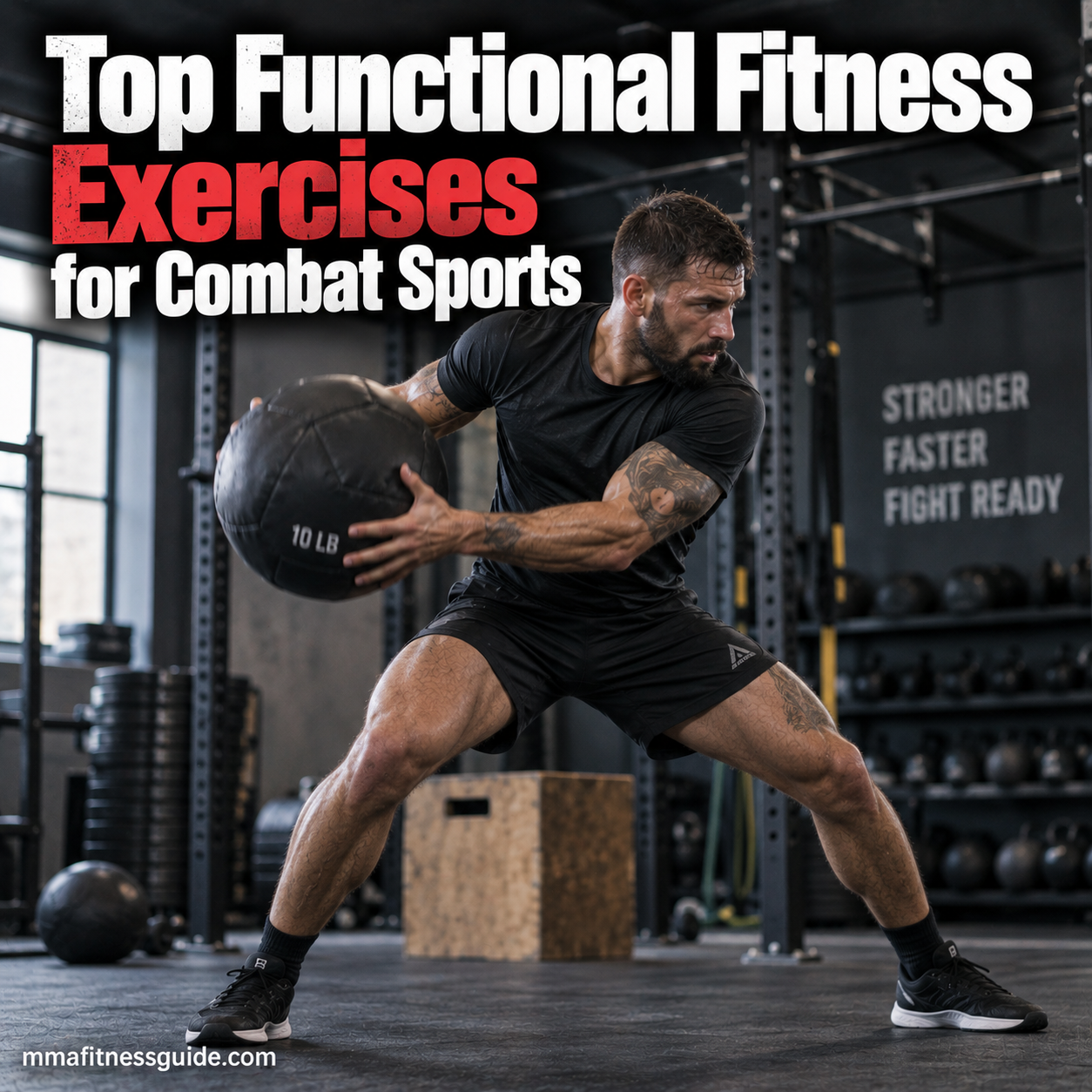
1. Medicine Ball Rotational Throws
Rotational medicine ball throws train the hips and torso to produce force quickly.
That makes them useful for athletes whose sports involve punching, kicking, throwing, and changing direction.
What They Train
- Explosive hip rotation
- Rotational power
- Coordination between the lower and upper body
- Rapid force production
How to Use Them
Perform 3–5 sets of 5–8 throws per side.
Choose a medicine ball light enough to throw aggressively. If the ball becomes so heavy that the movement slows considerably, you’re shifting away from the explosive quality the exercise is intended to train.
2. Kettlebell Swings
Kettlebell swings train rapid hip extension through a repeated hinge movement.
The glutes, hamstrings, back, grip, and trunk all contribute to controlling the kettlebell as it accelerates and returns.
What They Train
- Hip extension
- Posterior-chain strength
- Grip endurance
- Repeated power production
- Conditioning
Variations
- Two-handed swing
- Single-arm swing
Perform 3–4 sets of 10–15 repetitions.
The power should come primarily from extending the hips rather than lifting the kettlebell with the shoulders.
3. Turkish Get-Up
The Turkish get-up requires you to move from the floor to standing while maintaining control of a weight overhead.
Because several positions must be coordinated during one repetition, the exercise challenges stability differently from conventional presses or squats.
What It Trains
- Shoulder stability
- Trunk control
- Hip mobility
- Coordination
- Strength through transitions
How to Use It
Perform 2–4 controlled repetitions per side.
Start with a light kettlebell—or no weight at all—until you can move confidently through each stage.
4. Sled Pushes and Pulls
Sled work allows fighters to produce force horizontally while driving through the legs.
The movement can complement wrestling and clinch training, where athletes frequently have to generate force while moving another person.
What They Train
- Leg drive
- Lower-body strength
- Work capacity
- Repeated force production
How to Use Them
Push or pull the sled for approximately 20–40 meters per set.
Adjust the load based on the goal. Lighter resistance allows faster movement, while heavier resistance places greater emphasis on strength.
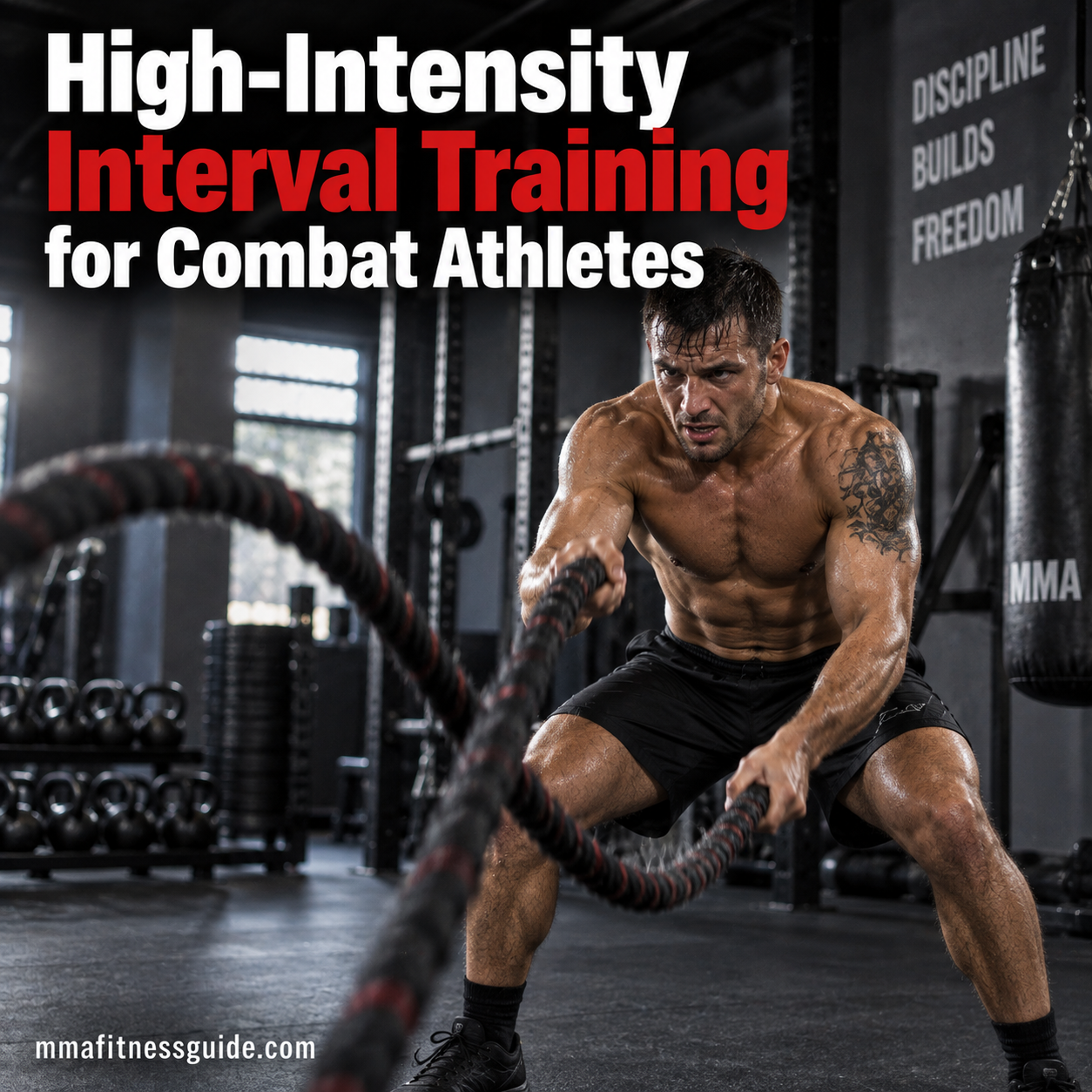
5. Battle Rope Power Waves
Battle ropes challenge the upper body while requiring the trunk and lower body to maintain position.
Short, hard intervals can create considerable fatigue in the shoulders and forearms.
What They Train
- Shoulder endurance
- Grip endurance
- Upper-body conditioning
- Repeated explosive movement
How to Use Them
Perform 10–20 seconds of hard work followed by adequate recovery.
Complete approximately 5–8 rounds.
Keep your posture stable instead of allowing the entire body to collapse as fatigue increases.
6. Sandbag Shouldering
Unlike a barbell, a sandbag shifts and changes shape as you lift it.
That forces you to adjust your grip and body position during each repetition.
What It Trains
- Grip strength
- Hip extension
- Trunk stability
- Upper-back strength
- Control of an awkward load
How to Use It
Perform 3–4 sets of 5–8 repetitions, alternating shoulders.
Keep the sandbag close to your body rather than trying to curl it upward with your arms.
7. Single-Leg Romanian Deadlift
Fighters spend considerable time transferring weight between legs. Kicking, changing stance, defending takedowns, and moving laterally can all require control from one leg at a time.
The single-leg Romanian deadlift develops that control while loading the posterior chain.
What It Trains
- Single-leg balance
- Hamstring and glute strength
- Hip stability
- Coordination
- Trunk control
How to Use It
Perform 8–12 repetitions per leg using a kettlebell or dumbbell.
Start with a manageable load and keep the hips controlled rather than rotating excessively as you lower the weight.
8. Lateral Bounds
Combat movement doesn’t happen exclusively forward and backward.
Lateral bounds train athletes to produce and absorb force while moving sideways.
What They Train
- Lateral power
- Single-leg control
- Coordination
- Deceleration
- Side-to-side movement
How to Use Them
Perform 3–4 sets of 6–10 bounds per side.
Land under control before immediately progressing to maximum-distance jumps.
Quality landings matter more than covering as much distance as possible.
9. Farmer’s Carry
The farmer’s carry is simple: pick up a heavy weight in each hand and walk while maintaining posture.
Keeping the weights controlled challenges the hands, forearms, shoulders, trunk, hips, and legs simultaneously.
What It Trains
- Grip strength
- Trunk stability
- Upper-back strength
- Posture under load
- Full-body work capacity
How to Use It
Carry kettlebells or dumbbells for approximately 20–40 meters.
Choose a load that challenges your grip without forcing you to lose posture.
10. Pull-Ups and Grip Variations
Pull-ups develop the back, arms, shoulders, and grip—areas that work repeatedly during clinching and grappling.
Grip variations can change where the challenge is concentrated.
Useful Variations
- Standard pull-ups
- Neutral-grip pull-ups
- Towel pull-ups
- Assisted pull-ups
- Rope-grip variations
Perform approximately 3–5 sets.
You don’t need to take every set to failure. Leaving a few repetitions in reserve can help manage fatigue when you’re also wrestling or grappling several times per week.
11. Landmine Rotations
Landmine rotations allow the athlete to move a loaded bar through an angled path while coordinating the hips, trunk, and upper body.
They can be used to develop controlled rotational strength without trying to imitate a punch directly.
What They Train
- Rotational strength
- Trunk control
- Hip-to-shoulder coordination
- Strength through multiple planes
How to Use Them
Perform 3–4 sets of approximately 8–10 repetitions per side.
Rotate through the hips and torso rather than moving the bar entirely with your arms.
12. Sprawl-to-Jump
This exercise combines dropping toward the floor with quickly returning to the feet and jumping.
The repeated transition makes it physically demanding, so it works better as a conditioning exercise than as a substitute for technical sprawl practice.
What It Trains
- Repeated explosive movement
- Lower-body power
- Conditioning
- Floor-to-standing transitions
How to Use It
Perform 3–5 sets of 5–8 controlled repetitions.
Keep the volume manageable. Once fatigue significantly changes your landing or sprawl mechanics, additional repetitions provide less value.
How to Structure Functional Training for Combat Sports
Two strength and conditioning sessions per week can work well for many recreational combat athletes. Some athletes may use three depending on their experience, recovery, and overall training schedule.
Rather than packing every exercise into every workout, divide training according to the qualities you want to develop.
For example, one session might emphasize:
- Explosive power
- Lower-body strength
- Rotational movement
Another could emphasize:
- Single-leg stability
- Pulling strength
- Grip
- Carries and conditioning
Your technical combat training should remain the priority.
Hard strength or conditioning sessions placed immediately before demanding sparring can leave you too fatigued to perform technical work effectively.
Common Functional Training Mistakes
Using Too Much Weight for Power Exercises
Power training depends on producing force quickly.
If a medicine ball or kettlebell is so heavy that every repetition becomes slow, the exercise is no longer training the same quality.
Match the resistance to the goal.
Turning Every Workout Into a Circuit
Strength, power, and conditioning are different training qualities.
Heavy farmer’s carries, explosive medicine ball throws, and battle-rope intervals don’t necessarily need to be performed back-to-back with minimal rest.
Allow enough recovery to maintain the intended speed and technique.
Trying to Train Everything at Once
A single session doesn’t need to include power, maximal strength, endurance, agility, grip work, and a long conditioning finisher.
Prioritize a few qualities and distribute the rest across the training week.
Ignoring Single-Leg Training
Fighting frequently places more weight on one leg than the other.
Split squats, single-leg RDLs, lateral bounds, and other unilateral movements can expose differences in balance and strength that bilateral exercises may not reveal as clearly.
Sample Functional Fitness Workout for Fighters
Here’s one way to combine several of these movements without turning the session into an exhausting circuit.
1. Medicine Ball Rotational Throws
3 sets × 6 throws per side
2. Kettlebell Swings
3 sets × 12–15 reps
3. Single-Leg Romanian Deadlift
3 sets × 8–10 reps per leg
4. Landmine Rotations
3 sets × 8 reps per side
5. Sled Pushes
4 sets × 20–25 meters
6. Farmer’s Carries
3 sets × 20–30 meters
Rest between exercises according to the difficulty of the movement and your training goal.
For explosive exercises, give yourself enough recovery to keep each set fast and technically clean.
Balancing Functional Training With Combat Practice
Strength and conditioning should support your combat training rather than compete with it.
If you have hard sparring scheduled for Friday, performing an exhausting full-body conditioning workout Thursday evening probably isn’t the best arrangement.
Place demanding strength sessions where you have enough recovery before your hardest technical sessions.
Also account for the physical work you’re already getting from:
- Sparring
- Wrestling
- Grappling
- Pad rounds
- Bag work
- Drilling
An athlete training MMA five days per week will generally need a different strength and conditioning workload from someone attending two recreational classes.
Final Thoughts
Good functional training develops physical qualities that combat athletes repeatedly rely on: producing force through the hips, rotating under control, maintaining balance on one leg, carrying and gripping heavy loads, and continuing to move efficiently as fatigue builds.
Medicine ball throws, kettlebell swings, sled work, carries, unilateral exercises, and controlled explosive movements can all contribute when they’re programmed around technical training.
Choose a handful of exercises that address your current needs, perform them with good technique, and progress the resistance or volume gradually.
The weight room doesn’t need to imitate a fight. It should build physical qualities that give you more strength, stability, and power to work with when you return to the mats.