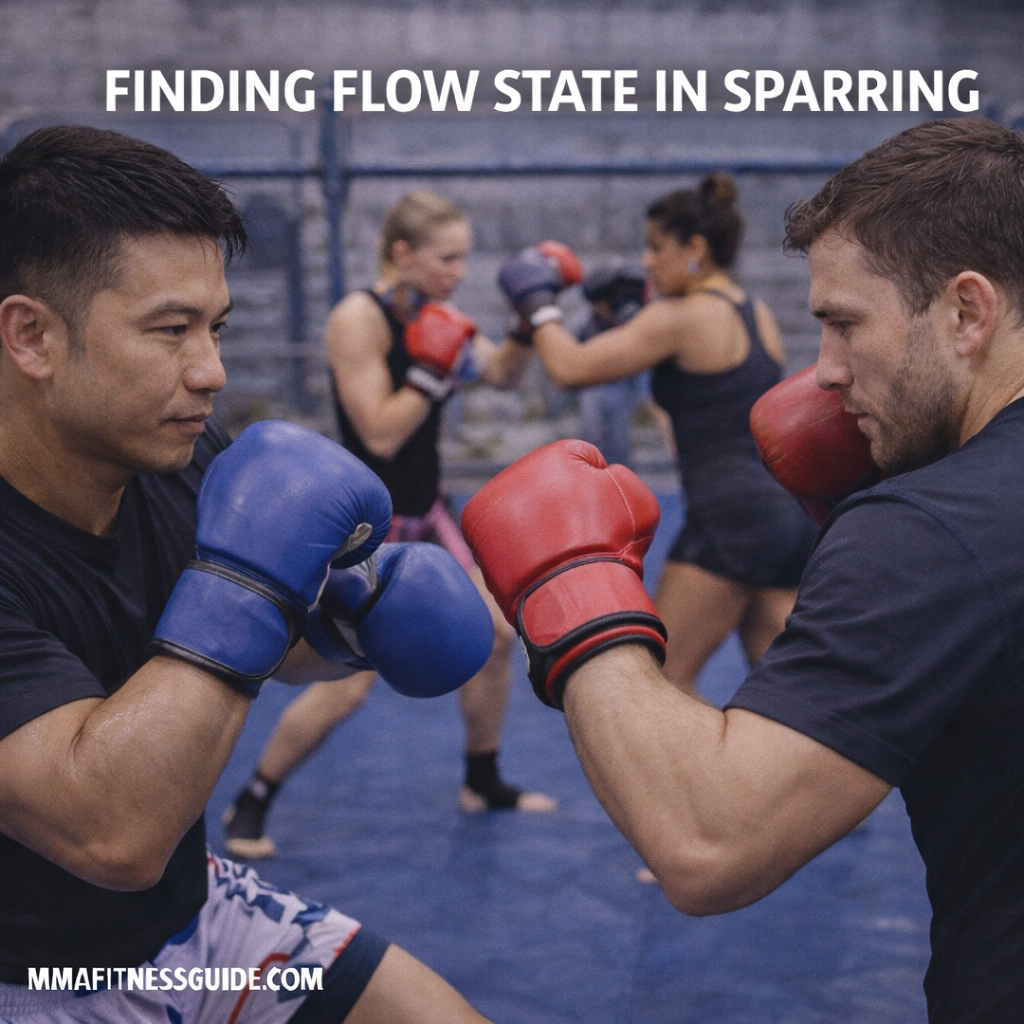
Mental Rehearsal Before the First Exchange
You’re preparing for a fight against an opponent known for aggressive takedowns. During training, your coach has drilled the same defensive sequence repeatedly: maintain distance, recognize the level change, establish an underhook, and circle away from the cage.
Now imagine rehearsing that sequence mentally before your next sparring session. You picture your opponent closing the distance, feel yourself adjusting your stance, and mentally walk through the defensive movements you’ve practiced.
This is visualization, also known as mental imagery.
For MMA fighters, mental rehearsal can complement physical training by helping them review techniques, prepare for unfamiliar situations, and develop confidence in their game plans. Rather than simply imagining a knockout or championship victory, effective visualization focuses on realistic exchanges, specific technical decisions, and the ability to adapt when a fight doesn’t unfold as expected.
What Is Visualization in MMA?
Visualization is the practice of mentally simulating an action or experience without physically performing it.
A fighter might imagine throwing a jab, defending a takedown, escaping side control, or walking into a crowded arena.
The objective is to create a detailed mental representation of the situation, including the movements and decisions involved.
For example, when mentally rehearsing a jab-cross combination, imagine:
- Establishing your stance and maintaining balance.
- Extending your lead hand toward the target.
- Rotating your hips and shoulders for the cross.
- Returning both hands to a defensive position.
- Moving away from the opponent’s counterattack.
Motor imagery can engage some of the brain networks involved in planning and performing movement. However, imagining a technique is not neurologically identical to executing it.
Mental rehearsal works best as a supplement to physical practice, coaching, and live training.
Why Fighters Use Visualization
MMA requires athletes to recognize changing situations and select appropriate responses while managing fatigue and pressure.
Visualization gives fighters an opportunity to rehearse those responses without adding physical training volume.
Potential applications include:
- Reviewing techniques learned during practice.
- Preparing for specific opponent tendencies.
- Developing familiarity with competition environments.
- Rehearsing responses to difficult positions.
- Supporting confidence through realistic preparation.
- Maintaining engagement during periods of reduced training.
For example, a fighter preparing for a southpaw opponent might mentally rehearse foot positioning, distance management, and defensive responses to the rear straight.
The rehearsal should reinforce techniques already practiced with a qualified coach rather than introduce unfamiliar movements without feedback.
Step 1: Create an Environment That Supports Concentration
Trying to visualize a complicated grappling exchange while checking your phone every few seconds makes sustained concentration difficult.
Choose a location where you can focus for several uninterrupted minutes.
This could be a quiet corner of the gym, your bedroom, or a comfortable space before training.
How to begin
- Sit comfortably and put your phone away.
- Relax unnecessary tension in your shoulders and jaw.
- Take a few comfortable, unforced breaths.
- Choose one specific technique or scenario.
- Begin rehearsing the movements mentally.
Start with two or three minutes.
If your attention wanders, return to the technique without criticizing yourself.
A short session focused on one familiar movement is more useful than spending 20 minutes imagining unrelated fight scenarios.
Step 2: Visualize Specific Techniques
Imagine you’re working on your rear-leg low kick.
Instead of picturing yourself landing a spectacular knockout, mentally rehearse the movement from beginning to end.
Visualize establishing distance, setting up the kick with your hands, rotating your hips, making contact with the target, and returning to a balanced stance.
Pay attention to details your coach has emphasized.
Use multiple perspectives
Two approaches can help you examine the movement.
First-person imagery
Imagine performing the technique through your own eyes.
Focus on what you would see and feel while moving.
Third-person imagery
Picture yourself performing the technique as though watching training footage.
This perspective may help you examine positioning, posture, and overall movement patterns.
Experiment with both approaches and use whichever helps you rehearse the intended technique accurately.
Include realistic sensory details
You might imagine:
- The sound of your coach giving instructions.
- The feeling of your feet moving across the mat.
- Your opponent changing distance.
- The sensation of maintaining a balanced stance.
- The rhythm of a familiar combination.
Sensory details can make imagery more vivid, but accuracy matters more than creating an elaborate mental scene.
Practical takeaway: Choose one technique, rehearse its correct execution, and connect the imagery to your next physical training session.
Step 3: Rehearse Difficult Fight Scenarios
A fight rarely follows a perfect script.
You might miss an opening combination, lose a dominant position, or discover that your opponent’s wrestling is stronger than expected.
Visualizing only successful exchanges leaves these possibilities unexplored.
Instead, mentally rehearse realistic problems and appropriate responses.
Scenario 1: Getting pressured against the cage
Imagine your opponent moving forward and cutting off your escape route.
Rehearse:
- Maintaining your defensive stance.
- Recognizing the opponent’s positioning.
- Establishing frames or underhooks when appropriate.
- Creating space and circling away.
Focus on the technical responses you’ve already practiced.
Scenario 2: Losing a grappling position
Picture your opponent passing your guard and establishing side control.
Rather than imagining an immediate escape, rehearse the sequence your coach has taught you.
Establish defensive frames, protect vulnerable positions, create space, and work toward recovering guard or escaping.
Scenario 3: Losing the opening round
Imagine returning to your corner after a difficult first round.
Your coach identifies a tactical adjustment.
Mentally rehearse listening to the instructions, identifying the relevant change, and beginning the next round with a clear objective.
The purpose isn’t to convince yourself that setbacks won’t happen. It’s to prepare a response when they do.
Practical takeaway: Include adversity in mental rehearsal, but concentrate on realistic, technically appropriate solutions.
Step 4: Incorporate Visualization Into Daily Training
Mental rehearsal doesn’t require a separate hour-long session.
Short, focused exercises can fit naturally into an existing MMA schedule.
Before technical drilling
Spend 30–60 seconds imagining the technique you’re about to practice.
If you’re working on a double-leg takedown, review your entry, positioning, and finish.
Then perform the technique physically and compare the execution with your mental rehearsal.
Before sparring
Choose one tactical objective.
For example, imagine maintaining distance against an aggressive opponent and responding with your jab rather than retreating in a straight line.
Keep the rehearsal simple enough to remember during the round.
After training
Recall one technique you performed successfully and one that needs improvement.
Mentally review the correct execution using feedback from your coach.
This creates a connection between physical practice, technical feedback, and mental rehearsal.
Step 5: Combine Visualization With Useful Self-Talk
Imagine preparing for a difficult sparring round.
You visualize your opponent moving forward aggressively, but your attention keeps returning to the possibility of getting overwhelmed.
A short verbal cue can help direct your focus toward the appropriate response.
Examples include:
- “Maintain distance.”
- “Stay balanced.”
- “Protect position first.”
- “Listen and adjust.”
- “One exchange at a time.”
Pair the cue with a specific action.
For example, repeat “Stay balanced” while imagining yourself completing a striking combination and returning to your stance.
Avoid relying exclusively on broad statements such as “I’m unbeatable.”
Confidence-building language is more useful when connected to realistic preparation and controllable actions.
Practical takeaway: Match your mental cue to the technique or decision you’re rehearsing.
Step 6: Use Visualization During Injury Recovery
An injured fighter may be unable to participate in normal training for several weeks or months.
During this period, visualization can provide a way to remain mentally engaged with familiar techniques without adding physical stress.
For example, a fighter recovering from a knee injury might mentally rehearse previously learned striking combinations while following an approved rehabilitation program.
Possible applications include:
- Reviewing familiar technical sequences.
- Mentally rehearsing tactical decisions.
- Maintaining connection with training goals.
- Preparing for a gradual return to practice.
However, visualization does not repair injured tissue or replace rehabilitation.
Do not use mental rehearsal as justification for returning to sparring before receiving appropriate medical clearance.
If imagining an injury or return to competition increases anxiety, discuss those concerns with your rehabilitation team or a qualified sports psychologist.
Practical takeaway: Use imagery to support your mental preparation while allowing physical recovery to follow medical guidance.
Step 7: Create a Pre-Fight Visualization Routine
Competition day introduces unfamiliar sights, sounds, and scheduling demands.
A short visualization routine can help you review your preparation without becoming absorbed in hypothetical outcomes.
Example: Five-minute pre-fight visualization
Mental rehearsal checklist
5 minutes
0 of 5 completed
0%
Minute 1
Settle your attention
Sit comfortably, breathe naturally, and identify your primary objective.
Minute 2
Rehearse your opening
Picture establishing your stance, managing distance, and executing your first planned action.
Minute 3
Review your strengths
Mentally practice two familiar techniques you’ve prepared during camp.
Minute 4
Prepare for adversity
Imagine one realistic setback and rehearse the appropriate response.
Minute 5
Return to the present
Review one tactical cue and shift your attention toward the warm-up.Reset checklist
Avoid repeatedly imagining every possible way the fight could go wrong.
Choose a small number of scenarios that relate directly to your preparation and game plan.
Common Visualization Mistakes Fighters Make
Imagining Only the Final Result
Picturing your hand being raised may feel motivating, but it provides little information about how to defend a takedown or manage distance.
Spend more time rehearsing actions than outcomes.
Rehearsing Incorrect Technique
Repeatedly imagining a movement with poor mechanics may reinforce an inaccurate mental representation.
Use coaching feedback and reliable training footage to guide your imagery.
Replacing Physical Practice
Visualization cannot reproduce the resistance, timing, fatigue, and unpredictability of live MMA training.
Continue practicing techniques physically whenever appropriate.
Making Every Session Too Complicated
Trying to mentally rehearse an entire five-round fight can make it difficult to maintain concentration.
Begin with one exchange or technical sequence.
Expecting Immediate Results
A few minutes of visualization won’t guarantee faster reactions or improved competition results.
Evaluate whether mental rehearsal helps you concentrate, recall techniques, and approach training with clearer objectives over time.
How to Measure Whether Visualization Is Helping
Rather than assuming visualization is working, monitor how it affects your training.
After two or three weeks, ask yourself:
- Can I recall the technical sequence more clearly?
- Am I executing the intended movement more consistently?
- Do I feel more familiar with specific sparring scenarios?
- Am I better prepared to follow my game plan?
- Does mental rehearsal help me concentrate before training?
Discuss your observations with your coach.
If imagery feels distracting or increases anxiety, simplify the exercise or seek guidance from a qualified sports psychologist.
The objective is to support your training, not introduce another source of pressure.
Key Takeaways
- Use visualization to rehearse specific techniques and tactical decisions.
- Include realistic setbacks instead of imagining only successful outcomes.
- Practice short mental rehearsal sessions before or after physical training.
- Connect self-talk to specific actions.
- Use coaching feedback to maintain technical accuracy.
- Treat visualization as a supplement to physical training, not a replacement.
- Evaluate its usefulness through observable changes in preparation and execution.
Final Thoughts
Picture the opening exchange of your next sparring round.
Your opponent steps forward, you recognize the movement, establish your position, and execute the response you’ve practiced.
That sequence can be rehearsed mentally before you step onto the mat, then tested and refined through physical training.
Over time, visualization can become a familiar part of your preparation alongside technical drilling, conditioning, and tactical review.
The aim isn’t to imagine a perfect fight. It’s to prepare for realistic situations, rehearse appropriate decisions, and enter training or competition with a clearer understanding of what you intend to do.
Visualize the actions you’ve trained, prepare for the situations you might face, and let physical practice determine how well those skills hold up under pressure.