Introduction
Partner workouts are a cornerstone of effective MMA training. From pad work and grappling drills to conditioning circuits, training with a partner improves timing, accountability, and fight realism in ways solo workouts cannot. When structured correctly, partner workouts help fighters build skill, conditioning, and mental toughness while strengthening coach–athlete relationships.
For trainers, partner-based sessions also create dynamic, engaging environments that mirror real fight demands.
Why Partner Training Is Essential in MMA
MMA is inherently interactive. Every exchange involves reacting to another person’s movement, pressure, and timing.
Partner workouts help fighters:
- Develop realistic fight timing
- Improve reaction speed and awareness
- Build functional strength under resistance
- Increase accountability and intensity
- Simulate fatigue and chaos found in competition
For trainers, partner drills provide immediate feedback and coaching opportunities.
Key Benefits of Partner Workouts
Well-designed partner training offers benefits beyond physical conditioning.
Key advantages include:
- Improved coordination and balance
- Enhanced mental focus under pressure
- Better communication and trust
- Increased motivation and consistency
- Real-world application of techniques
Partner work bridges the gap between drills and live fighting.
Safety First: Setting Rules and Expectations
Before any partner workout begins, safety must be prioritized.
Important safety guidelines:
- Match partners by size, experience, and intensity
- Establish clear rules for contact and power
- Emphasize control over ego
- Use protective gear when appropriate
- Encourage communication throughout sessions
Safe training leads to longer careers and better performance.
Striking-Based Partner Workouts
Pad Work Combinations
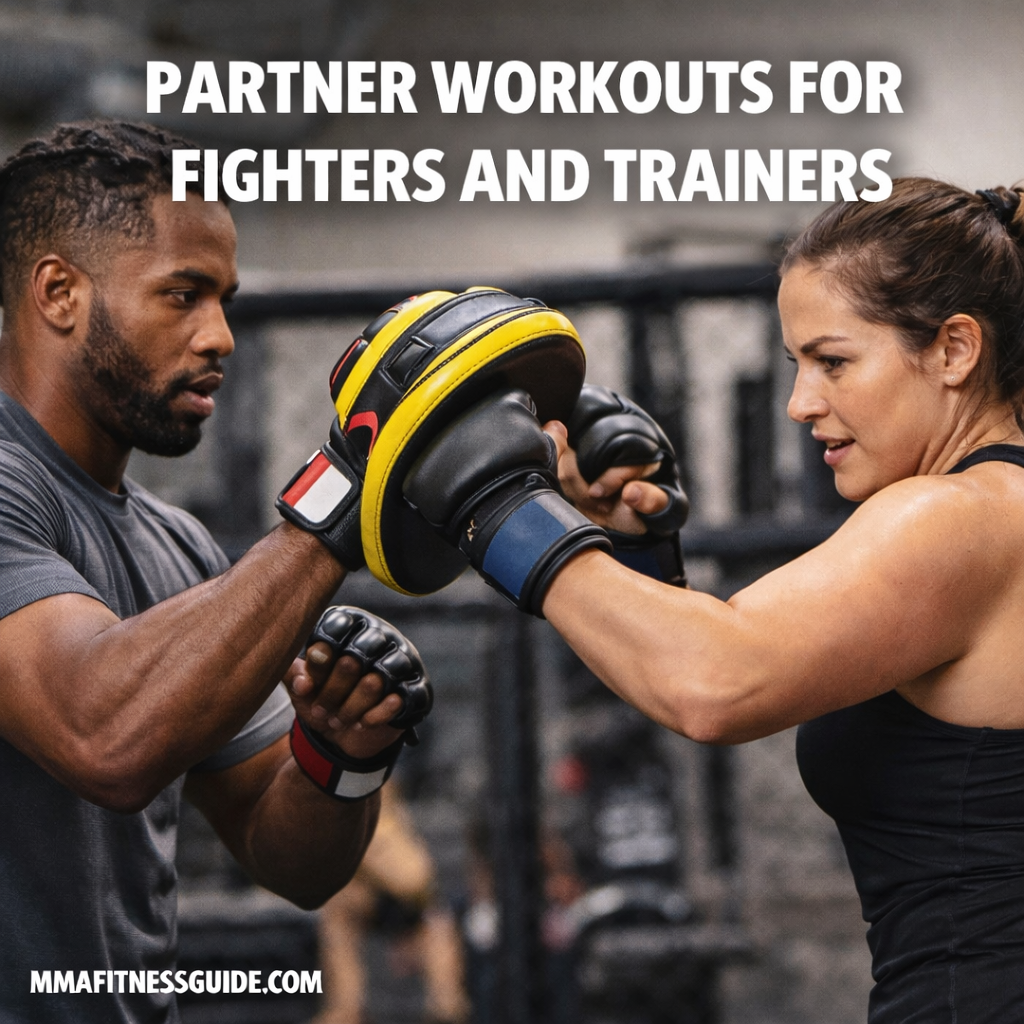
Pad work remains one of the most effective partner drills in MMA.
Benefits include:
- Timing and accuracy development
- Cardiovascular conditioning
- Fight-specific movement patterns
- Coach-led corrections in real time
Rotate roles frequently to maintain intensity and learning.
Defensive Reaction Drills
These drills sharpen awareness and movement.
Examples include:
- Slip-and-counter drills
- Check-and-return combinations
- Controlled distance management
Focus on clean execution rather than speed early on.
Grappling and Clinch Partner Drills
Position-Based Grappling
Starting from specific positions builds situational mastery.
Common positions include:
- Clinch against the cage
- Half guard or side control
- Takedown entries and defense
Short rounds with high focus are more effective than long, unfocused rolling.
Grip and Control Drills
Grip strength and control are essential in MMA.
Partner drills can include:
- Pummeling variations
- Hand fighting sequences
- Clinch resistance drills
These improve endurance while reinforcing technique.
Conditioning Partner Workouts
Partner Circuits
Conditioning circuits become more engaging with a partner.
Examples:
- Alternating sled pushes or carries
- Medicine ball throws and slams
- Partner-resisted sprints or sprawls
One works while the other rests, maintaining intensity.
Push-and-Pull Resistance Drills
Resistance-based drills build functional strength.
Benefits include:
- Core stability development
- Explosive power
- Grip and posture endurance
These drills mimic the physical demands of live exchanges.
Coach–Athlete Partner Training
Trainers can actively participate to guide effort and technique.
Benefits of coach involvement:
- Real-time correction
- Controlled intensity
- Enhanced athlete trust
- Improved communication
Coach-led partner work also sets the tone for professionalism and effort.
Structuring Effective Partner Sessions
A balanced partner workout follows a clear structure.
Effective sessions include:
- Warm-up and mobility together
- Technical partner drills
- Conditioning-based partner work
- Cool-down and feedback
Structure keeps sessions productive and focused.
Common Mistakes in Partner Training
Avoiding common errors improves outcomes.
Mistakes to watch for:
- Turning every drill into a competition
- Ignoring fatigue-related breakdowns
- Poor partner matching
- Lack of coaching oversight
- Skipping recovery considerations
Partner training should challenge, not injure.
Using Partner Workouts for Mental Conditioning
Beyond physical benefits, partner training builds mental toughness.
Mental gains include:
- Composure under pressure
- Emotional regulation during fatigue
- Trust and teamwork development
- Confidence in chaotic situations
These qualities transfer directly to fight performance.
Adapting Partner Workouts for Different Levels
Not all fighters train the same way.
Adaptations may include:
- Reduced intensity for beginners
- Controlled rounds for technical focus
- Increased resistance for advanced fighters
- Clear communication for mixed-level sessions
Customization keeps training effective and inclusive.
Final Thoughts
Partner workouts are one of the most powerful tools in MMA training. When structured with intention, safety, and progression, they develop skills, conditioning, and mental resilience that solo training cannot replicate.
For fighters and trainers alike, partner training transforms effort into fight-ready performance.