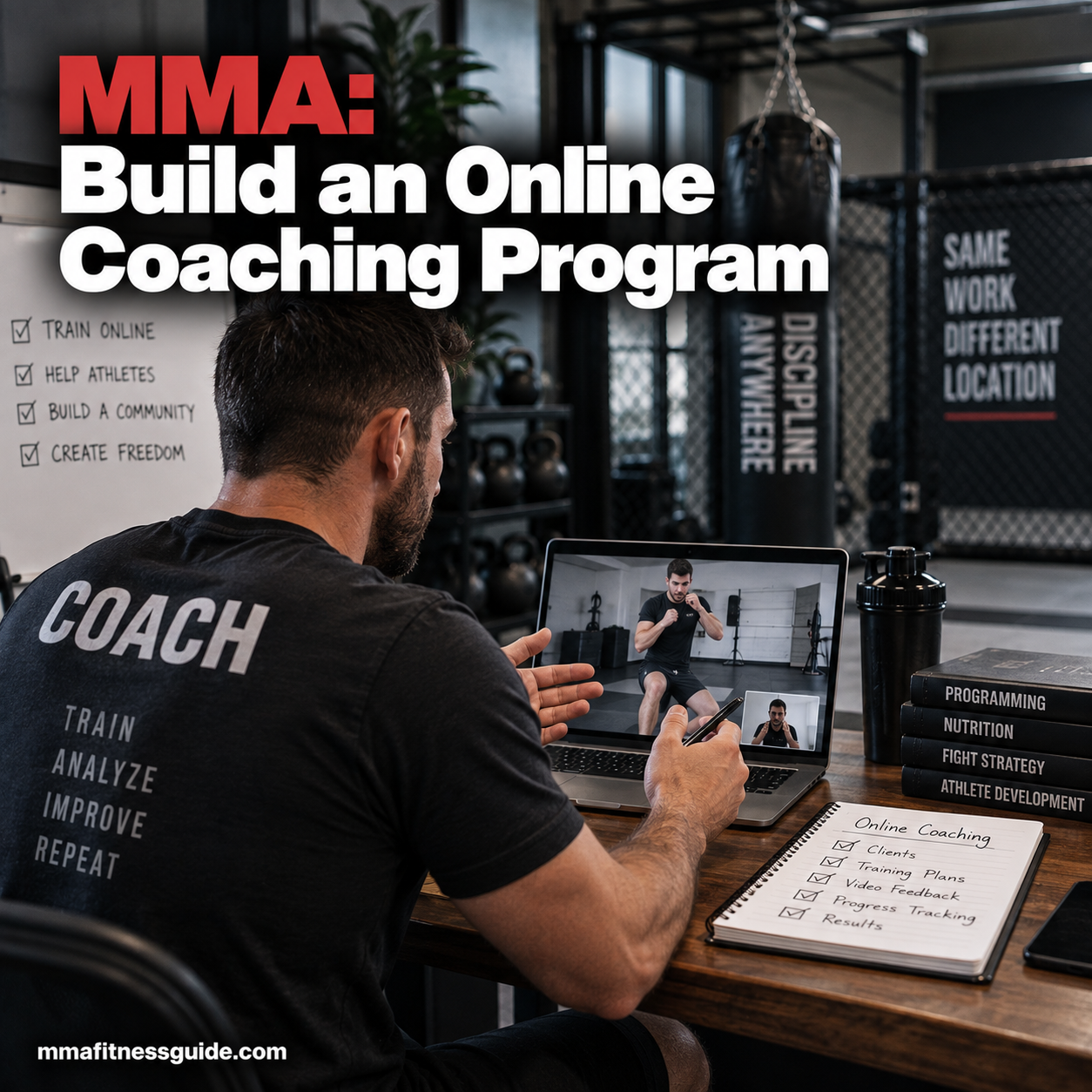
An MMA coach who normally works with 20 or 30 athletes at a local gym can use online coaching to work with clients in other cities, states, or countries. Training plans can be delivered digitally, technique videos can be reviewed remotely, and progress can be discussed through scheduled check-ins.
That opens several possibilities. A strength and conditioning coach could sell monthly fight-camp programming. A striking coach could provide video analysis to amateur fighters. A retired competitor could build a beginner MMA fitness program around lessons learned during years of training.
The challenge is turning that knowledge into a service athletes can actually follow. That means deciding who the program is for, what clients receive, how progress is measured, how feedback works, and how much personal access is included.
Why Online Coaching Works for MMA Professionals
Many parts of combat-sports coaching can be delivered or supported remotely.
Conditioning programs, mobility work, training schedules, recovery guidance, video analysis, and progress tracking don’t always require the coach and athlete to be in the same room.
Online coaching can give MMA professionals:
- Access to clients outside their local area
- Recurring revenue through monthly programs
- More control over coaching hours
- A way to continue coaching while traveling or competing
- Less dependence on physically demonstrating every session
- Additional income alongside gym or private coaching
It won’t replace hands-on coaching for every aspect of MMA. Sparring, live grappling, pad work, and certain technical corrections still benefit heavily from in-person instruction.
The opportunity is to identify the parts of your expertise that translate well to remote coaching and package them accordingly.
Defining Your Coaching Niche
“Online MMA coaching” is broad. A prospective client should be able to quickly understand exactly what problem your program addresses.
Possible niches include:
- Beginner MMA fitness and conditioning
- Fight-camp strength and conditioning
- Mobility and recovery for combat athletes
- Striking fundamentals and video analysis
- Grappling-focused supplementary training
- General strength programs for martial artists
- Competition preparation and training organization
The narrower the initial offer, the easier it becomes to explain who should join.
For example, “12-week conditioning for amateur MMA fighters preparing for competition” communicates far more than simply advertising “online MMA coaching.”
Be cautious with services such as nutrition, weight cutting, rehabilitation, and mental-health support. Depending on what you’re providing and where your clients live, these areas may require qualifications or licensed professionals.
Structuring Your Online MMA Program
Before selling the program, decide exactly what happens after someone joins.
A basic coaching system might include:
- An initial questionnaire or consultation
- A weekly training schedule
- Exercise or technique demonstrations
- Progress tracking
- Scheduled check-ins
- Video feedback
- Direct messaging within defined hours
- Monthly program adjustments
The amount of personal support should match the type of service you’re selling.
A lower-cost membership might provide standardized programming and a training library. Higher-priced coaching could include individualized plans, regular video reviews, and one-on-one calls.
Make these differences clear so clients understand what they’re paying for.
Creating High-Quality Training Content
Training videos should help athletes perform the exercise or drill correctly without requiring additional explanation.
For each demonstration, show the movement clearly and explain the coaching cues that matter.
Useful content can include:
- Exercise demonstrations
- Technical breakdowns
- Common mistakes
- Progressions for developing athletes
- Regressions when appropriate
- Sets, repetitions, and rest periods
- Equipment requirements
- Recovery instructions
Production quality matters, but clarity matters more.
Record in a well-lit area where the athlete can see your entire movement. Use clear audio, remove distracting background noise, and keep demonstrations focused on the lesson.
A two-minute video that clearly explains a drill is often more useful than a 15-minute video filled with unnecessary commentary.
Choosing the Right Coaching Platform
Choose your technology based on how clients will actually use the program.
Your system may need to handle:
- Training-plan delivery
- Exercise videos
- Progress tracking
- Payments
- Client messaging
- Check-ins
- Scheduling
- Community discussions
A coach offering personalized conditioning may benefit from a dedicated coaching app with workout tracking. Someone selling a technique library may prefer a membership website with organized video lessons.
You can also combine tools—for example, a website for payments and onboarding, a coaching app for programming, and video calls for monthly reviews.
Avoid adding software simply because it offers more features. Every additional login or app creates another step for the client.
Pricing Your Online Coaching Program
Pricing should reflect how much individual attention each client receives.
For example, you could offer:
Self-Guided Membership: Access to training plans, instructional videos, and educational resources.
Group Coaching: Programming plus group calls, community access, or scheduled Q&A sessions.
Individual Coaching: Personalized programming, regular check-ins, video reviews, and direct feedback.
Before setting a price, calculate how much time each client requires.
If a $50 monthly client requires several hours of individualized programming, messaging, and video analysis, the service may quickly become difficult to sustain.
Your pricing and service boundaries need to work together.
Attracting Your First Clients
Your first online clients may already be people who know your coaching.
Current students, former training partners, amateur fighters, gym contacts, and social media followers have already seen some evidence of your experience.
Give them a clear reason to consider the program.
Instead of repeatedly posting “online coaching available,” demonstrate what the service provides.
You might publish:
- A conditioning breakdown for MMA rounds
- A video explaining a common training mistake
- A sample training week
- A fighter’s measurable progress
- A behind-the-scenes look at program design
- Answers to questions athletes frequently ask
You can also open a small beta group and use their feedback to improve onboarding, programming, communication, and delivery before promoting the service more widely.
Retention and Long-Term Success
Signing up a client is only the beginning. They need to understand whether they’re progressing.
Depending on the program, you might track:
- Strength improvements
- Conditioning benchmarks
- Training consistency
- Mobility
- Session completion
- Recovery
- Technical goals
Regular check-ins also give clients a chance to explain what isn’t working.
If an athlete consistently misses Thursday’s conditioning session because of evening BJJ practice, changing the schedule may be more useful than repeatedly reminding them to complete the workout.
Good remote coaching still requires individual attention where the service promises it.
Legal, Safety, and Professional Considerations
Remote coaching creates responsibilities that should be addressed before taking clients.
Depending on your service and location, consider:
- Client agreements
- Informed consent
- Liability waivers
- Health and readiness screening
- Professional liability insurance
- Privacy and data handling
- Cancellation and refund policies
- Scope-of-practice limitations
Programming should also account for the limitations of remote coaching. You may not be able to observe every repetition, assess an injury, or know whether an athlete is accurately reporting symptoms.
Establish clear situations where a client should stop training and seek appropriate medical or other professional guidance.
For business-specific legal, insurance, or tax requirements, consult qualified professionals in your jurisdiction rather than relying solely on generic online templates.
Scaling Beyond One-on-One Coaching
Individual coaching has a natural capacity limit. If every client requires customized programming and several conversations each week, eventually your calendar becomes the bottleneck.
Once you’ve developed a system that produces consistent results, parts of it may be suitable for a less individualized format.
Options include:
- Group coaching programs
- Training memberships
- Beginner courses
- Technique libraries
- Conditioning programs
- Fight-camp templates
- Workshops and live online sessions
- Programs licensed to gyms
You don’t have to eliminate personalized coaching. Instead, you can reserve it for clients who need more support while offering structured programs to people who don’t.
Common Mistakes to Avoid
Online coaching can become unnecessarily complicated when coaches try to build everything at once.
Watch for problems such as:
- Targeting every type of athlete
- Providing more individual access than the price supports
- Uploading large amounts of poorly organized content
- Failing to define response times
- Using too many apps and platforms
- Starting clients without a clear onboarding process
- Making promises outside your professional scope
- Selling aggressively before proving the program works
Start with a specific client, a specific problem, and a clearly defined coaching process.
Improve the system as real clients use it.
Final Thoughts
An online MMA coaching business starts with a simple question: what part of your coaching can deliver useful results when the athlete isn’t standing in front of you?
For one coach, that might be fight conditioning. For another, it could be mobility programming, beginner fitness, technical video analysis, or structured accountability between gym sessions.
Build the first version around that strength. Define what clients receive, establish communication boundaries, track progress, and improve the program based on actual coaching experience.
If the system works for a small group of clients, you then have something worth expanding.