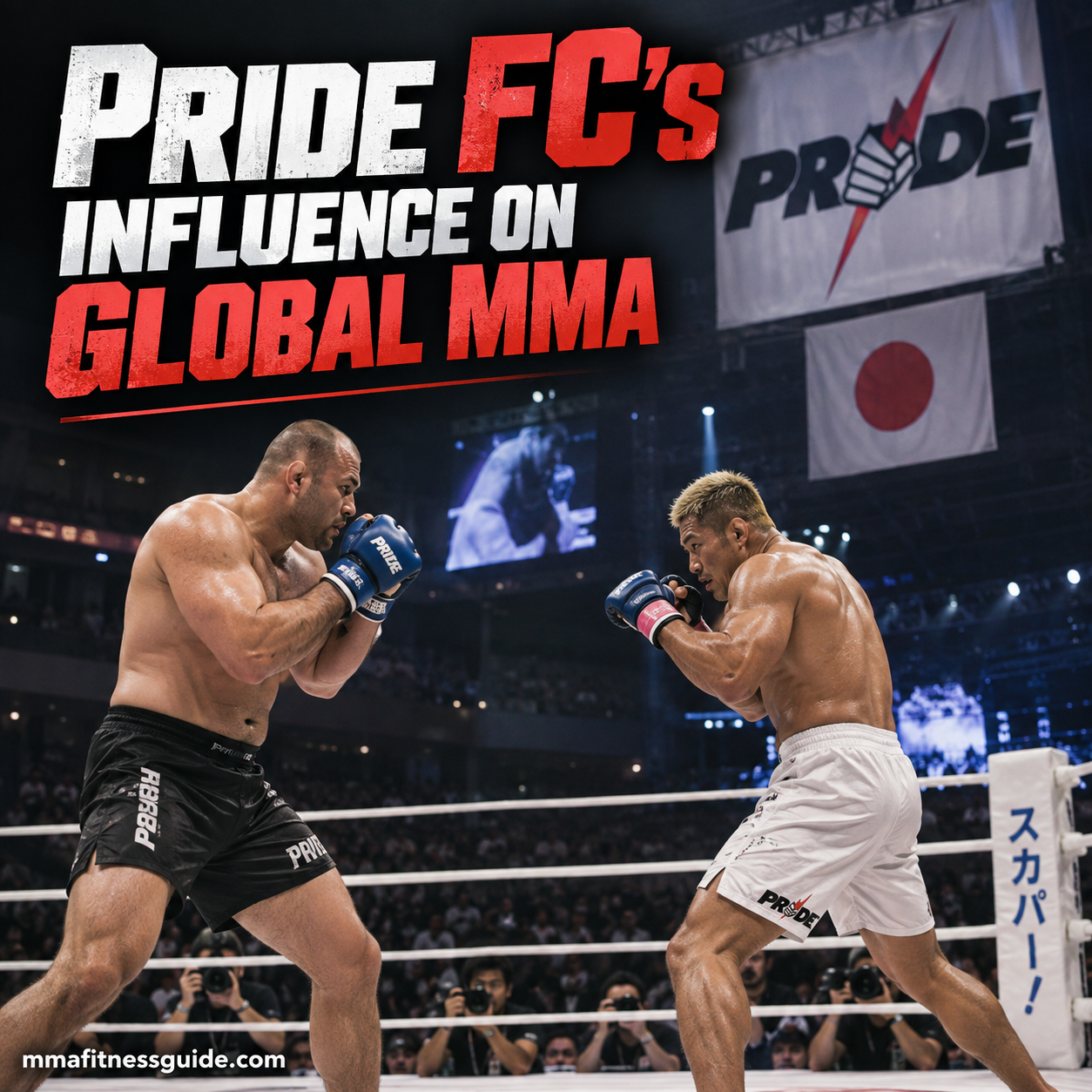
Before the UFC became the global powerhouse it is today, tens of thousands of fans were packing Japanese arenas to watch Fedor Emelianenko, Wanderlei Silva, Mirko “Cro Cop” Filipović, and other legends fight under a rule set unlike anything most modern MMA fans see today. Pride Fighting Championships combined elite competition with soccer kicks, grounded knees, elaborate entrances, and an atmosphere that made major events feel larger than life.
From the techniques fighters developed under its aggressive rules to the international stars it introduced to millions of fans, Pride left fingerprints across modern MMA. Its influence can still be seen in fighting styles, matchmaking, event production, and promotions around the world more than two decades after its peak.
Why Pride FC Was So Important
Pride wasn’t merely a competition; it was a spectacle. With sold-out arenas of 40,000–90,000 spectators, theatrical walkouts, and elite matchmaking, Pride elevated MMA into something mythic.
Its influence lives on because Pride:
- Pushed MMA toward a more global audience
- Created some of the sport’s biggest legends
- Introduced iconic rules and fighting styles
- Encouraged aggression, creativity, and finishing
- Set the stage for organizations worldwide
The Pride era set a standard that shaped the modern identity of MMA.
The Signature Pride Rules That Shaped a Generation
Pride’s rule set encouraged action — and often chaos. Many of these elements influenced MMA technique and strategy today.
Soccer Kicks and Stomps
These techniques forced fighters to develop better scrambling, positional awareness, and ability to finish aggressively.
Knees to a Grounded Opponent
This changed grappling dynamics drastically and made stalling positions dangerous.
Ring Instead of Cage
Fighting in a ring emphasized movement, angles, and stand-ups, shaping the strategies of many legendary fighters.
Yellow Cards for Stalling
Pride punished inactivity, encouraging relentless pace and aggression.
These rules made Pride fights uniquely dynamic and forced fighters to evolve in ways that still influence modern athletes.
Legendary Fighters That Defined Pride FC
Pride built a roster that reads like a Hall of Fame list. Their styles, rivalries, and highlight moments helped cement MMA as a global sport.
Fedor Emelianenko
The most iconic heavyweight in MMA history. His calm demeanor and explosive bursts defined the Pride aesthetic.
Wanderlei Silva
“The Axe Murderer.” Ferocious Muay Thai, lethal knees, and unmatched aggression.
Mirko “Cro Cop” Filipović
The left high kick that ended careers. His striking precision became the stuff of legend.
Shogun Rua
The blueprint of modern MMA striking — fluid, aggressive, and technical.
Antonio Rodrigo Nogueira
A pioneer of high-level BJJ in MMA, famous for impossible comebacks.
Rampage Jackson
Power slams, raw strength, and unforgettable rivalries.
These fighters shaped how the world understood MMA technique, personality, and storytelling.
Pride’s Contribution to Global MMA Style and Technique
More Aggressive Striking
The rules encouraged dynamic offense — especially knees, kicks, and combinations from unusual angles.
Evolving Grappling Under Pressure
Because knees and stomps were allowed, grapplers developed safer transitions and tighter control.
Ring Awareness
Movement and angles became crucial, influencing modern footwork patterns.
The Birth of the “Complete Fighter”
Pride athletes often cross-trained earlier than their U.S. counterparts, accelerating MMA’s evolution.
Production and Showmanship: The Pride Atmosphere
One of Pride’s greatest influences was its showmanship.
- Dramatic entrances
- The iconic deep-voiced announcer, Lenne Hardt
- Grand-scale events in stadiums
- Pyrotechnics and theatrical walkouts
- Dream-like camera angles and lighting
Pride treated MMA as a warrior spectacle, creating emotional investment and unforgettable moments. Many promotions today — including Rizin and ONE Championship — still emulate this aesthetic.
How Pride FC Helped Globalize MMA
1. International Talent Showcases
Pride pulled fighters from Brazil, Europe, Japan, the U.S., and Russia long before the UFC expanded globally.
2. Cross-Promotion Superfights
Pride fighters clashed with UFC fighters in legendary showdowns at Pride Shockwave and other events.
3. Broadcasting Reach
Pride’s events aired in Japan, Europe, Brazil, and the U.S. — spreading MMA beyond niche circles.
4. Inspiring New Generations
Many of today’s fighters grew up watching Pride icons like Cro Cop, Fedor, and Shogun.
Pride laid the groundwork for MMA’s global explosion.
What Modern MMA Still Takes from Pride
Even though Pride FC closed in 2007, its spirit and innovations continue to shape the sport.
- Aggressive, finish-oriented matchmaking
- Modern striking styles influenced by Pride legends
- Global talent scouting
- Tournament formats
- Production elements adopted by other promotions
Pride will always represent an era where creativity, courage, and chaos defined MMA.
Final Thoughts: The Legacy of Pride FC
Pride wasn’t perfect — but it was foundational. It created icons, shaped technical evolution, influenced worldwide promotions, and injected personality into MMA like no organization before it.
For fans and fighters alike, Pride FC remains a legendary chapter in MMA history — one that continues to inspire the sport’s identity today.