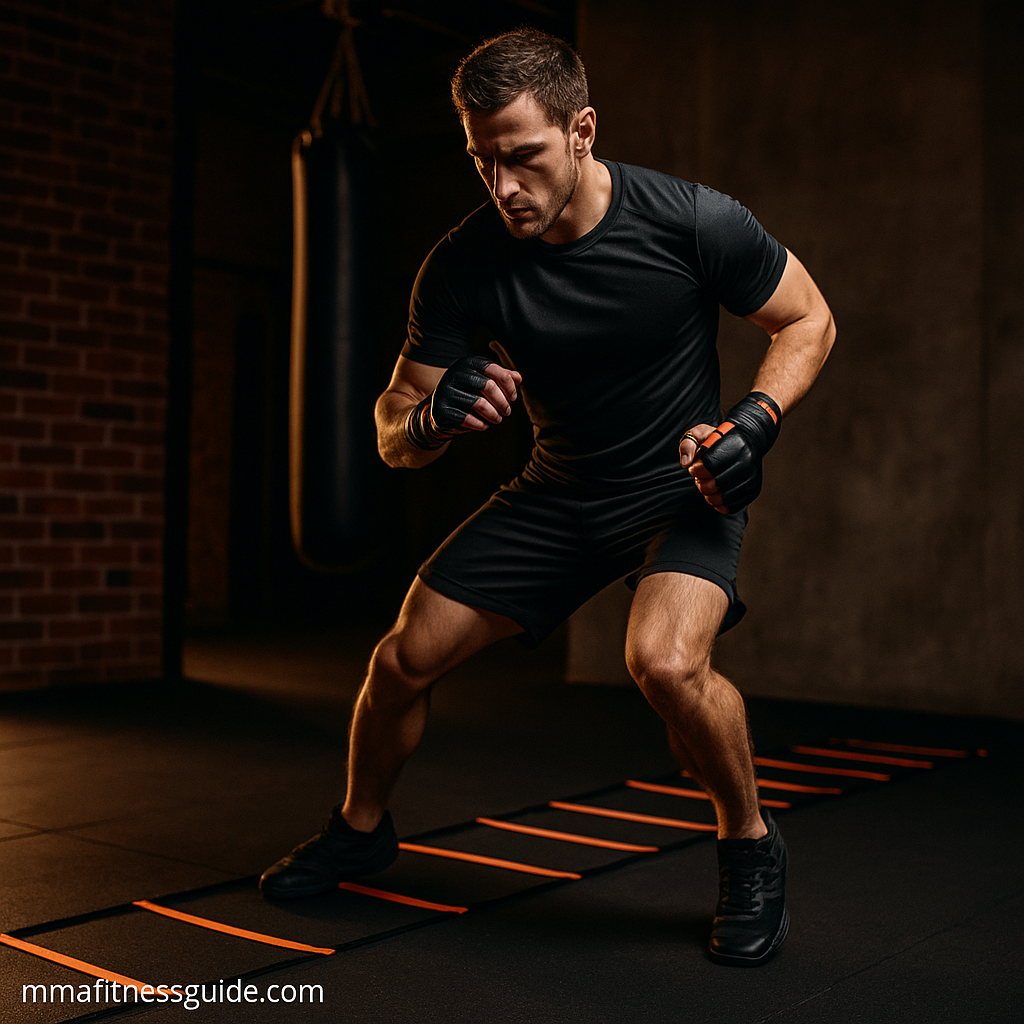
The Foundation of Fluid Movement
Power means nothing if you can’t move efficiently.
In MMA, agility and footwork separate great fighters from good ones. It’s how you stay balanced, create openings, evade attacks, and control distance.
Footwork isn’t just about speed — it’s about timing, precision, and rhythm. A fighter who moves well dictates the pace of the fight.
Whether you’re a beginner or a seasoned amateur, these drills will help you develop explosive agility and fight-ready movement.
Why Footwork Matters in MMA
Good footwork lets you:
- Control distance: Stay just outside your opponent’s range, then close in fast.
- Maintain balance: Throw combinations without overextending.
- Improve defense: Slip and pivot out of danger.
- Enhance reaction time: Move faster than your opponent can adjust.
From Anderson Silva’s fluid evasion to Dominick Cruz’s unpredictable angles, the best fighters all share one trait — mastery of movement.
The Core Principles of MMA Footwork
- Stay Light on Your Feet
Always move on the balls of your feet, not your heels. It allows quicker reaction and better balance. - Maintain Your Stance
Whether orthodox or southpaw, never cross your feet or over-rotate your hips. Stay ready to strike or defend instantly. - Small Steps, Big Control
Footwork is about precision, not flash. Short, sharp steps keep you stable while changing position efficiently. - Keep Hips and Shoulders Aligned
Your movement should support your strikes — avoid twisting off balance.
1. Agility Ladder Drills
Goal: Improve coordination, balance, and rhythm.
How to do it:
- Lay an agility ladder flat on the gym floor.
- Start with “one foot per square” for basic movement.
- Progress to side steps, in-and-outs, and crossover steps.
- Keep knees slightly bent and posture upright.
Pro tip: Focus on clean technique, not just speed.
2. Cone Step Drills
Goal: Sharpen direction changes and control.
Setup:
- Place 5–6 cones in a zigzag or diamond shape.
How to do it:
- Move around cones using shuffles, pivots, or feints.
- Visualize an opponent — each cone represents a strike or entry angle.
Why it works:
This simulates real movement patterns in striking and cage control.
3. Shadow Footwork Rounds
Goal: Integrate footwork into fighting rhythm.
How to do it:
- Set a timer for 3 minutes.
- Move in all directions while shadowboxing.
- Add pivots, stance switches, and angle changes.
- Keep your hands up and strikes light.
Focus on: Staying balanced after every combination.
4. Reaction Step Drill
Goal: Train responsiveness and reaction speed.
How to do it:
- Have a partner point in random directions.
- Step, pivot, or shuffle toward that direction quickly.
- Add slips, level changes, or defensive moves for realism.
This builds fight IQ — reacting without hesitation.
5. Jump Rope (The Classic Fighter’s Tool)
Goal: Build rhythm, endurance, and coordination.
How to do it:
- Jump lightly for 2–3 minutes per round.
- Mix in side-to-side hops, high knees, and double unders.
- Keep posture tall and land softly.
Why it works:
Rope work develops not just cardio — it fine-tunes your foot rhythm, balance, and timing.
6. Lateral Shuffle Drill
Goal: Strengthen movement across angles.
How to do it:
- Set two cones about 10 feet apart.
- Shuffle side-to-side for 30 seconds per set.
- Stay low, controlled, and light on your feet.
This builds the side-to-side explosiveness crucial for evasion and cage movement.
7. Pivot and Circle Drill
Goal: Develop smooth rotation and ring control.
How to do it:
- Place a marker on the floor to represent your lead foot.
- Practice pivoting around it, circling left and right.
- Combine pivots with light jabs or feints.
This is how you cut angles like a pro.
Bonus: Balance and Stability Work
Add balance exercises 2–3 times a week:
- Single-leg holds (30–45 seconds)
- Bosu ball squats
- Stability ball core work
A stable base means stronger movement and less injury risk.
Common Mistakes to Avoid
- Overreaching: Big steps ruin balance.
- Flat-footed movement: Slows reactions and power output.
- No rhythm: Movement should flow, not stutter.
- Ignoring defense: Good footwork always prepares for counters.
Weekly Footwork Routine Example
Day 1: Ladder + Cone drills (30 min)
Day 2: Shadow footwork + Reaction steps (20 min)
Day 3: Jump rope + Pivot drill (25 min)
Repeat 3–4 times a week for noticeable improvement.
Key Takeaways
- Agility and footwork give fighters control, speed, and balance.
- Short, sharp, controlled steps create efficient movement.
- Combine ladder, cone, and shadow drills to build full-body coordination.
- Consistency builds muscle memory — make movement a habit.
As Dominick Cruz once said,
“Footwork isn’t running — it’s how you set traps.”
Master your movement, and you’ll master the fight.