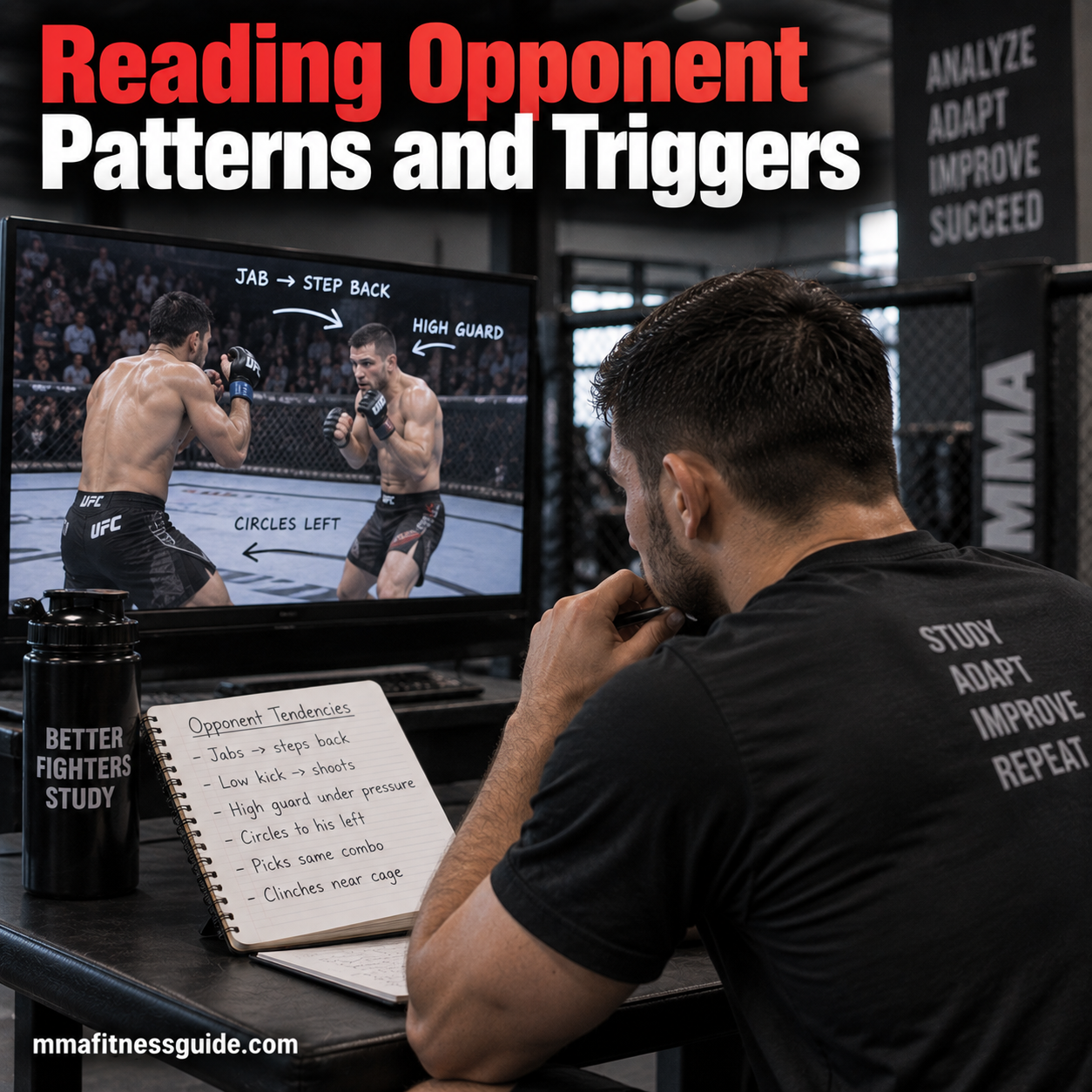
An opponent jabs, takes a half-step backward, and circles to their left. A few exchanges later, they do it again. Instead of simply following them, you anticipate the exit and place your next attack where they are about to move.
That is pattern recognition in a fight.
Fighters constantly reveal information through their footwork, combinations, defensive reactions, takedown attempts, and responses to pressure. Some habits appear repeatedly, while others are triggered by a specific action—such as reaching for a parry whenever they see a jab or immediately changing levels after being hit.
Learning to notice these behaviors gives you a clearer idea of what may happen next and helps you choose attacks based on observed reactions rather than guesswork.
What Are Patterns and Triggers in Fighting?
A pattern is a behavior that appears repeatedly. A trigger is an action or situation that produces a particular response.
For example, an opponent might:
- Step backward after nearly every jab
- Drop the lead hand before throwing a cross
- Shoot for a takedown after absorbing a hard combination
- Clinch when their back approaches the cage
- Reach down whenever you feint a body attack
- Circle in the same direction after exchanging
One occurrence may mean very little. When the same reaction appears several times under similar circumstances, it becomes information you can test.
Why Pattern Recognition Changes an Exchange
Pure reaction requires you to recognize an attack, process it, and respond after the movement has already started.
Recognizing a repeated sequence gives you another option: prepare for what is likely to follow.
That can help you:
- Position yourself before an attack develops
- Prepare counters earlier
- Spend less energy chasing unnecessary movement
- Control distance more deliberately
- Recognize safer moments to attack
- Avoid repeatedly falling for the same setup
The objective isn’t to predict everything your opponent does. It’s to narrow the possibilities using information they have already shown you.
Where Fighting Patterns Come From
Habits often become easier to see when a fighter has less time to think.
Pay attention when an opponent is:
- Fatigued
- Pressured toward the cage
- Hit cleanly
- Forced to defend consecutive takedowns
- Scrambling from a poor position
- Recovering after a missed attack
A fighter may have several defensive options during technical drilling but repeatedly choose the same one when pressured.
That repeated choice is worth remembering.
Reading Patterns in Striking Exchanges
Watch the Feet
Footwork can reveal where an opponent prefers to escape.
Look for:
- Circling predominantly in one direction
- Retreating straight backward under combinations
- Pivoting to the same side after punching
- Resetting the feet before throwing power shots
- Stepping heavily onto the lead leg before attacking
If an opponent consistently exits in one direction, you can begin positioning yourself to limit that escape instead of following them afterward.
Track Combination Habits
Most fighters have combinations they trust.
Instead of concentrating only on the first punch, watch how the entire sequence develops.
You might notice an opponent:
- Finishes combinations with the same hook
- Throws a cross whenever the jab lands
- Attacks the body after a double jab
- Pauses after three punches
- Exits in the same direction after a flurry
Once you recognize the sequence, you can prepare for a specific point within it rather than trying to counter randomly.
Recognizing Defensive Triggers
Defense can reveal some of the clearest habits because reactions often happen automatically.
An opponent might:
- Shell up when pressured
- Pull their head straight backward from punches
- Duck toward the same side
- Reach aggressively to parry the jab
- Raise both hands when you attack the body
- Retreat whenever you step into punching range
These reactions can be tested.
For example, if a jab feint repeatedly causes an opponent to reach with their rear hand, you may be able to feint the jab and attack the opening created by the parry.
Reading Grappling and Scramble Patterns
Grappling exchanges also produce repeated reactions.
Watch how an opponent responds when their preferred technique is stopped.
Useful details include:
- Which leg they attack first
- Which direction they turn during escapes
- Whether they immediately switch to another takedown
- Which grips they repeatedly seek
- Which arm they use to post
- How they react after a failed shot
Suppose an opponent repeatedly turns toward the same side when escaping bottom position. Recognizing that direction can help you prepare your control before the movement begins.
Reading Cage and Clinch Behavior
The cage reduces available movement, which can make habits easier to identify.
An opponent pressured toward the fence might:
- Immediately reach for an underhook
- Turn toward the same side
- Drop their hips and wait for a takedown
- Clinch rather than continue striking
- Push aggressively off the cage
- Attempt the same escape whenever space opens
Instead of treating every cage exchange as a new situation, track which responses keep appearing.
Use Feints to Test Reactions
A feint can function as a question.
Show an opponent something without fully committing and watch what they do.
For example:
Jab feint → opponent reaches to parry
Repeat it later.
Jab feint → opponent reaches again
Now you have evidence of a possible trigger.
Other useful tests include:
- Level-change feints
- Shoulder feints
- Hip movements suggesting a kick
- Small forward steps
- Body-shot feints
- Takedown-entry feints
The reaction matters more than how convincing the feint looks in isolation.
Gather Information Without Overcommitting
You don’t have to throw full-power combinations to learn how an opponent reacts.
Early exchanges can include:
- Light jabs
- Range-finding kicks
- Small feints
- Controlled entries
- Short clinch engagements
- Footwork changes
Watch what happens after each action.
Does the opponent retreat? Counter? Change levels? Shell up? Circle?
Those responses gradually build a picture of their preferred decisions.
Confirm a Pattern Before Exploiting It
Seeing something once doesn’t make it a reliable pattern.
An opponent may have moved a certain way because of cage position, balance, fatigue, or the specific attack you used.
Look for repetition.
A useful process is:
Observe → Test → Confirm → Exploit
Notice the behavior, recreate a similar situation, see whether the response repeats, and then decide whether there is an opening worth attacking.
This reduces the chance of committing heavily to a read that was never actually there.
Expect the Opponent to Adjust
Once you punish a habit, the opponent may stop using it.
Suppose they repeatedly pull backward from your jab and you eventually catch them with a follow-up cross. The next time you jab, they may slip, block, or counter instead.
Continue collecting information rather than assuming the original pattern will remain.
Stay alert for:
- Changes in defensive reactions
- Different escape directions
- New counterattacks
- Altered timing
- Deliberate attempts to bait your previous counter
Pattern recognition is an ongoing process throughout the fight.
Training Pattern Recognition in the Gym
Sparring becomes more useful for this skill when you enter a round with something specific to observe.
Try rounds where your goal is to identify:
- Your partner’s preferred exit
- Their reaction to jab feints
- Their first response to pressure
- Their favorite counter
- Their preferred takedown setup
- Their escape direction during grappling
Afterward, compare what you noticed with your partner or coach.
This turns sparring into both physical practice and information-gathering practice.
Using Video Study to Find Patterns
Video allows you to replay exchanges that happened too quickly to analyze in real time.
When reviewing footage, avoid watching only for dramatic moments.
Instead, track repeated details:
- What happens immediately before an attack?
- Which direction does the fighter exit afterward?
- How do they respond when pressured?
- What causes them to shoot?
- Which defensive movement appears repeatedly?
- What changes as they become tired?
You can also study your own footage this way.
Finding your own predictable habits gives you an opportunity to correct them before an opponent takes advantage.
Common Pattern-Reading Mistakes
Pattern recognition becomes unreliable when you start seeing what you expect instead of what is actually happening.
Watch for:
- Treating a single reaction as a pattern
- Ignoring cage position or distance
- Forgetting that fatigue changes behavior
- Hunting one counter after the opponent adjusts
- Becoming predictable while trying to bait a reaction
- Assuming every feint will produce the same response
Keep updating your read as new information appears.
Staying Calm Enough to Notice Patterns
Observation becomes harder when every exchange feels urgent.
Instead of trying to force an opening immediately, pay attention to what your opponent gives you.
Notice where they move after combinations. Watch their guard when you feint. Remember which direction they scramble. Track what happens when you pressure them toward the cage.
Those small details accumulate.
Final Thoughts
A fighter who repeatedly circles left, reaches for the same parry, or turns the same direction during a scramble is giving away information.
The challenge is recognizing that information without assuming too much from a single exchange.
Observe the behavior, test it again, and adjust when the opponent changes. With enough practice, fighting begins to feel less like responding to isolated attacks and more like recognizing sequences as they develop.
The better you become at noticing those sequences, the earlier you can position yourself for what comes next.