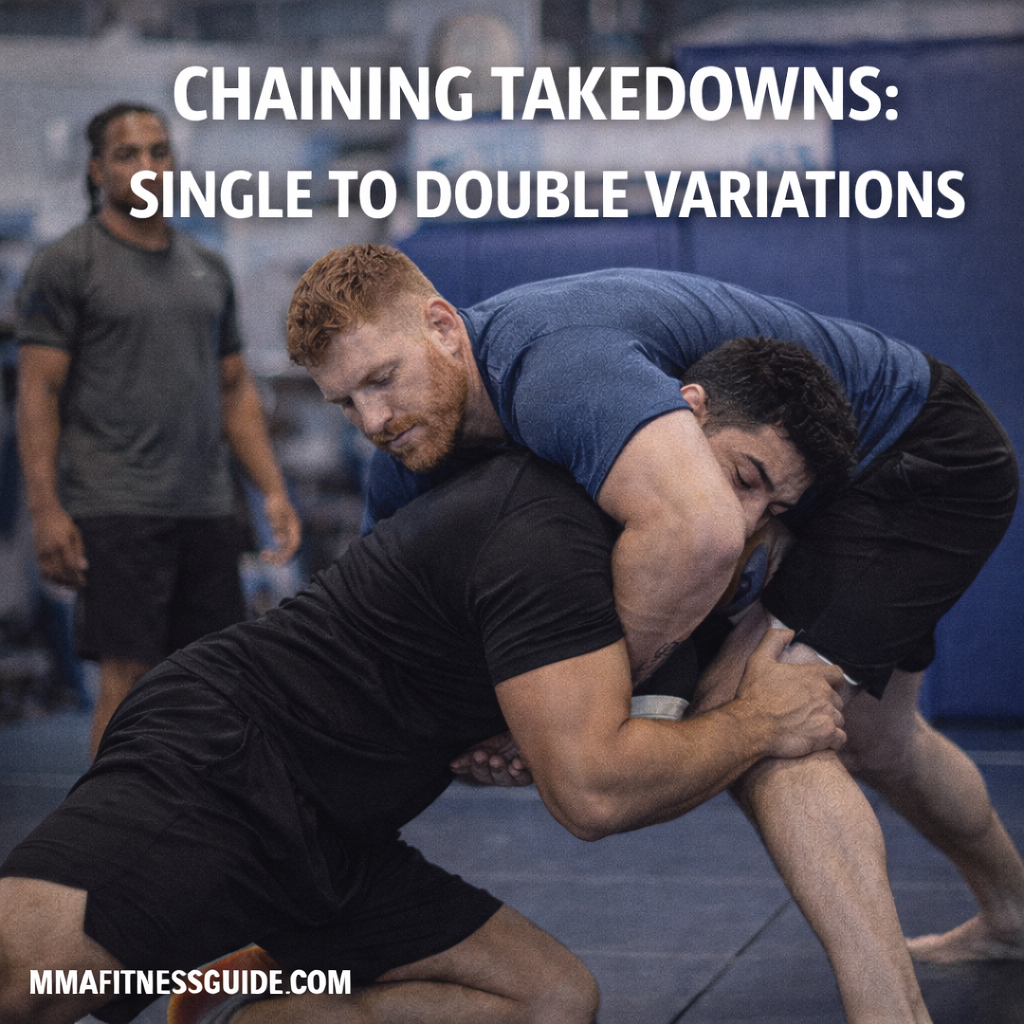
A fighter shoots for a single-leg, but the opponent widens their base, hops away, or starts driving their hips back. Holding onto the original attack can turn a good entry into a stalled position. Switching to both legs while the opponent is adjusting can create a new finishing opportunity before their defense settles.
That is the purpose of chaining takedowns. The first attack forces a response; the next attack targets the position created by that response. A single-to-double transition is a common example because the opponent’s effort to protect one leg can change their balance, hip position, and stance.
Rather than treating a defended single as a failed shot, fighters can use it as the beginning of a sequence.
Why Chain Takedowns in MMA?
A skilled opponent rarely stays still after a takedown attempt begins. They may sprawl, frame, turn their hips, pull the targeted leg away, or use the cage to remain upright.
Chaining attacks allows the offensive fighter to respond to those adjustments.
It can help by:
- Forcing multiple defensive reactions
- Creating openings during transitions
- Reducing dependence on a perfect first entry
- Maintaining forward pressure
- Making the next attack harder to anticipate
The first shot does not always need to finish the takedown. Sometimes its job is to move the opponent into a position where the second attack has a better chance.
Single-Leg Takedowns as an Entry
A single-leg gives the attacker control over one side of the opponent’s base while leaving several possible follow-ups available.
Depending on the position, a fighter may be able to:
- Finish the single directly
- Run the pipe
- Elevate the leg
- Transition behind the opponent
- Drive them toward the cage
- Switch to a double-leg
The value of the position comes partly from those options.
If the opponent successfully protects the captured leg, the attacker does not necessarily need to keep fighting the same battle. Their defensive movement may expose both hips or bring the second leg within reach.
Common Single-Leg Defenses You’ll Encounter
Recognizing defensive reactions makes it easier to determine when to continue the single and when to change attacks.
Common responses include:
- Sprawling with hip pressure
- Hopping on the free leg
- Pushing or framing against the head
- Turning the captured knee outward
- Pulling the leg backward
- Using an underhook
- Posting against the cage
Each response changes the opponent’s balance or positioning.
Instead of automatically switching techniques, identify what the defense has actually made available.
Why the Single-to-Double Transition Can Work
Defending one leg often requires the opponent to redistribute their weight.
For example, someone hopping to protect a captured leg is temporarily relying heavily on the other leg for balance. An opponent pulling their leg free may square their hips as they recover.
Those moments can provide access to both legs.
Useful openings may appear when:
- The opponent shifts weight toward the free leg
- Their stance narrows during recovery
- Their hips become square
- They rise more upright
- Their second leg moves within reach
The transition works best when it responds to those positional changes rather than being forced regardless of the defense.
Core Single-to-Double Takedown Variations
The exact transition will vary with stance, head position, cage location, and the opponent’s reaction.
Outside Single to Double-Leg
An outside single can transition into a double when the opponent squares up or brings the far leg closer while defending.
A basic sequence may look like this:
- Enter on the outside single
- Secure control of the leg
- Observe the opponent’s defensive movement
- Change your level as the second leg becomes available
- Transfer your grip toward both legs
- Reposition your feet and head
- Drive or turn into the finish
Avoid reaching across for the second leg while remaining upright. The transition should include your hips and feet, not just your arms.
Inside Single to Double-Leg
An inside single can place the attacker in position to change attacks quickly when the opponent begins defending.
The sequence may involve:
- Securing the single-leg position
- Applying pressure to make the opponent respond
- Allowing the captured leg to return toward the floor when appropriate
- Changing levels underneath the defense
- Collecting both legs
- Continuing forward or turning the corner
Rather than abandoning the single randomly, use the opponent’s attempt to regain their stance as the cue for the transition.
High Single to Double Finish
Elevating a leg changes the opponent’s balance and often forces them to hop, post, or fight to return the foot to the floor.
If the opponent successfully lowers the leg, that recovery can become another entry.
A possible sequence is:
- Establish the high single
- Make the opponent balance on the support leg
- Follow their movement rather than standing still
- Allow or guide the captured leg downward
- Drop your level as they rebuild their stance
- Attack both legs before their base is fully restored
The double becomes a second attack created by the opponent’s attempt to escape the first.
Cage-Assisted Single-to-Double Transitions
The fence changes takedown mechanics because the opponent cannot continue retreating indefinitely.
Once their back reaches the cage, they may use it to remain upright while widening their stance and fighting for underhooks.
From there, the attacker can work between different threats rather than committing to a single finish.
Options may include:
- Single-leg finishes
- Double-leg attacks
- Body locks
- Trips
- Mat returns
- Clinch strikes
A single-to-double transition becomes available when the opponent squares their hips or plants both feet while trying to regain balance.
The cage does not finish the takedown automatically. Fighters still need good position, pressure, and awareness of the opponent’s frames and underhooks.
Head Position and Angle Control
Head position influences posture, pressure, and the ability to transition safely.
During single-to-double sequences, focus on:
- Keeping the head connected to the opponent rather than hanging away
- Maintaining strong posture
- Adjusting head position as the attack changes
- Moving the feet with the upper body
- Avoiding extended positions where the neck becomes vulnerable
Poor posture can make the attacker easier to frame away, strike, or threaten with front-headlock and guillotine attacks.
Your head, hips, hands, and feet should change position together.
Timing the Transition
Switching too early can abandon a single-leg that was close to succeeding. Switching too late can leave the fighter holding onto a position that is no longer productive.
Useful transition cues can include:
- The opponent begins hopping hard
- Their hips start squaring
- The far leg moves closer
- They push strongly against your head
- They begin recovering from a sprawl
- They plant both feet against the cage
Think of the defense as information.
When the opponent changes their position to solve one problem, look for the new problem that movement has created.
Striking Setups for Takedown Chains
Takedown chaining starts before contact with the legs.
Strikes and feints can alter stance, guard position, and weight distribution before the entry.
Possible setups include:
- Jab → level change
- Jab-cross → single-leg
- Overhand → level change
- Body punch → single-leg
- Level-change feint → punches → shot
- Cage pressure → single-leg entry
A fighter reacting to punches may stand taller, shell up, retreat toward the cage, or plant their feet to counter.
Those reactions can change the quality of the wrestling entry.
Where Takedown Chains Break Down
Takedown chains become inefficient when the fighter continues attacking a position that has already disappeared.
Watch for:
- Holding a stalled single-leg too long
- Reaching for the second leg without moving the feet
- Transitioning while standing upright
- Letting the head drift away from the opponent
- Pulling primarily with the arms
- Shooting repeatedly without rebuilding posture
- Changing attacks without reading the defense
Another common problem is treating chaining as a memorized sequence.
Single → double → single does not automatically work simply because the techniques are connected. Each transition should have a positional reason behind it.
Drills to Improve Single-to-Double Transitions
Training should gradually progress from predictable movements to reactions that require decisions.
Useful drills include:
- Single-to-double movement repetitions
- Partner resistance flow drills
- Single-leg finishing rounds
- Reaction-based sprawl drills
- Cage wrestling
- Situational wrestling from a captured leg
- Live rounds requiring multiple takedown attempts
During early repetitions, prioritize positioning and smooth transitions over speed.
Once the mechanics become consistent, increase resistance and allow the defender to choose different responses.
That forces the attacker to recognize when the double is actually available.
Applying Single-to-Double Chains in MMA
MMA adds striking, submissions, and the cage to wrestling exchanges.
A fighter pursuing a takedown must account for more than whether they can reach the legs.
During transitions:
- Maintain posture and defensive awareness
- Avoid leaving the neck unnecessarily exposed
- Watch for knees and short strikes
- Use cage pressure when positioning allows
- Avoid staying underneath a heavy sprawl without improving position
- Establish control after completing the takedown
Finishing the takedown is only part of the sequence.
Once the opponent reaches the mat, immediately consider how they are likely to stand, scramble, attack a submission, or use the cage.
Know When to Abandon the Chain
Not every takedown attempt should become a prolonged wrestling exchange.
If the opponent establishes dominant head position, strong underhooks, a threatening front headlock, or enough separation to strike cleanly, continuing to force the shot may become counterproductive.
Sometimes the better decision is to disengage, rebuild your stance, and create another entry.
Chaining attacks means moving between useful positions—not refusing to let go of a failed one.
Final Thoughts
A single-leg does not have to end with the opponent immediately hitting the mat.
They may hop, sprawl, square their hips, pull the leg free, or reach the cage. Each reaction changes the position, and those changes determine what should happen next.
When the far leg becomes available, the single can become a double. If the double stalls, another finish or positional transition may appear. If the position deteriorates, resetting may be the better choice.
That is what makes takedown chaining different from simply attempting techniques in sequence: the next attack comes from the opponent’s response to the one before it.
Train the reactions as carefully as the takedowns themselves, and the transition from single to double becomes part of a larger system rather than a memorized combination.