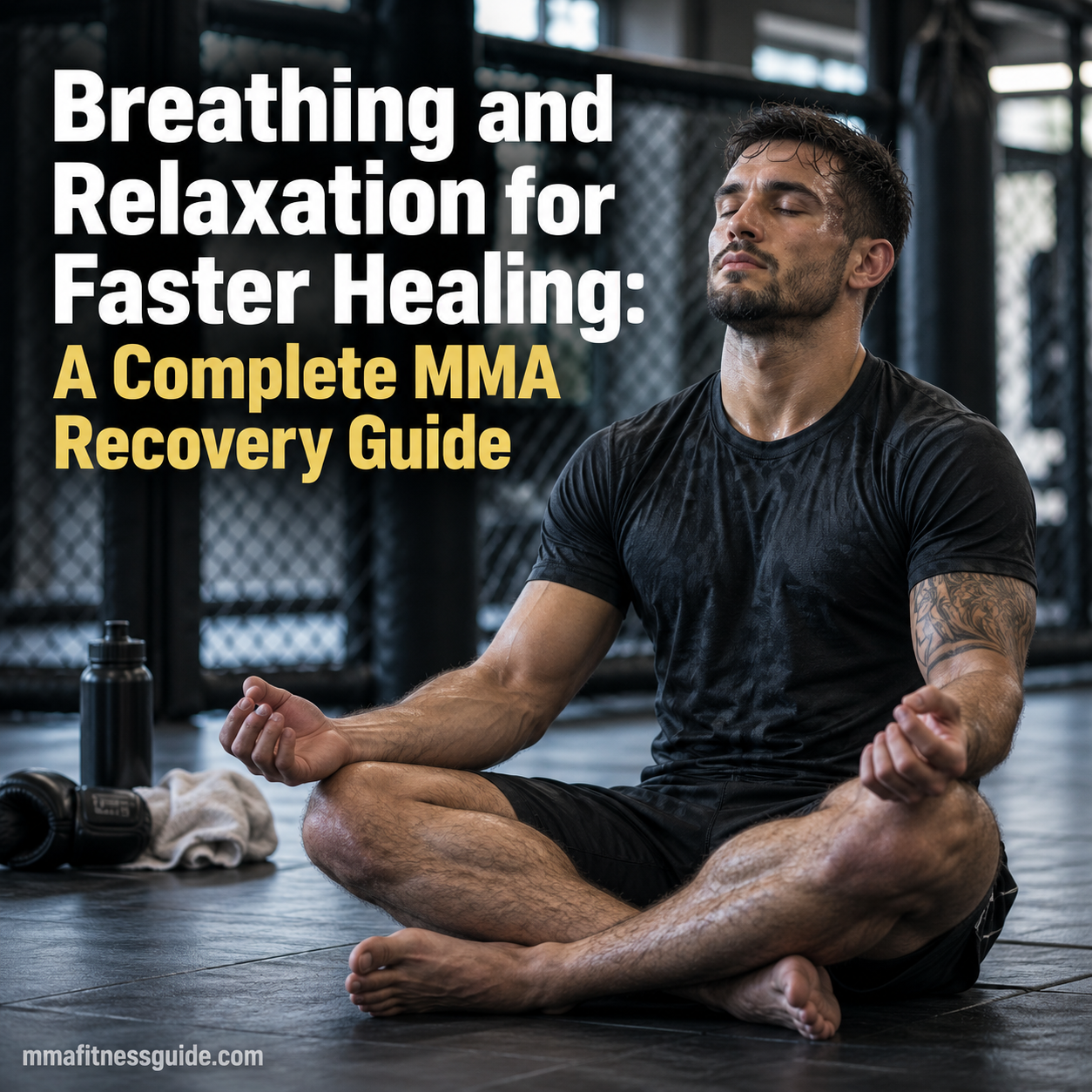
Recovery is not just about resting sore muscles or waiting for an injury to disappear. For MMA fighters, it also involves managing stress, improving sleep, controlling unnecessary muscle tension, and creating the conditions that allow the body to repair itself.
One of the simplest ways to support that process is through controlled breathing.
After a demanding sparring session, your heart rate may remain elevated, your shoulders may feel tight, and your mind may continue replaying exchanges long after training ends. Even when you are physically resting, your body can remain in a heightened state of arousal.
Breathing and relaxation techniques can help you transition from intense physical activity toward a calmer state.
They may reduce perceived stress, ease muscle tension, improve relaxation, and support better sleep. These benefits can make recovery more comfortable and help you maintain consistent rehabilitation habits.
However, breathing exercises do not directly repair torn ligaments, heal fractures, or replace medical treatment. Their primary value is supporting the conditions in which normal recovery takes place.
This guide explains how fighters can use breathing, relaxation, and gentle movement during everyday recovery, after intense training, and while managing minor injuries.
Why Breathing Impacts Recovery
Breathing is closely connected to the autonomic nervous system, which regulates functions such as heart rate, digestion, and the body’s response to stress.
Two important branches are the sympathetic and parasympathetic nervous systems.
The sympathetic nervous system: Fight or flight
During intense training, the sympathetic nervous system helps prepare your body for physical demands.
Your heart rate increases, breathing becomes faster, and your muscles receive the resources needed to perform.
This response is useful when you are defending a takedown, throwing combinations, or completing a difficult conditioning circuit.
However, psychological stress and persistent arousal can make it harder to relax after training.
You might notice:
- Elevated breathing even after exercise has ended.
- Tightness in your jaw, neck, or shoulders.
- Difficulty settling down before bed.
- Restlessness or an inability to relax.
- Increased awareness of soreness and discomfort.
These sensations do not necessarily indicate an injury or a nervous system disorder. They can simply reflect the physical and mental demands of training.
The parasympathetic nervous system: Rest and recovery
The parasympathetic nervous system supports functions associated with rest, digestion, and reduced physiological arousal.
Slow, comfortable breathing can encourage parasympathetic activity and help regulate the body’s stress response.
This may contribute to:
- A gradual reduction in heart rate.
- Reduced feelings of anxiety.
- Less unnecessary muscle tension.
- Improved relaxation.
- Better preparation for sleep.
- More manageable perceptions of discomfort.
The relationship is not as simple as fast breathing always meaning stress or slow breathing automatically producing healing. Exercise intensity, breathing depth, emotional state, and individual physiology all influence the response.
Still, deliberately slowing your breathing can be a practical way to transition out of a demanding training session.
Can breathing actually make injuries heal faster?
This distinction matters.
Research supports slow breathing and relaxation for certain outcomes, including stress reduction, autonomic regulation, and some aspects of pain management.
However, there is insufficient evidence that a particular breathing pattern directly accelerates ligament healing, muscle regeneration, or bone repair in otherwise healthy athletes.
Healing depends on factors such as injury severity, appropriate loading, nutrition, sleep, circulation, and medical management.
Breathing is best understood as a supportive recovery strategy rather than a shortcut to tissue repair.
For fighters, that is still valuable. A relaxed athlete who sleeps adequately and follows a rehabilitation program is better positioned to maintain productive recovery habits.
1. Diaphragmatic Breathing: The Foundation of Recovery
Diaphragmatic breathing, sometimes called belly breathing, is a useful starting point for fighters who want to develop better breathing control.
The diaphragm is a dome-shaped muscle located beneath the lungs. It contracts during inhalation, moving downward and helping the lungs expand.
Although the diaphragm is active during normal breathing, stress and physical exertion can sometimes lead to a faster, more upper-chest-dominant breathing pattern.
Practicing relaxed diaphragmatic breathing can help you become more aware of your breathing mechanics.
How to perform diaphragmatic breathing
- Lie on your back with your knees slightly bent, or sit comfortably in a chair.
- Place one hand on your upper chest and the other on your abdomen.
- Relax your shoulders and jaw.
- Inhale gently through your nose for approximately four seconds.
- Allow your abdomen and lower ribs to expand naturally.
- Exhale slowly for approximately six seconds.
- Repeat for two to five minutes.
Your chest does not need to remain completely motionless. The goal is comfortable expansion through the lower rib cage rather than forcing your stomach outward.
If the timing feels uncomfortable, shorten the inhale and exhale.
For example, three seconds in and four seconds out is perfectly acceptable.
Why fighters benefit from this technique
Diaphragmatic breathing can help reduce unnecessary upper-body tension.
This is particularly useful for athletes who unconsciously elevate their shoulders or tighten their neck while breathing.
After several rounds of clinch work or wrestling, you may notice that your shoulders remain tense even when training has stopped.
A few minutes of relaxed breathing can help you recognize and release some of that tension.
It can also provide a consistent transition between training and the rest of your day.
When to use it
Diaphragmatic breathing works well:
- After finishing a cooldown.
- During a recovery break.
- Before rehabilitation exercises.
- Before going to bed.
- During stressful periods outside the gym.
If you struggle to find a comfortable position, start by learning the mechanics described in our breathing and posture basics for exercise guide.
Good positioning can make breathing practice easier without requiring exaggerated or forceful breaths.
2. Box Breathing for Calm and Control
Box breathing uses four equally timed phases: inhalation, holding the breath, exhalation, and another brief hold.
It is commonly used as a structured relaxation technique in high-pressure environments.
For MMA fighters, its main advantage is simplicity.
You do not need special equipment, a quiet room, or a lengthy meditation session.
How to perform box breathing
Follow this sequence:
- Inhale gently for four seconds.
- Hold your breath for four seconds.
- Exhale slowly for four seconds.
- Hold after exhaling for four seconds.
- Repeat for five to ten cycles.
One complete cycle takes approximately 16 seconds.
Start with three-second phases if four seconds feels difficult.
Avoid forcing the breath holds or attempting to tolerate significant air hunger.
How box breathing supports recovery
Box breathing gives your attention a specific task.
Instead of mentally replaying a difficult sparring exchange or worrying about your next training session, you concentrate on a predictable rhythm.
This can help reduce feelings of stress and improve your sense of control.
The breathing pattern may also help lower physiological arousal when performed comfortably.
However, breath holding is not necessary for relaxation. Some people find it uncomfortable, particularly immediately after intense exercise.
If holding your breath makes you dizzy or anxious, switch to continuous slow breathing without pauses.
Best time to use box breathing
Box breathing is particularly useful after your breathing and heart rate have already begun returning toward normal.
For example, after hard sparring:
- Walk slowly for several minutes.
- Allow your breathing to settle naturally.
- Sit comfortably.
- Perform five relaxed box-breathing cycles.
Do not force breath holds while you are still gasping for air.
Fighters interested in using breathing to manage anxiety during competition can explore our guide to breathwork for calm under pressure .
3. Long-Exhale Breathing for Pain Relief and Muscle Relaxation
One of the simplest relaxation techniques involves making your exhale slightly longer than your inhale.
This approach can help regulate breathing rhythm and reduce feelings of physiological arousal.
For fighters dealing with soreness or minor discomfort, it may also make relaxation exercises easier.
How to perform long-exhale breathing
Begin with the following pattern:
- Inhale gently through your nose for three seconds.
- Exhale slowly for six seconds.
- Continue for one to three minutes.
If six seconds feels too long, use a four-second exhale instead.
You can gradually extend the exhale as long as breathing remains comfortable.
Avoid emptying your lungs forcefully.
Why longer exhales may help
Slow breathing with a comfortable extended exhale can influence autonomic regulation and encourage relaxation.
It may also help reduce unnecessary muscle guarding.
Muscle guarding occurs when muscles tighten around an uncomfortable or potentially injured area.
Some guarding is protective and appropriate, especially following an acute injury.
However, excessive tension can make certain movements feel more difficult.
Relaxation techniques may help reduce unnecessary tension, although they should never be used to override protective pain signals.
Using breathing before rehabilitation
Imagine that you are recovering from a minor ankle sprain and have been cleared to begin gentle mobility exercises.
Before starting:
- Sit in a comfortable position.
- Perform one minute of slow breathing.
- Relax your shoulders and jaw.
- Begin the prescribed ankle movements.
- Continue breathing naturally throughout the exercises.
The goal is to reduce anxiety and unnecessary tension so that you can perform the movements with better control.
If pain becomes sharper, swelling increases, or the joint feels unstable, stop and reassess the exercise.
Breathing should support rehabilitation, not disguise symptoms that indicate excessive loading.
4. Guided Relaxation and Body Scanning
Body scanning is a relaxation technique that involves directing your attention through different parts of the body.
For MMA fighters, it can be particularly useful because combat sports demand repeated muscular contractions, defensive reactions, and sustained concentration.
After training, some athletes continue holding tension without realizing it.
Common areas include the jaw, shoulders, hands, hips, and lower back.
Body scanning helps you identify these sensations.
How to perform a body scan
Find a comfortable position and allow approximately five to ten minutes.
Start at your feet.
Notice whether your toes are curled or your feet are pressing unnecessarily against the floor.
Allow them to relax.
Gradually move your attention through:
- Feet and ankles.
- Calves and knees.
- Thighs and hips.
- Abdomen and lower back.
- Chest and shoulders.
- Arms and hands.
- Neck, jaw, and face.
Continue breathing slowly throughout the process.
When you notice tension, allow the area to soften if doing so feels comfortable.
You do not need to force a muscle to relax or eliminate every sensation.
Body scanning during injury recovery
Injured athletes sometimes become highly focused on discomfort.
A sore shoulder, for example, may dominate your attention throughout the day.
Body scanning can help you notice sensations throughout your entire body rather than concentrating exclusively on the injured area.
This may reduce distress and improve awareness of unnecessary tension.
It does not mean ignoring pain or attempting to mentally eliminate an injury.
If you are recovering from a significant injury, follow your clinician’s instructions regarding movement and positioning.
A practical post-training example
After a difficult wrestling session, lie on a mat in a comfortable position.
Spend one minute noticing your breathing.
Then check your hands, forearms, shoulders, and jaw.
These areas often remain tense after gripping and clinching.
Allow each area to relax gradually.
Finish with another minute of natural breathing.
For additional techniques that combine attention and physical awareness, read our mindfulness drills you can do in the gym .
5. Breathing for Sleep and Overnight Recovery
Nothing moves the needle on recovery quite like sleep.
During sleep, the body performs numerous processes involved in physical maintenance, immune regulation, memory consolidation, and normal tissue repair.
Insufficient sleep can affect pain sensitivity, reaction time, mood, and training performance.
For fighters, this creates a practical problem.
You might complete your final training session at 8:30 p.m., drive home, eat dinner, and still feel mentally stimulated when it is time for bed.
Breathing exercises can help establish a consistent transition toward sleep.
A simple bedtime breathing routine
Try this two to three minutes before bed:
- Lie comfortably on your back or side.
- Inhale gently through your nose for four seconds.
- Exhale slowly for six to eight seconds.
- Relax your shoulders and jaw.
- Repeat without forcing the rhythm.
If the eight-second exhale feels uncomfortable, shorten it.
The goal is relaxation, not achieving a particular breathing count.
Does breathing improve sleep quality?
Slow breathing may reduce pre-sleep arousal and help some people fall asleep more comfortably.
However, it does not guarantee deeper sleep or directly increase tissue repair.
Its benefits are most useful when combined with appropriate sleep habits.
These include maintaining a consistent sleep schedule, limiting late caffeine intake, and creating a comfortable sleeping environment.
Managing sleep after evening MMA training
A fighter who finishes sparring late may need more than a breathing exercise to settle down.
Consider this sequence:
- Complete a gradual cooldown.
- Rehydrate and eat an appropriate recovery meal.
- Shower and change into comfortable clothing.
- Reduce unnecessary stimulation before bed.
- Perform several minutes of slow breathing.
Avoid treating breathing as a substitute for adequate sleep duration.
Most adults need at least seven hours of sleep, and athletes may require more depending on training demands and individual needs.
For a more complete approach, see our article on how to sleep better during MMA recovery .
6. Using Nasal Breathing During Training
Nasal breathing is often promoted as a way to improve endurance and recovery.
There are legitimate reasons to practice it, but its benefits should not be exaggerated.
The nose filters, warms, and humidifies inhaled air.
Breathing through the nose during low-intensity exercise may also encourage a more controlled breathing rhythm.
However, nasal breathing is not automatically superior during every form of exercise.
During intense MMA rounds, your body may require ventilation that is more comfortably achieved through a combination of nasal and mouth breathing.
When nasal breathing makes sense
Nasal breathing can be useful during:
- Easy warm-ups.
- Low-intensity shadowboxing.
- Walking.
- Gentle mobility sessions.
- Light technical drilling.
- Relaxed cooldowns.
For example, during a five-minute warm-up walk, try breathing naturally through your nose while maintaining a comfortable pace.
If breathing becomes strained, slow down or allow yourself to breathe through your mouth.
Does nasal breathing improve aerobic efficiency?
Practicing nasal breathing may help some athletes develop breathing awareness and tolerate controlled breathing during easy exercise.
However, claims that it automatically improves aerobic capacity, cardiovascular health, or recovery speed are not firmly established.
Aerobic improvements primarily depend on appropriate endurance training, progression, and recovery.
Nasal breathing can be one component of that process, but it is not a replacement for conditioning.
Avoid restricting breathing during hard rounds
Do not force nasal-only breathing during maximal intervals, hard sparring, or demanding wrestling exchanges.
Breathing should meet the demands of the activity.
Restricting airflow to maintain a particular technique may unnecessarily compromise performance or create discomfort.
For conditioning-specific applications, explore our guide to breathing techniques for better cardio .
7. Pair Breathing With Mobility Work
Breathing and gentle movement can work well together during recovery.
After hard training, fighters often experience stiffness in the hips, shoulders, back, and ankles.
This can result from muscular fatigue, temporary changes in movement tolerance, and the repeated positions required during grappling and striking.
Controlled breathing may help you perform mobility exercises without unnecessary tension.
It does not directly hydrate tissues or guarantee faster injury healing.
The primary benefit is combining comfortable movement with relaxation and improved body awareness.
Cat–cow with slow breathing
Begin on your hands and knees.
Inhale gently as you move into a comfortable spinal extension.
Exhale as you slowly round your back.
Repeat for six to ten controlled repetitions.
Avoid pushing into painful ranges.
This exercise can be useful after prolonged sitting or training sessions that leave your back feeling stiff.
Hip mobility with relaxed exhales
Use a comfortable half-kneeling hip-flexor stretch.
Maintain a stable pelvis and avoid excessively arching your lower back.
Inhale naturally.
Exhale slowly while allowing unnecessary tension to decrease.
Hold for approximately 15–30 seconds if the position is comfortable.
Repeat on the opposite side.
Do not force deeper stretching simply because you are exhaling.
Ankle mobility with controlled breathing
Place one foot forward in a supported standing position.
Gradually move your knee toward your toes while keeping your heel down.
Breathe naturally throughout the movement.
Perform eight to ten controlled repetitions.
If you are recovering from an ankle injury, follow the movement limits established by your rehabilitation professional.
Foam rolling and breathing
Foam rolling may temporarily improve range of motion and reduce perceived soreness for some athletes.
Pairing it with relaxed breathing can make the experience more comfortable.
Use moderate pressure and move slowly.
Avoid rolling directly over acute injuries, significant swelling, or areas where pressure produces sharp pain.
For a broader collection of movements, see our simple mobility routines for everyday life .
8. Relaxation Techniques That Support Healing
Breathing is only one way to manage recovery-related stress.
Different fighters respond to different relaxation methods.
Some prefer sitting quietly, while others find it easier to relax through gentle movement.
The most useful method is one you can perform consistently without interfering with your recovery plan.
Gentle stretching
Light stretching may help reduce feelings of stiffness and improve movement comfort.
Avoid aggressive stretching immediately after an injury or when muscles are significantly irritated.
Stretching should not produce sharp pain.
Heat therapy
Heat can provide temporary relief from certain types of muscle stiffness and discomfort.
However, it is not appropriate for every injury.
Avoid applying excessive heat to an acutely injured area with significant swelling unless a healthcare professional recommends it.
Use comfortable temperatures and protect your skin.
Contrast showers
Alternating warm and cool water is sometimes used after training.
Some athletes find contrast showers refreshing or helpful for perceived soreness, but evidence for faster tissue healing is limited.
They are optional rather than essential.
Avoid extreme temperatures, particularly if you have circulatory problems, reduced skin sensation, or relevant medical conditions.
Meditation
Meditation can help athletes develop awareness of thoughts and physical sensations without reacting immediately to them.
A simple practice involves sitting comfortably and focusing on natural breathing for five minutes.
When your attention wanders, return it to the breath.
You do not need to empty your mind.
Quiet walks
Walking is a practical form of active recovery when your condition permits it.
A short, comfortable walk can provide gentle movement and an opportunity to decompress after training.
For fighters recovering from lower-body injuries, walking may need to be modified or temporarily avoided.
Gentle yoga
Restorative yoga may combine comfortable positioning, breathing, and relaxation.
Choose movements that respect your current mobility and injury restrictions.
Avoid demanding poses that place unnecessary pressure on injured joints.
Calming music
Listening to relaxing music can provide a simple way to reduce perceived stress.
You might use it during a cooldown, while stretching, or before bed.
It is not a direct treatment for injury, but it can help establish a consistent recovery environment.
9. How Often Should Fighters Practice Recovery Breathing?
You do not need to spend an hour practicing breathwork.
Short sessions are often easier to integrate into a demanding training schedule.
Consistency matters more than completing an elaborate routine once every few weeks.
The following schedule is a practical starting point rather than a medically established dose for faster healing.
Daily breathing schedule for MMA recovery
A simple routine for training days and rest days.
After training
2–3 minutes
Practice diaphragmatic breathing after your cooldown. Allow your heart rate and breathing to settle naturally first.
Before rehabilitation
1–3 minutes
Use comfortable, longer exhales to reduce unnecessary tension before beginning prescribed exercises.
Before bed
2–5 minutes
Practice slow breathing in a comfortable position to help establish a relaxing bedtime routine.
On rest days
5–10 minutes total
Divide your practice into short sessions. Combine breathing with gentle walking, mobility, or body scanning if appropriate.
Should you breathe differently after sparring?
Immediately after a hard round, your breathing will naturally be faster because your body needs to recover from intense exercise.
Do not attempt to force an extremely slow breathing rhythm while you are still heavily winded.
Instead, begin with gentle movement and allow your ventilation to decrease gradually.
Once you can breathe comfortably, introduce slow, controlled breathing.
This approach fits naturally into a structured cooldown.
For additional guidance, read our articles on cooldowns that help you recover faster and the best warm-down techniques after intense sparring .
10. Common Breathing Mistakes to Avoid
Even simple breathing techniques can become counterproductive when performed incorrectly.
Fighters sometimes approach breathwork with the same intensity they bring to conditioning.
Recovery breathing requires a different mindset.
Forcing excessively deep breaths
Taking repeated, exaggerated breaths can cause overbreathing.
This may reduce carbon dioxide levels in the blood and produce dizziness, tingling, or lightheadedness.
Breathe gently rather than attempting to fill your lungs to maximum capacity.
If you become dizzy, stop the exercise and return to comfortable, natural breathing.
Ignoring posture
A severely hunched position can make comfortable breathing more difficult.
Choose a position that allows your chest and abdomen to move freely.
However, you do not need to maintain a rigid, perfectly upright posture.
Comfortable support is more important than forcing your spine into a particular position.
Treating breathing as a substitute for recovery
Breathwork cannot compensate for inadequate sleep, insufficient nutrition, excessive training volume, or an untreated injury.
A fighter who repeatedly trains through worsening pain will not solve the underlying problem by adding five minutes of breathing.
Use relaxation as one component of a complete recovery strategy.
Practicing only when injured
Breathing techniques are easier to use when they are already familiar.
Practicing during normal training weeks allows you to develop a comfortable routine before you encounter an injury or particularly stressful period.
Breathing too slowly
Slower is not always better.
Extremely slow breathing can create air hunger, discomfort, or anxiety.
Use a rhythm that feels natural and sustainable.
Holding your breath during rehabilitation
Some fighters unintentionally hold their breath while performing difficult movements.
This can increase unnecessary strain and make exercises feel more demanding.
Unless a specific exercise requires a different breathing strategy, breathe naturally during rehabilitation.
Ignoring warning signs
Stop breathing exercises if they cause significant dizziness, chest discomfort, unusual shortness of breath, or faintness.
Seek urgent medical attention for severe or persistent symptoms.
If you have a respiratory or cardiovascular condition, consult your healthcare professional before attempting breath-holding exercises or unusually restrictive breathing techniques.
11. Breathing and Relaxation During Injury Recovery
An injury changes more than your training schedule.
It may affect your confidence, sleep, mood, and willingness to move.
A fighter recovering from a shoulder injury might worry about returning to punching.
Someone with a knee injury may become anxious about wrestling or takedown defense.
These reactions can make rehabilitation mentally demanding.
Relaxation techniques may help athletes manage that stress.
Managing frustration during rehabilitation
Progress is rarely perfectly linear.
Some days, an injured area feels better. Other days, soreness returns after an increase in activity.
Breathing exercises can provide a short pause before you react to those changes.
For example, when you notice discomfort during a rehabilitation session:
- Stop the movement.
- Return to comfortable breathing.
- Identify the location and intensity of the discomfort.
- Consider whether it matches the symptoms your clinician said were acceptable.
- Modify or stop the exercise when necessary.
The goal is to make a measured decision rather than pushing through pain or abandoning rehabilitation out of frustration.
Breathing does not determine whether an injury is safe
A reduction in pain after relaxation does not necessarily mean an injury has healed.
Pain is influenced by numerous factors, including tissue condition, nervous system activity, stress, and previous experiences.
A joint may feel more comfortable after breathing exercises while still requiring protection or restricted loading.
Return-to-training decisions should consider strength, mobility, function, symptoms, and appropriate medical guidance.
This is particularly important following concussions, fractures, significant ligament injuries, and persistent joint instability.
When medical assessment matters
Seek medical evaluation for injuries involving severe pain, obvious deformity, inability to bear weight, progressive swelling, loss of sensation, or significant weakness.
Suspected concussions require prompt assessment and removal from contact activity.
Breathing exercises should never delay necessary treatment.
12. Build a Complete Recovery Routine Around Breathing
The greatest practical value of breathwork may come from using it as part of a predictable recovery routine.
Instead of treating breathing as an isolated activity, connect it to the habits you already perform after training.
Here is an example for a fighter finishing a demanding MMA session.
Step 1: Gradually reduce exercise intensity
Spend several minutes walking or performing easy movement.
Allow your heart rate and breathing to settle.
Avoid immediately collapsing onto the floor after maximal effort unless you need to stop for safety.
Step 2: Practice comfortable breathing
Once your breathing has normalized enough to speak comfortably, perform two minutes of diaphragmatic breathing.
Use a natural rhythm with a slightly longer exhale if it feels relaxing.
Step 3: Perform gentle mobility
Choose two or three movements targeting areas that feel stiff.
For example:
- Cat–cow for the back.
- Comfortable hip mobility.
- Gentle shoulder movement.
Avoid movements that aggravate an injury.
Step 4: Rehydrate and refuel
Replace fluids lost through sweating and consume an appropriate meal or snack.
Protein supports muscle repair and adaptation, while carbohydrates help replenish glycogen used during demanding training.
The amount you need depends on session intensity, body size, and your overall nutrition plan.
Step 5: Prioritize sleep
Establish a consistent bedtime routine.
Use a short breathing session if you feel mentally stimulated.
Aim for adequate sleep rather than relying on relaxation techniques to compensate for insufficient rest.
Step 6: Adjust your next training session
Pay attention to persistent soreness, unusual fatigue, worsening pain, and reduced performance.
These signs may indicate that training intensity or volume needs adjustment.
Breathing can help you feel calmer, but it does not eliminate the need to manage workload.
A complete recovery plan balances physical loading with sufficient opportunities for adaptation.
Frequently Asked Questions About Breathing and Healing
Can deep breathing reduce inflammation?
Slow breathing and relaxation may influence stress-related physiological processes, and some research has examined their effects on inflammatory markers.
However, evidence does not establish that ordinary breathing exercises reliably reduce injury-related inflammation or accelerate tissue healing in MMA athletes.
Inflammation is also a normal part of tissue repair, so eliminating it is not necessarily the goal.
Use breathing for stress management and relaxation rather than as a direct anti-inflammatory treatment.
How long should a recovery breathing session last?
Two to five minutes is a practical starting point.
Some fighters prefer longer sessions of ten minutes or more, particularly when combining breathing with meditation.
There is no universally established session length that produces faster injury healing.
Choose a duration that feels comfortable and fits your schedule.
Is breathing through the nose better than breathing through the mouth?
Nasal breathing can be comfortable during rest and low-intensity activity.
During hard exercise, mouth breathing or a combination of nasal and mouth breathing may be necessary to meet ventilation demands.
Neither method should be forced when it creates discomfort.
Can breathing help with muscle soreness?
Breathing exercises may help you relax and manage the discomfort associated with soreness.
However, they have not been shown to directly eliminate delayed-onset muscle soreness or substantially accelerate muscle repair.
Appropriate training progression, nutrition, sleep, and recovery time remain important.
Should I use breathing exercises immediately after an injury?
Gentle, comfortable breathing may help you remain calm while obtaining appropriate care.
However, it should not replace first aid or medical assessment.
Avoid breath holding, straining, or movements that worsen symptoms.
Following a suspected concussion or significant injury, prioritize established medical protocols.
Can breathing exercises improve MMA performance?
Breathing control may help fighters manage anxiety, maintain attention, and develop awareness of unnecessary tension.
However, performance benefits depend on the technique, individual athlete, and training context.
Breathing exercises do not replace technical practice, conditioning, strength training, or tactical preparation.
Final Thoughts
Breathing and relaxation deserve a place in an MMA fighter’s recovery routine, but their benefits should be understood realistically.
They can help reduce perceived stress, manage unnecessary muscle tension, support relaxation, and establish better sleep habits.
These effects may make recovery more comfortable and help athletes remain consistent with appropriate rehabilitation.
They do not directly repair injured tissues or guarantee a faster return to training.
Start with two to five minutes of comfortable diaphragmatic breathing after training. Add longer exhales when you want to relax, body scanning when you notice persistent tension, and a short breathing routine before bed.
Combine these practices with adequate nutrition, appropriate training loads, sufficient sleep, and medical care when necessary.
The objective is not to force your body into a particular breathing pattern. It is to develop a reliable method for settling down after physical and mental stress.
A calmer fighter may find recovery easier to manage, but lasting healing still requires time, appropriate care, and smart training decisions.
Related MMA Recovery and Breathing Guides
Breathing works best as part of a broader approach to conditioning, mobility, and recovery. Continue with these related articles from MMA Fitness Guide:
- Breathing Techniques for Better Cardio — Learn how breathing strategies fit into endurance training and cardiovascular conditioning.
- Breathwork for Calm Under Pressure — Explore practical ways to manage nerves and maintain composure during demanding situations.
- Breathing and Posture Basics for Exercise — Understand how positioning and breathing mechanics work together.
- Cooldowns That Help You Recover Faster — Build a structured transition from demanding workouts to recovery.
- Best Warm-Down Techniques After Intense Sparring — Develop a practical post-sparring routine.
- MMA: Sleep Better During Recovery — Improve the sleep habits that support athletic recovery.
- Mindfulness Drills You Can Do in the Gym — Combine mental awareness with everyday training.
- Simple Mobility Routines for Everyday Life — Maintain comfortable movement through accessible mobility exercises.