Introduction
Agility is a critical physical quality in MMA. Fighters must change direction quickly, maintain balance during exchanges, and react instantly to unpredictable movement. Ladder drills are one of the most effective and accessible tools for improving agility, foot speed, coordination, and movement efficiency.
When used correctly, ladder drills enhance how fighters move—not just how fast they move—making them a valuable addition to MMA training and conditioning programs.
Why Agility Matters in MMA
Agility affects nearly every aspect of fighting.
Improved agility helps fighters:
- Change angles efficiently
- Maintain balance during strikes and scrambles
- Enter and exit range cleanly
- React faster to opponent movement
- Reduce unnecessary foot crossing or stumbles
Better agility leads to cleaner technique and safer movement.
What Ladder Drills Actually Train
Ladder drills are not just cardio.
They improve:
- Foot speed and coordination
- Neuromuscular control
- Rhythm and timing
- Balance during rapid movement
- Cognitive processing under movement stress
These qualities translate directly into better cage movement.
Ladder Drills vs Sport-Specific Movement
Ladder drills do not replace MMA movement—but they support it.
Ladders help fighters:
- Clean up inefficient footwork
- Improve reaction speed
- Build movement discipline
They should complement shadowboxing, sparring, and footwork drills—not replace them.
Key Principles for Using Ladder Drills in MMA
To get real benefits, ladder drills must be used correctly.
Key principles include:
- Emphasize quality over speed
- Maintain athletic posture
- Stay light on the feet
- Avoid excessive bouncing
- Keep eyes forward
Speed comes after control.
Proper Posture During Ladder Drills
Posture determines carryover.
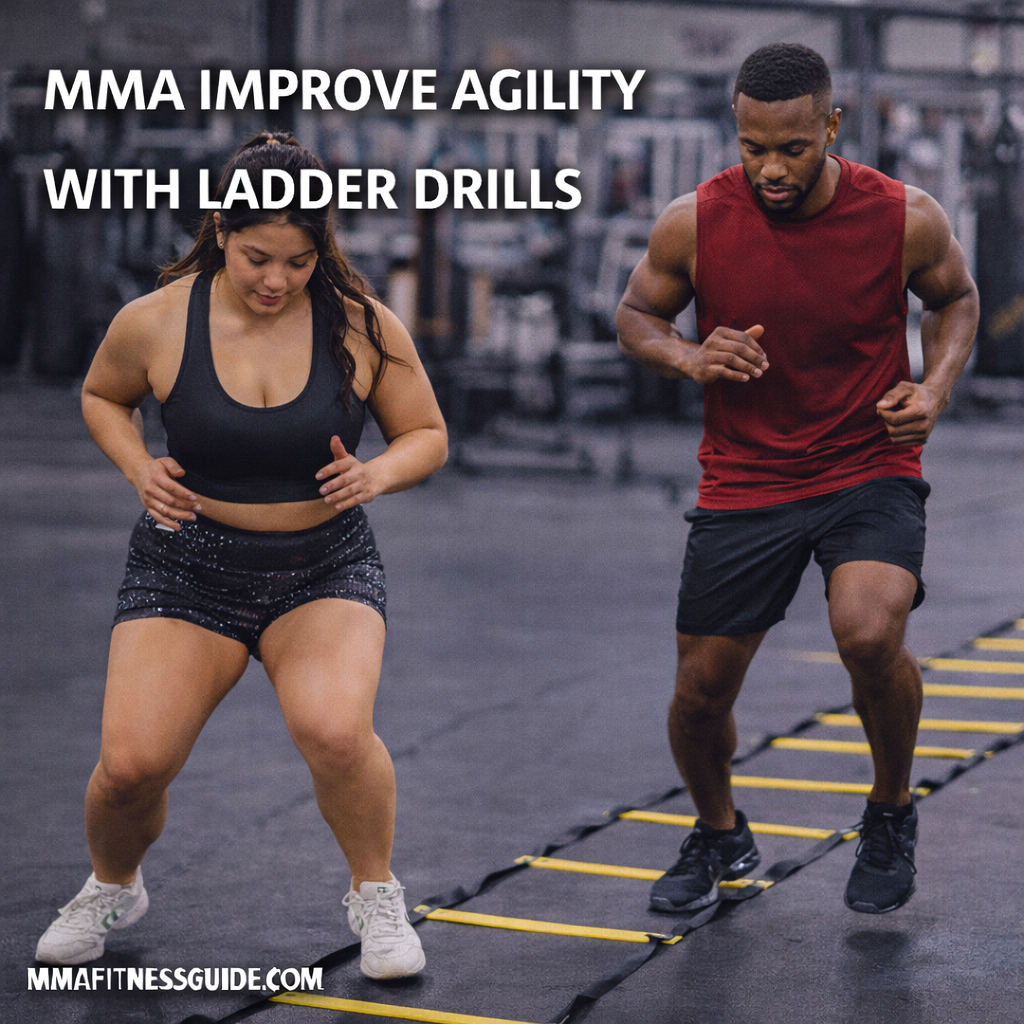
Good ladder posture includes:
- Slight knee bend
- Upright torso
- Relaxed shoulders
- Eyes forward
- Arms moving naturally
Poor posture limits transfer to fighting.
Basic Ladder Drills for MMA Beginners
One-Foot-In Drill
This drill builds basic foot speed and coordination.
How to perform:
- Step one foot into each square
- Alternate feet
- Maintain rhythm and posture
Focus on smooth, controlled movement.
Two-Foot-In Drill
This drill builds symmetry and timing.
How to perform:
- Step both feet into each square
- Move quickly but stay controlled
Useful for beginners learning ladder rhythm.
Lateral Ladder Drills for Cage Movement
Lateral movement is essential in MMA.
Side Step Drill
Benefits include:
- Improved lateral agility
- Better angle changes
- Enhanced defensive movement
Move sideways through the ladder without crossing feet.
In-and-Out Drill
This drill mimics range management.
Focus on:
- Quick entry and exit
- Staying balanced
- Controlled foot placement
Excellent for striking transitions.
Rotational Ladder Drills for MMA
Rotation supports striking and defense.
Pivot Step Drill
This drill trains:
- Hip rotation
- Angle changes
- Balance during turns
Rotate smoothly instead of spinning.
Reaction-Based Ladder Drills
Advanced fighters benefit from unpredictability.
Examples include:
- Coach calling patterns
- Visual cues for direction changes
- Partner-directed movement
Reaction drills improve fight-specific agility.
Ladder Drills for Grappling and Scrambles
Agility isn’t just for striking.
Ladder drills help grapplers:
- Improve foot repositioning
- Maintain balance during scrambles
- Transition between stances
Foot awareness supports ground exchanges.
Common Ladder Drill Mistakes Fighters Make
Avoid these common errors:
- Racing through drills without control
- Looking down constantly
- Poor posture
- Treating ladders as conditioning only
Technique determines effectiveness.
How Often Fighters Should Use Ladder Drills
Ladder drills are low-impact and easy to program.
Recommended frequency:
- 2–4 times per week
- 10–20 minutes per session
- Often used in warm-ups
Short, consistent exposure works best.
Ladder Drills During Fight Camp
During camp, ladder drills should support—not fatigue—fighters.
Best uses include:
- Warm-up activation
- Movement prep
- Light reaction work
Avoid exhausting ladder circuits close to competition.
Combining Ladder Drills With MMA Training
Ladder drills work best when paired with:
- Shadowboxing
- Pad work
- Footwork drills
- Technical sparring
Transfer movement skills immediately when possible.
Signs Your Agility Is Improving
Progress shows up in movement quality.
Signs include:
- Cleaner foot placement
- Faster angle changes
- Less wasted movement
- Improved balance under pressure
Agility improvements often appear subtly.
Ladder Drills and Injury Prevention
Improved foot control reduces injury risk.
Benefits include:
- Better ankle stability
- Reduced awkward steps
- Improved coordination under fatigue
Controlled movement protects joints.
Final Thoughts
Ladder drills are a simple but powerful tool for improving agility in MMA. When performed with proper posture, intent, and progression, they enhance foot speed, coordination, and movement efficiency without excessive impact.
Used consistently and intelligently, ladder drills help fighters move with confidence, precision, and control—inside and outside the cage.