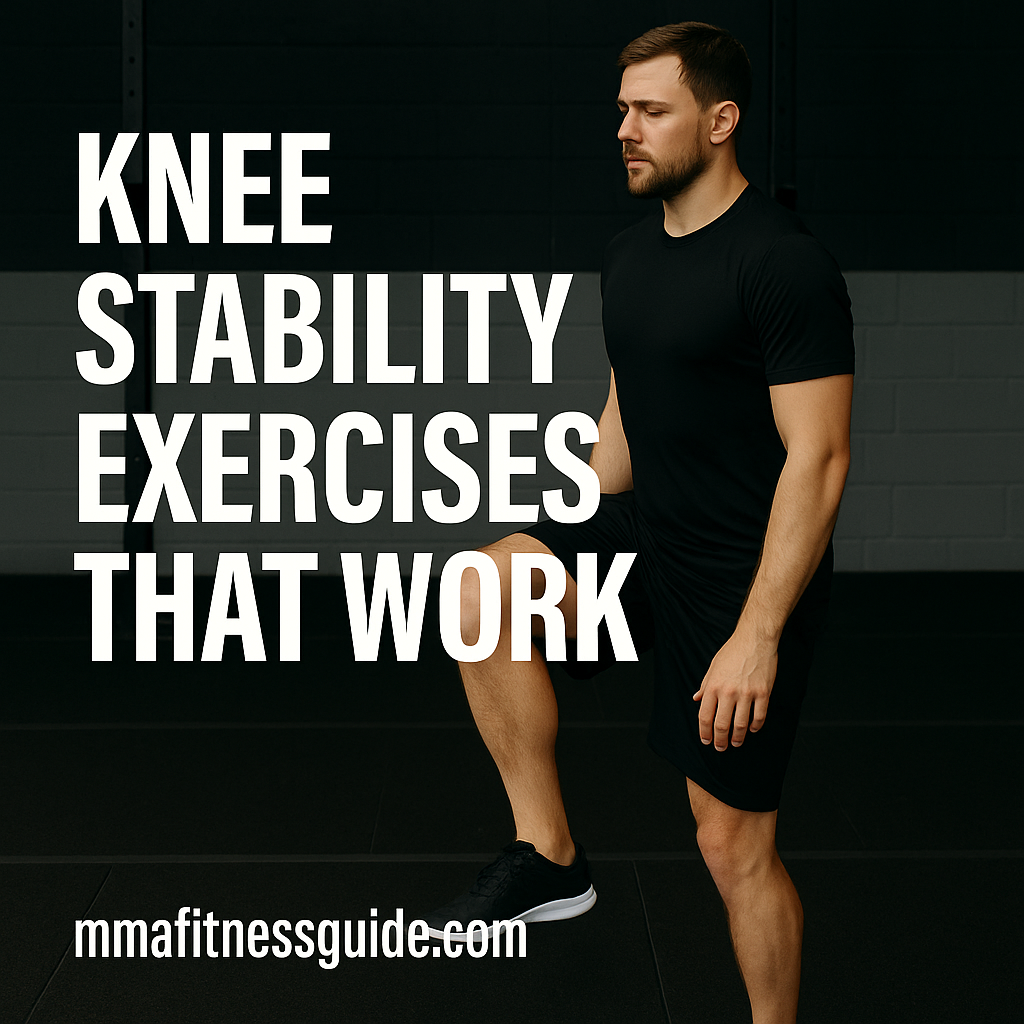
Strong, stable knees are essential for every fighter. Whether you’re shooting takedowns, checking kicks, pivoting on strikes, or scrambling on the ground, your knees take a beating in MMA. Without proper stability training, the risk of sprains, ACL injuries, and chronic pain goes way up.
The good news: you can build strong, resilient knees with simple exercises that improve balance, joint control, and the strength of the muscles surrounding the knee.
These knee stability exercises work for fighters at every level — and they take just a few minutes a day.
Why Knee Stability Matters in MMA
Your knees do more than just bend and straighten — they stabilize the entire lower body during explosive movements. Strong knees help you:
- Cut angles without collapsing
- Absorb impact from kicks and takedowns
- Improve balance during striking
- Generate power from a strong base
- Reduce injury during pivots, sprawls, and level changes
- Recover faster from intense training sessions
Without adequate stability, small movements can create big problems.
What Causes Knee Instability in Fighters?
Many fighters deal with knee issues because of:
- Weak glutes or hamstrings
- Tight hip flexors and quads
- Poor landing mechanics
- Overuse or repetitive striking
- Lack of single-leg training
- Previous injuries
- Hard sparring and takedowns
Stability training corrects these weaknesses before they lead to injury.
The Best Knee Stability Exercises for Fighters
These exercises strengthen the stabilizers around the knee — especially the glutes, hamstrings, calves, and deep hip muscles.
1. Single-Leg Balance Holds
One of the simplest and most effective stability exercises.
How to do it:
- Stand on one leg
- Slight bend in the knee
- Hold for 20–30 seconds
- Switch sides
Why it works:
Improves proprioception (body awareness) and strengthens the stabilizing muscles in the knee and hip.
Progressions:
- Close your eyes
- Stand on a pillow
- Add small knee bends
2. Step-Downs (Controlled Lowering)
A top exercise recommended by physical therapists.
How to do it:
- Stand on a step or low box
- Slowly lower your opposite heel toward the floor
- Keep knees aligned with toes
- Rise back up
Why it works:
Strengthens the quads, glutes, and hip stabilizers needed for takedowns and pivots.
3. Glute Bridge Marches
Great for stabilizing the hips — a key factor in protecting the knees.
How to do it:
- Lift hips into a glute bridge
- Raise one leg at a time, marching in place
- Keep hips level
Why it works:
Glute stability reduces inward knee collapse during striking and sprawls.
4. Lateral Band Walks
A must-do for fighters with weak knee alignment.
How to do it:
- Place a resistance band above the knees or around ankles
- Step sideways with control
- Keep knees pushed outward
Why it works:
Strengthens glute medius, which controls knee tracking during movement.
5. Terminal Knee Extensions (TKEs)
A classic exercise for knee rehab and prehab.
How to do it:
- Anchor a band behind the knee
- Slightly bend and straighten the knee against tension
Why it works:
Builds strength in the vastus medialis (VMO), which stabilizes the knee cap.
6. Single-Leg Romanian Deadlifts
A top-notch movement for hamstring and hip stability.
How to do it:
- Stand on one leg
- Hinge forward at the hip
- Keep knee slightly bent
- Return to standing
Why it works:
Improves balance, posterior chain strength, and knee stability during explosive movements.
7. Split Squat (or Bulgarian Split Squat)
Excellent for building strength and control in each leg independently.
How to do it:
- Step forward or elevate rear leg
- Lower into a controlled lunge
- Keep knee aligned with toes
Why it works:
Develops stability in the quadriceps, hips, and ankle — reducing knee strain.
8. Calf Raises (Straight & Bent Knee)
Calf strength is often overlooked in knee stability.
How to do it:
- Stand on both feet
- Rise up onto toes
- Slowly lower
Bent-knee variation targets the soleus, which helps control knee flexion.
Why it works:
Supports balance, jumping, and shock absorption during takedowns.
How Often Should Fighters Train Knee Stability?
For best results:
- 2–3 times per week
- 10–15 minutes per session
- Combine 4–5 exercises per workout
These movements pair well with warm-ups, cool-downs, or recovery days.
Red Flags: When to Be Cautious
See a professional if you experience:
- Sharp or sudden knee pain
- Locking or catching
- Persistent swelling
- Knee giving out
- Pain lasting more than a week
Stability work helps, but injuries still require evaluation.
Final Takeaway
Knee stability is essential for long-term training longevity in MMA. Strengthening the supporting muscles — especially the glutes, hamstrings, and hips — protects you from injury and improves performance in striking, grappling, and footwork.
Just a few minutes of targeted stability exercises each week can keep your knees strong, balanced, and ready for the demands of combat sports.
Strong knees → better movement → safer training.