Introduction
Grappling lives and dies by grip strength. Whether you’re controlling wrists, locking a body lock, finishing a choke, maintaining sleeve grips, or holding onto a single leg — your grip determines who controls the exchange.
The stronger your hands, fingers, and forearms are, the easier it becomes to dominate scrambles, maintain positions, and secure submissions. Grip strength isn’t just “nice to have” — it is a core skill for every grappler.
Here’s how to build world-class grip strength with workouts that translate directly to MMA, wrestling, and BJJ.
Why Grip Strength Matters in Grappling
Grapplers rely on grip strength for:
- maintaining sleeve/collar control
- securing underhooks and wrist ties
- holding single-legs and body locks
- preventing opponents from peeling grips
- finishing chokes
- controlling scrambles
- maintaining top pressure
A strong grip helps you attack — but it also keeps your opponent from escaping.
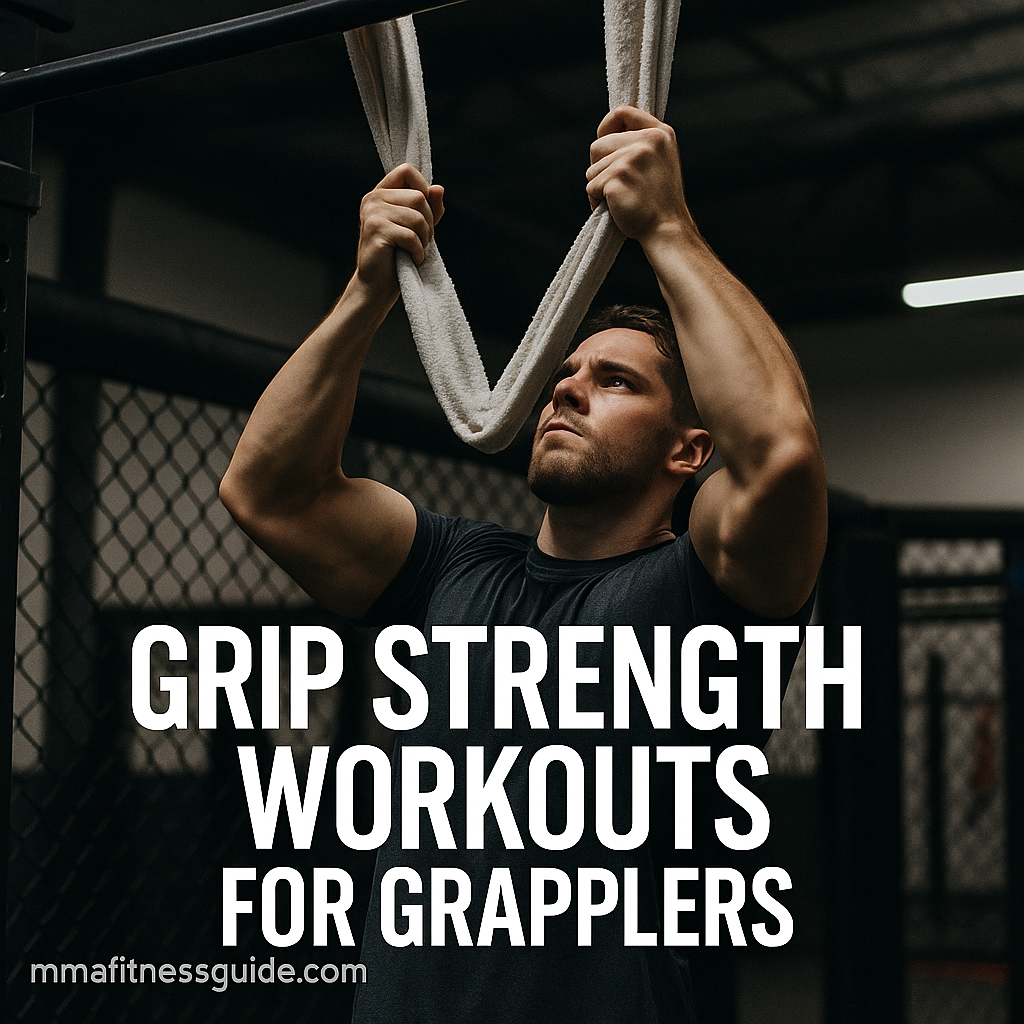
1. Gi Pull-Ups (Or Towel Pull-Ups for No-Gi)
Why it works:
- builds crushing finger strength
- mimics real grappling grips
- improves pulling power
How to do it:
- hang a gi or two towels over a pull-up bar
- grip the fabric like sleeves or lapels
- perform pull-ups
3–5 sets of 4–8 reps.
2. Farmer’s Carries
Why it works:
- total forearm engagement
- real-world, multi-directional strength
- improves grip endurance
How to do it:
- carry heavy kettlebells or dumbbells
- walk 20–40 meters
- keep posture tall
4–6 rounds.
3. Plate Pinch Holds
Why it works:
- increases thumb strength
- builds pinch grip used in wrist control
- excellent for endurance
How to do it:
- hold two weight plates together (smooth sides out)
- pinch at your sides
- hold 20–40 seconds
3–5 sets.
4. Rope Climbs or Rope Pulls
Why it works:
- develops finger and forearm strength
- mimics grappling pulling mechanics
- improves upper-body endurance
Variations:
- rope climb
- seated rope pulls
- rope rows
3–4 sets.
5. Dead Hangs
Why it works:
- strengthens all grip types
- builds tendon durability
- teaches you to relax under load
How to do it:
- hang from a bar
- start with 20–30 seconds
- build up to 60+ seconds
Use both:
- overhand grip
- mixed grip
- one-arm hang (advanced)
6. Wrist Roller
Why it works:
- isolates forearms
- builds strength for grip transitions
- improves wrist integrity
Roll the weight up and down for 2–3 rounds.
7. Kettlebell Bottom-Up Press
Why it works:
- massive forearm activation
- improves wrist stability
- teaches tension control
How to do it:
- hold the kettlebell upside down
- slowly press overhead
3 sets of 5–8 per arm.
8. Gi Gripping Drills (If You Train Gi)
Sleeve drag reps
Collar control holds
Lapel pulls
Do 1–3 minutes per grip type.
These translate directly to BJJ competition and gi rolling.
9. Sandbag Holds
Why it works:
- simulates wrestling/grappling objects
- builds whole-hand strength
- teaches you to lock your hands under fatigue
Hold for 15–30 seconds, 3–5 rounds.
10. Grip Ball or Grip Trainer Squeezes
Why it works:
- finger flexor strength
- improves choke finishing power
- portable and beginner friendly
100–150 reps split throughout the day.
11. Rice Bucket Training
Old-school but incredibly effective.
Why it works:
- strengthens small muscles in fingers
- improves hand toughness
- boosts wrist resilience
Drills:
- finger digs
- wrist rotations
- hand spreads
- crushing motions
2–3 minutes per drill.
12. Sledgehammer Levering
Why it works:
- exceptional wrist strength
- improves grip angles used in grappling scrambles
Movements:
- forward levers
- side levers
- controlled rotations
3 sets of 5–8 reps each direction.
A Sample Grip Strength Routine for Grapplers
2–3x per week
1. Towel Pull-Ups — 3×5
2. Farmer’s Carries — 4×30 meters
3. Plate Pinch Holds — 3×30 seconds
4. Rope Pulls — 3 rounds
5. Dead Hang — 1×max time
Optional finisher:
Rice Bucket Circuit — 3 minutes
Total time: 15–20 minutes.
Common Mistakes to Avoid
❌ Overtraining grip
Your hands need rest — don’t go heavy every day.
❌ Skipping wrist training
Hand strength is useless without wrist stability.
❌ Only training crushing grip
You also need:
- pinch grip
- finger strength
- thumb control
- endurance
❌ Training grip after a hard grappling session
Your grips will already be exhausted.
Train grip on conditioning days or lifting days.
How to Recover Grip Properly
- stretch forearms
- use contrast water (hot/cold)
- massage thumbs and fingers
- rest 24–48 hours after heavy days
- avoid over-squeezing during non-training activities
Healthy hands = stronger grappling.
Final Thoughts
Grip strength is one of the biggest force multipliers in grappling. With stronger hands, fingers, and wrists, everything becomes easier — takedowns, control, scrambles, chokes, and transitions. Add these workouts to your weekly routine and your grappling will immediately jump to another level.
Strong grips win battles. Build them.