Introduction
A strong core is one of the most important injury-prevention tools for MMA athletes. The core does far more than create visible abs—it stabilizes the spine, transfers force between the upper and lower body, and protects joints during explosive, unpredictable movements.
Core workouts that focus on stability, control, and endurance help fighters stay resilient under pressure, reduce injury risk, and maintain performance throughout long training camps.
Why Core Strength Matters for Injury Prevention
In MMA, nearly every movement passes through the core.
A well-trained core helps:
- Stabilize the spine during strikes and takedowns
- Protect the lower back under fatigue
- Improve balance and posture
- Reduce unnecessary strain on hips and shoulders
- Absorb and redirect force during impact
When the core fails, other structures compensate—and injuries follow.
The Difference Between Abs and Core
Many athletes train abs but neglect true core function.
The core includes:
- Deep abdominal muscles
- Obliques
- Lower back muscles
- Pelvic stabilizers
- Hip flexors and glutes
Effective core training emphasizes stability and control, not just flexion.
Common MMA Injuries Linked to Weak Core Stability
A weak or poorly trained core increases injury risk in several areas.
Common issues include:
- Lower back strains
- Hip and groin injuries
- Shoulder overuse injuries
- Knee instability
- Rib and oblique strains
Strengthening the core reduces stress on these vulnerable areas.
Principles of Injury-Protective Core Training
Core training for MMA should prioritize quality over quantity.
Key principles include:
- Neutral spine control
- Anti-rotation and anti-extension strength
- Isometric endurance
- Controlled movement under fatigue
Avoid excessive crunches and uncontrolled twisting.
Foundational Core Exercises for Fighters
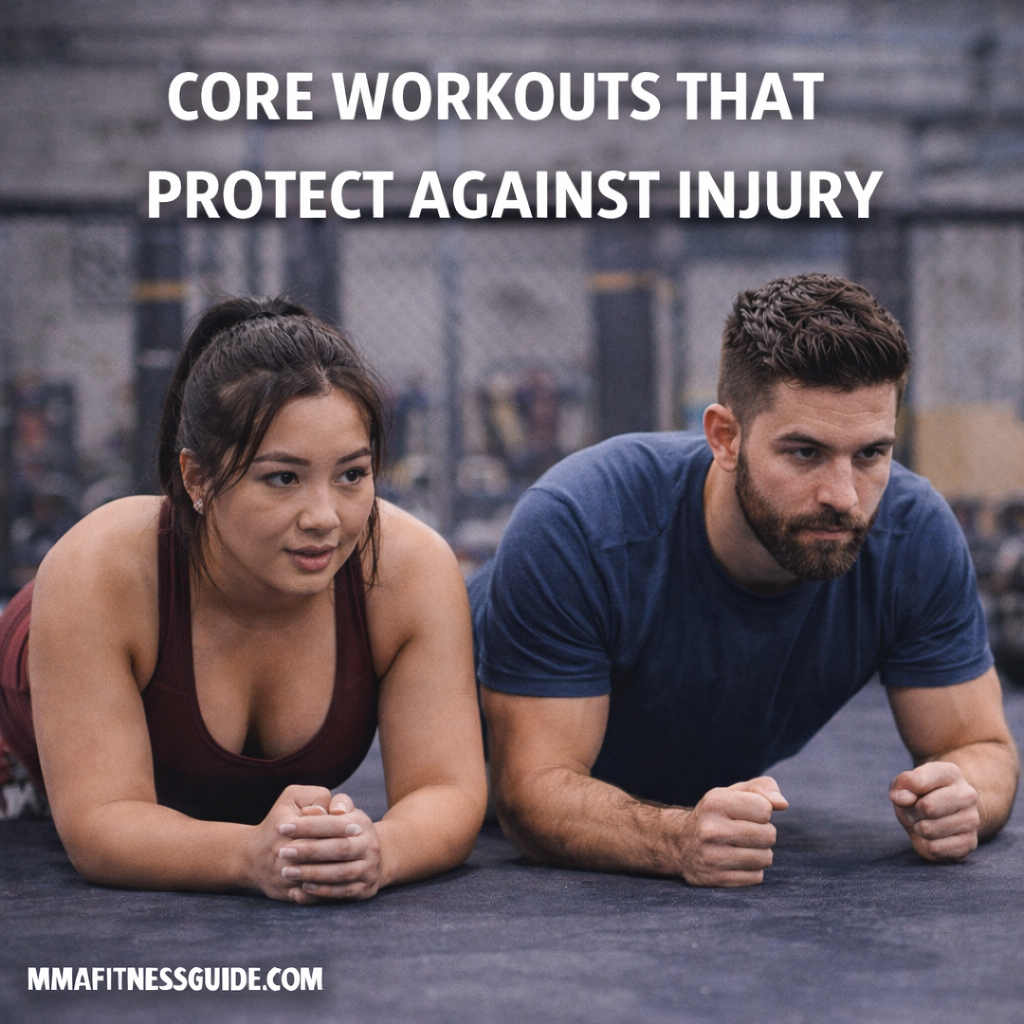
Plank Variations
Planks build deep core endurance and spinal stability.
Effective variations include:
- Standard planks
- Side planks
- Shoulder tap planks
- Extended-arm planks
Focus on maintaining perfect alignment.
Dead Bug Variations
Dead bugs train core control while protecting the spine.
Benefits include:
- Improved coordination
- Reduced lower back strain
- Enhanced pelvic control
Move slowly and deliberately.
Bird Dogs
Bird dogs reinforce spinal stability during limb movement.
Key benefits:
- Anti-rotation strength
- Lower back protection
- Improved posture
Avoid shifting hips or arching the back.
Anti-Rotation Core Exercises
Anti-rotation training is essential for MMA.
Pallof Presses
Pallof presses teach the core to resist unwanted rotation.
Benefits include:
- Oblique strength
- Spinal protection
- Improved striking and grappling control
Use light resistance and strict form.
Cable or Band Holds
Static holds challenge core endurance.
Focus on:
- Upright posture
- Controlled breathing
- Even tension
These build resilience under fatigue.
Core Exercises That Support Grappling and Clinch Work
Farmer Carries
Carries develop total-body stability.
Benefits include:
- Core bracing under load
- Grip endurance
- Postural strength
Keep the torso tall and controlled.
Suitcase Carries
Uneven loads challenge lateral stability.
These improve:
- Oblique strength
- Hip stability
- Anti-side-bending control
Excellent for injury prevention.
Rotational Core Work (Done Safely)
Rotation is part of MMA—but must be controlled.
Safe rotational options include:
- Medicine ball rotations (light load)
- Controlled cable rotations
- Slow rotational holds
Avoid fast, uncontrolled twisting under fatigue.
Core Training for Lower Back Protection
Lower back safety depends on stability, not flexion.
Helpful exercises include:
- Glute bridges
- Hip hinges with core bracing
- Back extensions with control
Strengthen the surrounding system, not just the spine.
How Often Fighters Should Train Core
Core training should be frequent but not exhausting.
General guidelines:
- 3–5 sessions per week
- Short, focused sessions
- Integrated into warm-ups or finishers
Consistency matters more than volume.
Core Training During Fight Camp
During camp, core work should support—not fatigue—performance.
Focus on:
- Stability over intensity
- Isometric holds
- Low-risk movements
Avoid aggressive new exercises close to competition.
Common Core Training Mistakes
Avoid these injury-prone habits:
- Excessive sit-ups and crunches
- Training through lower back pain
- Poor breathing mechanics
- Overloading rotation too early
Core training should feel controlled, not chaotic.
Signs Your Core Training Is Working
Positive indicators include:
- Improved balance and posture
- Reduced back or hip discomfort
- Better control during scrambles
- Less fatigue-related breakdown
Progress often shows up in performance before aesthetics.
Integrating Core Work Into MMA Training
Core work fits best when integrated, not isolated.
Smart integration options:
- Warm-up activation
- Between-round circuits
- Conditioning finishers
- Recovery-focused sessions
Efficiency keeps training sustainable.
Final Thoughts
Core workouts that protect against injury focus on stability, control, and endurance—not flashy movements. For MMA athletes, a resilient core is essential for absorbing impact, transferring force, and staying healthy through demanding training cycles.
A strong core doesn’t just help you perform better—it helps you stay in the fight longer.