Decades before MMA fighters routinely combined boxing, wrestling, submissions, kicks, and strength training, Bruce Lee was already questioning why martial artists should be limited to a single style.
Rather than treating martial arts as rigid systems, Lee emphasized adaptability, efficiency, physical conditioning, and using techniques because they worked—not simply because tradition demanded them. Through his development of Jeet Kune Do and his broader approach to training, he promoted a mindset that closely resembles the cross-training philosophy at the heart of modern MMA.
Bruce Lee never competed in MMA as we know it today, but his influence can still be recognized in the way fighters train, coaches approach skill development, and athletes combine techniques from different disciplines. His legacy is less about claiming he invented MMA and more about how early he embraced many of the ideas that would eventually become central to the sport.
Who Was Bruce Lee?
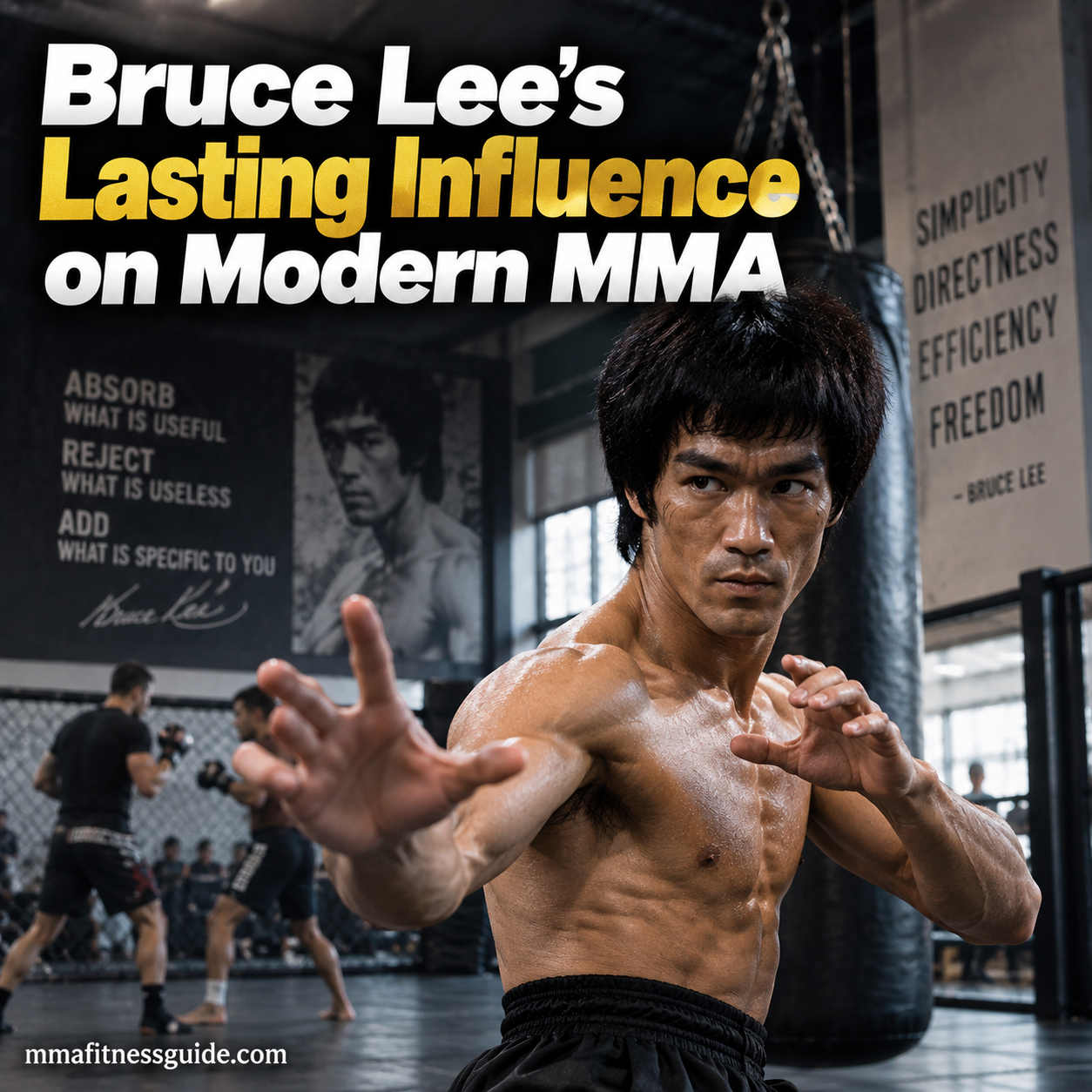
Bruce Lee was a martial artist, actor, philosopher, and cultural icon best known for his work in martial arts films and his revolutionary approach to combat training. He developed his own system, Jeet Kune Do, which emphasized simplicity, directness, and efficiency.
Rather than adhering strictly to one martial arts style, Bruce Lee encouraged practitioners to learn from multiple disciplines and adapt techniques to their own physical attributes. This open-minded approach was uncommon at the time but later became a defining characteristic of mixed martial arts.
The Philosophy Behind Jeet Kune Do
Jeet Kune Do was not intended to be a fixed martial art. Instead, it was a philosophy centered on freedom of movement and practical effectiveness. Bruce Lee believed that rigid systems limited personal growth and real-world applicability.
Core ideas included:
- Absorbing what is useful
- Rejecting what is ineffective
- Adapting techniques to the individual
- Prioritizing efficiency over tradition
These principles closely mirror the mindset of modern MMA, where fighters train across disciplines to develop well-rounded skill sets.
Cross-Training and Style Integration
One of Bruce Lee’s most influential contributions was his advocacy for cross-training. He studied boxing, fencing, wrestling, Wing Chun, and other disciplines, blending techniques that suited his goals.
Modern MMA is built on this same concept. Fighters train in striking, grappling, conditioning, and movement rather than limiting themselves to a single martial art. Bruce Lee’s willingness to blend styles helped normalize this approach decades before MMA became mainstream.
Movement, Conditioning, and Athleticism
Bruce Lee placed strong emphasis on physical conditioning, agility, and coordination. He believed that speed, balance, and endurance were just as important as technique.
His training methods often included:
- Strength and resistance training
- Cardiovascular conditioning
- Flexibility and mobility work
- Repetitive movement drills
These principles align closely with modern MMA fitness programs, which focus on total-body conditioning and athletic performance.
Mental Discipline and Self-Awareness
Beyond physical training, Bruce Lee emphasized mental discipline and self-awareness. He believed that understanding one’s strengths, limitations, and emotional responses was essential for growth.
Modern MMA training places similar importance on mental resilience, focus, and adaptability. Athletes must remain composed under pressure, adjust strategies, and maintain confidence during intense physical demands.
This mental aspect of Bruce Lee’s philosophy continues to influence both competitive fighters and MMA fitness enthusiasts.
Influence on Modern MMA Culture
Although Bruce Lee passed away before the rise of modern MMA organizations, his ideas were widely adopted by later generations of fighters and coaches. Many early MMA pioneers referenced his philosophy when describing the importance of versatility and adaptability.
Today, Bruce Lee is often credited with popularizing the concept that martial arts should evolve with the practitioner rather than remain static. This mindset helped shape the culture of innovation seen in MMA gyms and fitness programs worldwide.
Bruce Lee’s Role in MMA Fitness Training
In MMA fitness contexts, Bruce Lee’s influence is seen less in specific techniques and more in training philosophy. His emphasis on functional movement, efficiency, and personal expression aligns well with fitness-focused MMA training.
MMA fitness programs inspired by these ideas often:
- Focus on full-body movement
- Encourage adaptability and progression
- Prioritize conditioning and coordination
- Avoid rigid, one-size-fits-all routines
This approach makes MMA fitness accessible to a broader audience while maintaining authenticity.
Common Misconceptions About Bruce Lee and MMA
A common misconception is that Bruce Lee was an MMA fighter. While he never competed in MMA, his influence on the sport is philosophical rather than competitive.
Another misconception is that his methods promoted unsafe training. In reality, Bruce Lee emphasized control, awareness, and personal responsibility, which align closely with modern safety-focused training principles.
Training Safety and Historical Context Notice
Bruce Lee’s training methods and philosophies are discussed here for historical and educational purposes only. Modern MMA fitness training should always be approached with proper instruction, safety considerations, and respect for individual physical limitations. Consult qualified professionals before beginning any new training program.
Final Thoughts
Bruce Lee’s lasting influence on modern MMA lies not in specific techniques but in the mindset he introduced to martial arts training. His emphasis on adaptability, efficiency, conditioning, and self-expression helped pave the way for the evolution of mixed martial arts.
For MMA fitness enthusiasts, Bruce Lee’s philosophy continues to serve as a reminder that effective training is personal, adaptable, and rooted in continuous learning. His legacy remains an important part of MMA’s cultural and philosophical foundation.