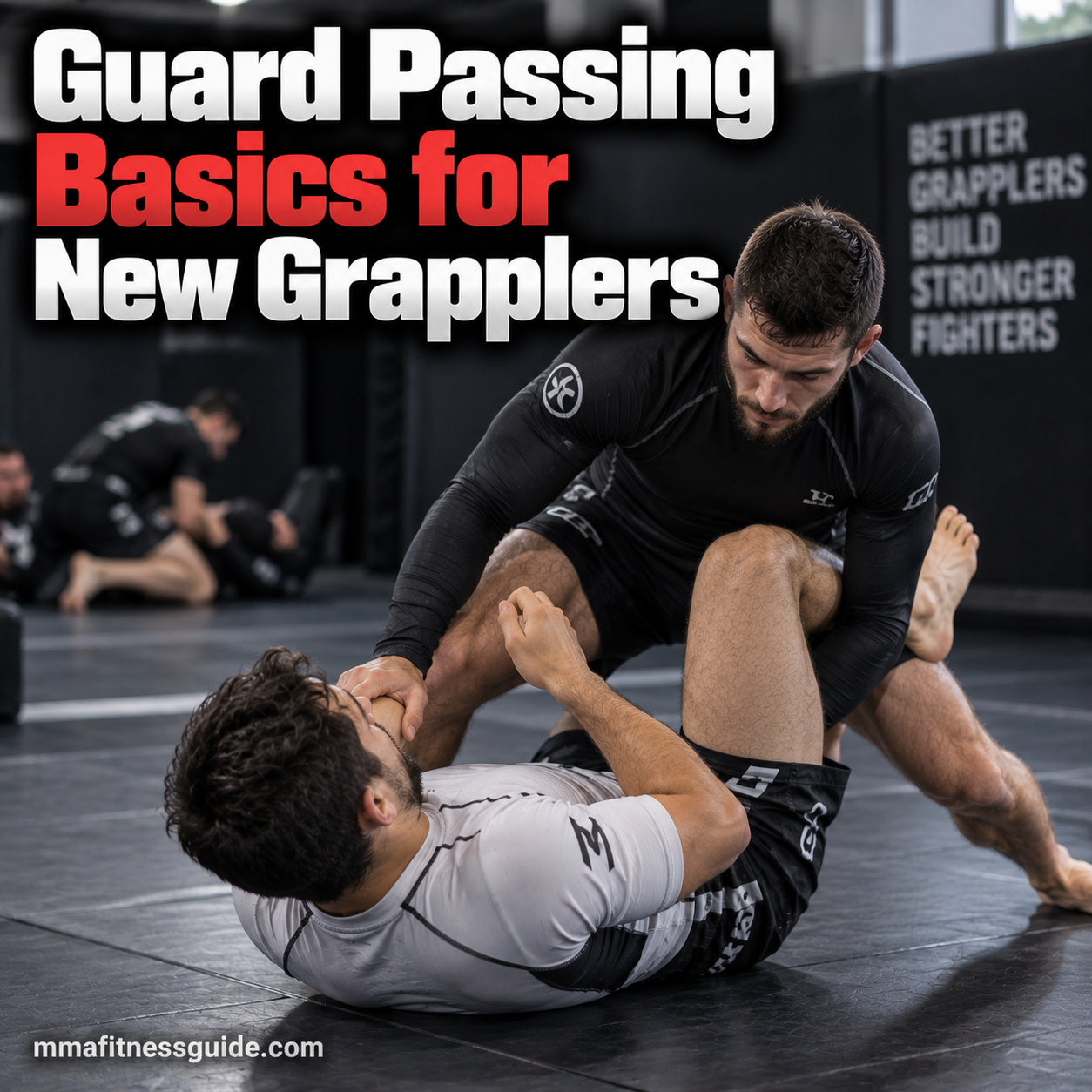
A new grappler often gets stuck before the pass even begins. They lean forward, reach for the legs, and immediately get pulled off balance or caught between their opponent’s knees. The problem usually is not a lack of techniques—it is trying to move around the guard before establishing posture, controlling distance, and dealing with the legs.
Guard passing becomes easier to understand when you give each step a purpose. Establish your base, prevent the bottom player from controlling your posture, open or clear the guard, control the legs or hips, and then move into a stable top position.
Start with a small number of passes and learn what makes them work. Once those mechanics become familiar, variations are much easier to add.
What Guard Passing Actually Means
When an opponent has their legs between you and their upper body, those legs act as barriers.
They may use them to:
- Control your distance
- Break your posture
- Off-balance you
- Set up sweeps
- Attack submissions
- Create space to stand
- Prevent you from reaching stronger top positions
Passing means clearing those barriers and establishing control beyond the opponent’s legs.
Depending on the ruleset and situation, that may lead to side control, mount, knee-on-belly, or another top position.
Start With Your Base and Posture
Before trying to move past the legs, make sure the bottom player cannot easily pull you out of position.
Your exact posture will depend on whether you are standing, kneeling, dealing with closed guard, or facing an open guard, but several principles remain useful:
- Keep your weight balanced
- Avoid reaching far ahead of your hips
- Keep your elbows from becoming unnecessarily exposed
- Protect your head and arms from easy control
- Maintain a base wide enough to resist off-balancing
- Adjust your feet and knees as your opponent moves
Posture is not simply about keeping your back perfectly straight.
The goal is to maintain a structure from which you can move without being easily swept, submitted, or dragged into a weaker position.
Understand the Role of Hip Control
The bottom player uses their hips to create angles, reposition the legs, recover guard, and generate many sweeps and submission entries.
Limiting that movement makes passing easier.
Depending on the type of guard, you may control the hips indirectly by:
- Pinning or redirecting the knees
- Controlling the legs
- Using your own knees to block movement
- Applying pressure through the torso
- Maintaining useful grips or frames
- Controlling the space around the hips
Think less about holding the opponent completely still and more about limiting the direction they need for their next movement.
If you are passing to your left, for example, preventing them from freely turning and bringing their legs back between you becomes part of the pass.
Open Closed Guard Before Trying to Pass
If the opponent has their ankles locked behind your back, you are dealing with closed guard.
Trying to move around their legs while they remain locked usually creates unnecessary problems.
First establish posture and work on opening the guard.
Common approaches involve:
- Building a stable base
- Controlling the opponent’s upper body or hips appropriately
- Standing or adjusting position without giving away your balance
- Creating enough pressure and space for the legs to separate
- Maintaining control as the guard opens
Avoid digging your elbows aggressively into the opponent’s thighs. It is uncomfortable, often creates poor posture, and does not teach reliable guard-opening mechanics.
Once the ankles separate, expect the opponent to immediately transition to another type of guard.
Opening the guard is not the end of the exchange. It is the beginning of the pass.
Learn Two Basic Passing Routes
Most beginner passing exchanges can be simplified into two broad ideas:
- Go around the legs
- Go through or between the legs
You do not need a large collection of techniques immediately.
Choose a few passes that demonstrate different concepts and learn how the opponent is likely to respond to each one.
Over-Under Pass
The over-under pass uses close connection and pressure to limit the bottom player’s ability to freely reposition their legs.
A simplified sequence looks like this:
- Establish control around the legs.
- Position one arm underneath one leg.
- Control the opposite leg from the outside.
- Keep your posture protected while applying forward pressure.
- Begin moving around the legs.
- Prevent the opponent from turning their hips back toward you.
- Clear the legs and establish top control.
The pass should come from body positioning and pressure rather than squeezing with the arms as hard as possible.
If your upper body becomes disconnected from the opponent, they may have enough room to recover their guard.
Knee Slice Pass
The knee slice uses a knee-through position to separate the opponent’s legs while the upper body controls their ability to turn into you.
A basic progression is:
- Establish control over the opponent’s legs or upper body.
- Position your knee between or across their legs.
- Maintain control of the upper body.
- Prevent an easy underhook or turn toward you.
- Drive the knee through while keeping your base.
- Clear the trapped leg.
- Establish side control or another secure top position.
One common beginner mistake is focusing entirely on sliding the knee.
The upper-body battle matters too. If the opponent gains strong frames or an underhook, they may be able to turn, recover guard, or initiate a scramble.
Torreando (Bullfighter) Pass
The torreando uses leg control and lateral movement to create a path around the guard.
A basic version involves:
- Control the opponent’s legs near the ankles, shins, or appropriate grips.
- Redirect the legs away from the direction you want to move.
- Step laterally around the legs.
- Keep enough distance that the opponent cannot easily reconnect their feet.
- Close the distance once you have cleared the legs.
- Establish top control.
Speed can help, but positioning comes first.
If you throw the legs aside and rush forward without controlling distance, the opponent may simply bring their knees back between you.
Pressure Is More Than Pushing Hard
Pressure passing works when your body positioning makes movement difficult for the opponent.
Useful pressure can come from:
- Chest-to-chest connection
- Shoulder positioning
- Hip placement
- Head position
- Controlled bodyweight
- Preventing the opponent from turning freely
More muscular effort does not automatically create better pressure.
A smaller grappler with good positioning can feel difficult to move because their weight is directed into the right place while their limbs remain structurally supported.
When you find yourself squeezing constantly with your arms, check whether your body position could be doing more of the work.
Prevent Guard Recovery
Clearing the legs does not automatically complete the pass.
A common beginner sequence looks like this:
The passer gets around the feet → pauses → the bottom player turns → a knee comes back inside → guard is recovered.
After getting beyond the legs, continue controlling the hips and upper body until you establish a stable position.
Watch for the opponent trying to:
- Bring a knee between your bodies
- Turn onto their side
- Frame against your shoulders
- Shrimp their hips away
- Recover hooks
- Create enough space to sit up
The pass becomes secure when the opponent can no longer easily put their legs back between you.
Learn to Recognize Frames
Bottom players often use their forearms, hands, knees, and shins as frames to maintain space.
Instead of simply pushing harder against those structures, identify what the frame is preventing.
For example:
- A forearm across your shoulder may prevent chest-to-chest control
- A knee between your bodies may block forward pressure
- A shin across your torso may control distance
- A hand on your hip may stop you from closing space
Once you understand the purpose of the frame, you can work on changing its angle, moving around it, or controlling the limb creating it.
Common Guard Passing Mistakes
New grapplers frequently encounter the same problems.
Reaching Too Far Forward
When your hands move far ahead of your base, the opponent can use that extension to pull or off-balance you.
Move your feet and hips with your hands.
Trying to Pass Before Controlling the Legs
Running around an opponent whose feet and knees are still freely tracking you often leads directly back into guard.
Control or redirect the barriers first.
Using a Narrow Base
Keeping your feet or knees too close together can make sweeps easier.
Adjust your base according to the opponent’s movement.
Moving Fast Without Establishing Control
Speed is useful when the path is already available.
Moving quickly into the opponent’s frames usually creates a scramble instead of a clean pass.
Stopping After Clearing the Legs
Continue into a stable top position.
Do not give the opponent time to rebuild their guard.
Trying to Force One Pass
Sometimes the opponent’s defense makes another route easier.
If they strongly block your knee slice, for example, their reaction may create an opportunity to change direction or switch passes.
A Simple Guard Passing Routine
A short training block can reinforce the mechanics without introducing too many techniques at once.
Warm-Up — 2 Minutes
Practice:
- Hip movement
- Stance changes
- Lateral steps
- Level changes
Keep the movements controlled.
Technique Practice — 8 to 10 Minutes
Perform:
- Knee slice → 5 controlled repetitions each side
- Over-under movement → 5 repetitions each side
- Torreando footwork → 20–30 seconds
- Guard pass → establish side control → reset
Focus on clean positioning rather than completing repetitions as quickly as possible.
Positional Training — 5 to 8 Minutes
Start with one grappler playing open guard and the other attempting to pass.
The top player works on:
- Maintaining balance
- Controlling the legs
- Choosing a passing direction
- Clearing the guard
- Establishing top control
Reset after a completed pass, sweep, submission, or agreed stopping point.
As you improve, allow the bottom player to use more resistance and a wider range of guards.
Build Passing Around Reactions
Eventually, guard passing becomes less about performing isolated techniques and more about responding to resistance.
You attempt to move right.
The opponent blocks that direction.
Their hips and legs shift left.
A different route appears.
That interaction is what turns individual passes into a passing system.
Start by learning the mechanics of a few techniques. Then pay attention to how training partners stop them. Those defensive reactions will show you which pass, angle, or direction to explore next.
Final Thoughts
For a new grappler, three reliable passes practiced against real resistance are more useful than memorizing dozens of variations without understanding when to use them.
Begin with your base. Control the space around the opponent’s hips and legs. Create a path around or through the guard, and continue moving until you have established a stable top position.
When a pass gets blocked, pay attention to how the opponent stopped it. Their defense often creates the opening for your next attempt.
That is where guard passing starts to become less about remembering steps and more about solving the position in front of you.