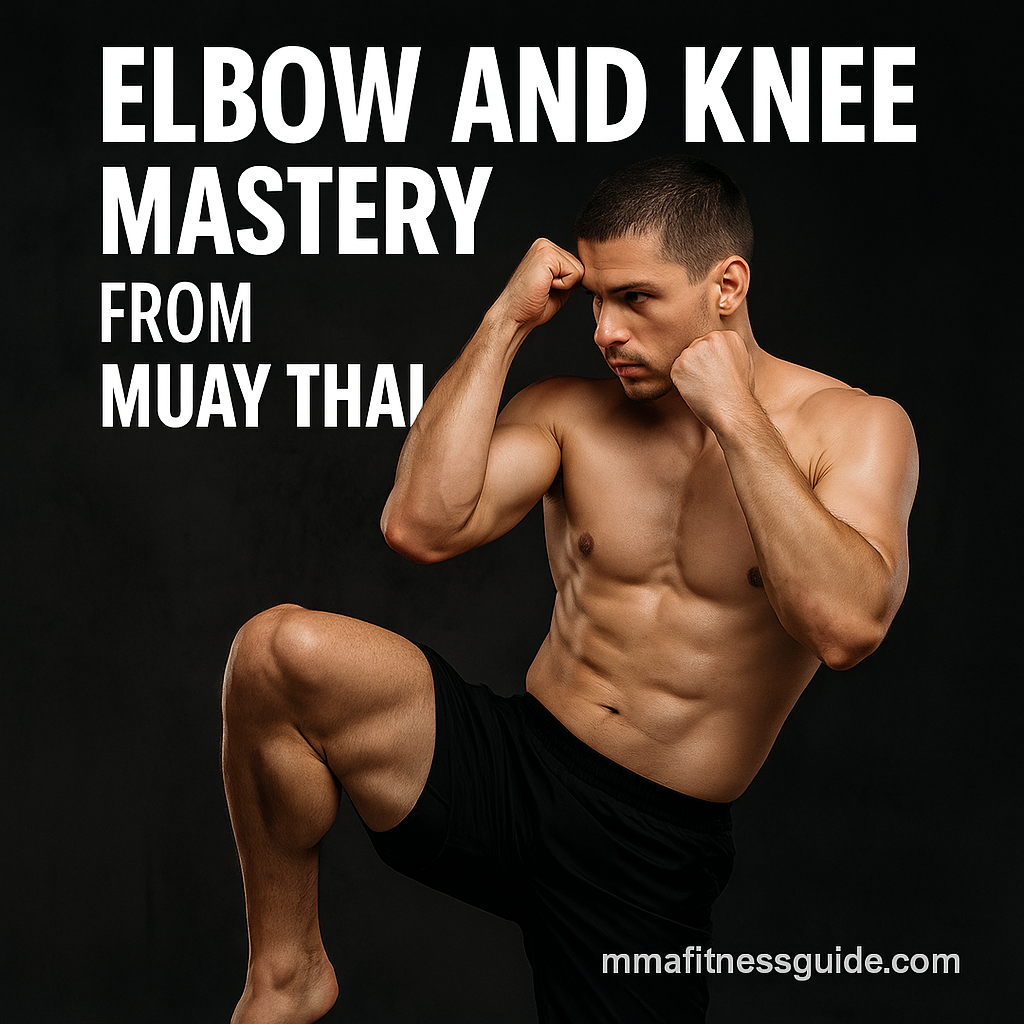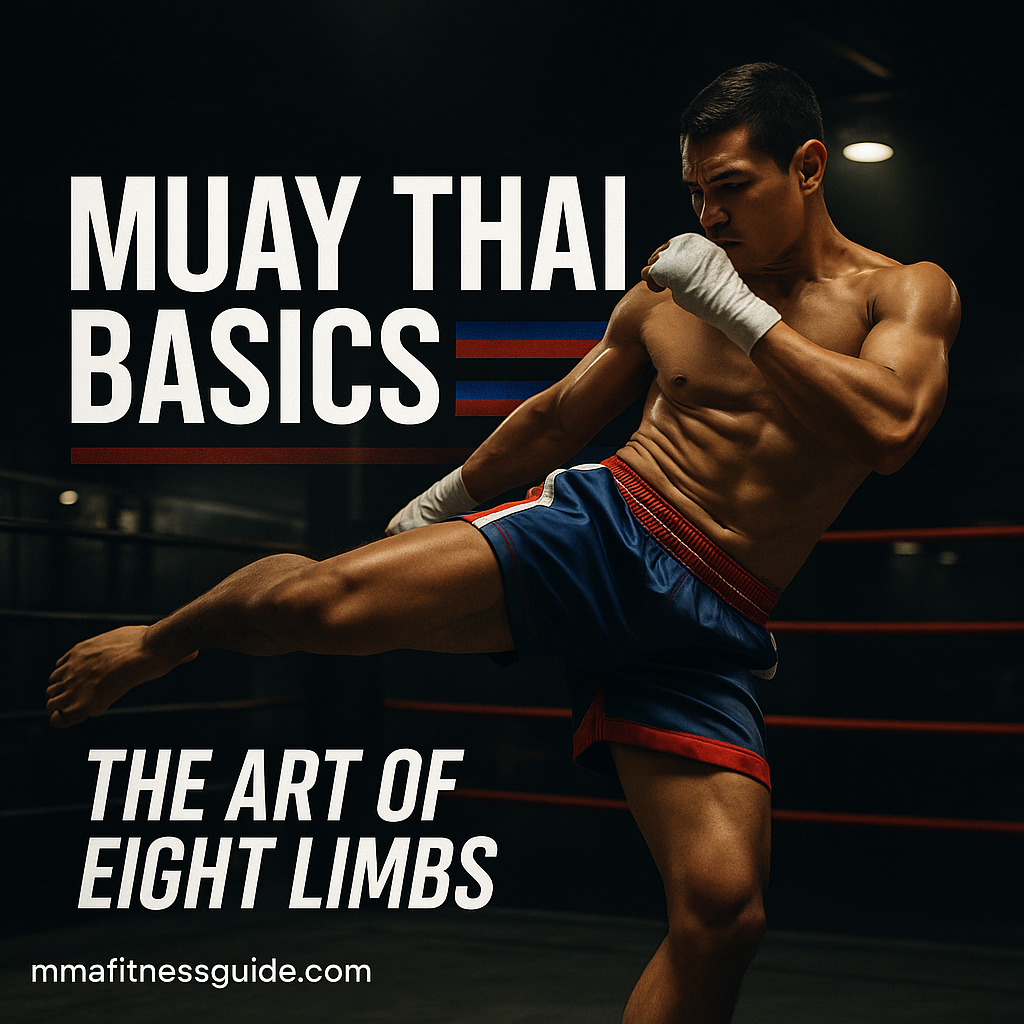
A Muay Thai combination can begin with punches at long range, transition into a round kick, and finish with knees or elbows after the distance closes. That ability to strike with the fists, elbows, knees, and shins gives the Thai martial art its familiar nickname: the “Art of Eight Limbs.”
For MMA athletes, Muay Thai provides techniques for several striking ranges while developing the footwork, balance, hip rotation, posture, and conditioning needed to repeatedly deliver those techniques.
Training doesn’t have to begin with hard sparring. Beginners typically spend considerable time learning stance, movement, basic punches, kicks, knees, defensive actions, and controlled combinations before adding greater speed or resistance.
What Is Muay Thai?
Muay Thai is a combat sport and martial art from Thailand built around striking and clinch fighting.
Its techniques commonly include:
- Punches
- Elbows
- Knees
- Kicks
- Defensive checks
- Footwork
- Clinch control
Unlike a workout that simply uses punches and kicks to raise your heart rate, technical Muay Thai training teaches how those movements function against another person.
A fighter must learn how to maintain balance while striking, return to a defensive position, manage distance, and react to an opponent’s movement.
These characteristics have also made Muay Thai a major influence on striking training in modern MMA.
Why Is Muay Thai Called the Art of Eight Limbs?
The nickname refers to eight primary striking surfaces:
- Two fists
- Two elbows
- Two knees
- Two shins
Each has a different role depending on distance and position.
Punches can establish combinations and create openings. Kicks attack from longer ranges. Knees become useful as distance closes, while elbows can operate from very short range where longer strikes may be difficult to use.
Training several striking tools also requires coordination between the upper and lower body.
A round kick, for example, isn’t produced by the leg alone. The supporting foot, hips, trunk, shoulders, and arms all contribute to the movement and help the fighter maintain balance.
The Muay Thai Stance
Before learning complicated combinations, start with stance.
A basic Muay Thai stance should allow you to strike, defend, check kicks, and move without having to completely reorganize your feet.
While exact stance mechanics vary between coaches and athletes, common characteristics include:
- Hands positioned to protect the head
- Chin controlled rather than raised
- Balanced weight distribution
- Knees slightly bent
- Feet positioned for movement and defense
- Upper body relaxed enough to react
Avoid becoming excessively rigid.
Tension in the shoulders and arms can make movement slower and cause unnecessary fatigue during longer rounds.
Basic Muay Thai Footwork
Muay Thai footwork is usually economical.
Instead of constantly bouncing or taking oversized steps, fighters learn to maintain their stance while moving in different directions.
Begin by practicing:
- Forward steps
- Backward steps
- Lateral movement
- Pivots
- Controlled directional changes
Try to maintain roughly the same stance after each movement.
Crossing your feet or bringing them too close together can compromise balance and make it harder to defend or counter.
Punching Basics
Muay Thai incorporates familiar boxing punches, including:
- Jab
- Cross
- Hook
- Uppercut
Punches can be used independently or combined with kicks, knees, and other attacks.
A basic combination might be:
Jab → cross → round kick
Another could be:
Jab → cross → hook → exit
Beginners should concentrate on returning the hands to a defensive position and maintaining balance rather than throwing every punch at maximum power.
Round Kicks
The Muay Thai round kick typically involves substantial rotation through the hips and supporting foot.
Depending on the target and ruleset, round kicks may be directed toward different levels.
Training the kick develops:
- Hip rotation
- Balance
- Coordination
- Lower-body power
- Timing
Beginners should first learn the movement with coaching and controlled repetitions.
Repeatedly striking a heavy bag with poor mechanics can reinforce mistakes and unnecessarily stress the foot, ankle, knee, or hip.
Knee Strikes
Knees are particularly useful as the distance between fighters decreases.
Basic training may include straight knees performed from stance or knees delivered during controlled clinch drills.
Knee practice requires coordination between hip extension, posture, balance, and upper-body positioning.
For conditioning, knees can also be incorporated into pad or bag rounds.
For example:
30 seconds punches → 30 seconds alternating knees → rest
Keep the movement controlled as fatigue increases.
Elbow Techniques
Elbows operate at shorter distances than most punches and kicks.
Muay Thai includes several elbow trajectories, but beginners should learn them under qualified instruction before attempting fast partner drills.
Elbows can easily cause cuts and injuries during uncontrolled training.
When practicing without appropriate pads or supervision, use technical shadowboxing rather than making contact with a partner.
Defensive Checks
Muay Thai isn’t only about throwing strikes.
Checking is a common defensive response to certain kicks. The defender raises the leg and positions it to intercept the incoming attack.
Learning to check requires:
- Single-leg balance
- Timing
- Posture
- Quick weight transfer
Start slowly.
Good defensive technique should be learned before turning checking drills into fast exchanges.
The Muay Thai Clinch
When fighters move too close for comfortable long-range striking, the clinch becomes another part of Muay Thai.
Clinch training can involve:
- Posture control
- Hand and arm positioning
- Head position
- Knees
- Off-balancing
- Turns
- Trips or sweeps permitted under the relevant rules
For MMA athletes, clinch experience can be particularly useful because striking and grappling frequently overlap at close range.
MMA clinching isn’t identical to competitive Muay Thai clinching, however. Wrestling attacks, cage positioning, and the MMA ruleset change how fighters approach the position.
How Muay Thai Builds Conditioning
Pad rounds, heavy-bag work, shadowboxing, and partner drills require repeated movement rather than a single isolated effort.
A typical round may involve:
- Footwork
- Punch combinations
- Kicks
- Knees
- Defensive movements
- Brief periods of lower output
- Harder bursts of activity
This creates a mixture of sustained movement and higher-intensity efforts.
As technique improves, athletes can gradually increase round duration, pace, and complexity.
Conditioning should follow technical development rather than replacing it.
Beginner Muay Thai Training
A new athlete should spend the early stages learning repeatable movement patterns.
A basic session might include:
Warm-Up
5–10 minutes of:
- Light jump rope
- Mobility work
- Easy shadowboxing
- Dynamic movement
Technique
Practice:
- Stance
- Footwork
- Jab and cross
- Basic defensive movement
- Round-kick mechanics
- Straight knees
Controlled Rounds
Complete several short shadowboxing or pad rounds.
For example:
3 rounds × 2 minutes
Rest approximately one minute between rounds.
Keep the pace manageable enough to maintain technique.
Intermediate Muay Thai Training
As movement becomes more automatic, training can become less predictable.
Intermediate athletes might begin combining:
- Punch-to-kick sequences
- Defensive reactions
- Angle changes
- Longer pad rounds
- Bag work
- Controlled clinch drills
Rather than simply increasing the number of techniques, focus on connecting them smoothly.
For example:
Jab → cross → round kick → defensive movement → reset
The transition between techniques matters just as much as the individual strikes.
Advanced Training
Experienced athletes can work with greater intensity, resistance, and decision-making.
Training may include:
- Complex pad rounds
- Partner reaction drills
- Clinch sparring
- Situational sparring
- Full sparring
- Competition-specific conditioning
At this stage, training volume should be managed carefully.
Hard sparring, strength training, clinch work, running, and conditioning all contribute to the athlete’s total workload.
More sessions aren’t automatically more productive if recovery and technical quality begin to decline.
Muay Thai for MMA Training
Muay Thai provides MMA fighters with a strong striking framework, but techniques often require adjustment for mixed martial arts.
An MMA fighter also has to consider:
- Takedown threats
- Smaller MMA gloves
- Cage positioning
- Wrestling entries
- Ground fighting
- Different clinch dynamics
For example, a stance that works well in pure striking competition may need modification when an opponent can attack the legs.
The goal isn’t to copy every Muay Thai technique unchanged. It’s to understand the mechanics and determine how they fit into the broader MMA ruleset.
Common Muay Thai Training Mistakes
Throwing Everything at Full Power
Beginners often assume harder strikes mean better training.
Power should increase after technique becomes consistent.
Use controlled repetitions to develop balance and mechanics before increasing intensity.
Losing Balance After Kicks
A kick isn’t finished when it hits the target.
You should also be able to recover your stance.
If every hard kick spins you around or leaves you unable to defend, reduce the speed and work on control.
Holding Your Breath
New athletes frequently tense up and hold their breath while throwing combinations.
Practice relaxed breathing during shadowboxing and technical rounds.
Ignoring Defense
Throwing long combinations without practicing defensive recovery creates incomplete habits.
Return your hands to position, regain your stance, and consider what the opponent could throw back.
Increasing Training Volume Too Quickly
Kicking, clinching, bag work, and repetitive striking can place unfamiliar stress on the body.
Increase the number and intensity of rounds gradually rather than jumping immediately into high-volume training.
Training Muay Thai Safely
Learn striking mechanics from a qualified coach whenever possible, particularly before performing high-impact bag work, partner drills, or sparring.
Use appropriate equipment for the session, which may include:
- Hand wraps
- Boxing or Muay Thai gloves
- Shin guards for appropriate partner drills
- Mouthguard for contact training
- Suitable pads or heavy bags
Warm up before harder rounds and increase intensity progressively.
Stop training if you experience sharp pain, dizziness, or symptoms that go beyond normal exercise fatigue.
Partner contact should match the purpose of the drill. Technical practice doesn’t need to become hard sparring.
Final Thoughts
Muay Thai gives fighters several striking tools that operate at different distances: punches and kicks from range, knees as the gap closes, and elbows and clinch techniques at short range.
Learning those tools starts with stance, balance, footwork, and controlled technique—not maximum intensity.
Build combinations gradually, practice returning to a defensive position after each attack, and increase speed or resistance only when the movement remains controlled.
For MMA athletes, the next step is learning how those striking skills interact with wrestling, cage positioning, and takedown defense. That’s where Muay Thai technique begins adapting to the broader demands of mixed martial arts.