Strength Starts at the Center
Every punch, kick, and takedown in MMA begins with one thing — core power.
Your core isn’t just your abs — it’s the foundation of every movement. It connects your upper and lower body, stabilizes balance, and transfers force into your strikes and grappling.
A strong core means sharper technique, faster transitions, and fewer injuries.
Whether you’re a beginner or just building your fitness base, mastering the fundamentals of core training will transform how you move, fight, and perform.
Why Core Stability Matters
In combat sports, the core acts like a shock absorber and power engine.
It helps you:
- Maintain balance during punches, kicks, and sprawls.
- Absorb impact from strikes or takedowns.
- Generate rotational power for hooks and roundhouses.
- Prevent lower-back injuries and fatigue.
Without a solid core, even strong muscles struggle to deliver force efficiently.
The Core Isn’t Just Abs
Your core includes the rectus abdominis, obliques, transverse abdominis, erector spinae, and even muscles in your hips and glutes.
Training all of them ensures stability, strength, and mobility.
1. Plank (Stability Foundation)
How to do it:
- Start in push-up position with elbows under shoulders.
- Engage abs and glutes, keeping your body in a straight line.
- Hold for 30–60 seconds, breathing steadily.
Why it works:
The plank builds isometric core strength — perfect for maintaining posture during long training rounds.
2. Side Plank (Lateral Stability)
How to do it:
- Lie on one side with your forearm under your shoulder.
- Lift hips until your body forms a straight line.
- Hold for 20–40 seconds each side.
Why it works:
Strengthens obliques and stabilizers, helping with balance during lateral movements and head movement in striking.
3. Dead Bug (Core Control and Coordination)
How to do it:
- Lie on your back, arms up and knees bent 90°.
- Lower opposite arm and leg slowly without touching the floor.
- Return to start and switch sides.
Why it works:
Teaches control, breathing, and core engagement — key for maintaining tight form in grappling.
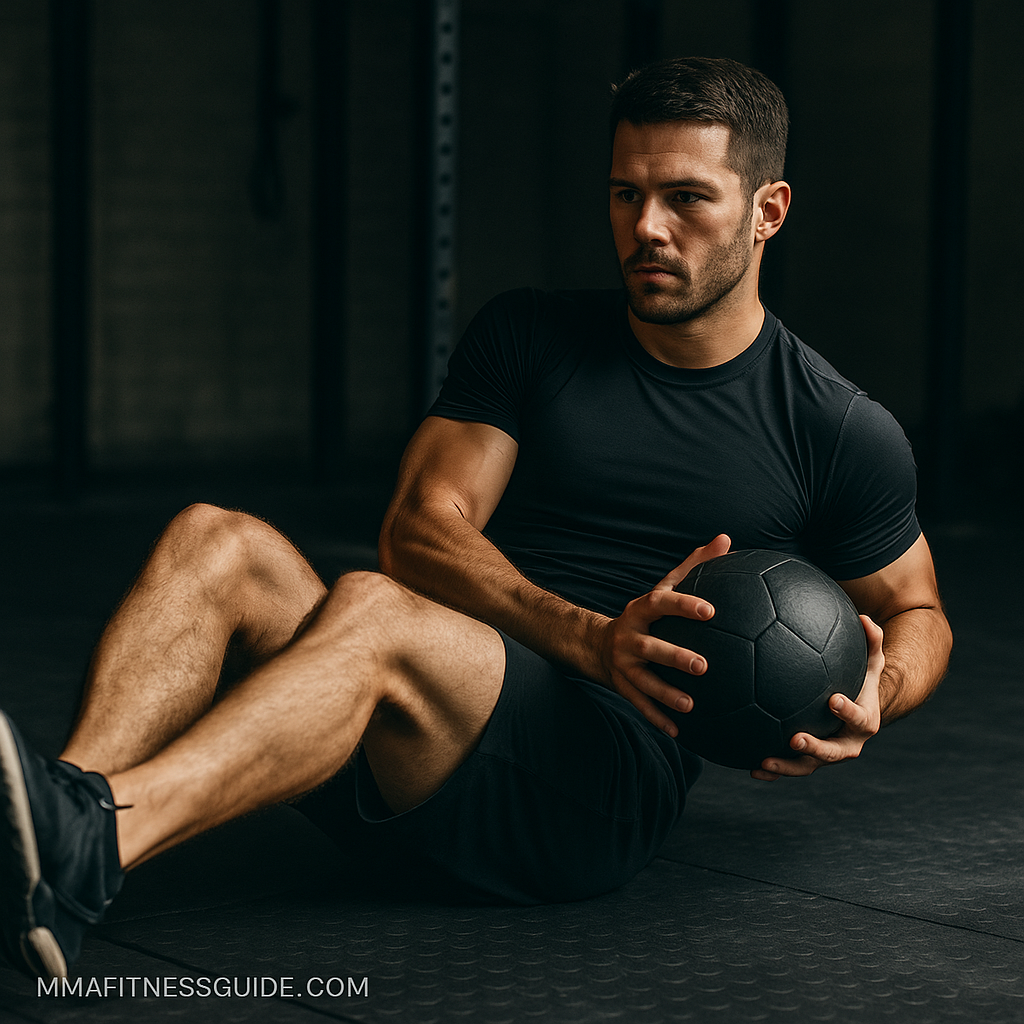
4. Russian Twists (Rotational Power)
How to do it:
- Sit slightly leaned back, feet off the floor.
- Rotate your torso side to side, tapping the floor on each side.
- Perform 15–20 reps.
Why it works:
Builds rotational strength for hooks, kicks, and hip turns.
Add a medicine ball for resistance once you’ve mastered the form.
5. Leg Raises (Lower Core Strength)
How to do it:
- Lie flat with legs straight.
- Lift both legs to 90°, keeping your lower back on the floor.
- Slowly lower without touching the ground.
Why it works:
Targets the lower abs and improves hip control — great for guard work and high kicks.
6. Bird Dog (Balance and Coordination)
How to do it:
- Start on all fours.
- Extend opposite arm and leg straight out.
- Hold for 2–3 seconds, then switch sides.
Why it works:
Strengthens stabilizers in your back and glutes — improving balance and posture.
7. Medicine-Ball Slam (Explosive Core Power)
How to do it:
- Lift a medicine ball overhead.
- Slam it to the ground with full force.
- Pick it up and repeat for 10–15 reps.
Why it works:
Builds dynamic power and coordination, translating directly to striking explosiveness.
Sample Core Routine for Beginners
Perform 3 rounds of the following:
- Plank – 45 sec
- Dead Bug – 10 reps each side
- Russian Twists – 15 reps
- Side Plank – 30 sec each side
- Leg Raises – 10 reps
- Bird Dog – 10 reps each side
Rest 60–90 seconds between rounds.
Repeat 3–4 times per week for steady improvement.
Common Mistakes to Avoid
- Rushing through reps: Core work is about control, not speed.
- Holding your breath: Exhale during effort to stay stable.
- Overtraining abs: Core recovery is just as important as intensity.
Key Takeaways
- Your core connects strength, stability, and power.
- Focus on total-core development, not just abs.
- Quality movement beats high volume.
- Consistent practice improves posture, balance, and endurance.
As Fedor Emelianenko once said,
“Strength is not in the muscles, it’s in the balance of the body and mind.”
Master your balance — and your power will follow.